Our revised itinerary took us by Croatian Air from Split to Zagreb for a one night stop near the airport and then on another flight to Sarajevo, Bosnia. There we were met by a driver arranged by the hotel – Uber does not operate in Bosnia. Our driver wanted badly to have a conversation but although he had two or three languages, none of them worked for us. We were able to manage a few words and he was surprised to learn that we were from Canada.
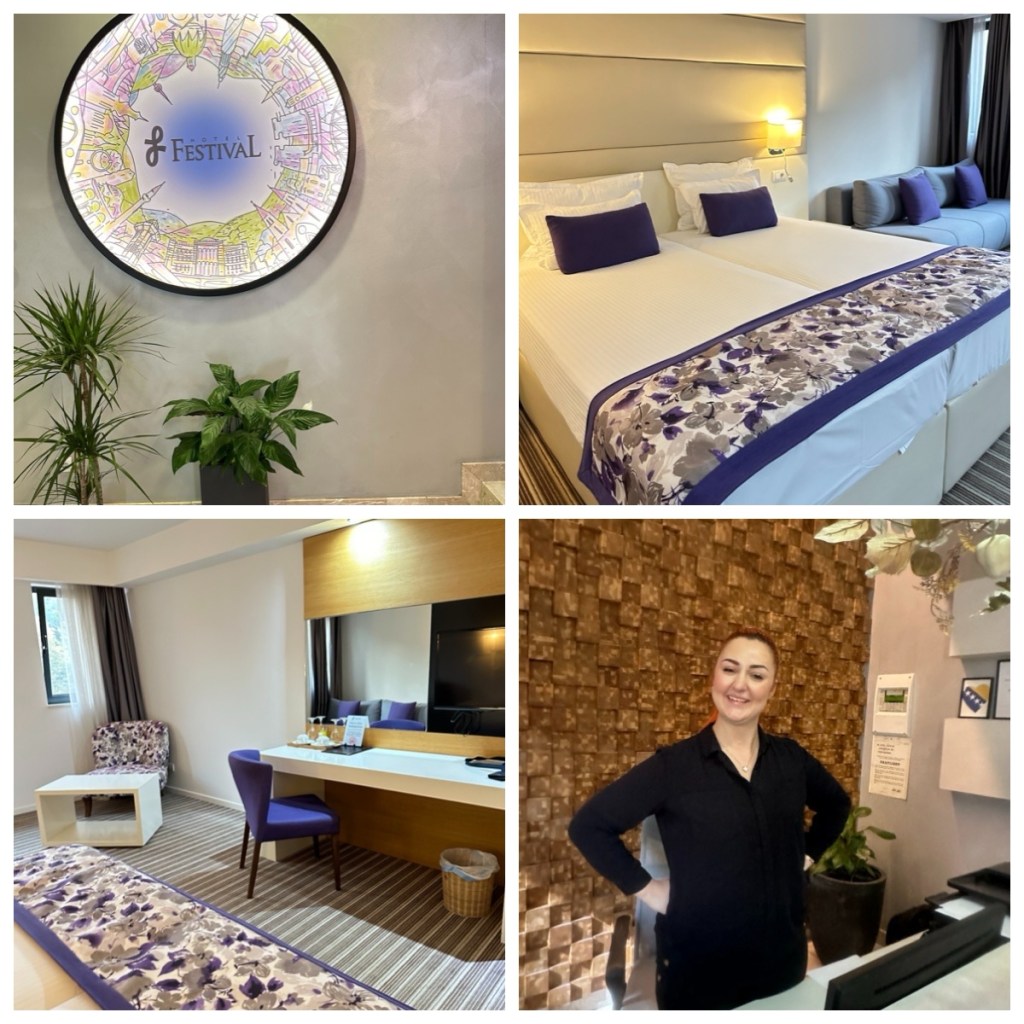
The Hotel Festival is a boutique hotel with 20 varied rooms. Our comfort double room was a great size with a lovely decor. The staff were extremely friendly and helpful and the breakfast presented a good variety of European and Bosnian dishes. It is located very close to the main historical area. Again, definitely recommend!
Bosnia and Herzegovina is comparable to Croatia in size (~20,000 square miles) with a slightly smaller population (~3.2 million). It also shares a similar history – with domination by Illyrians, Romans, Slavs, Ottomans and the Austro-Hungarian Empire. It was a major component of the former Yugoslavia from which it declared independence in the spring of 1992. The war that erupted after this declaration lasted for 4 years. The details of this war – including the cause, the participants and the eventual resolution – are very complicated and I won’t try to go into them in this blog. Detailed information is available in an on-line search.
Bosnia and Herzegovina applied for EU membership in February 2016, was granted candidate status in 2022 and negotiations continue. They continue to use their official currency – the convertible mark (abbreviated KM locally and BAM internationally). For the sake of brevity, I will refer to the country as Bosnia in this blog.
Sarajevo is the capital of Bosnia and has a population of ~350,000 with a metro area population nearing 700,000. It enjoys a spectacular setting in a mountain valley.
In 1984, the city was showcased to the world as it hosted the Winter Olympics. We visited the former Zetra Olympics Centre, but there is not a lot to see. The arena, where Torvill & Dean captured the hearts of the ice-dance world with their Bolero skate, has been renovated but we weren’t allowed to enter. Similarly, the stadium is now used for football matches, but was not open for viewing when we passed by.

Only eight years after the glory of the Olympics, Sarajevo was subjected to the longest siege in modern European history (three years and eight months). The city was cut off from food, water, electricity, telephone, medicine and other critical supplies. Again, in this blog, I won’t go into the specifics of the war and siege, but will show you a few of the remaining scars evidenced in the sites we visited.
For most of it’s history, Sarajevo has been a model of ethnic diversity with Muslims, Catholics, Orthodox Christians and Jews living together in harmony – the valley didn’t allow room for splitting up of different sects. The war and siege upset this harmony although we were told by locals that ethnicity and religion did not matter for the majority of the citizens trapped within the city – they were first and foremost, the people of Sarajevo.
Today, the diversity is evident but once again, harmonious. As you travel the main pedestrian-only street, you cross from Sarači street with its predominantly Ottoman influences to Ferhadija Street where you feel as if you could be in Vienna. The marking on the pavement proclaim this as “Sarajevo – Meeting of Cultures”.

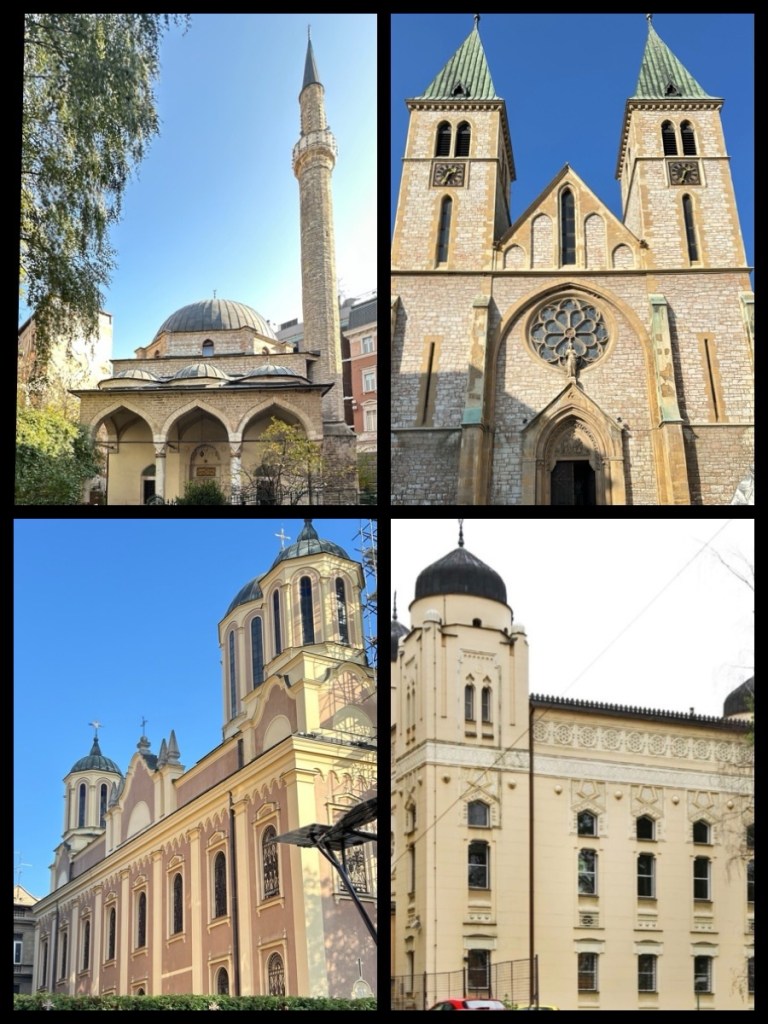
Within a few blocks, you can view a mosque, a cathedral, a synagogue and an Orthodox church. Clockwise from top left – the Ferhadija Mosque, Catholic Cathedral of the Sacred Heart, Sarajevo Synagogue and Serbian Orthodox Cathedral. You hear the Muslim call to prayer intermingled with the Catholic and Orthodox church bells in a pleasant mix of cultures.
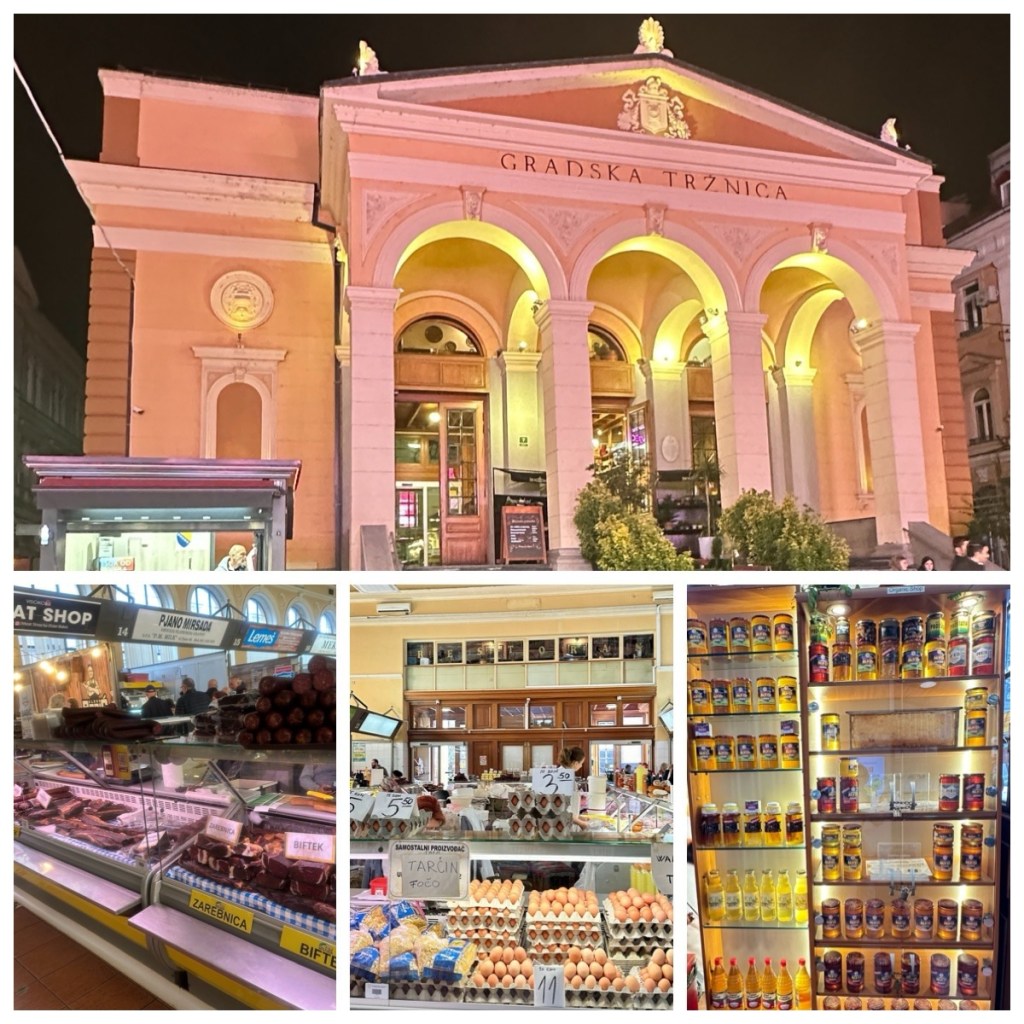
The Market Hall – Gradska Tržnica Markale – has been a vibrant part of Sarajevo life since 1895. It was the first building in the city to feature a steel girder roof. During the day, it is a bustling local market with a predominance of meat and cheese shops.
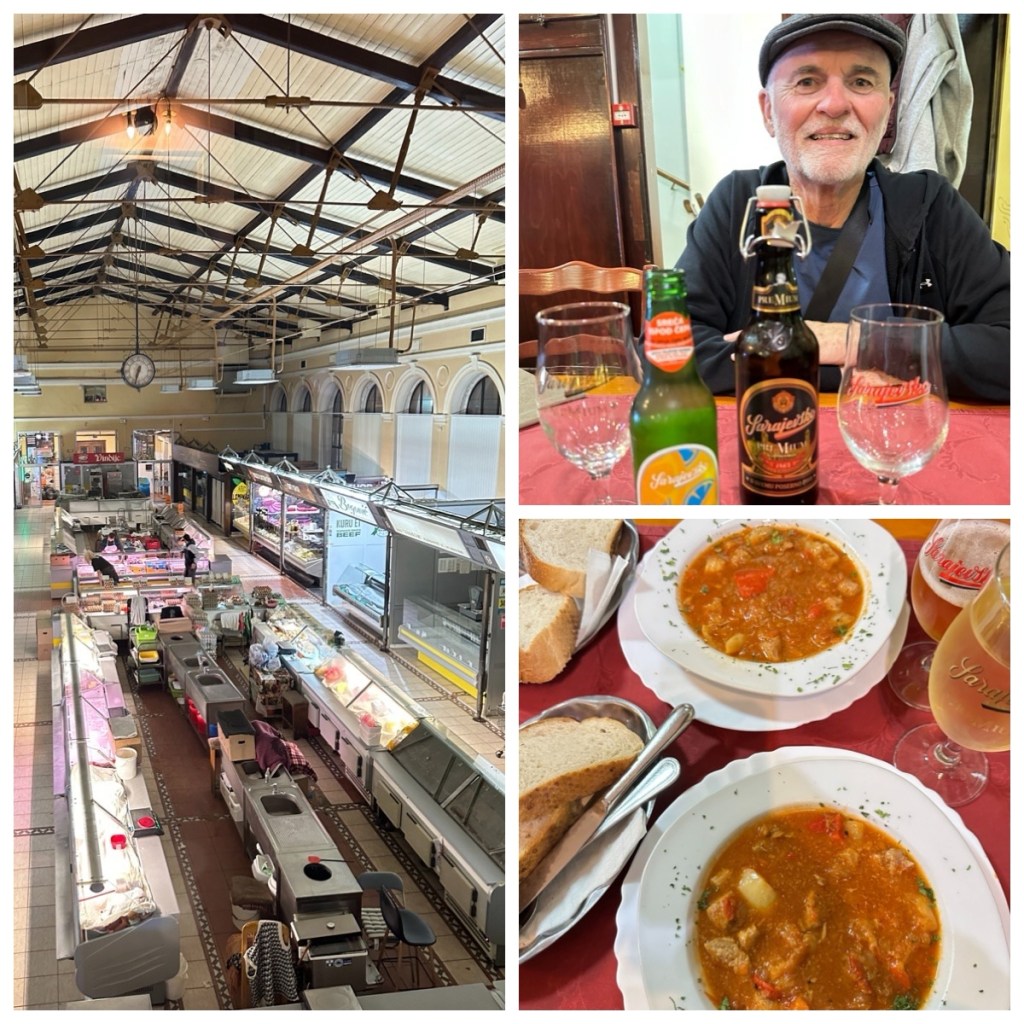
Perched on the second floor at the end of the Market Hall is the Srebrena Skoljka restaurant. We visited this small (8 tables) restaurant on our first night in Sarajevo. It is family run, filled with locals and serves authentic Bosnian food. We loved the experience and friendly staff and thoroughly enjoyed our muckalica (veal stew) accompanied by Bosnian bread, beer and cider. We did note that the ‘no smoking’ sign on the door appears to be optional.
The Miljacka River runs through Sarajevo and is crossed by about 20 bridges. Many have unique features. Here are four that we crossed. It would be fun to search out more.
- At one time there were many wooden bridges but the Drvenija Ćuprija is the last of its kind. Built in 1898, a thorough reconstruction was carried out in 1988, resulting in a reinforced concrete bridge with a symbolic wooden railing.
- The Latinska Ćuprija (Latin Bridge) was first mentioned in a document from 1541. It acquired its current form in 1798 and became a National Monument in 2004.
- It is presumed that the Seher-Cehaja’s Ćuprija was built in the middle of the 16th century. This bridge was made a National Monument in 2005.
- The Festina Lente (Latin for “make haste slowly”) is a pedestrian bridge opened in 2012. It is 38 meters long and features an unusual looping in the middle, suggesting slowing down and enjoying the view.

On June 28, 1914, Archduke Franz Ferdinand – heir to the throne of the Hapsburg Empire – and his wife were assassinated in Sarajevo by a Bosnian Serb named Gavrilo Princip. Serbia’s refusal to grant access to the Hapsburgs to investigate for co-conspirators set off a chain reaction that eventually resulted in World War I. Hence, it’s often referred to as the ‘shot heard around the world’. The spot where the assassination occurred is marked by a plaque and footprints outside the Sarajevo 1878 – 1918 Museum. We didn’t visit the museum but reviews say it is well worth a look.

City Hall (Vijećnica) is a monument to the multiculturalism of Bosnia. Built between 1892 and 1894, the pseudo-Moorish building honored the Muslim background of this Austro-Hungarian territory. The building has been used for various municipal purposes since its construction, including as a city court and parliament house, which it was until 1948, when it became the National and University Library of Bosnia and Herzegovina. On August 25-26, 1992, the City Hall was hit by heavy artillery and incendiary bombs. The hall was set ablaze and the entire library holdings were lost as well as causing severe damage to the structural and decorative elements of the building. In the late 1990’s, the government of Austria and the European Commission provided funding to start the restoration of the building. Additional funding has followed and in May 2014 the building reopened with a public ceremony. The building now houses the national and university libraries, the city council, and a museum.
The President of Montenegro, Jakov Milatović, was on an official visit to Sarajevo on the day we were passing by City Hall and we spotted him on the balcony.

The centre of the Ottoman old town is the square of Baščaršija. Literally translated as Main Marketplace, the name has come to represent the entire Old Town. Despite its official name, the square is nicknamed Pigeon Square – and it’s not hard to see why!!
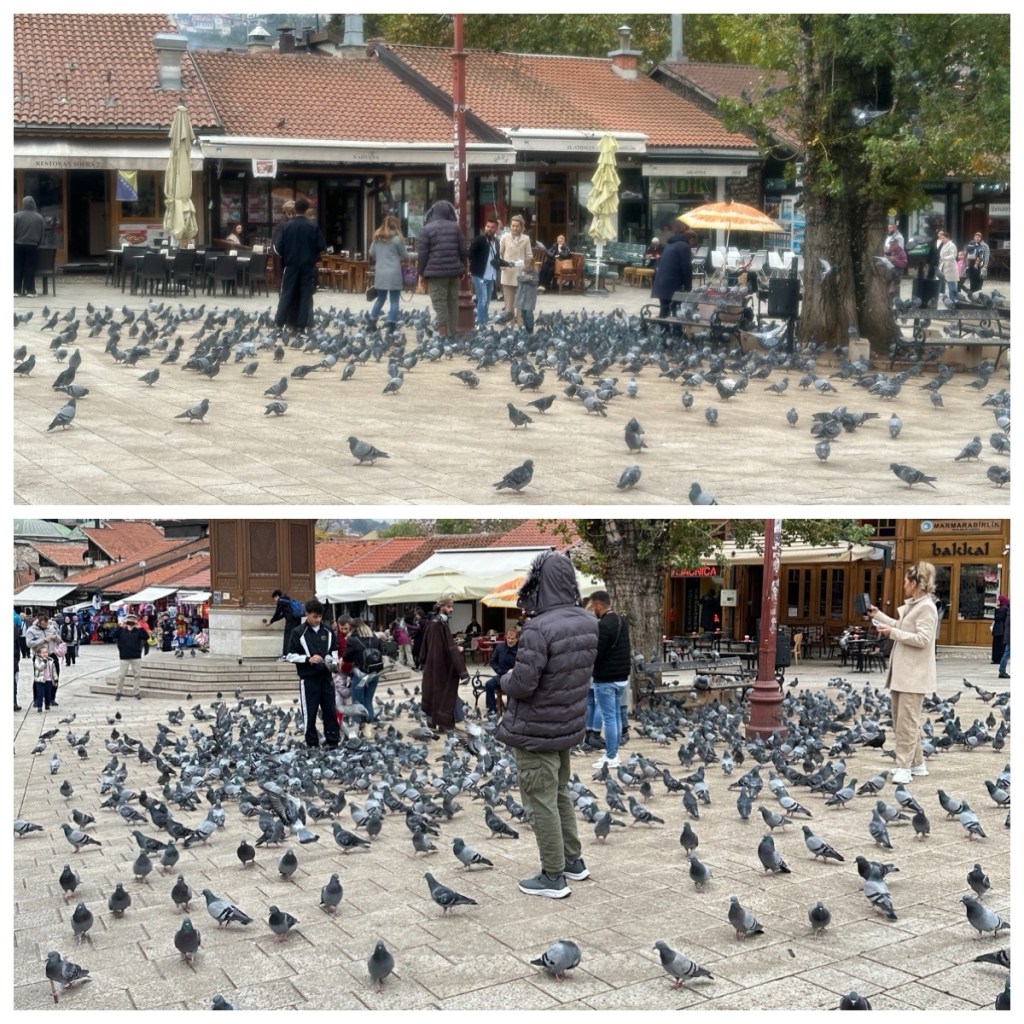
The city of Sarajevo was once filled with hundreds of elaborately decorated fountains or sebiljs, unique kiosk-shaped fountains that provided free drinking water to the public. Today, the sebilj at the centre of Baščaršija Square is the only surviving one, and is widely regarded a national landmark. The original fountain was built in 1753 but was severely damaged in a 19th-century fire. The current restored version was installed in 1913. Local legend says that those who drink water from the small tap at the base will return to Sarajevo someday.
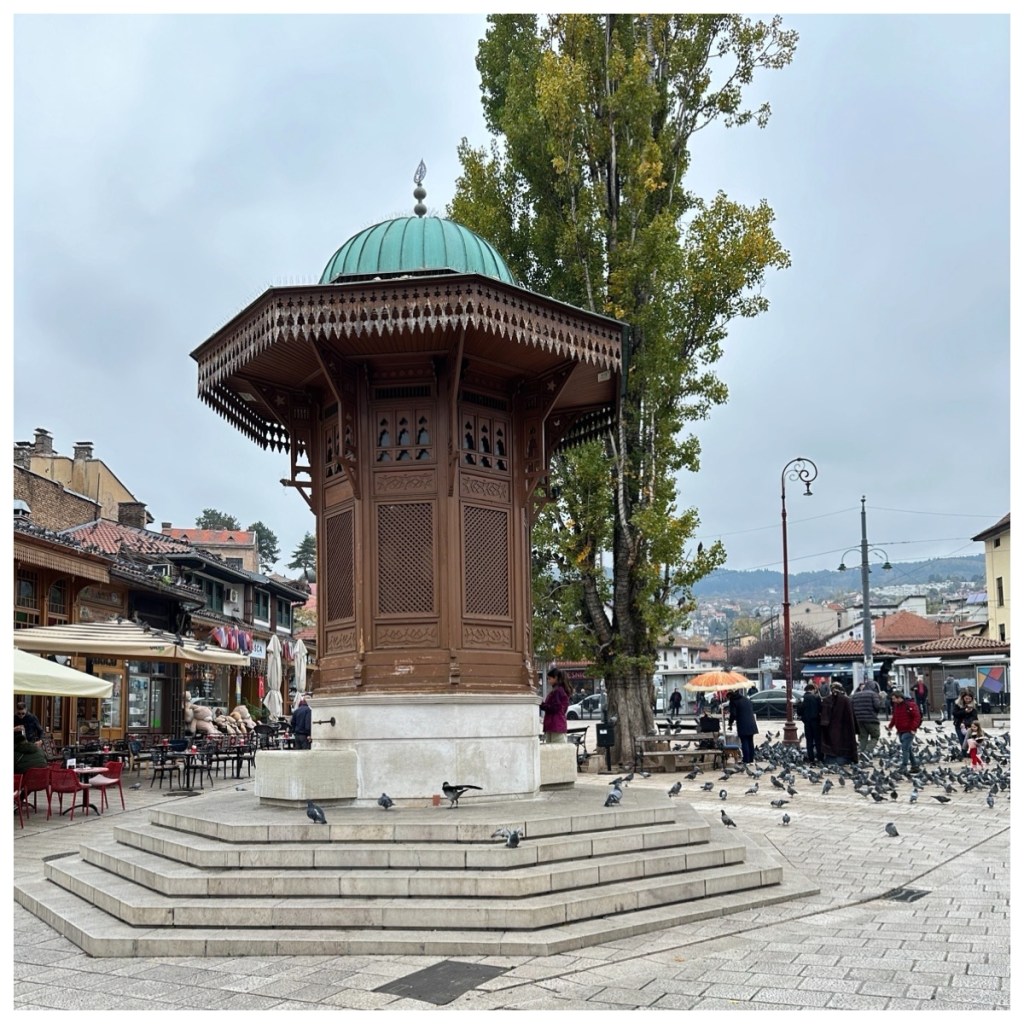
Baščaršija Mosque sits at the foot on the square. This mosque is closed to the public. Note the ever-present pomegranate juice cart in front of the mosque.

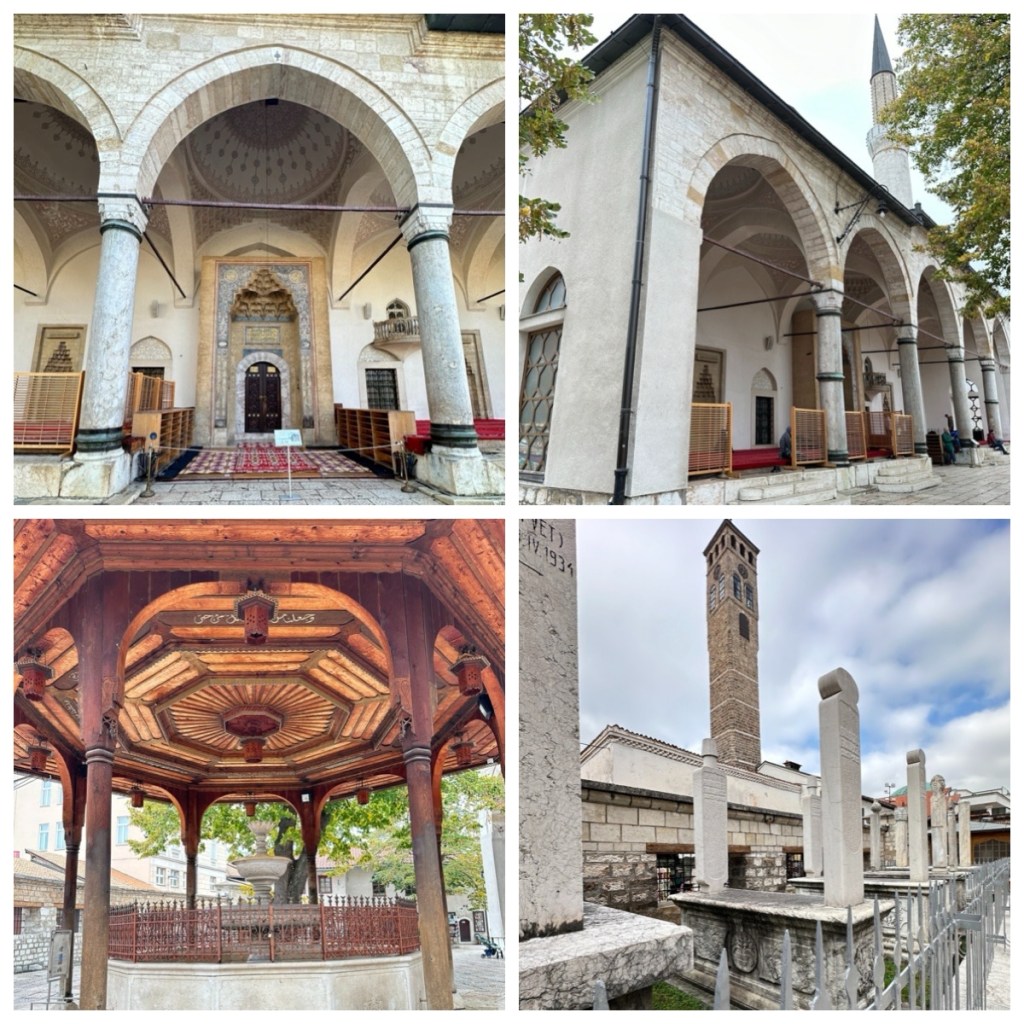
Mosques abound in Sarajevo, their minarets dominating the skyline. The most historic of those is the Gazi Husrev-Beg’s Mosque. Built in 1530, it is considered an architectural masterpiece of the Ottoman period. Five times a day, from the mosque minaret a voice of the muezzin calls the believers to prayer, and this call has been repeated daily from the year 1530/31 until today. The mosque is open for tourists to view the interior but unfortunately, we were never in the area at the right time.
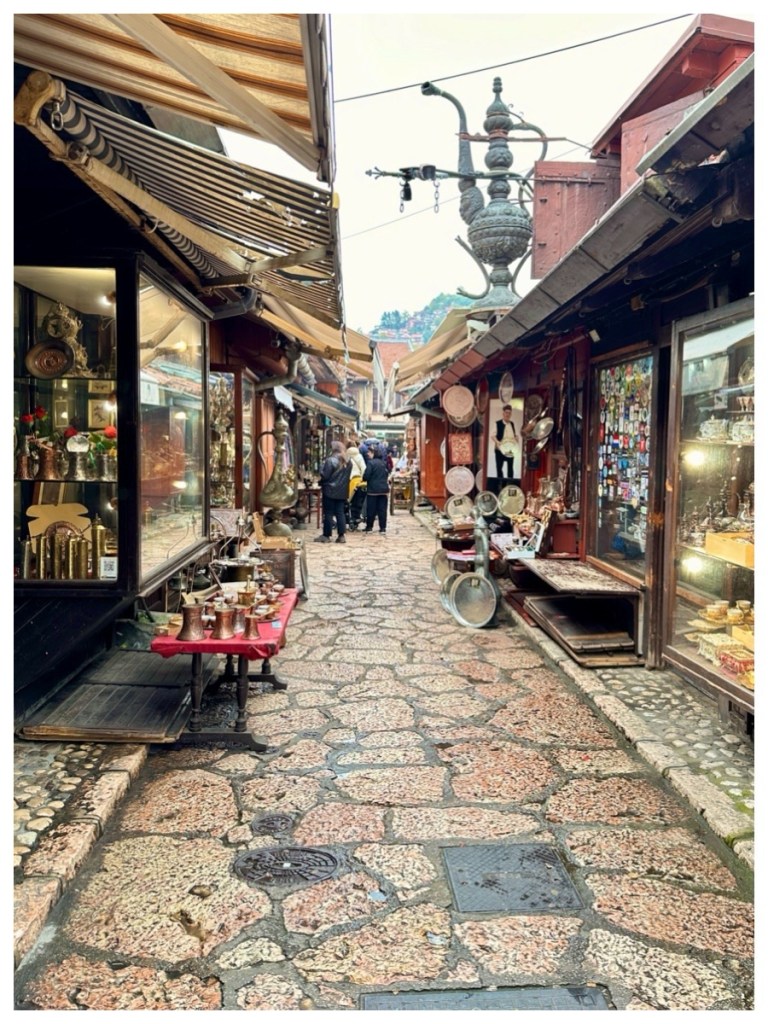
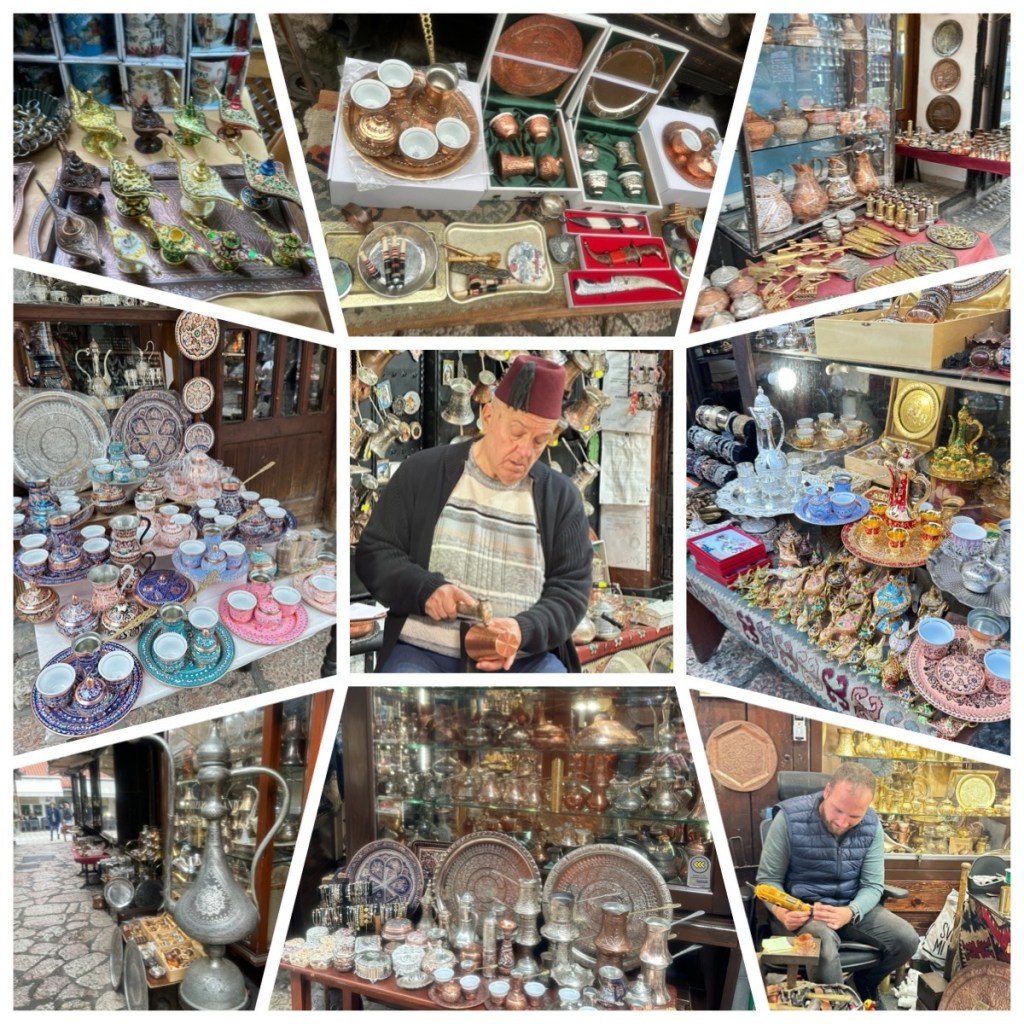
The narrow pedestrianized streets of the Old Town are a delight to visit, with colourful and interesting window displays.

A particularly authentic lane is Coppersmiths’ street (Kazandžiluk). Here you can see craftspeople at work, hammering beautiful works of art from copper. The items you could buy were many and varied; as one writer put it – it’s the perfect place to buy that copper Bosnian coffee set that you will never use!
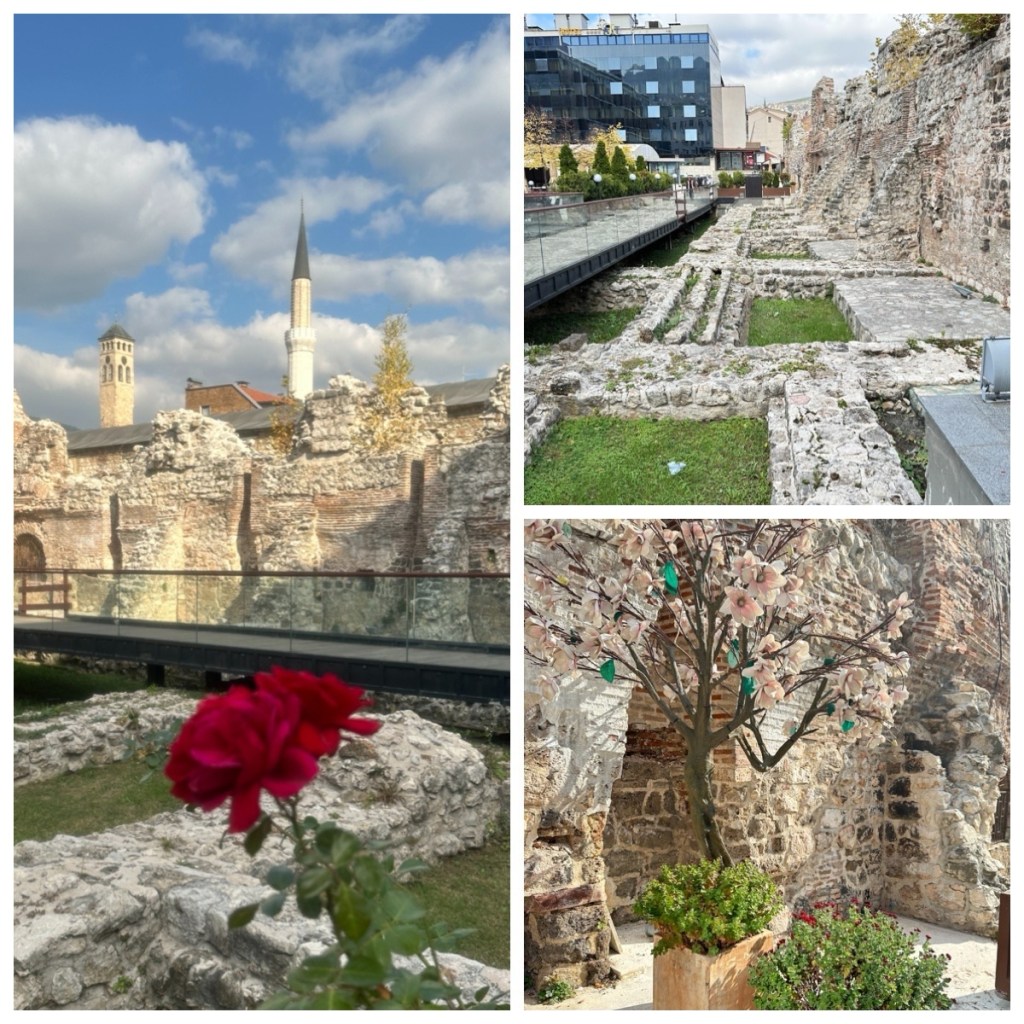
The ruins of the Tašlihan, also known as the stone han, Husrev-bey caravanserai or old han, are nestled in between the Gazi Husrev-Bey Bezistan market hall and the Hotel Europe. This Ottoman caravanserai was built between 1540 and 1543, at the same time as the bezistan, with which it was physically connected. The complex provided accommodation for passing travellers, traders and merchants and their wares and horses. There were 30 rooms covered by small domes with chimneys meaning each room had its own heating system. Unlike other inns, the accommodation was free. The courtyard of the Taslihan contained a row of shops, making it a trading hub and a sebilj (public fountain) with a mosque on piers above it. The Tašlihan was damaged on several occasions by fire and was completely destroyed by the fire of 1879.
In 1729, five bastions were commissioned by the Bosnian Governor to defend the city from attack and placed at points along the fortified wall. The Yellow Fortress, which takes its name from the yellow rock that was used in its construction was positioned up on Jekovac Cliff and therefore, is also known as Jekovac Fortress. The fortress lost its original function once the Austro-Hungarians took over Sarajevo. Today, it offers a fantastic view of the city and is also the spot where a cannon is fired at sunset during the Islamic month of Ramadan to mark the time for breaking the fast. To reach the fortress, you walk about 10 minutes up Kovači Street from Pigeon Square. You first reach the Kovači Martyrs’ Memorial Cemetery and then climb an inclined street to the fortress.

Throughout Sarajevo, there are numerous memorials and reminders of the war of the 1990’s. As you look into the hills surrounding the city, you see a number of sprawling cemeteries. During the siege, victims were buried in these places either at night or under the cover of fog to escape the notice of the snipers.

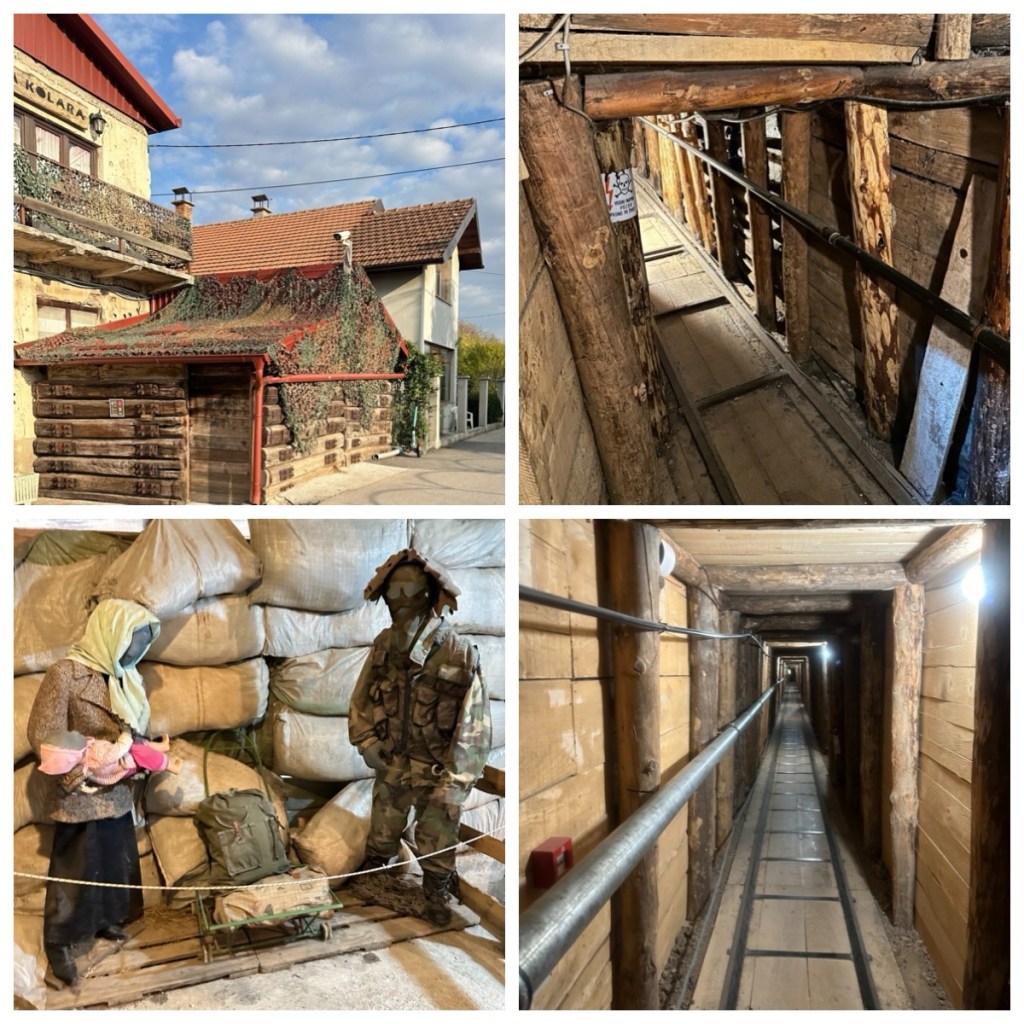
During the siege of Sarajevo, the city was almost entirely surrounded by the Bosnian Serb Army. The lone connection to the outside world was a mountain pass. However, between the city and the pass was the airport which was controlled by the United Nations and could not be crossed by either side. To overcome this obstacle and to provide a lifeline, the Sarajevans dug a tunnel under the airport.
Digging started in March 1993 with members of the Army digging nonstop, 24 hours a day. The shift lasted for 8 hours; they were digging simultaneously from opposite directions with only shovels and picks, and their paycheck was a package of cigarettes daily. Wheelbarrows were used to carry out the 3000 m3 of soil. 5 tons of steel and close to 200 m3 of wood were used to construct the tunnel. The passageway that was 785.5 meters long and little over a meter wide with an average height of 1.5 meters was completed in four months and four days.
In the tunnel, a pipeline was installed so that oil could be delivered to the city and electric cables were installed to provide electricity and telephone communications. Approximately 3 million trips were made through the Sarajevo war tunnel during the war.
Today, the Sarajevo War Tunnel Museum tells visitors the story of this life-saving endeavour. We chose to take the War Tunnel Tour offered by Insider Tours. This not only provided us with transportation to the museum but also, included an excellent guided tour. We were fortunate that no one else had booked the tour at that time, so we had a private tour. Our guide, Nermin, was a police officer during the siege and provided an incredible amount of information, both on the journey to the museum and during our time there. The museum has a stretch of ~80 meters of the original tunnel that you are able to walk through, as well as exhibits and a film. However, it was Nermin who brought the story to life and made us realize the almost unbelievable conditions with which the citizens had to cope. We would definitely recommend this tour as a way of learning more about the siege and the consequences.
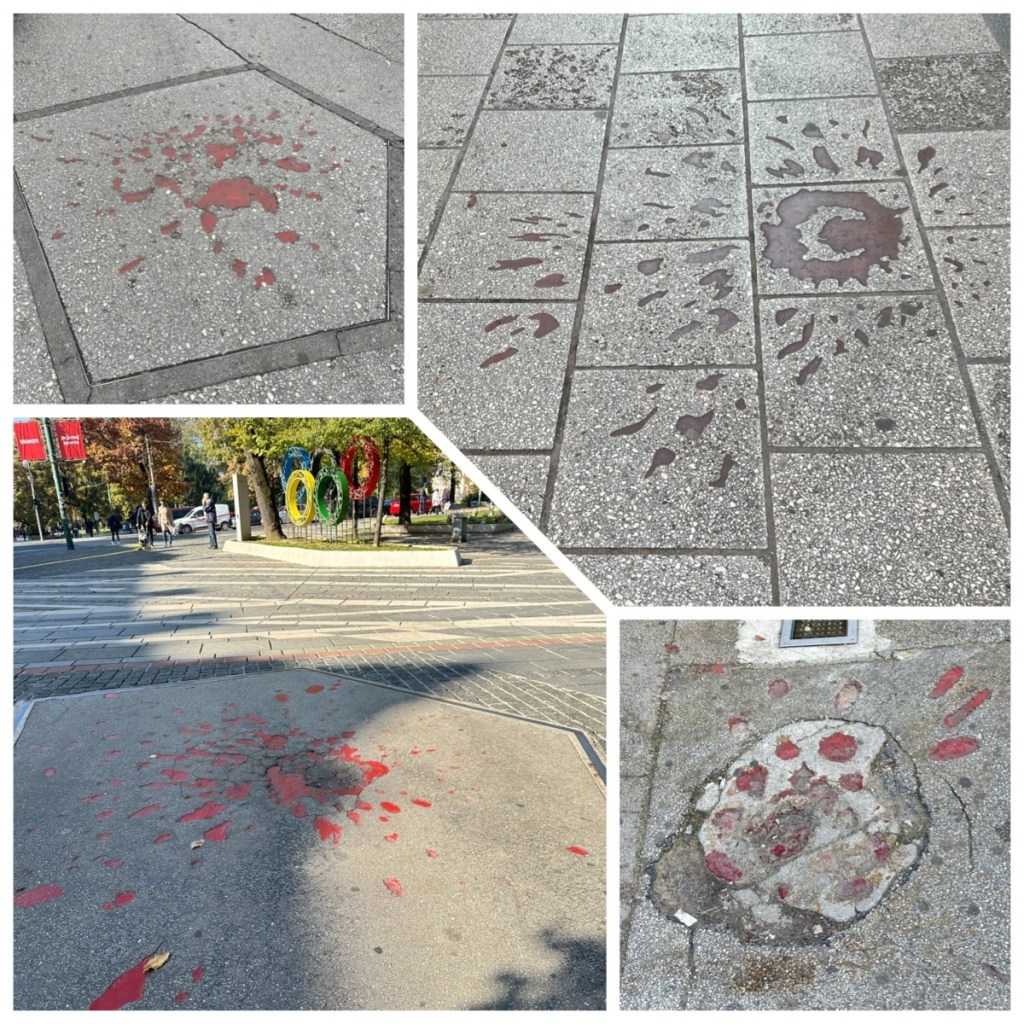
Between April 5, 1992 and February 29, 1996, tens of thousands of shells rained down upon the inhabitants of Sarajevo. The mortar rounds landing on concrete created a unique fragmentation pattern that looked almost floral in arrangement. Immediately following the war, approximately 1000 of these impact craters at any location where it was known that three or more people had died were filled with red resin. These were known as the Sarajevo Roses. Many of the roses have been covered with new asphalt as the city rebuilt but approximately, 200 of these poignant memorials remain.
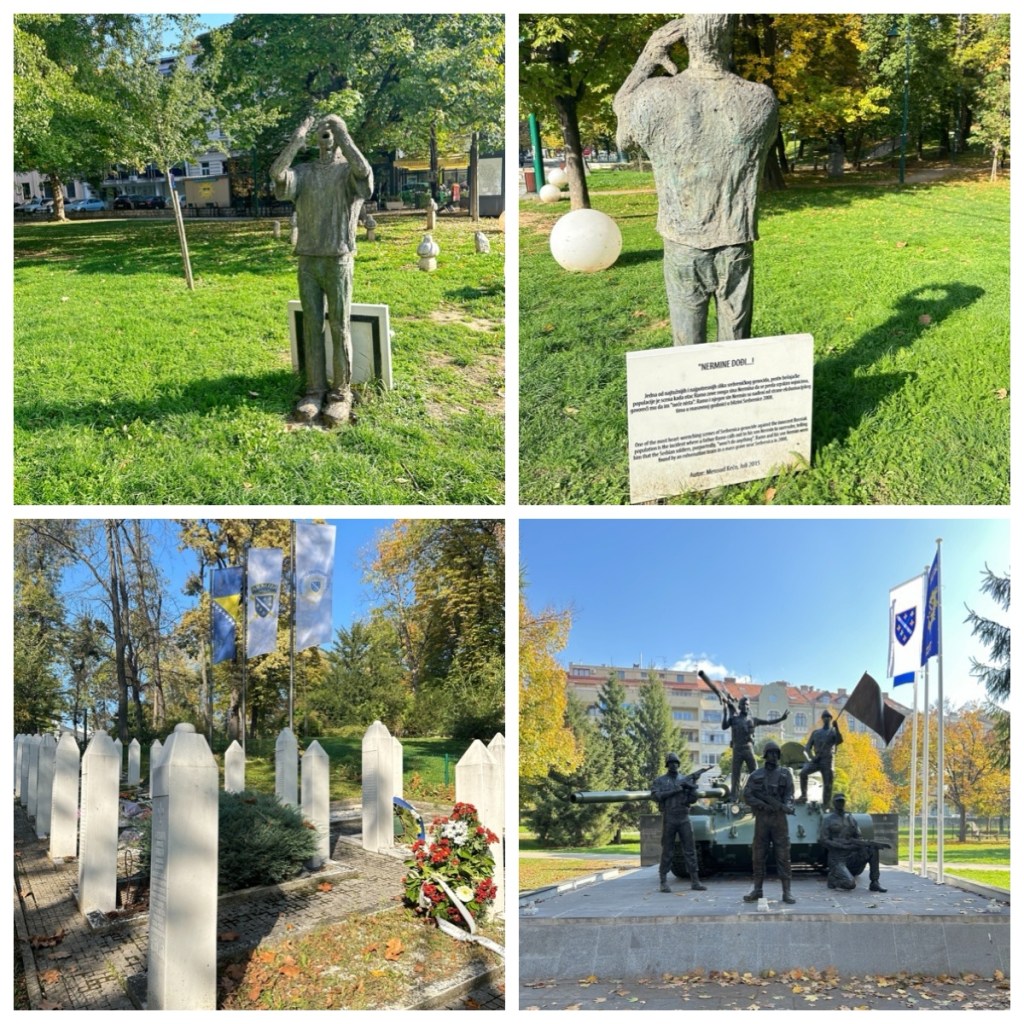
Along Maršala Tita Street is a Veliki Park that houses some powerful memorial monunents.
The Memorial to Children Killed in the Siege of Sarajevo remembers the 1621 children who were killed during the siege. The glass sculpture features two cylindrical forms leaning toward each other. Interpretations of this sculpture are that it represents a mother protecting her child and also, a tower built by children playing in the sand . The circular ring-like bronze structure bearing children‘s footprints speaks to the eternal presence of the killed children and the water in the fountain that gently surfaces and washes over the footprints symbolises life and the movement of nature.
Next to the monument are seven pedestals. They are engraved with the first and last names of the children, the names of their fathers, their birth years, and the year the child was killed. Currently, there are 521 names etched into the pedestals.
On one of the days that we observed this heart-breaking monument, a group of school children were playing behind it. This created an especially poignant moment.

We encountered a number of other memorials in the parks we visited. A few of these are pictured below.
We enjoyed strolling the streets of Sarajevo and happening on lovely places.

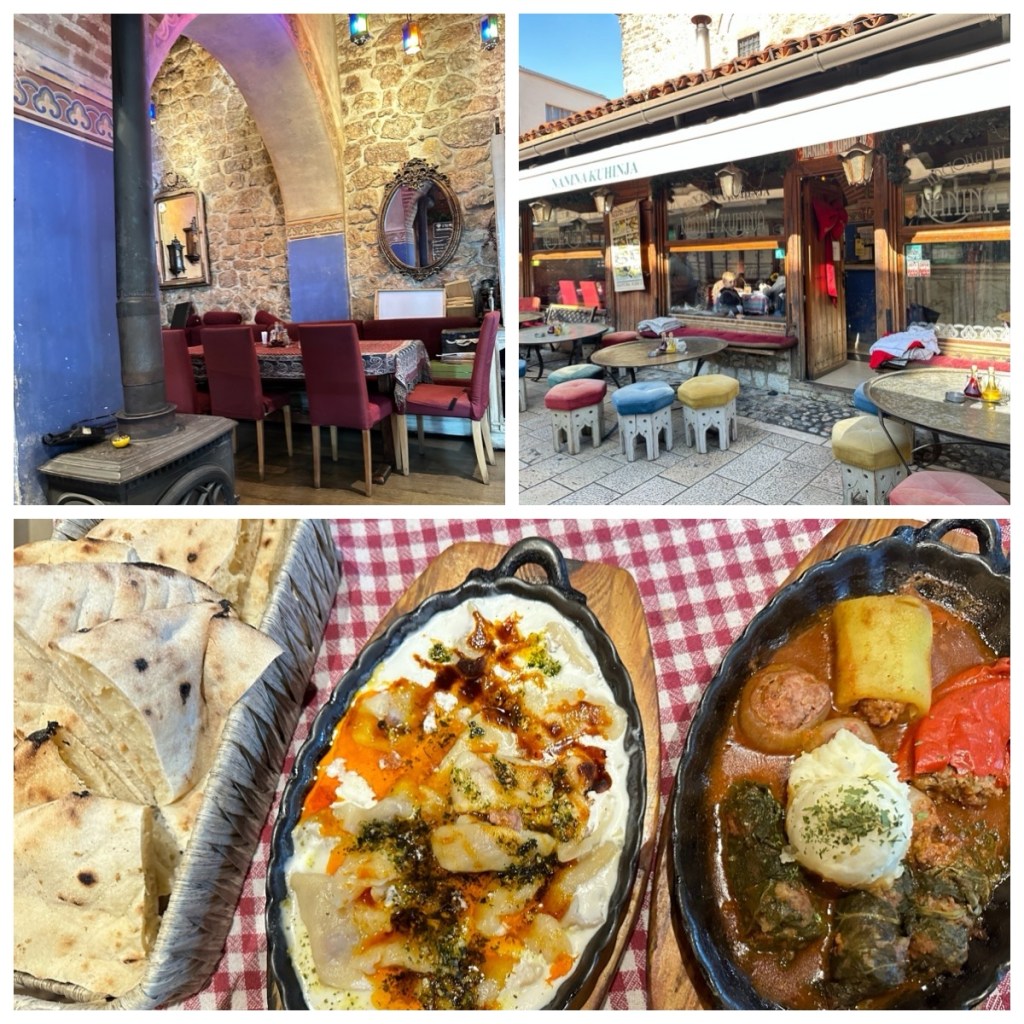
We immersed ourselves in the traditional Bosnian cuisine. As well as the muckalica at the Srebrena Skoljka restaurant mentioned above, we tried a number of other local items.
Nanina Kuhinja, meaning ‘Grandmother’s Kitchen’, was recommended by both a guidebook and our hotel staff. We asked the waiter to choose for us and we thoroughly enjoyed his choices of:
- Sarajevski Sahan (Sarajevo pot): a special dish stuffed with meat, peppers, zucchini, onions and vine leaves.
- Klepe sa Mesom: Pasta filled with veal and a special sauce made with sour cream, yogurt, garlic, parsley and smoked peppers.
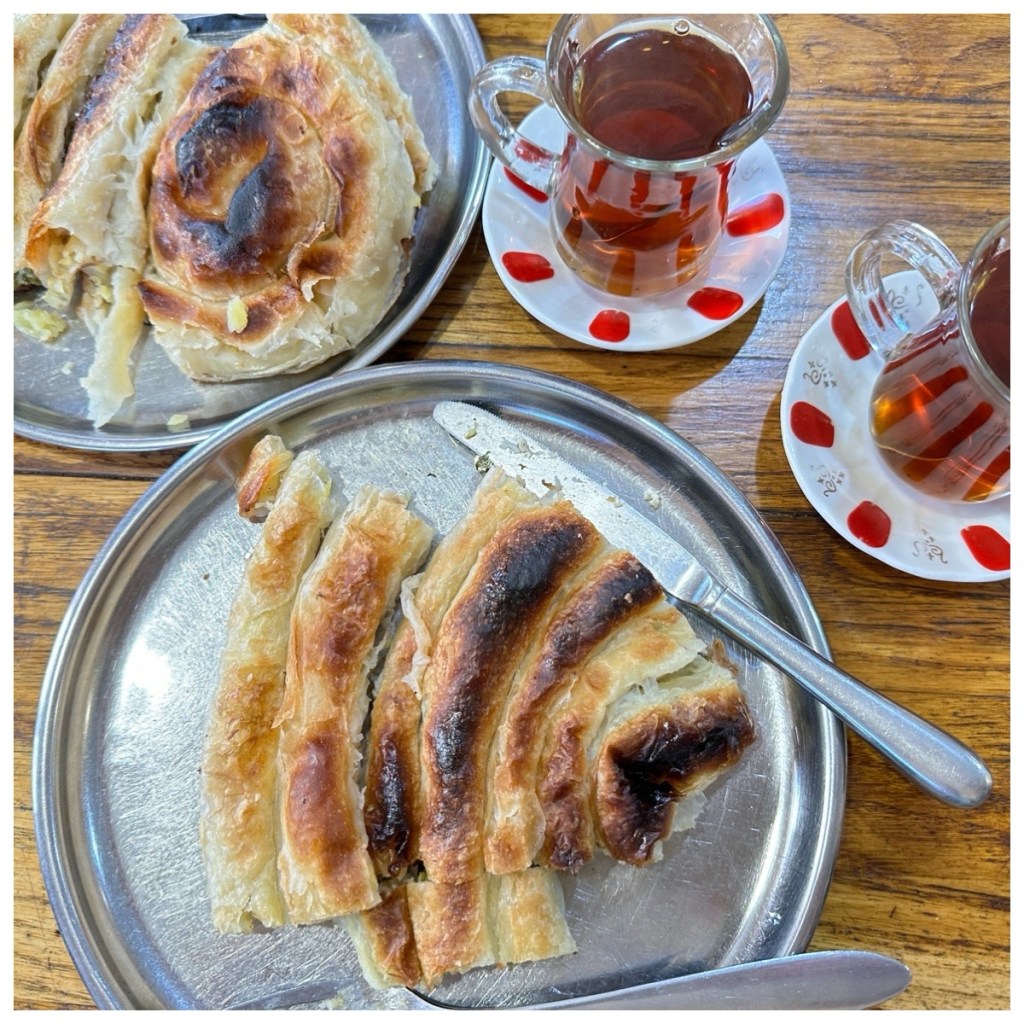
Burek – often called a Bosnian pie – is made with flaky phyllo dough and savory fillings – ours were salty cheese and potato – and cooked in an open oven under a press. We tried these at Buregdžinica Saraj Bosna. Most of the locals seemed to be enjoying them as a lunch. We also enjoyed them – but that was enough food for the day. Perhaps we should have shared one!
Bosnian ćevapi are tasty little sausages of two types of minced beef, hand-mixed and formed with a funnel. They are grilled and served with minced onions, pita bread and sour cream – really quite delicious. We tried this dish out at Ćevabdžinica Željo 1 – named for the local soccer team. This time we remembered to share! Harvey was wishing we hadn’t waited until the last day to try these out!

In the Viennese area of Sarajevo, we just had to stop for coffee and cake on a few occasions!

Sarajevo is a city still in recovery from the horrors of the 1990’s. Many of the parks and streets hold reminders of the despair of the siege and they seek to remember and remain strong while growing into a new harmony. The people are incredibly friendly and open. There are also beautiful spaces and the meeting of the cultures is so interesting and enjoyable to experience.
We didn’t drink the water from the Sebilj fountain, but perhaps we should have, as we would love to return to Sarajevo someday!
Cheers,
Bev & Harvey

 A Long and Winding Journey