After our great Tokyo introductory day with our guide Posh, we had four days to explore on our own. We now felt fairly confident with the metro systems. The train and subway network is extensive and consists of the Tokyo Metro, the Toei Subway, the JR lines and Keisei railway. This sounds like a nightmare but it really isn’t. Google maps is excellent at determining which train you want to take, where to change, etc. There are a number of passes you can purchase. We found it easiest to have a Suica card on our Apple Wallet and just tap in and out. The only time you need a different ticket is if you are taking one of the Limited Express or Express trains. Just ask at the station – the employees are extremely helpful!
On Day 2 of our Tokyo visit, we decided to head to the action and visit Shibuya. After our great weather on Day 1, it was somewhat rainy and cool.
Shinjuku and Shibuya are the dual centers of Western Tokyo. These areas came into prominence after the 1923 earthquake. Shibuya became the party town for Tokyo’s youth in the 1930’s and today is where you will find the latest in fashion, music, shopping and food. It is where the affluent youth demand the newest trends.
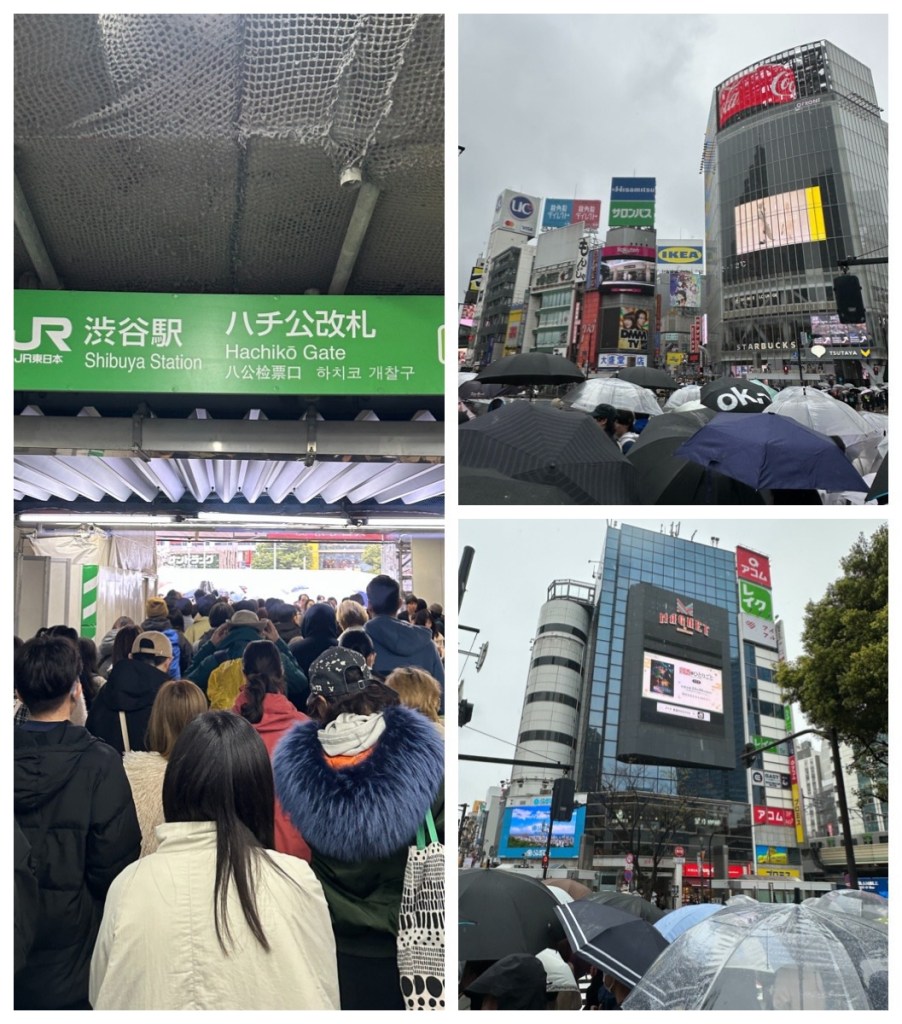
Shibuya Station is a major transport hub which sees 2.4 million passengers a day. This was our view as we slowly made our way out of the station and watched the masses open their umbrellas!
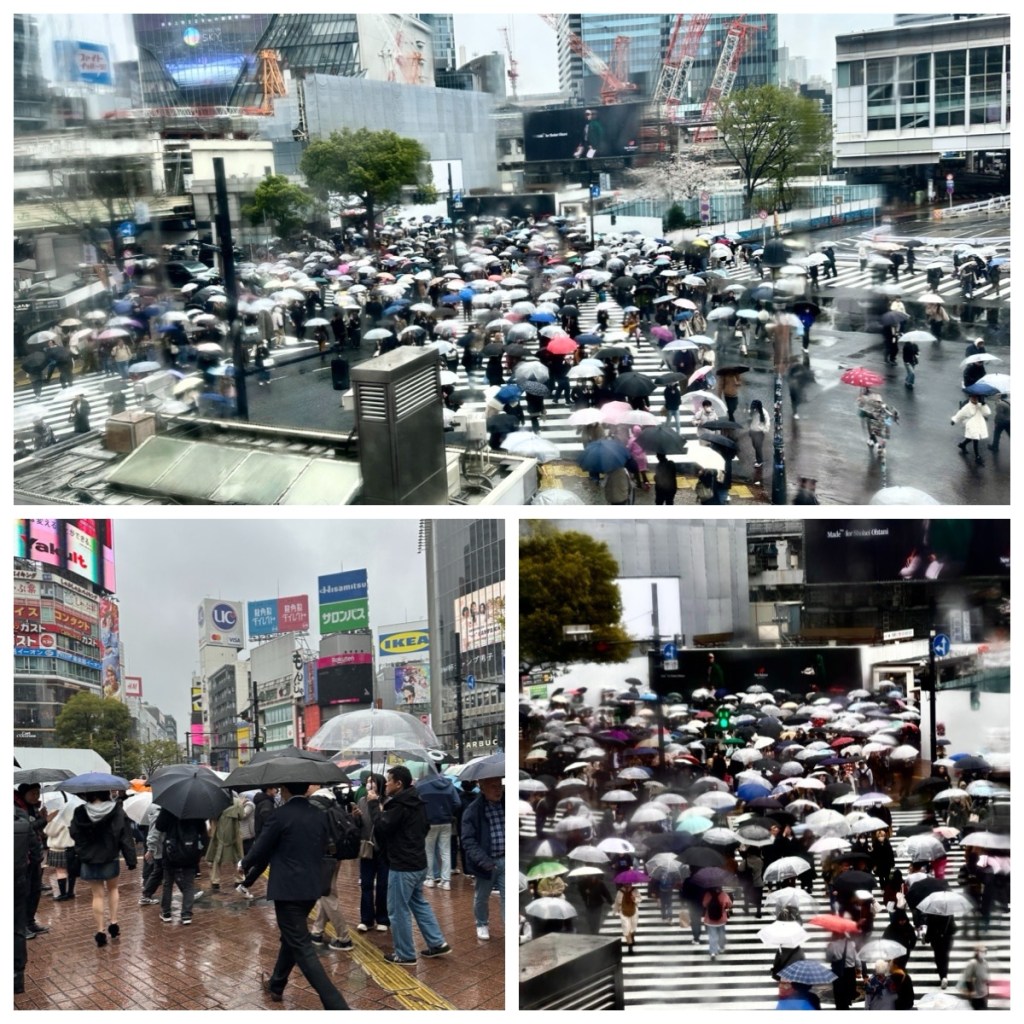
The view most often shown of Tokyo is the iconic Shibuya Crossing which is located just outside of Shibuya Station. At peak times, more than 2,500 people cross the road from five different directions each time the light goes green adding up to 500,000 people per day. Tourists crowd the second floor cafes and restaurants that look down at the intersection to try and photograph the crossing. We joined the crowds and travelled up to the second floor of the glass-fronted Starbucks. Our photos were somewhat hampered by the raindrops on the windows and as it was a rainy Saturday, the crowds were somewhat less than peak; however, the masses of umbrellas were a sight to see.
The busy scramble crossing is surrounded by high-rises and vibrant ads – a mass of billboards, lights and enormous screens.
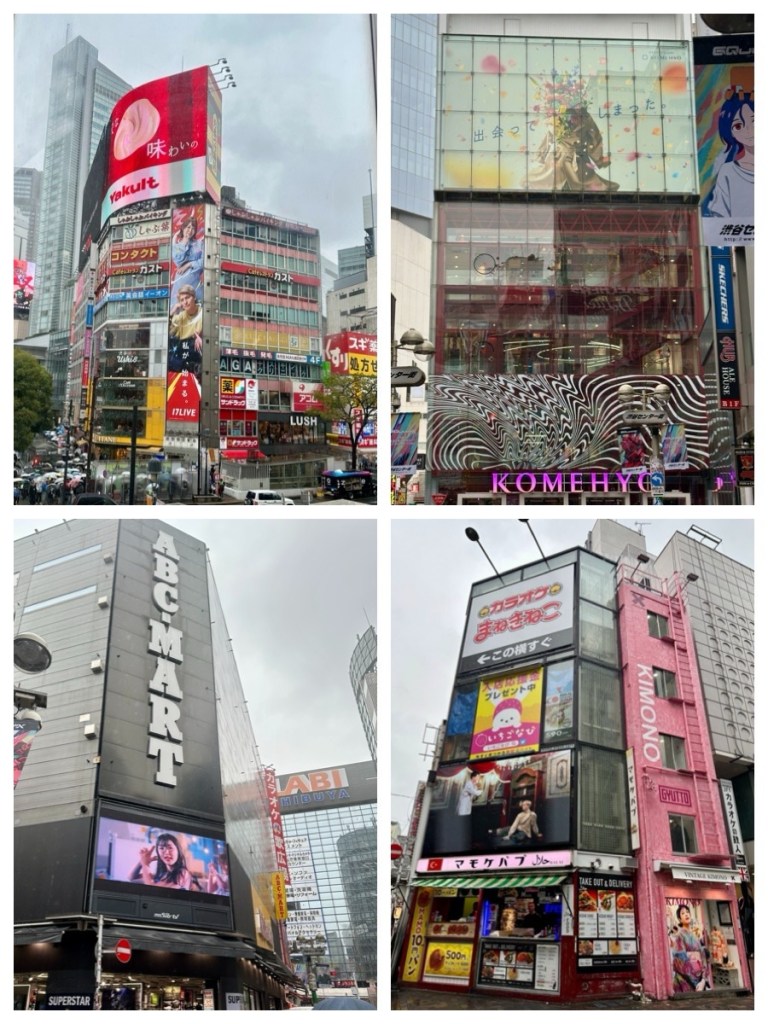
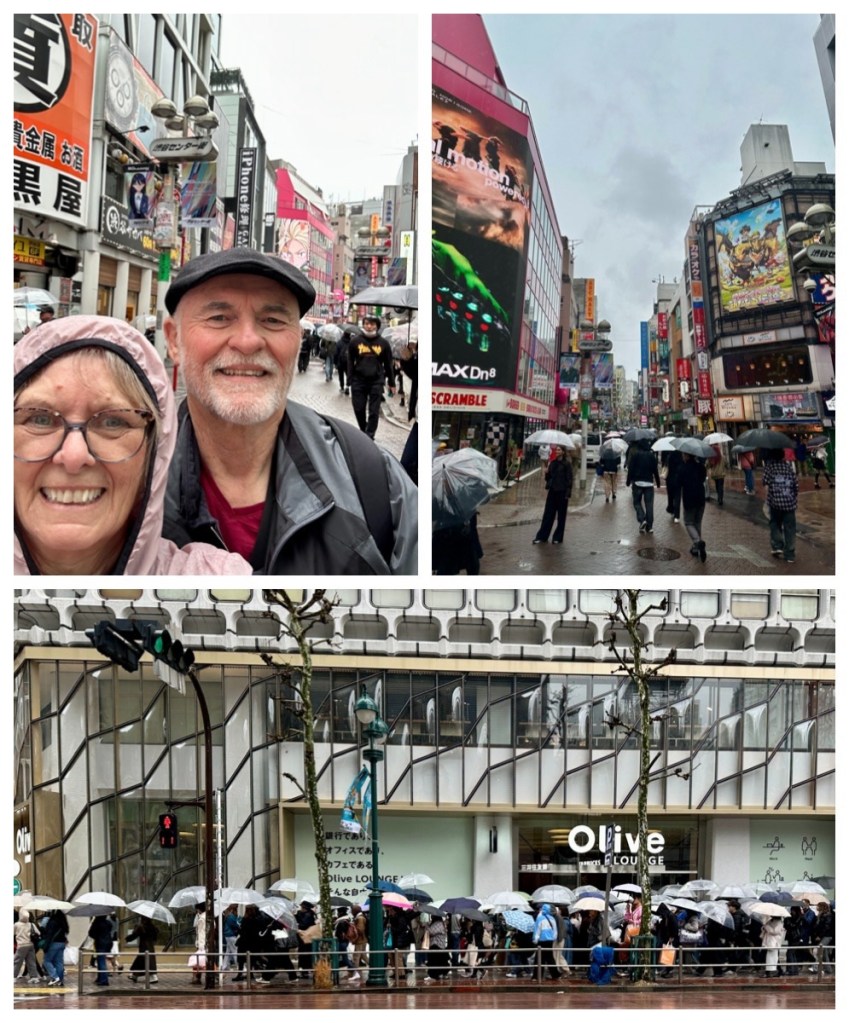
The billboards and screens continue onto the streets leading away from the crossing. We wandered for a while, just taking in the atmosphere.
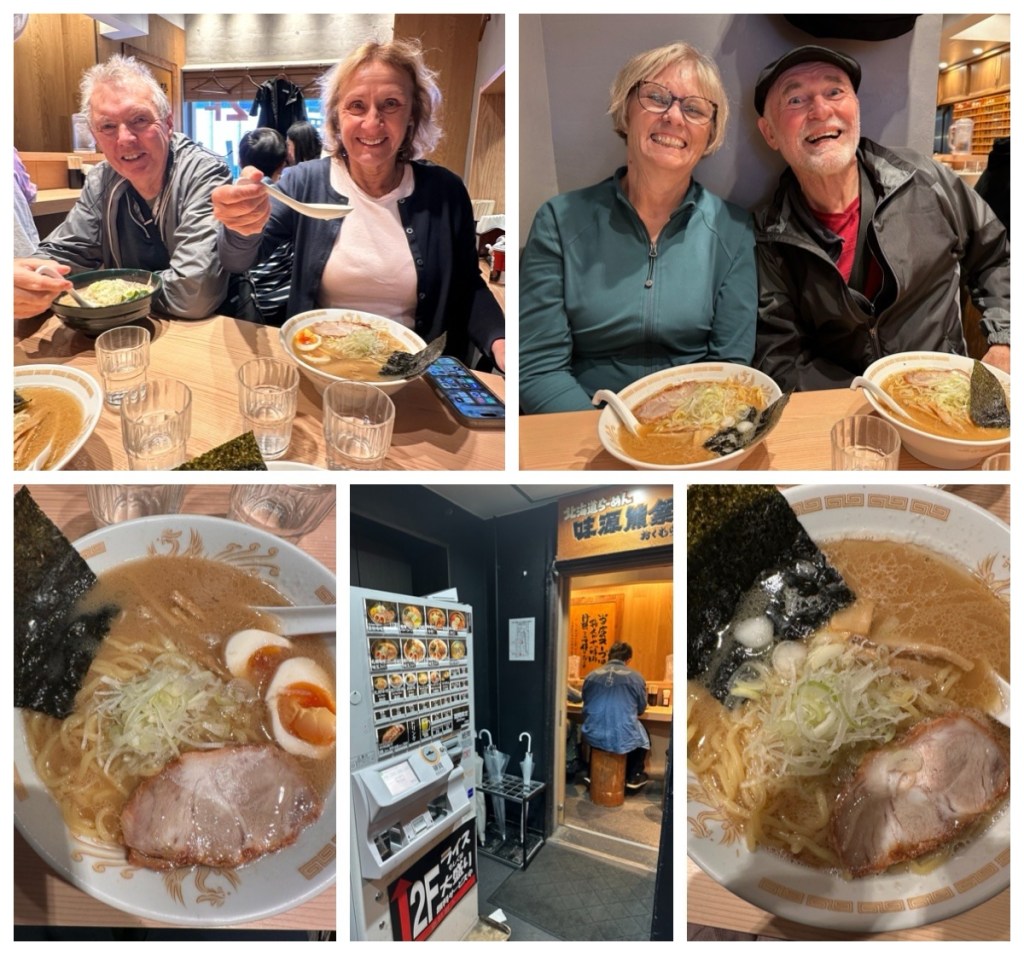
After maneuvering through the crowds and dodging umbrellas, it was time for lunch. We happened upon a small second floor restaurant – Ajigen Kumamatsuri Okumura. Their specialty is Hokkaido miso ramen, named for Hokkaido where it originated. This variety of ramen has a deep, umami-rich flavor with a slight sweetness and a hint of tanginess that comes from the miso. The broth is often thicker and more robust compared to other ramen types, making it particularly satisfying and warming. It was just what was called for on a cool, rainy day!
Shibuya Tower Records is an iconic landmark located a three minute walk from Shibuya Station. This nine story red and yellow building can be seen from quite a distance. Tower Records, an American-based company, first came to Japan in 1979 and opened this store in 1995. It is considered the flagship store and underwent renovation in 2012 to increase its already huge space. Our audiophile, Larry, enjoyed adding to his collection at the store.
Larry also visited Disk Union’s towering five-storey Shibuya store. The new and used records, numbering in the hundreds of thousands, are conveniently filed by floor. Of course, albums were also purchased there.

At 2,080 ft (634 m), the Tokyo Skytree is the tallest structure in Japan. While its main function is broadcasting, the Skytree also hosts a mall, aquarium, planetarium and restaurants. We didn’t have a chance to visit, only spotting it from a distance.

“Sometimes overlooked by visitors, Northern Tokyo is a cultural powerhouse, packed with some of Japan’s best museums and galleries, as well as the historic Ueno Park.”
This was the line in my guidebook and I said “Let’s go there on Day 3. It will be quieter than Shibuya”. The sun promised to shine and away we went.
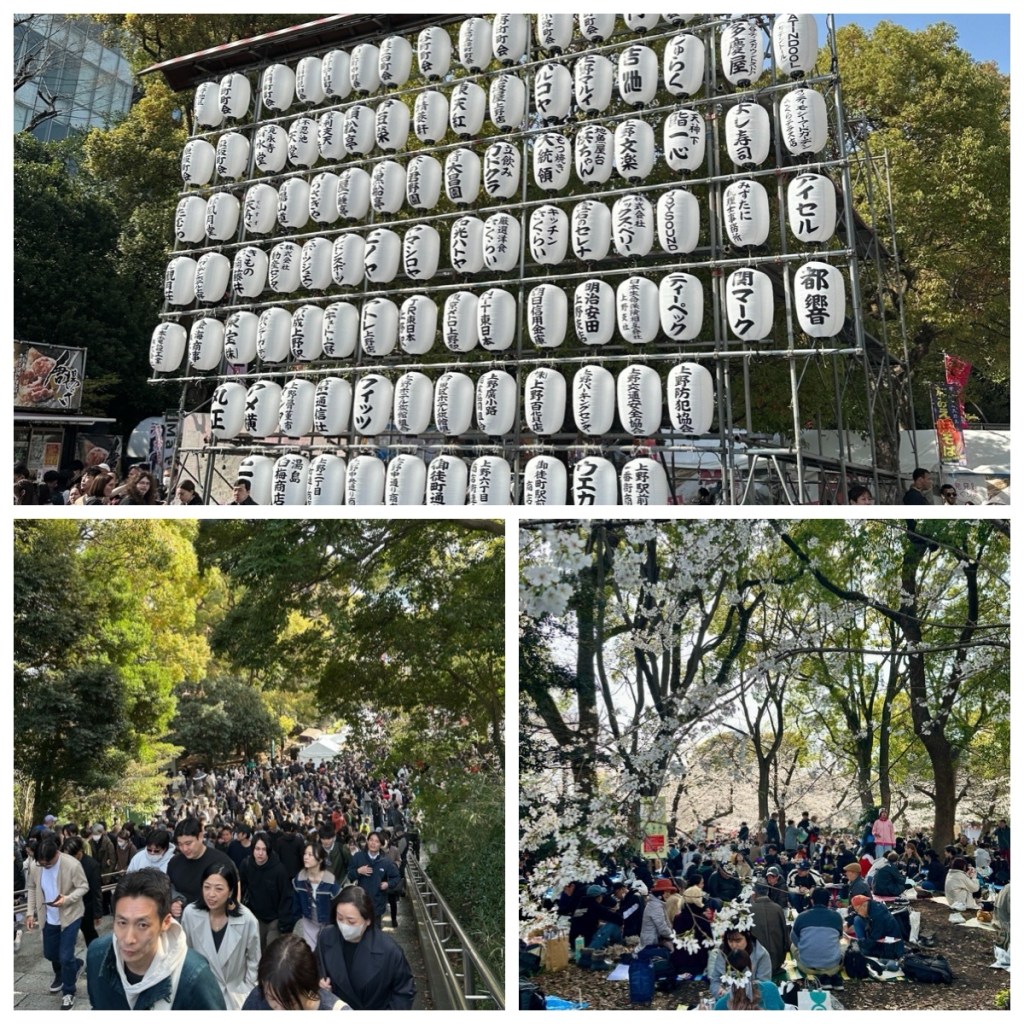
My excuse may be that it was getting later in the trip and my planning skills were tired but I should have researched a bit more. Getting off the subway at the Ueno Station, this was what we encountered.

Further in the guidebook, it stated “Join hundreds of thousands of Tokyoites and make a beeline for Ueno Park, the perfect place to enjoy hanami: the traditional spring picnic gatherings under the cherry blossoms”.
We were there on March 30, the peak cherry blossom day in Tokyo for 2025.

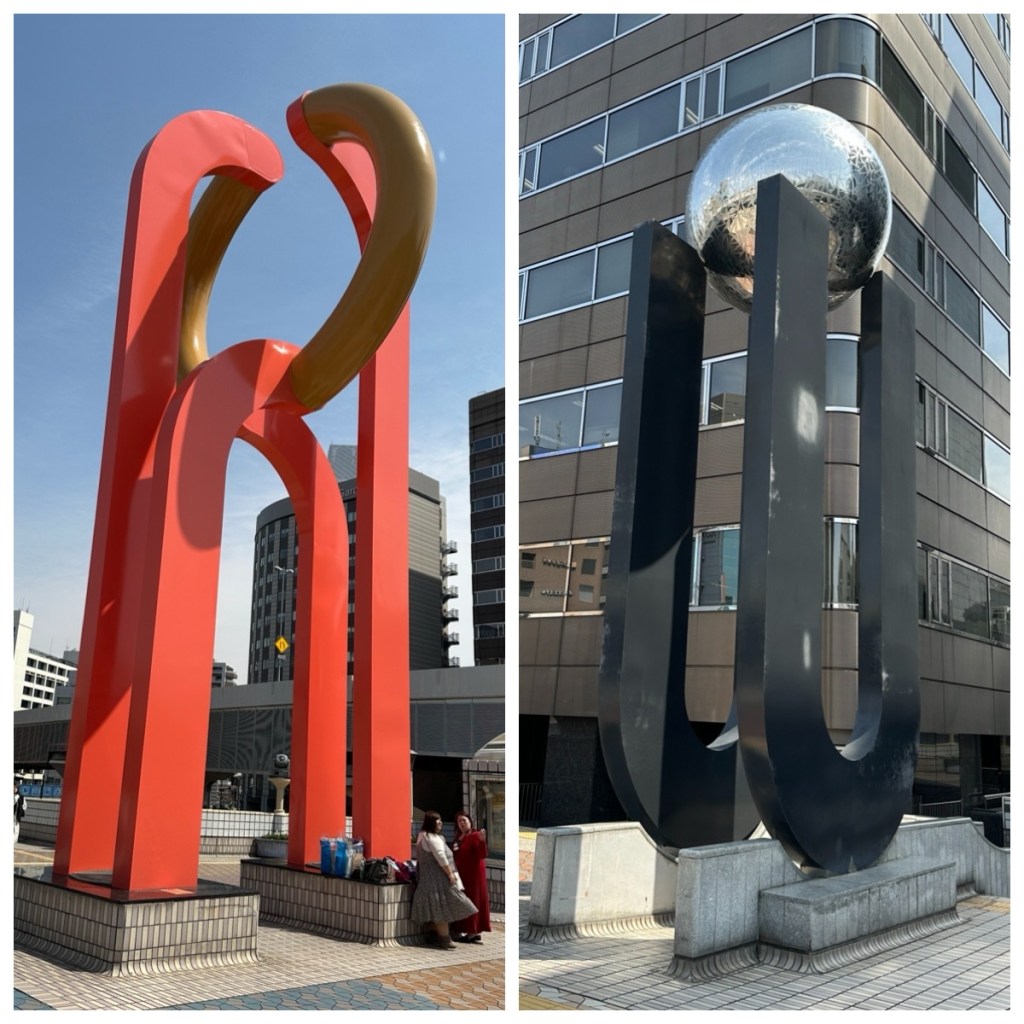
Somewhat shell-shocked, we veered off on the Panda Bridge, the sky walkway connecting Keisei Ueno Station with the JR Ueno Station and Ueno Park. There were some interesting modern sculptures on the walkway.
Coming down from the sky walk, we entered some very quiet streets. It was Sunday and the shopfronts on the street were closed. The only thing we encountered on the streets were many, many coffee vending machines. There were multiple machines on each block.
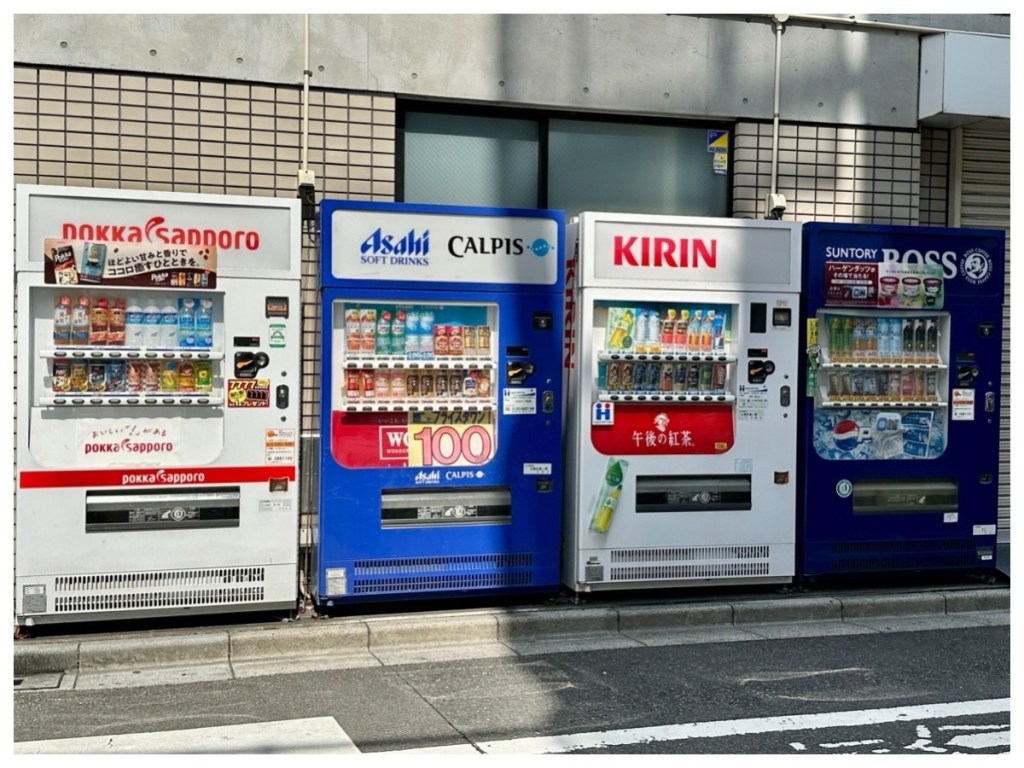
I had to do some research into this. I summarize an excellent on-line article from Honest Coffee Guide about this phenomena. If you would like to know more details, I would encourage you to read the entire article at https://honestcoffeeguide.com/japanese-vending-machine-coffee/
Japan has the highest number of vending machines per capita in the world (one for every 31 people). They offer everything that is smaller than a vending machine – including homemade hamburgers, soup stock, umbrellas, photos of J-pop idols, batteries, live goldfish, fortunes and mysteries.
Why are they so popular? The article gives the following reasons:
- The post-war economic growth meant people had money to spend but no one to sell them the stuff they wanted to spend it on.
- Japan has an astonishingly low crime rate. Vandalism is extremely rare.
- There are low costs associated with cleaning or repair – and the vending machines can be out on the street night and day, increasing sales.
- The lack of strict planning regulation means anyone can apply for a vending machine.
- Japan is high on the uncertainty avoidance index – interactions with vending machines are always the same.
- Japanese people do not like to inconvenience others.
An interesting fact – some vending machines are designed to continue working in the event of a natural disaster. Japan is now installing vending machines that can dispense food and drinks for free in case of an event.
It is surprising that vending machine coffee is so popular especially since convenience store coffee (konbini) is actually great coffee coming from a machine that grinds fresh beans and brews them on the spot. The article sites the following reasons that people choose the vending machine version.
- Some people actually prefer it.
- Canned coffee is cheaper, around ¥110-¥150
- The cultural reasons listed above (inconveniencing others, avoiding uncertainty)
- Time constraints
- Smoking – perhaps smokers can’t taste how bad the canned coffee is
On the smoking angle, another interesting fact – one of the most popular brands called Boss Coffee even has a guy smoking a pipe for their logo.
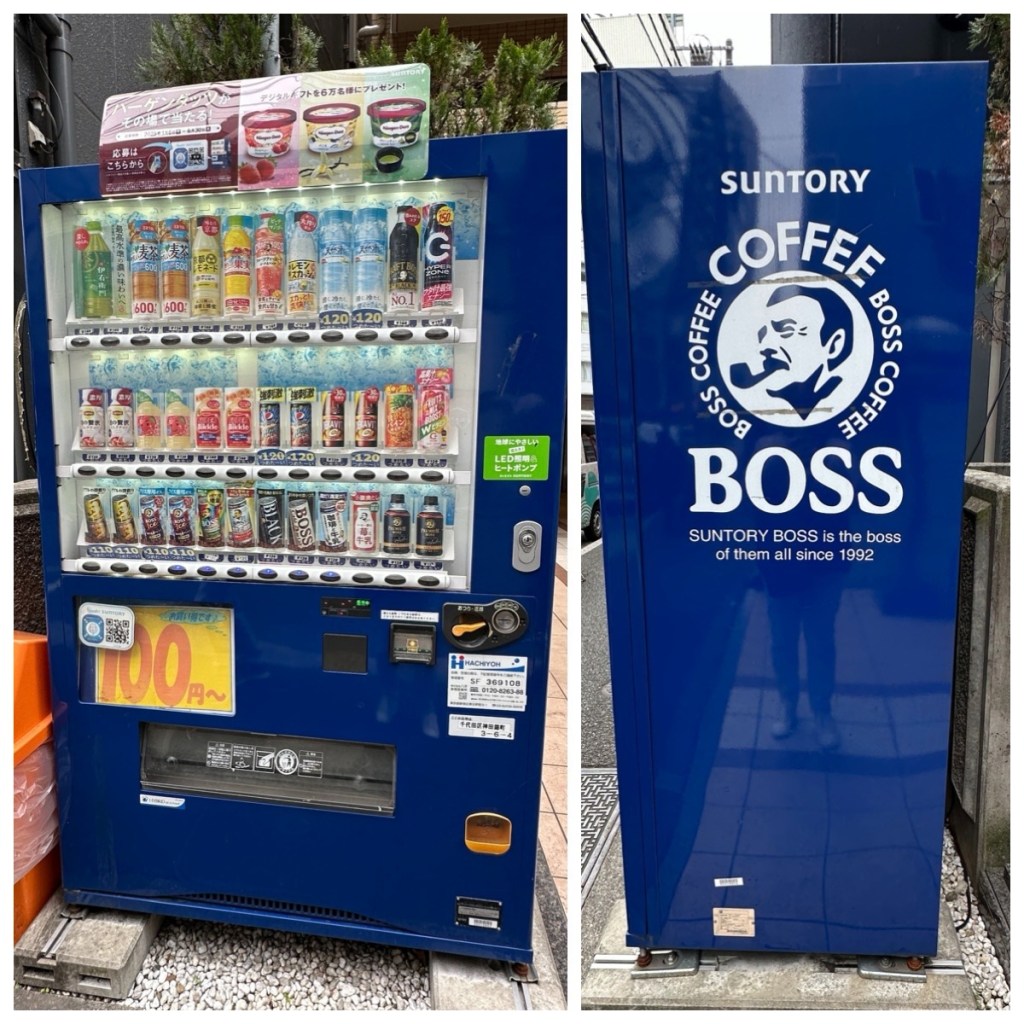
Honest Coffee Guide reviewed a number of the vending machine canned coffees. The one that our group tried was Asahi Wonda Morning Shot. The review states “Suitable for morning … apparently. It tasted empty and you could barely taste the coffee – it actually tasted like sugary watered-down milk with a pinch of salt (maybe that was the coffee?). At least the texture of the faceted can is quite nice to hold.”
Although we were very excited to try the machines, I think our tasters generally agreed with the Honest Coffee review – they didn’t rush back for more. Not being a real coffee drinker, I tried the sweetened condensed milk tea drink – I enjoyed it although it certainly wasn’t the best version of this drink that I had on the trip!

The quiet streets of Ueno were very nice to visit on a Sunday morning. We walked through some nice parks.

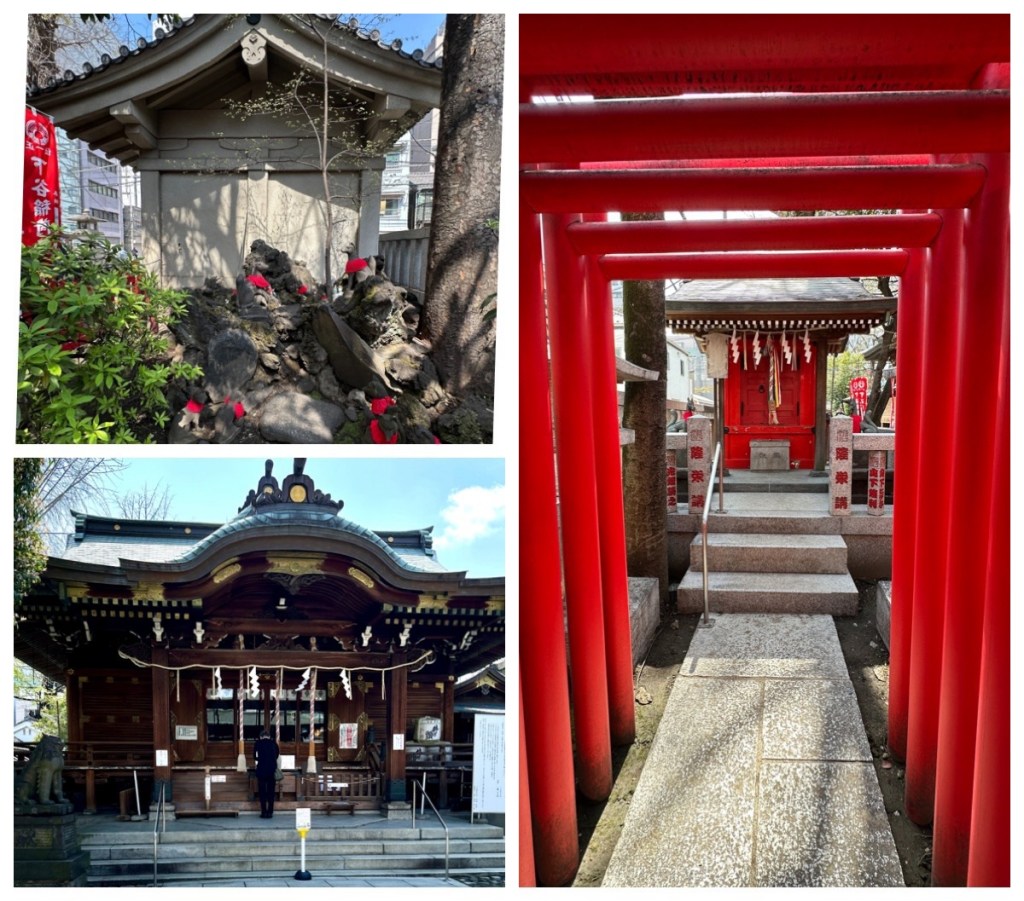
As we were walking, we encountered Shitaya Shrine. It was peaceful and very nice to visit. Only on further research did we realize that this shrine is known as the oldest Inari shrine in Tokyo. It was built in 730. The shrine is dedicated to the god Otoshi no Kami who has benefits for good business and home safety, and the mythical prince, Yamato Takeru no Mikoto who has wisdom, ingenuity and courage. Its main building burned down due to the Great Kanto Earthquake in 1923 but was rebuilt in 1934. It escaped damage during World War II and has survived to the present day.
There are many events related to the Inari shrine where prayers are offered for good harvests. The Shitaya Shrine Grand Festival has a 1000-year history and is held in May every year. At this earliest summer festival in downtown, nearly 140 booths are present around the shrine.
Ameya Yokocho is an area of tiny shops packed under the elevated train tracks and spilling into a busy market that stretches along the street. During the Edo era, the market was full of candy stores (ame-ya). After World War II, black-market goods – such as liquor, cigarettes and nylons – started appearing here. Ameya is no longer a black market but is still known as the place for bargain foreign brands. On this and surrounding streets, you can find anything from clothes and bags to fresh fish and spices – and usually at a discount.


After checking out the market streets, it was time for lunch. Many of the restaurants were full with long lines but we came upon Shinobu Ueno Ten. Our shared lunch of tataki cucumbers, assorted sushi and assorted tempura was excellent although the service was exceptionally slow and we were a bit surprised to be charged for the small appetizer that was placed on our table although we hadn’t ordered it.


Feeling rested from our quiet morning and good lunch, we tackled Ueno Park.
Tokugawa Ieyasu, the first Tokugawa shogun, built the Kan’ei-ji temple and subtemples in Ueno in the 17th century to negate evil spirits from the northeast. The protection must have worked as the Tokugawas held power for more than 250 years. In 1868, the Battle of Ueno, one of the last great battles in Japan, saw the Tokugawa shogunate defeated by Emperor Meiji’s imperial forces. The park area was slotted to become an army hospital and cemetery but in 1872, Dr Anthonius Baudin, a Dutch military doctor, observed the area’s natural beauty and successfully petitioned for the land to be turned into one of Japan’s first public parks. Thus, Ueno Park was registered as Japan’s oldest park in 1876. The park hosted the first and second National Industrial Exhibitions in 1877 and 1881.
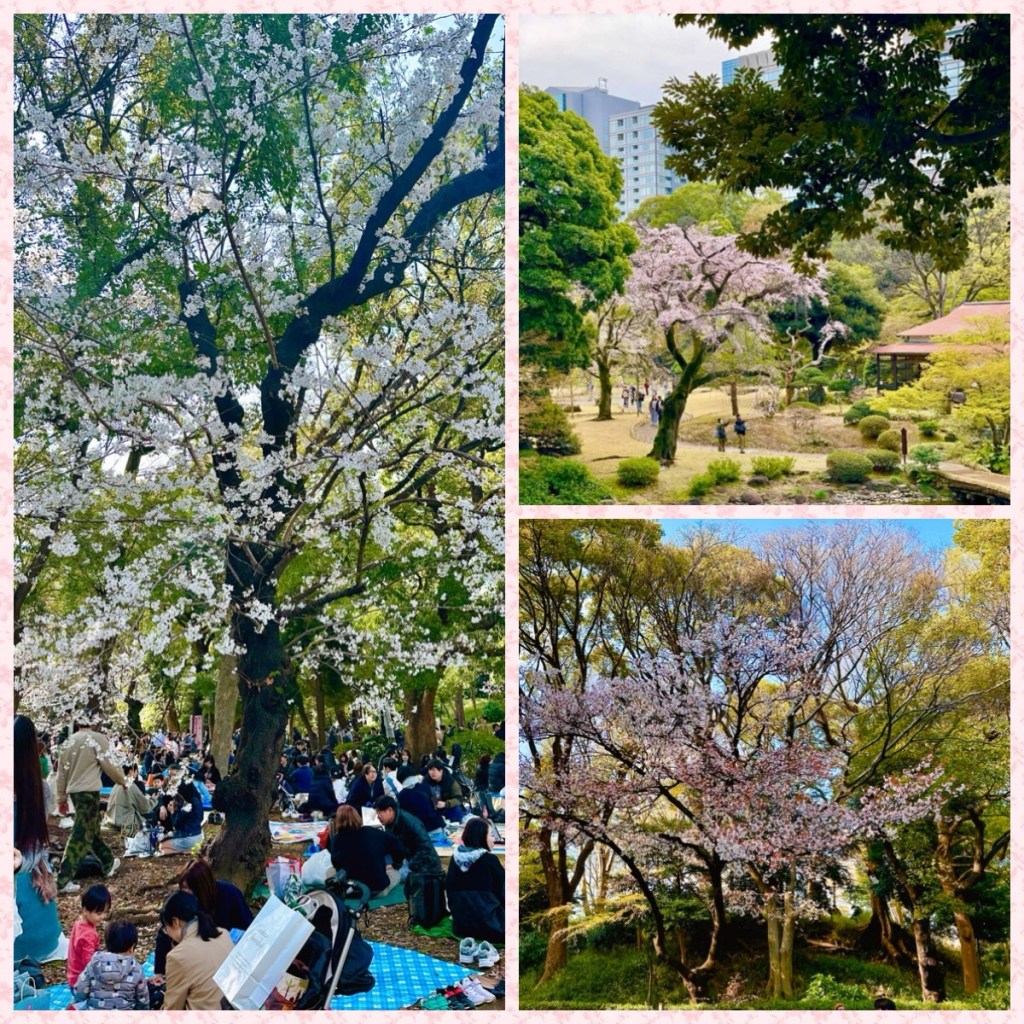
More than 800 sakura (cherry blossom) trees grow in Ueno Park. Each spring, the park erupts in a riot of pink cherry blossoms. Over a brief period, more than 2 million people visit the park for hanami (cherry blossom-viewing) picnics – and we had apparently arrived when they were all there! Blue tarps covered the ground as families gathered to picnic in the sun.

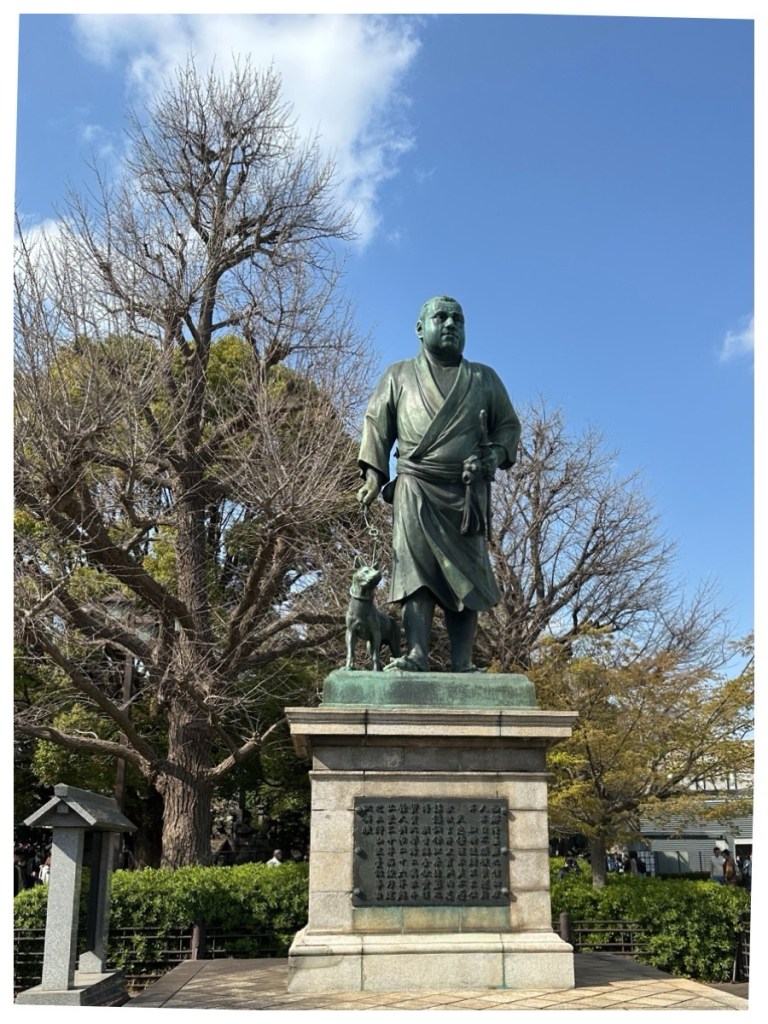
The park is dotted with statues. Near the entrance stands Saigo Takamori, one of the last great samurai, accompanied by his faithful dog.
With a circumference of 2 kilometres, Shinobazu Pond sits in the southernmost part of Ueno Park. We caught glimpses of the pond but would love to explore it more. A temple is located on the small island at its centre. The pond is split into three sections, one for boating, one as a habitat for cormorants and migrating birds and the third covered in lotuses, which bloom in July.

Despite the crowds, it was fun to wander around the park taking in the entertainment venues and checking out the multiple food options – unfortunately, we had just lunched and the line-ups at the food stands were quite prohibitive!
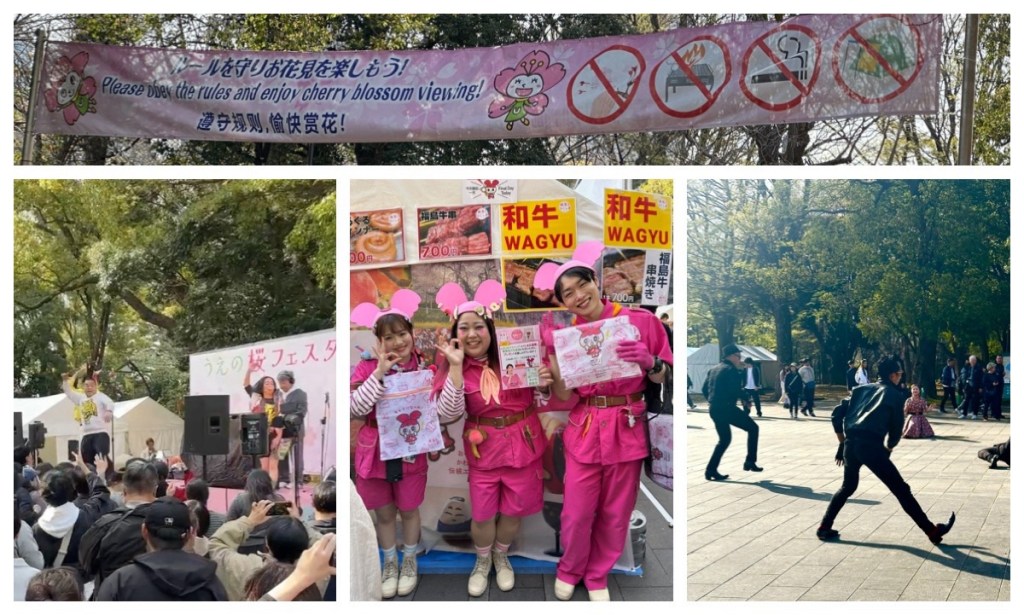
The Japanese are always fashion conscious, even when picnicking!

As well as its natural beauty, Ueno park is home to a diverse array of permanent attractions ranging from modern art museums to tranquil temples. Again the crowds were too great for us to take in these attractions but as I always say, maybe next time……
The National Museum of Western Art was established in 1959 with the private collection of Japanese businessman and art collector Kojiro Matsukata at its core. It now includes exhibits of European artworks including pre-18th century paintings by Van Cleve, Rubens and Van Ruysdael, as well as 19th to early 20th century masterpieces by Gaugin, Monet, Renoir and Van Gogh. The plaza in front of the museum has a number of excellent reproductions of famous statues.

The Tokyo National Museum, established in 1882, is the oldest and largest museum in Japan and consists of seven buildings in the northeast corner of Ueno Park. Displaying artifacts from 10,000 BC up to modern 20th century art, it features one of the largest and best collections of art and archeological artifacts in Japan. With a collection of over 100,000 individual items including nearly a hundred national treasures, about 4000 different items from the permanent museum collection are on display at any one time.

The National Museum of Nature and Science is easy to spot from the life-sized model of a blue whale outside its entrance. Spread across four floors, the museum features dinosaur exhibits and permanent exhibitions dedicated to topics such as the history and nature of Japan’s islands, Japanese inventions from the Edo era onwards and the Earth’s origins.

Ueno Park is also home to:
- Tosho-gu Shrine, built in the memory of Ieyasu Tokugawa in 1627, featuring intricate carvings and gold foil
- Tokyo Metropolitan Art Museum, opened in 1926, Japan’s first public art museum, housing an eclectic mix of Japanese and Western art
- Ueno Zoo, Japan’s oldest zoo, home to giant panda bears
- Shitamachi Museum, displaying life in Edo-era Tokyo
- Kannon-do Temple, Tokyo’s oldest temple, built in the early years of the Tokugawa shogunate
It was an experience to visit Ueno and Ueno Park on the peak Spring Festival Sunday and we are glad that we were able to see this extravagant event! We hope that one day we will be able to return to the area and park to delve more into its many attractions.
Day 4 and Larry has found an interesting district for us to explore – Jimbocho. Off on the metro – we are getting pretty good at this now.
Arriving at Jimbocho Station, it was quite obvious that this is the booksellers district – what a fun way to decorate a metro station.
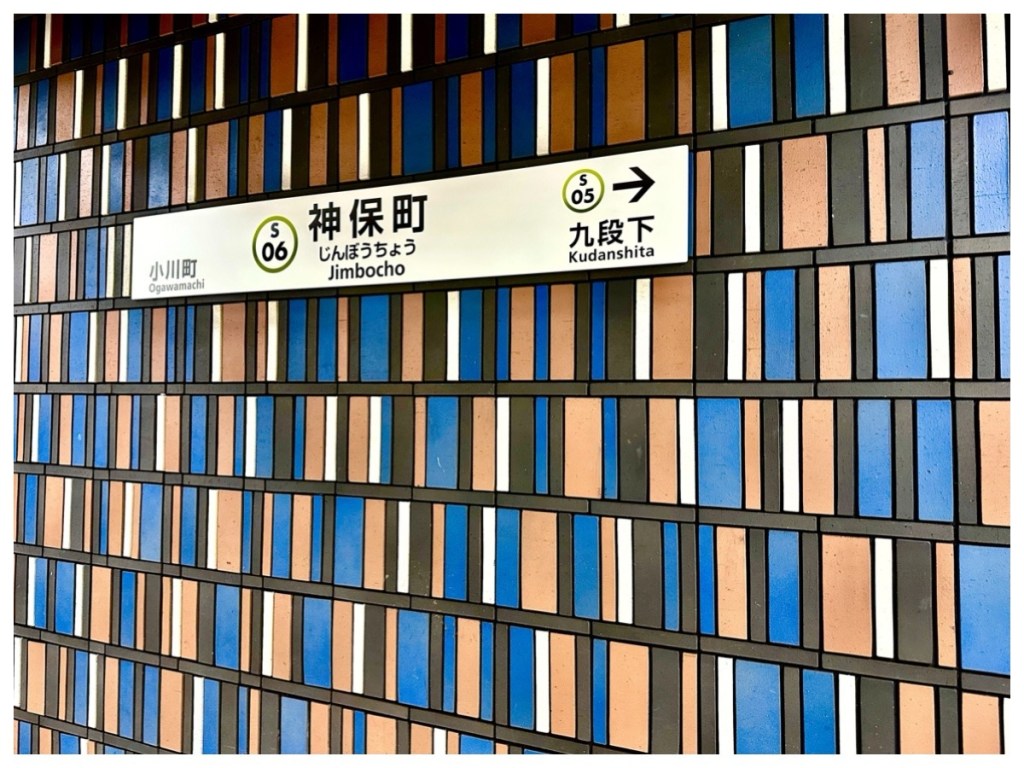
Three of the country’s great universities – Meiji, Chuo, and Nihon – started out in the Jimbocho area in the 1870s and 1880s and soon booksellers sprang up selling both new and used books. At one time as many as 50 per cent of Japan’s publishers were based in this district. Today, only Meiji University and Nihon University are still in the area but dozens of bookshops remain. The bookstores are lined along the street at the junction of Yasukuni-dori and Hakusan-dori. The racks of used and new books spill on to the sidewalk. At one point during our visit, a sprinkle of rain fell and the booksellers were busy covering the outside racks with plastic. The majority of the books are in Japanese but some of the stores also sell English books. We browsed a bit but did not buy.
Fun fact – the Japanese word tsundoku means “to buy more books than you can ever read.”

The streets of Jimbocho were uncrowded and it was interesting to walk about them. Times have changed for Tokyo’s university students and as well as bookstores, you now see numerous shops selling sporting goods and music shops full of electric guitars.

A sign of a university area is always a proliferation of coffee houses. Glitch Coffee is a name that comes up frequently when you search coffee in the area. It’s relatively new – opened in 2015 – but has made its name with single origin coffees and dedicated preparation techniques. This has resulted in long line-ups. Here is Harvey waiting patiently.
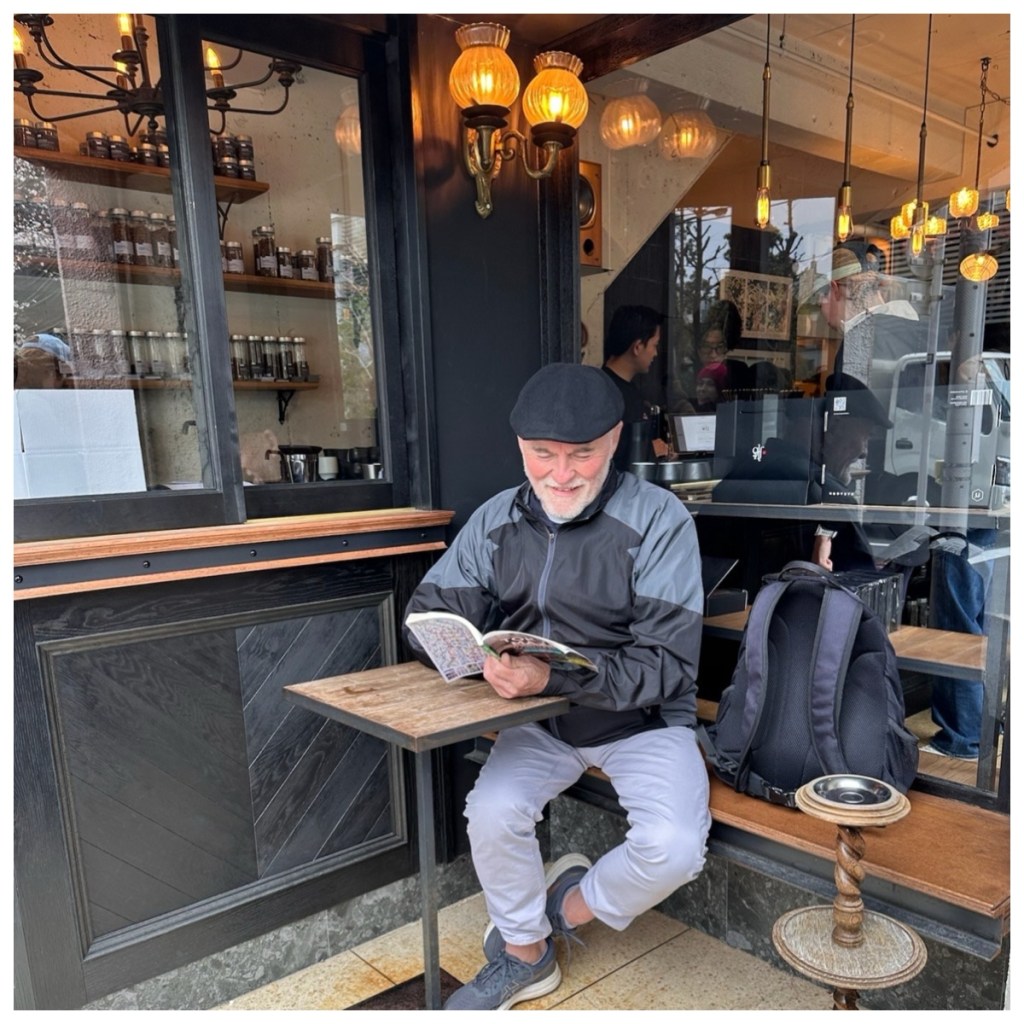
Here is Harvey after we were able to peek in and see a person buying 5 cups of coffee for about $70.

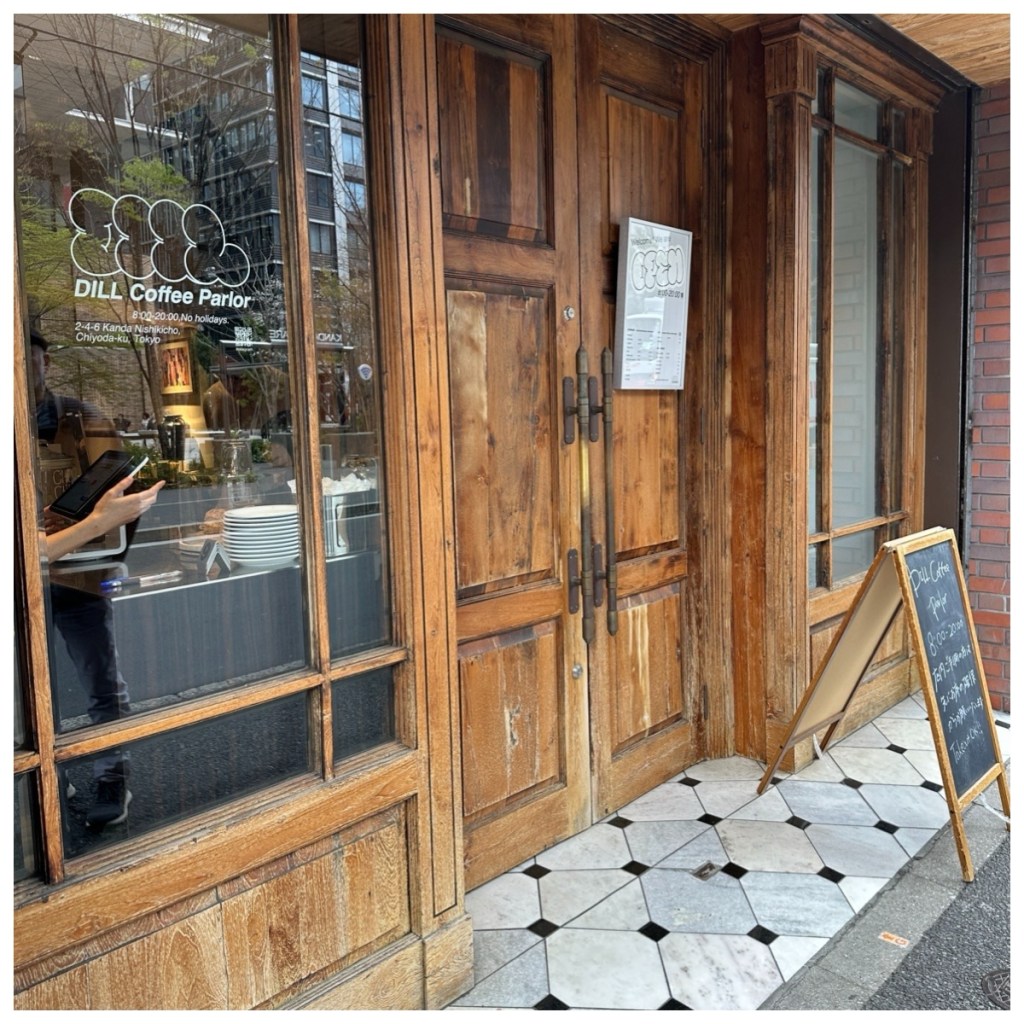
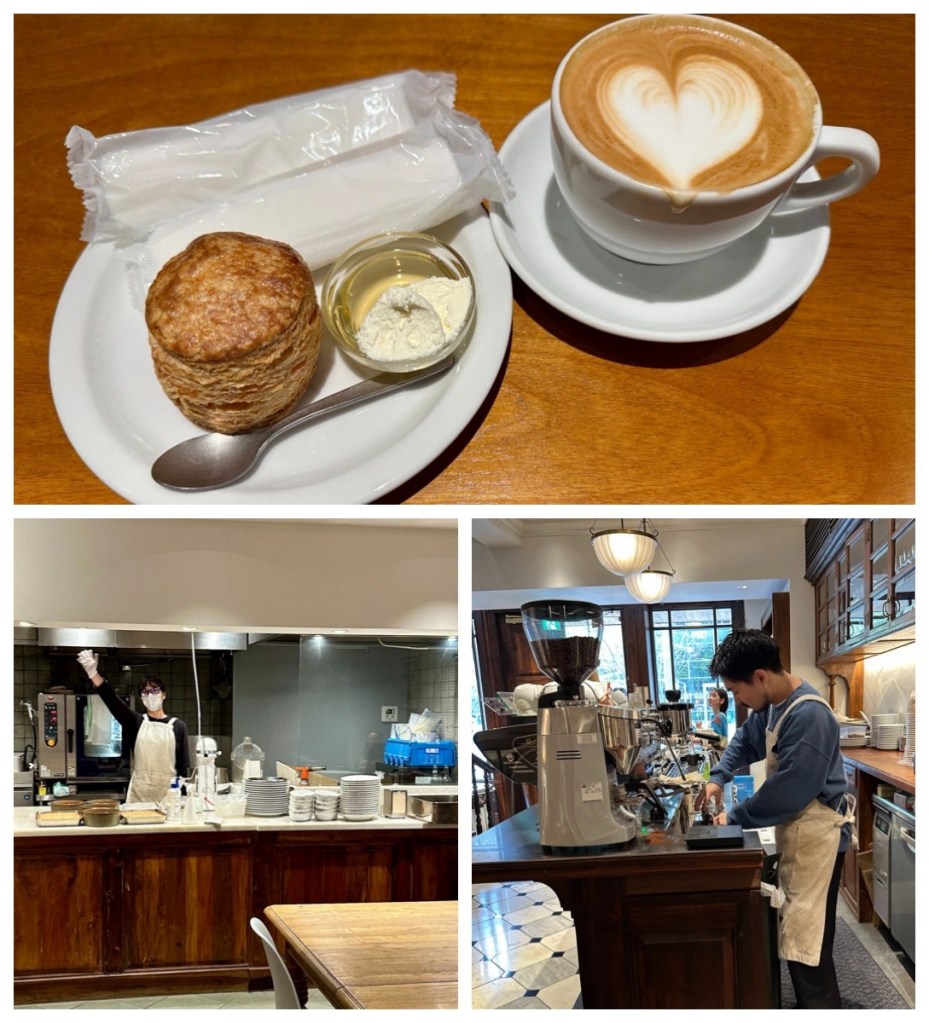
We decided to leave the line-up and travelled a short distance to DILL Coffee Parlor. This was a delightful coffee house. The beverages were excellent as were the scones that were being made in-house. Always good to check out places that haven’t made the guide book circuit yet!
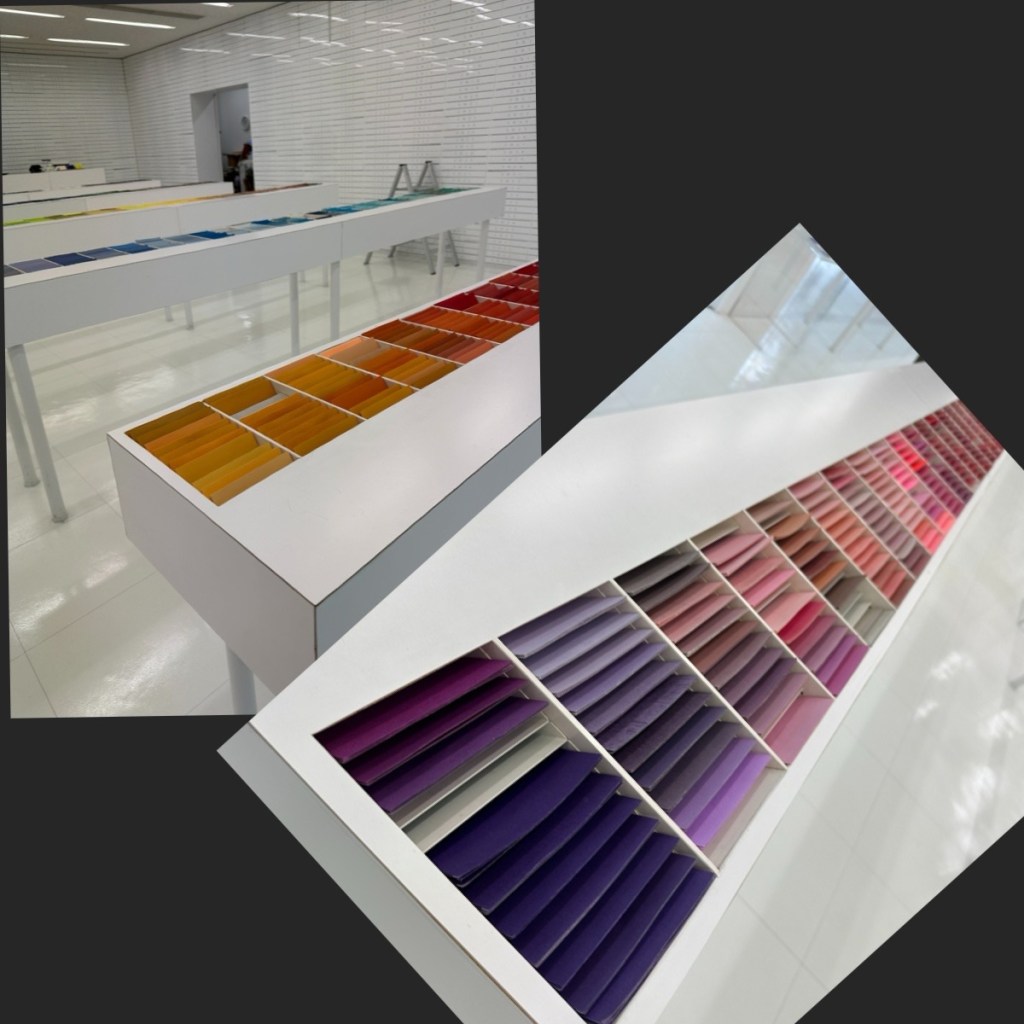
A rather odd stop – but one we had found mentioned – is Takeo Paper. In this, the company’s flagship store, you find yourself surrounded by the selection of approximately 7000 papers on display – the papers are arranged in a beautiful rainbow of colours.
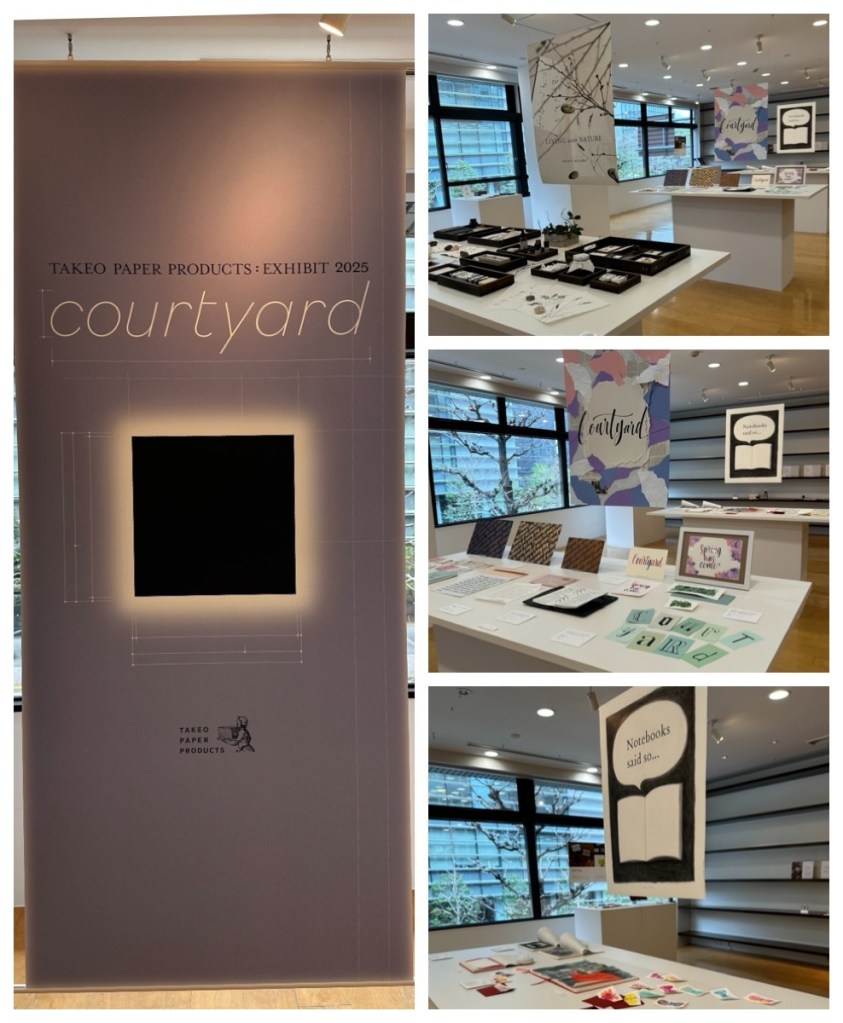
On the second floor of the shop, Takeo was presenting an exhibit entitled Courtyard. The displays were quite exquisite, with the Japanese style combining nature, beauty and precision.
At lunchtime, we found a great café – the Little Mermaid. Their selection of baked goods – both sweet and savoury – was very interesting. We would have liked to try more!

After lunch, we took a short walk to the Imperial Palace area.
Edo Castle was built in 1457 by samurai warrior-poet and military strategist Ota Dokan. At its peak, Edo Castle had 20 gates, 11 towers/keeps, 15 barracks, and the 51 metre tall main castle tower, the tallest in Japan. The castle remained the Togukawa shogunate’s seat until the 1868 Meiji Restoration, at which time the Meiji Emperor moved his official residence from the Kyoto Imperial Palace to Edo Castle. This then became the official residence of the Japanese Emperor. During the Meiji era, most of Edo Castle’s structures disappeared and new palace buildings were constructed. Most of the Tokyo Imperial Palace was destroyed in the 1945 Tokyo air raids during WWII. The current palace complex was constructed and completed in 1968.
The grounds of the Imperial Palace Gardens are around 115 hectares and are divided into four main areas – the Kokyo Gaien National Garden, the Imperial Palace East Garden, Kitanomaru Park and the inner palace area.
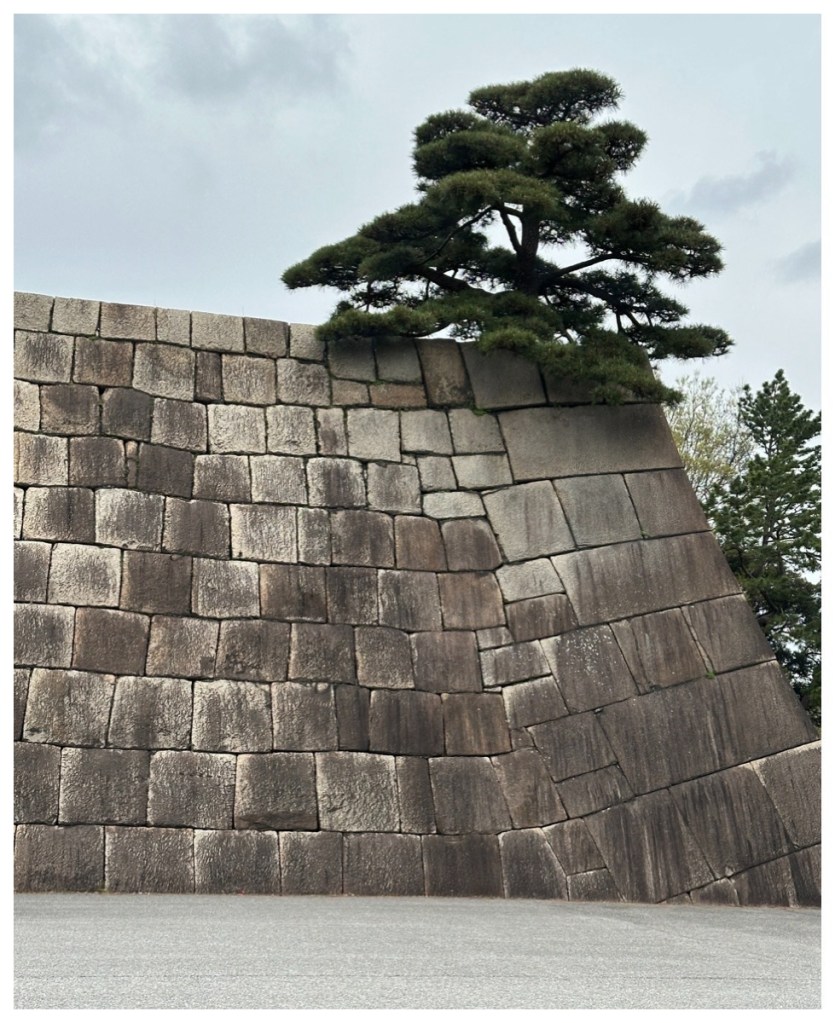
The Palace grounds are protected by wide moats and thick walls. We entered the East Garden through the Kita-hanebashimon gate on the northernmost side of the complex. The name of this gate was derived from the fact that there was a bridge (bashi) that could spring up (hane) if there was an emergency of the northern (kite) side of the castle keep. There is a deep moat and stone walls that tower over 20 meters high. Originally, two pipes ran from the gate area to supply water to the Hanzo-mon Gate inside Edo Castle.
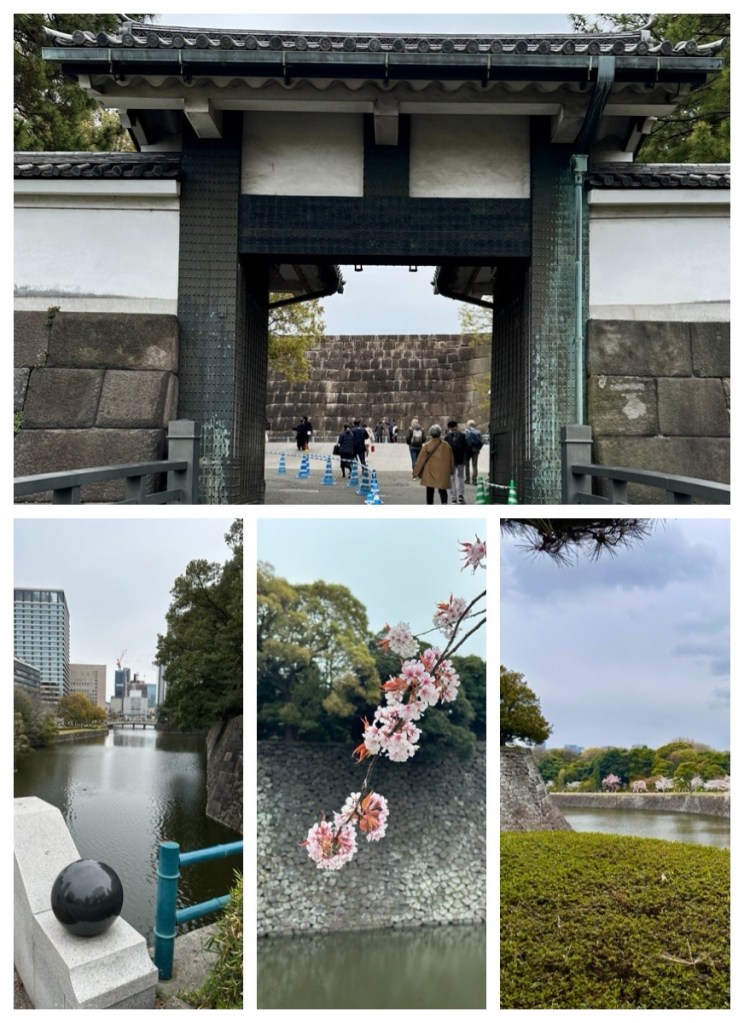
The tenshudai was the massive independent raised stone foundation upon which the main castle keep stood. Constructed in 1607, the tenshudai had 5 storeys, was 51m tall with multiple roofs and was ornamented with gold. Only small portions of the tenshudai remain.
Near to the tenshudai is the Tokagakudo Concert Hall. This octagonal hall with a petal shaped roof was designed to evoke the shape of a clematis flower. It was built in1966 to mark the sixtieth birthday of Empress Kojun (1903–2000), the consort of Emperor Showa (1901–1989). Tokagakudo means “Peach Blossom Hall” referring to the peach emblem of the Empress. Each of the mosaic walls represent a bird with outspread wings expressing a different theme, for example the four seasons. The hall has staged performances for elite ears over the decades, sometimes under the refined gaze of the Imperial family themselves. In 2024, it hosted a concert to celebrate the 90th birthdays of the Emperor Emeritus and Empress Emerita.

The East Gardens of the Imperial Palace are located on the eastern part of the palace grounds and are open to the public. These meticulously kept gardens stand next to but in contrast with the steel and glass of downtown Tokyo’s modern office buildings.

The Bamboo Garden was established in 1996 at the suggestion of His Majesty the Emperor Emeritus. The bamboos had originally been presented to Emperor Showa, whose emblem was young bamboo, by the Imperial Household Agency staff to celebrate his 77th birthday and planted in the Fukiage Gardens of the Imperial Palace. It was His Majesty’s wish to transplant the bamboos here in the East Gardens. The garden includes thirteen varieties of bamboos native to Japan and China.

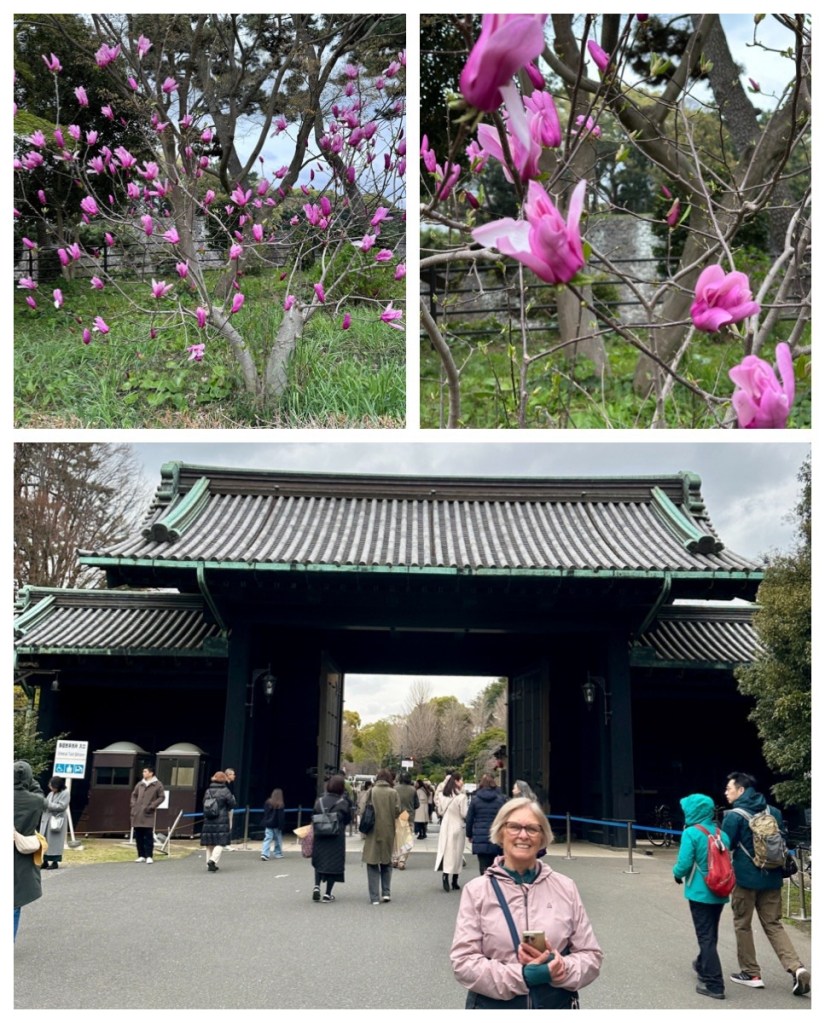
Springtime blossoms were resplendent in the park, with the Sakura (cherry) trees setting off the vibrant foliage.


A number of guardhouses are still present on the palace grounds.
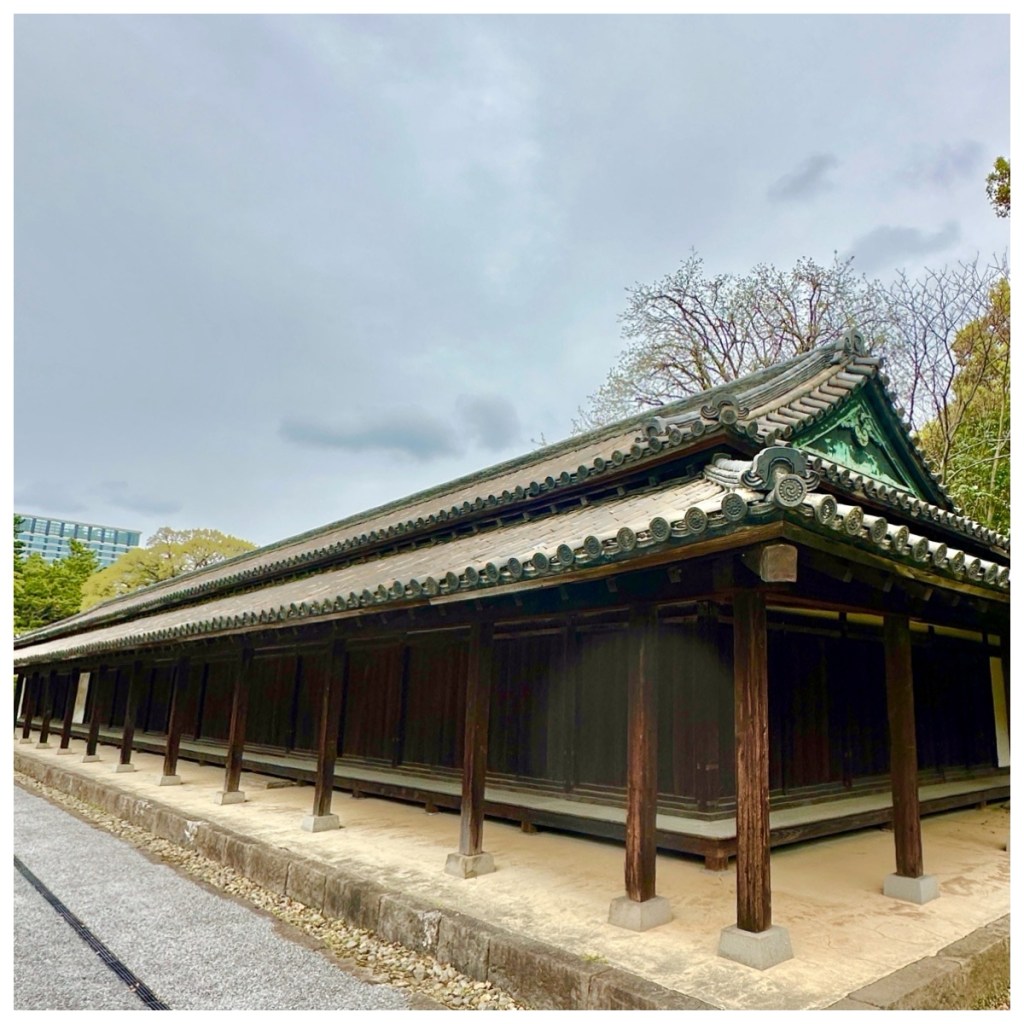
Hyakunin Bansho Guardhouse is the largest of three guardhouses that have survived from the Edo period (1603–1867). The name means ‘100-Man Guardhouse’ as it is said that the guardhouse was always manned by 100 samurai. The 45-metre-long building was staffed day and night by four shifts of samurai who screened visitors entering through the Ote-mon Gate leading to Edo-jo Castle.
O-bansho Guardhouse was built inside the Otenakano-mon Gate and was said to have been guarded by the highest ranking samurai as it was the last guardhouse on the way to the inner citadel of Edo Castle. O-bansho has since been rebuilt but 15 steps pockmarked with old bullet holes remain as a testament to the powerful old architecture and the passage of time.

We exited via the Ote-mon gate, the main gate and most significant entrance to Edo Castle. This impressive gate is characterized by a square-shaped turret situated on a stone mound and an earth-paved bridge. Built in 1606, the original bridge was wooden. It was built with the aim of heavy security. The gate has witnessed numerous historical events, including the assassination of the chief minister of the shogunate and the surrender of the shogunate to the imperial forces. Ote-mon Gate has been rebuilt multiple times, following a fire in 1657, three strong earthquakes in 1703, 1855 and 1923 and fire again during World War II in 1945. The current gate was built in 1967 and has been designated an Important Cultural Property of Japan.

We made our way down Uchibori-Dori Avenue, enjoying the views of Kikyobori Moat to our right. On the corner sits Sakurada Niju-yagura Tower (aka Tatsumi-yagura or Sakurada tatsumi-yagura). This two-story corner keep is one of the three remaining original keeps from Edo Castle.

Guided tours of the actual palace grounds are offered but require advance ticketing. Reviews of these tours vary but generally, people feel they are not that worthwhile so we had not booked one. However, a kind gentleman in the gardens informed us that Inui Street at the Imperial Palace was open for this year’s spring season. The street is opened to the public twice a year, to coincide with the spring cherry blossom season and the autumn foliage season. The practice began in 2014 to celebrate the 80th birthday of then Japanese Emperor Akihito.
We entered through the Sakashita gate, the key entrance point to the Imperial Palace.

The emperor of Japan is the hereditary monarch and head of state of Japan. The emperor is defined by the Constitution of Japan as the symbol of the Japanese state and the unity of the Japanese people, his position deriving from “the will of the people with whom resides sovereign power”. Since the enactment of the 1947 constitution, the role of emperor has been relegated to that of a ceremonial head of state without even nominal political powers. For example, the emperor is the head of the Japanese honors system, conferring orders, decorations, medals and awards in the name of the state and on behalf of its people in accordance with the advice of the Cabinet.
The current Emperor of Japan acceded to the throne on May 1, 2019, becoming the 126th Emperor of Japan after his father Emperor Akihito abdicated. Emperor Naruhito lives in the Imperial Palace with his wife Empress Masako and his only child, Princess Aiko. Due to the agnatic primogeniture (male-only imperial succession) reinforced by the constitution of Japan, Aiko remains at present legally ineligible to inherit the throne and she cannot succeed her father.
The Imperial Palace has served as the residential complex of the successive Emperors since 1868. It contains the Imperial Residence and the Imperial Palace Complex, where His Majesty the Emperor undertakes official duties.
This is as close as we could come to the any of the actual Palace buildings.

We were able to walk down Inui Street, a lane of approximately 750 meters. On our walk, we passed some major buildings. One was labelled as the Hasuike-Sanshujo or Meeting House. I haven’t been able to find any more information about the history or purpose of this building.
The Unaicho Chosha is the headquarters of the Imperial Household Agency. The building dates back to 1935. After WWII, until construction of the Imperial Palace was completed, the third floor of the building was used as the temporary Imperial Palace.

Some 100 cherry trees, including the Somei-Yoshino and Satozakura species, line Inui street.

We exited through the Inui gate. While the walk down Inui Street didn’t really expose any of the actual palace buildings, it was a pleasant stroll and you could see how important this opportunity was to the Japanese people.
On the metro ride back to the hotel, our train car advertised itself as the Brûlée Train. I really would have liked one of those brûlées!

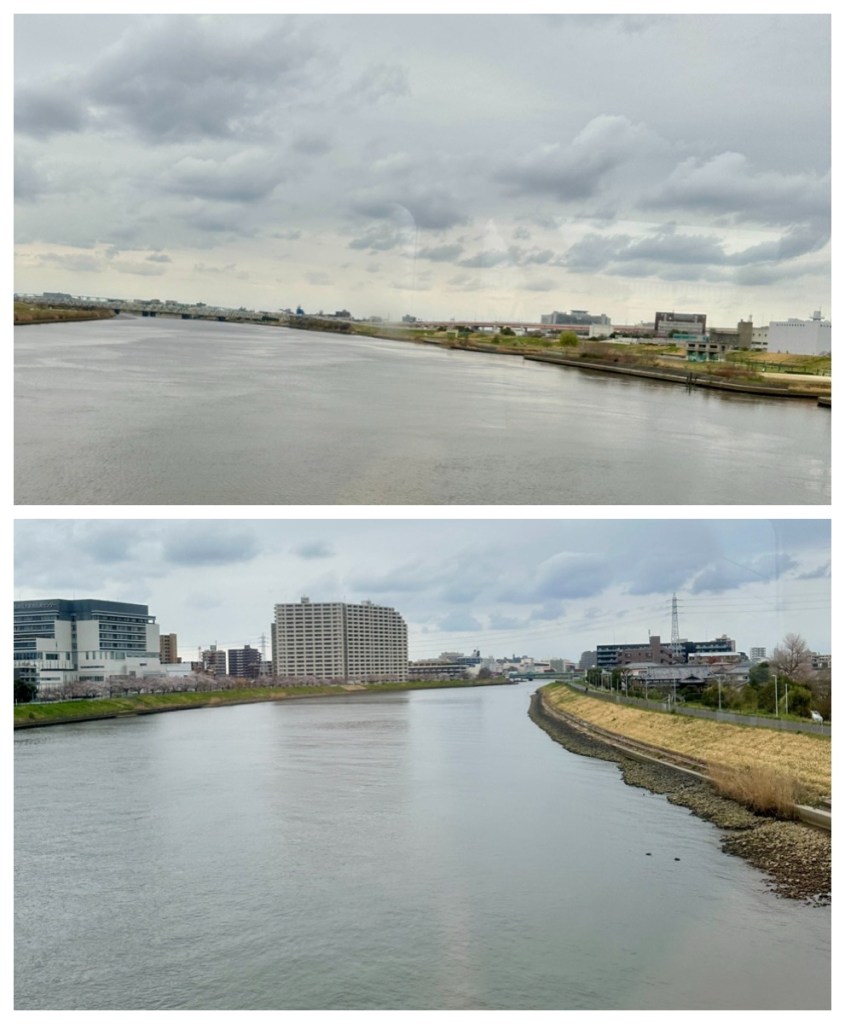
Our train crossed two rivers – the Arakawa and the Edo.
Day 5 dawned with rain falling and not a lot of promise of it letting up. We decided we would forgo another journey into Tokyo. Harvey wanted to check out a Toyota dealership and we knew there was one in Narita. So after a lazy morning, we hopped on the hotel shuttle bus to the Aeon Mall Narita.
Harv grabbed his umbrella and headed out a couple of blocks to the Toyota dealer. He didn’t find too many cars on display but was impressed with all the dealership offered, including a store and restaurant.

Aeon Mall Narita is a shopping mall popular with foreign travelers due to its proximity to Narita Airport. The mall is a typical modern Japanese shopping mall with over 150 stores that offer a wide range of goods from fashion to fresh foods and home improvement. We browsed a bit and found an excellent store where we purchased a few traditional Japanese items. We walked through Aeon Styles which we characterized as Japanese WalMart. We were quite surprised to see the relatively low prices for foodstuffs.
We had been told that we had to try taiyaki while in Japan. We hadn’t come across them as we toured but there in the mall was a dedicated taiyaki stand. These warm, crispy fish-shaped pastries are a classic Japanese street food snack. The waffle-like pastry is traditionally filled with a sweet red bean paste. At this stand they offered multiple other fillings as well. But first we had a dilemma – the stand was cash-only and our supply of Yen was running low. We scrounged through all nooks and crannies of our purses and came up with all we had – we were about 30 yen (about 29 Canadian cents) short of what we needed for the minimum purchase of 12 of the small taiyaki. Deb bargained with the lovely salesgirl and she kindly agreed to sell us 10 for what we had. We chose five different fillings and all were delicious!!
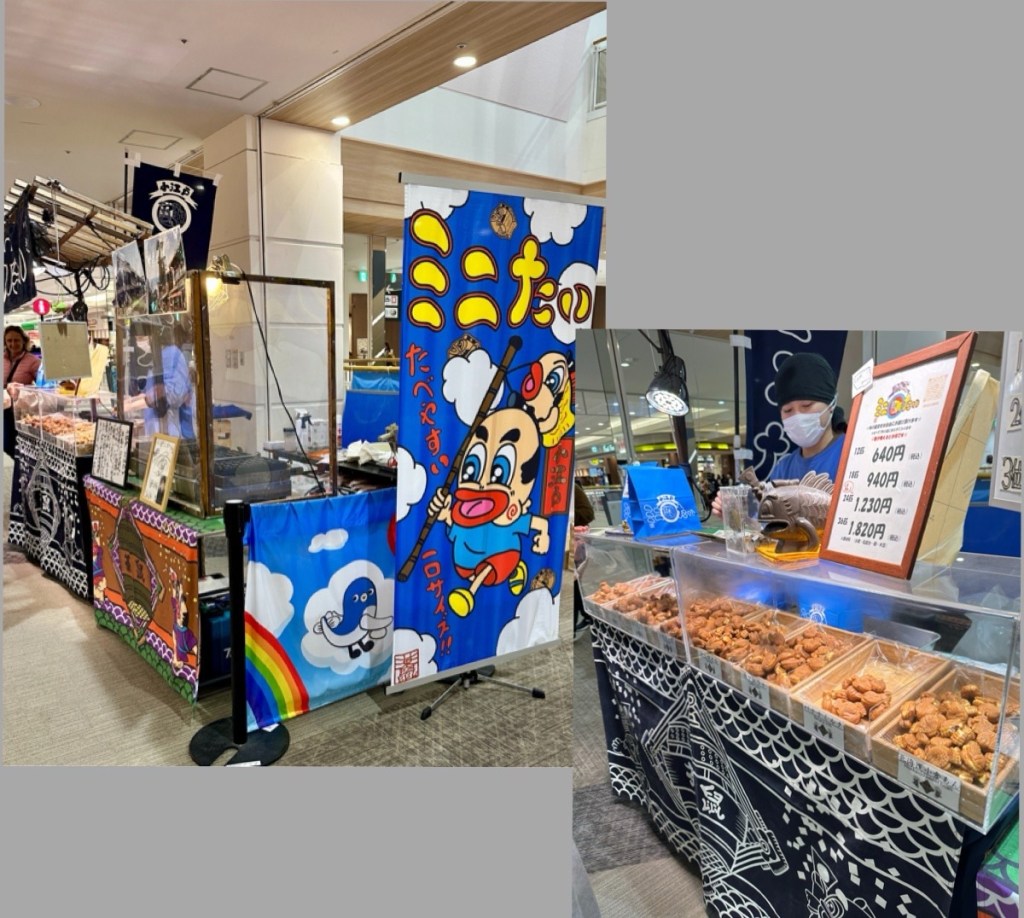
The mall featured a huge Capcom games arcade, the likes of which we have never seen. Children of all ages were busily engaged in all sorts of arcade activities, all the while carrying their buckets of coins around with them. A brief internet search tells me that gambling is illegal in Japan but this does not include gaming machines. Apparently, these machines (the most popular of which are pachinko games) are wildly popular. It appears to me that this arcade is an entry level to this activity.

There is a large selection of restaurants at the Aeon Mall offering most cuisines. One thing that we found interesting all over Tokyo are the windows outside restaurants. Detailed and incredibly realistic replicas of meals are displayed and apparently have been for more than 100 years. The very first “sample models” were made by a manufacturer of anatomical models from Kyoto named Soujiro Nishio. His earliest efforts were made of wax and began appearing in the windows of restaurants in his home town around 1917. The concept caught on, encouraged by the fact that most restaurants of the day did not use menus, and a number of craftsmen began to similarly create models.
The process of creating the perfect plastic meal is painstaking:
- The restaurant provides a real dish, which is then “deconstructed” into all of its individual elements and exact molds are created.
- Liquid plastic is then carefully injected into the mold, making sure that no bubbles or imperfections are left, and the “food” is “cooked” at 180 degrees before being left to cool.
- A magnifying glass is then used to examine every element of the dish, with any component exhibiting the slightest imperfection rejected.
- Painters use delicate sprays to turn the items the exact shades of colour.
- The competed ingredients are then precisely arranged on a plate or in a bowl.
An establishment’s success can depend on how well its dishes look in the window.
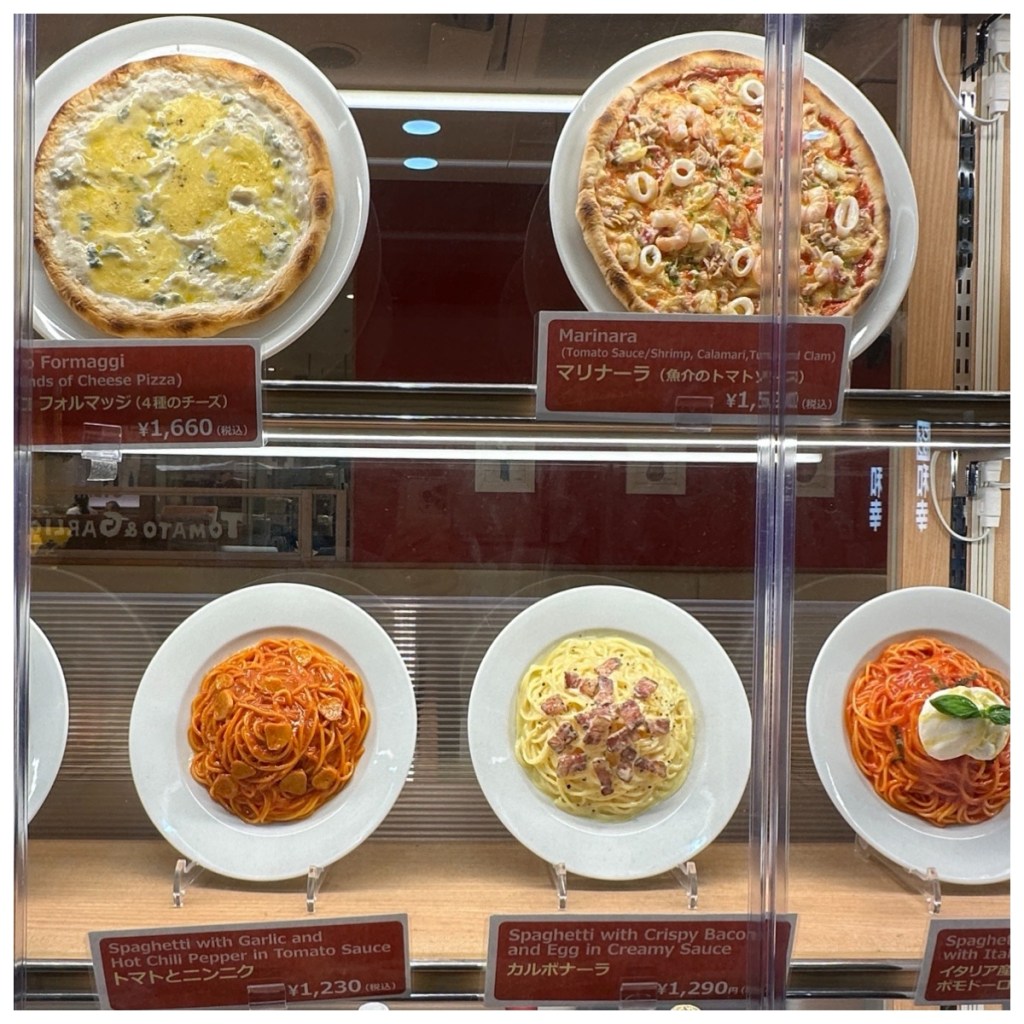
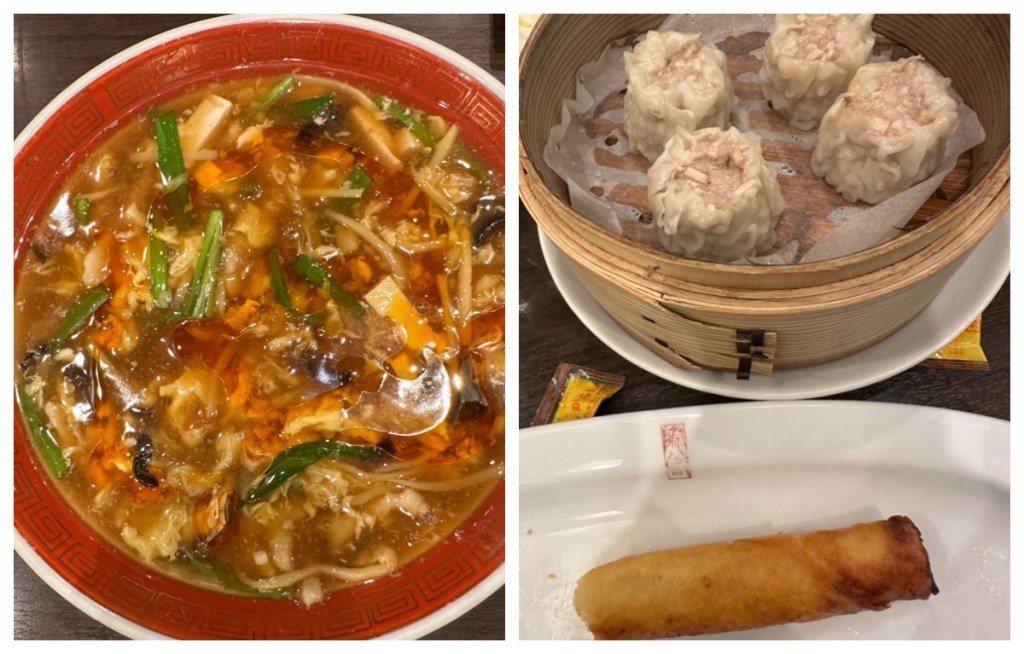
I’m not sure if the window display affected our choice but we opted for Tonkatsu Wako where we enjoyed an early dinner.
On our last evening, we checked out the Sky Bar Windows lounge at the hotel. We probably should have tried this out earlier in the trip!

Our departure day was once again very rainy. Although our flight wasn’t scheduled to depart until 1830 h (and was then delayed to 1940 h), we decided we did not need to do any more touring. A lazy morning and early afternoon at the hotel, a few hours in the airport lounge and off we went on WestJet for a successful final flight on the trip.
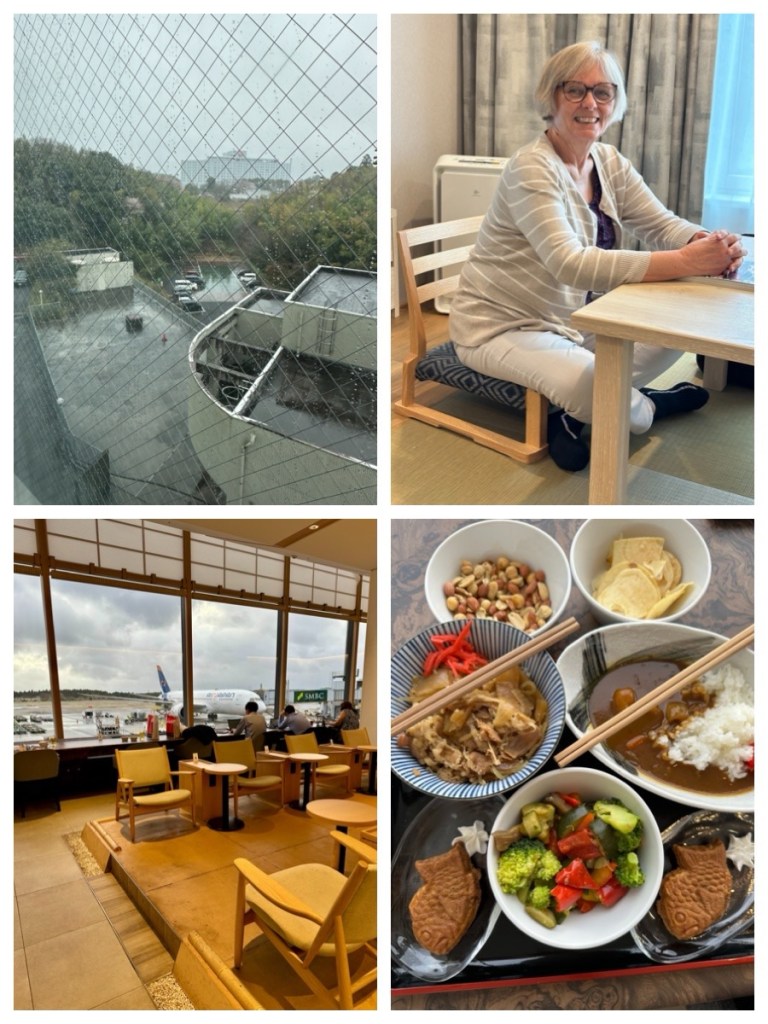
Our time in Tokyo was another wonderful stop on what has been an amazing trip. I would say ‘the trip of a lifetime’, but we are really hoping that we get a chance to address those things that I’ve designated as ‘maybe next time….’.
We hope you enjoyed the blogs about our Asia travels – thanks for reading them!!
Until next time,
Cheers,
Bev & Harvey
 A Long and Winding Journey
Wow, I would say you guys did have a wonderful trip!
LikeLike
Pingback: Asia 2026 – Stop #1 – Tokyo | A Long and Winding Journey