After our great time in Vietnam, we caught an Air Asia flight from Da Nang International to Kuala Lumpur. The Da Nang airport was crazy busy but as usual we were very early so had no problem.
We visited Kuala Lumpur on our 2025 trip so I won’t repeat any of the details from those blogs. If you are interested, here are the links:
https://alongandwindingjourney.com/2025/03/10/asia-trip-stop-2-kuala-lumpur-malaysia/
https://alongandwindingjourney.com/2025/03/13/asia-trip-kuala-lumpur-continued/
We returned to the IHG Intercontinental Hotel in KL. We loved this hotel last year and felt the same on this trip. It ranks up there as one of our favourites in all of our travels!
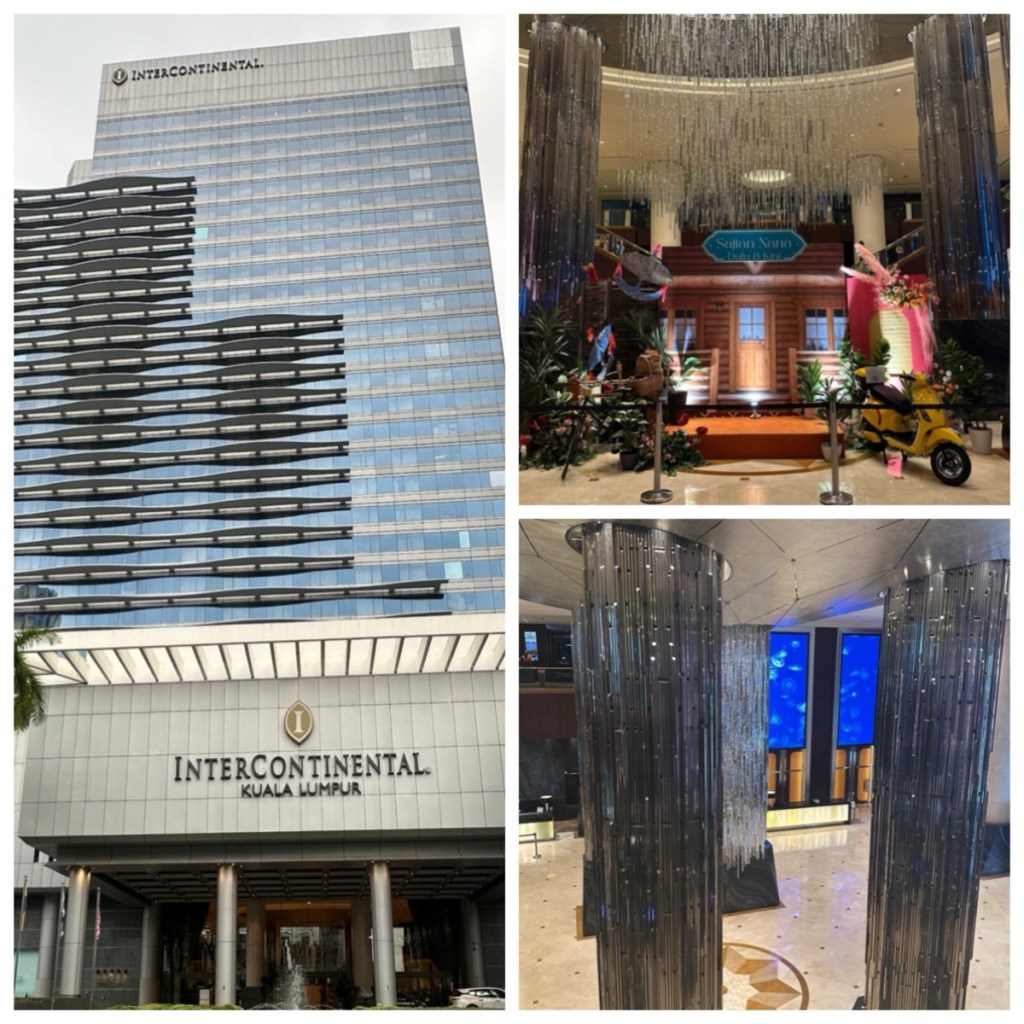
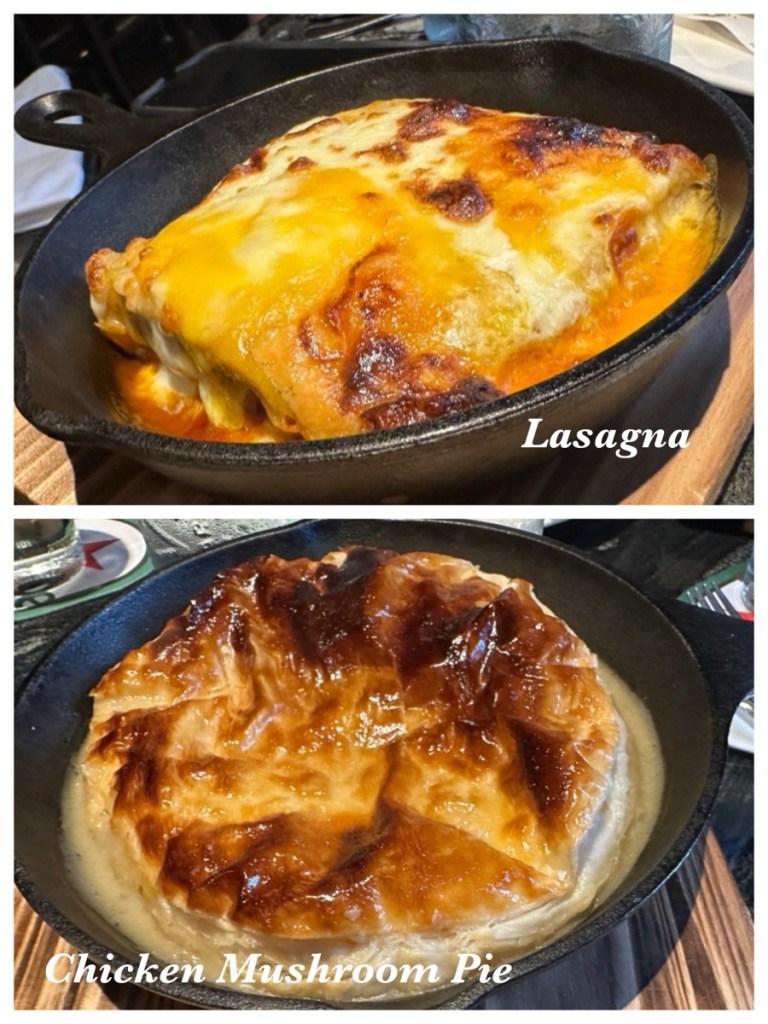
We arrived in the early evening and capped our day with dinner in Bentley’s Pub at the hotel.
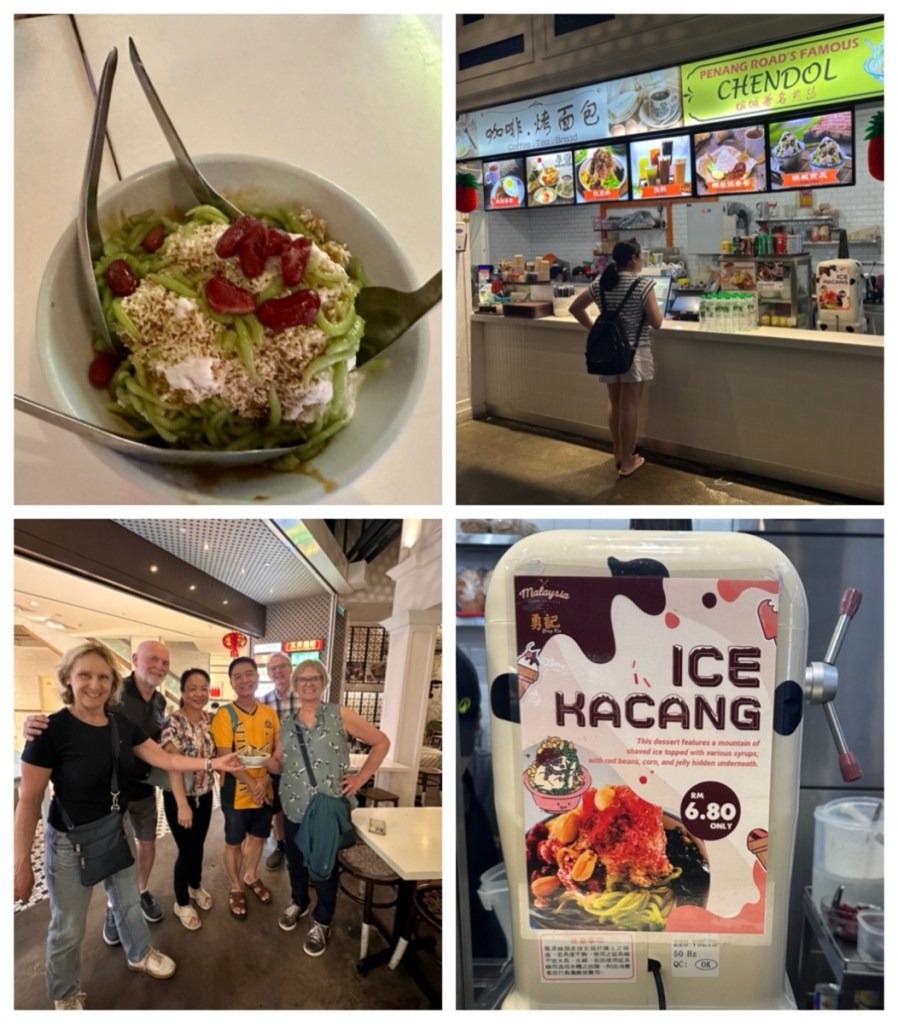
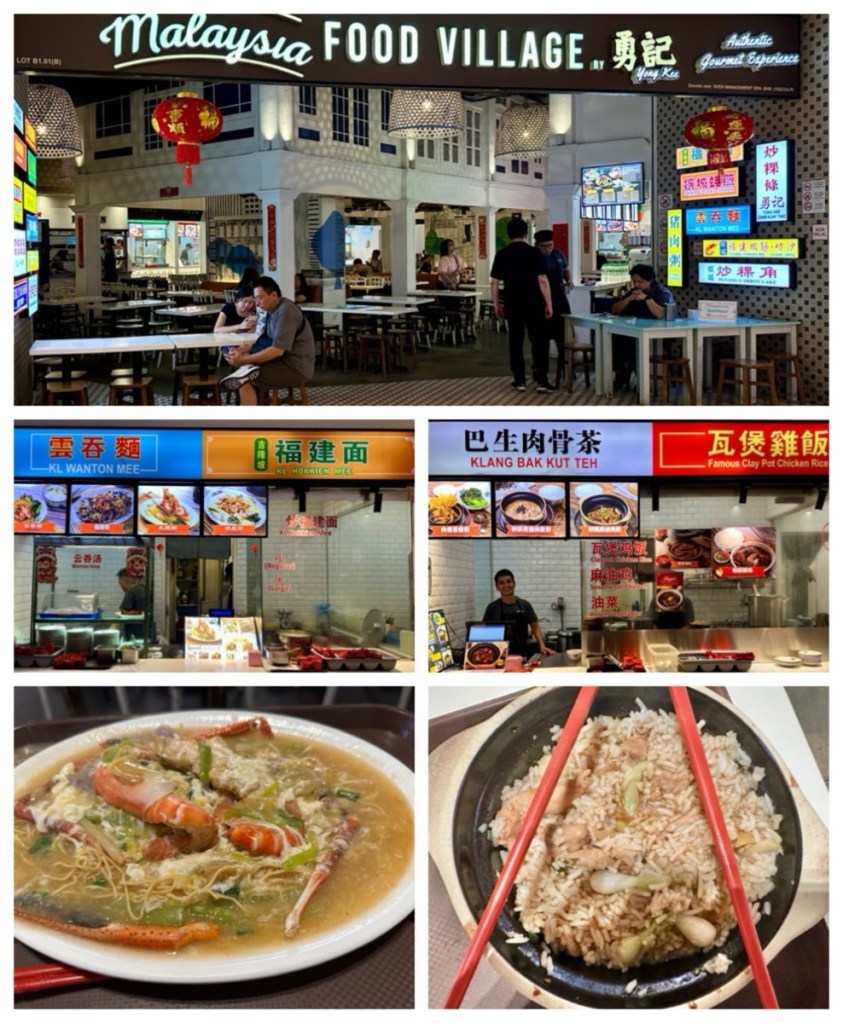
Our new friend Carol (see our blogs on Luang Prabang and Hanoi) recommended the Malaysia Food Village in the Four Seasons Hotel so in the evening we wandered over to have a look. While we were checking it out, a very nice KL man chatted with us and was extolling the virtues of the food from the various stalls. We asked about a picture of a dessert and he told us that it is a local specialty, an Ice Kacang, and we had to try it. We mentioned that we hadn’t picked up Malaysian cash yet so we would try it later in our stay. He wouldn’t have any of that and immediately went and bought us one to share (we actually had to stop him from buying two). What a lovely gesture – such a welcoming people. He and his wife told us how they have travelled to Canada including Banff, Jasper and Lake Louise.
Day 1: We started our first full day in KL with the Intercon’s amazing breakfast. Again, it is above and beyond all of the other amazing hotel breakfasts that we have had on this trip (rivalled only by the Voco in Bangkok).
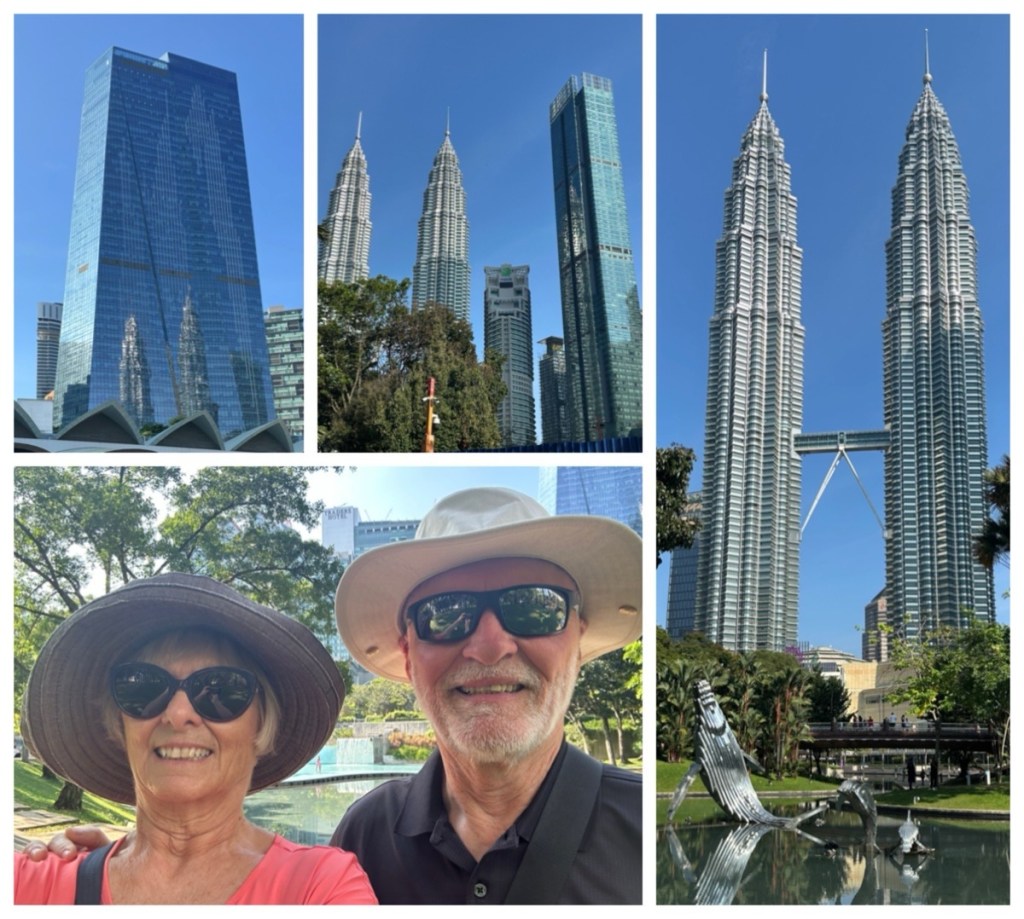
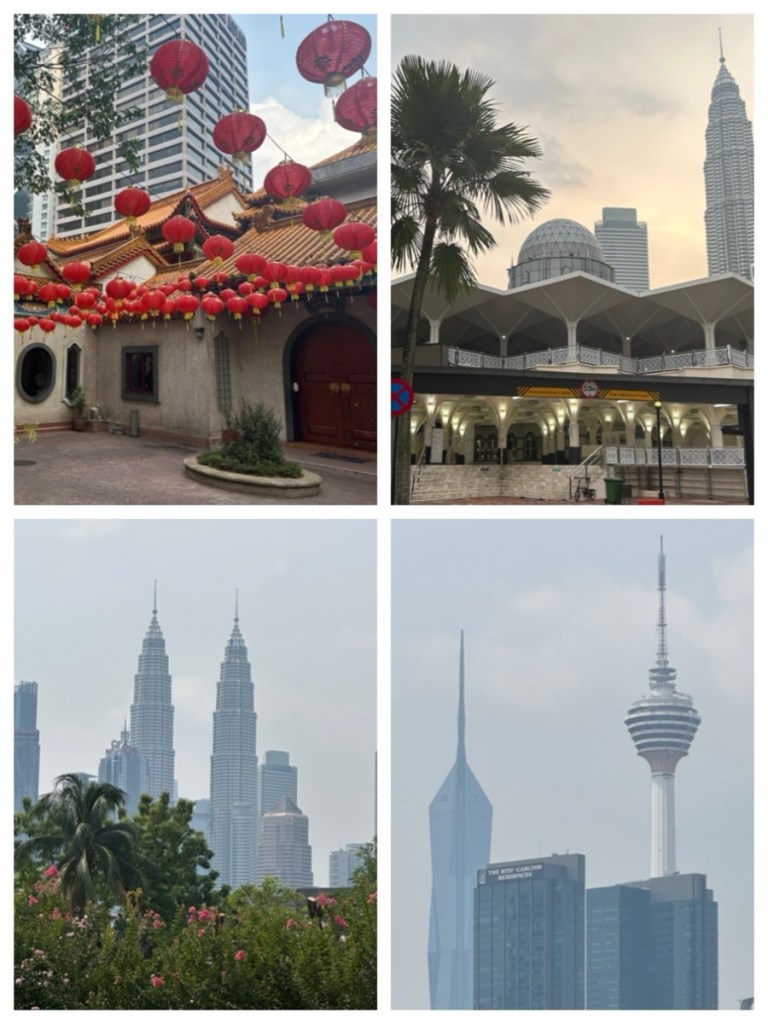
Harvey and I went for a long morning walk in the KL city centre area. The architecture is mind-boggling and the KLCC park is an oasis amidst the grand buildings.
As we are winding down from this long trip and it is extremely hot and humid in Malaysia, we took the afternoon to relax in our great hotel!
For dinner, we returned to the Malaysia Food Village where Harvey ordered the Sang Har Mee (freshwater prawn noodles in broth) and I had the Ginger Chicken Rice Clay Pot. Both dishes were quite enjoyable. And I must add as an example of the cost of meals in Malaysia, the total came to 50 Malaysian Ringets or $17.50 Canadian.
Day 2: We were ready to venture a bit further and grabbed a Grab (Malaysia’s version of Uber) to take us to the Perdana Botanical Garden. This lush verdant garden stretches over 226 acres in the heart of the city. The garden was initially established in 1888 and has expanded to its present size and stature over the years.
The Garden contains many specific areas as well as undeveloped green areas. We walked through the Orchid and Hibiscus Gardens as well as past the Sunken Garden and waterfalls and around Perdana Lake. We loved the many species of flowers and other plants and the beautiful scenery and smells.
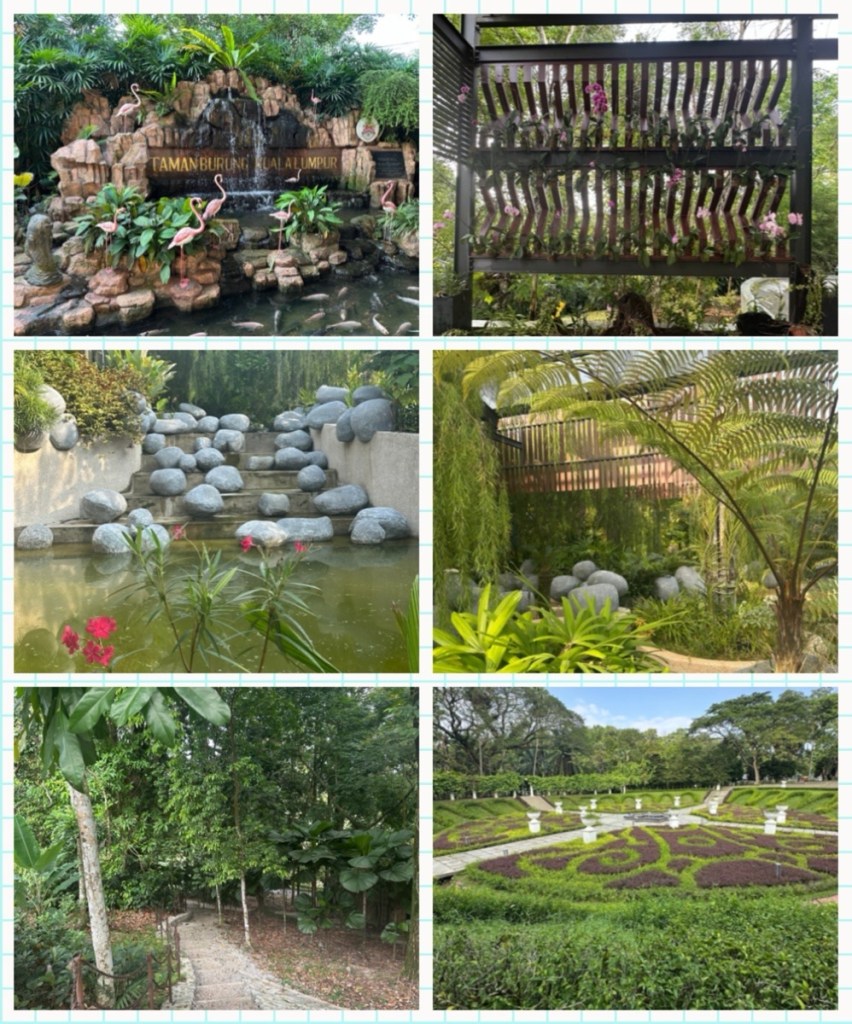
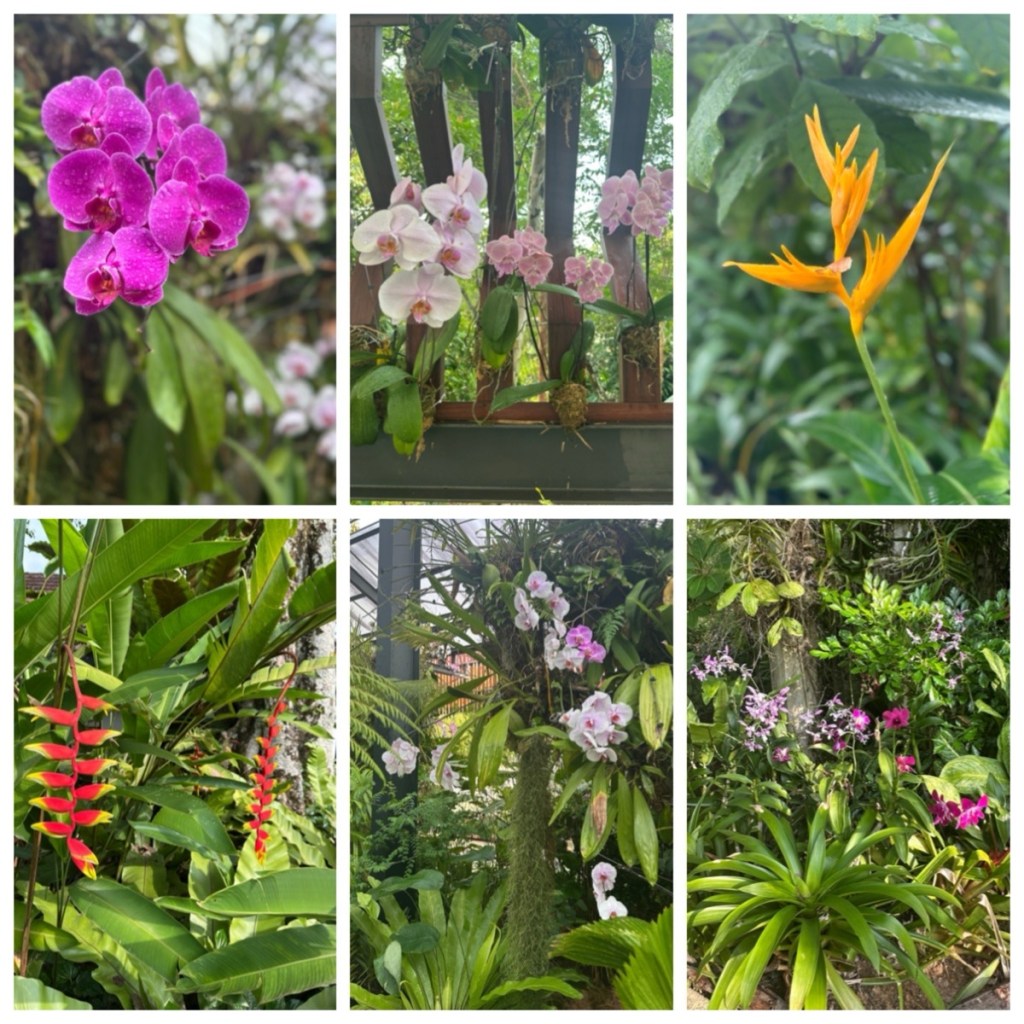
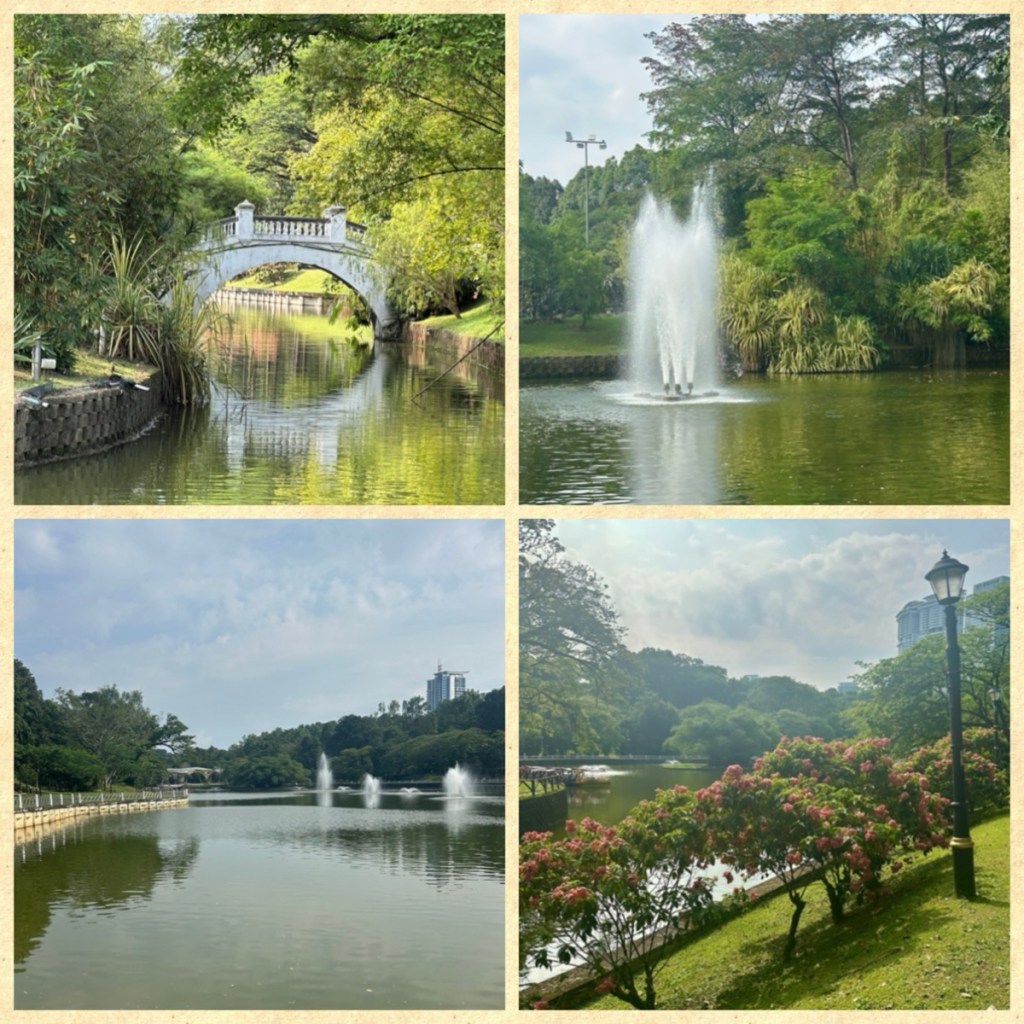
There are many other areas in the Garden that we didn’t visit as it was getting too hot to wander any longer. These include the Butterfly, Bird and Deer Parks which we read are also great to see.
From the park we walked over to the KL Sentral Station where we stopped for a much needed rest and coffee.
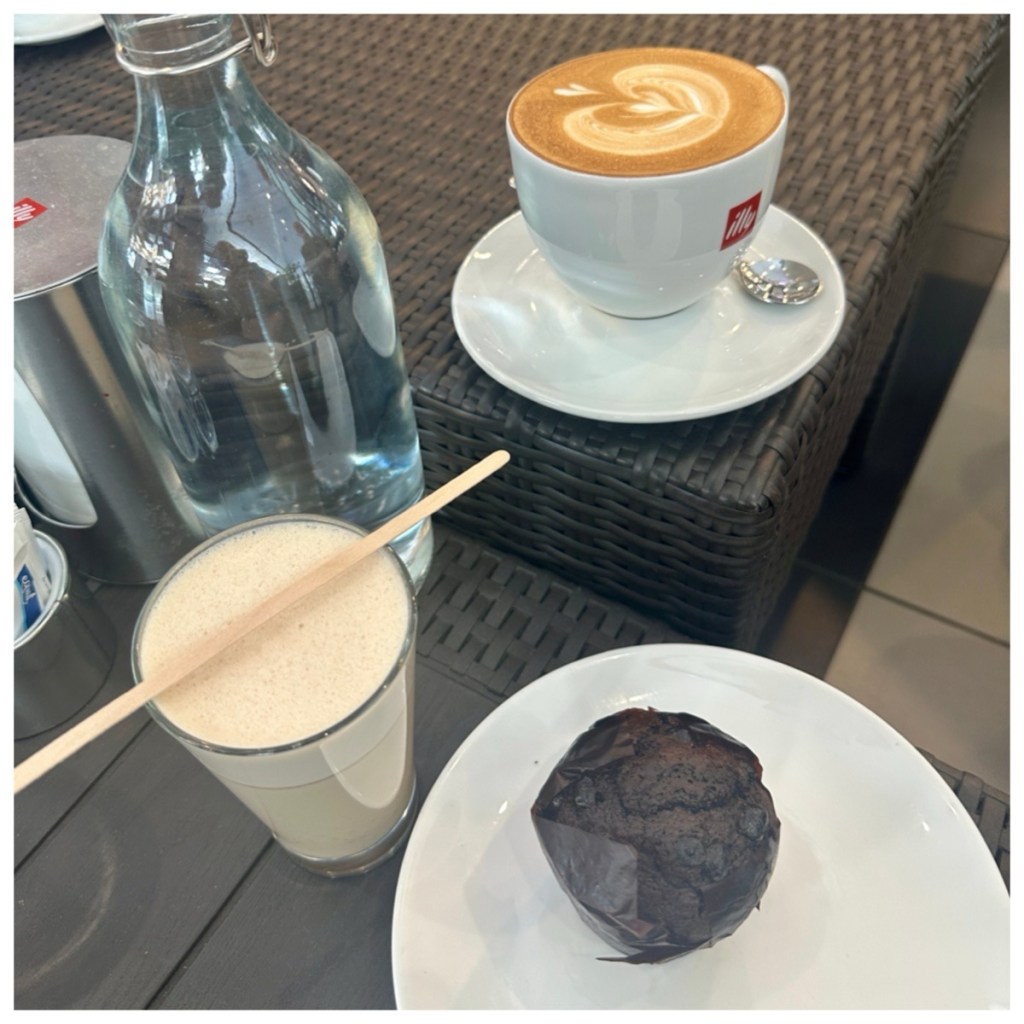
Another relaxing afternoon and a light dinner. This heat wears you down!!
Day 3: We were off to see another part of Malaysia. With Cousin Ron in tow, we took off in a Go My Transport van heading to Cameron Highlands. This area sits in the western area of Pahang state in a mountainous range at ~1800 metres above sea level.
English surveyor Sir William Cameron and his companion Kulop Riau are credited with the discovery of Cameron Highlands under a commission by the colonial government. While forging a path through the vast Titiwangsa Range in 1885, they reached what he called “a magnificent and sublime plateau shut up in the mountains”. After that time, the area remained relatively undisturbed for 40 years until a hill station was established by British Administrator Sir George Maxwell. Development of the area soon followed as British and Malays settled in the area, encouraged by the fertile soil and weather conducive to agriculture. Today Cameron Highlands is Malaysia’s leading highland resort area and has a population of ~50,000 people.
We were headed to Tanah Rata, a distance of ~210 kilometres from KL. The journey was scheduled to take us about 3.5 hours. Stay tuned………
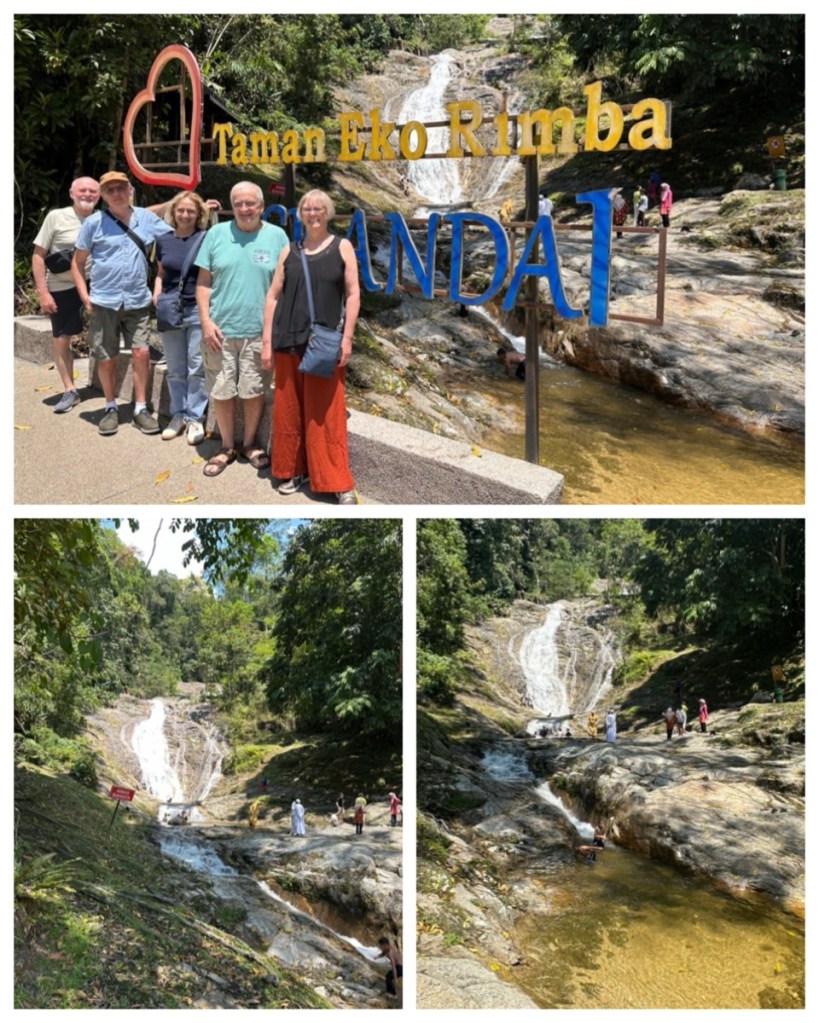
We made one short rest stop and then another brief visit at the Taman Eko Rimba Lata Iskandar Waterfall. Many families were enjoying the pools and sliding along the water.
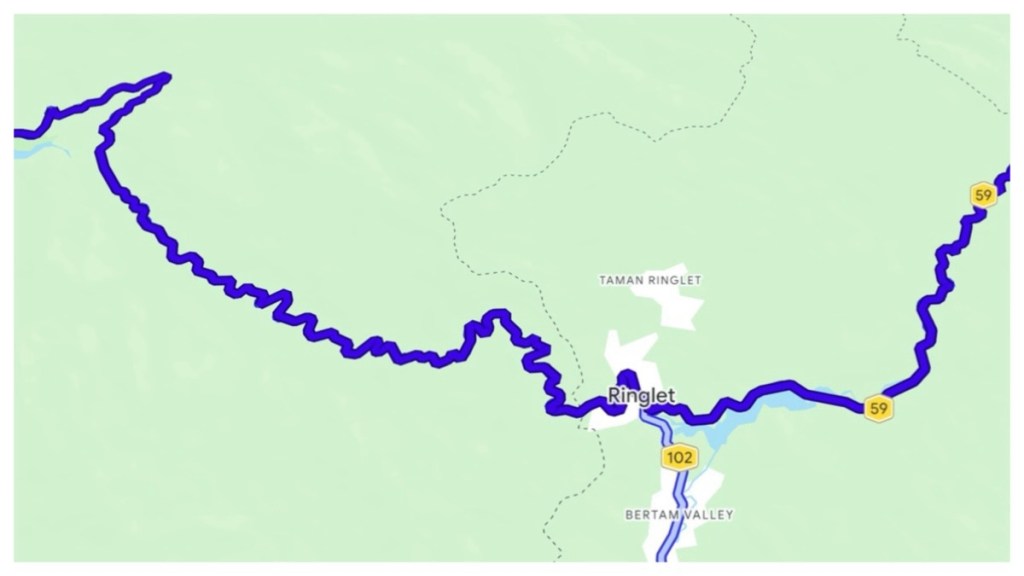
The road up to the highlands is extremely curvy. Here is a screenshot of the Google Map of just part of the journey.
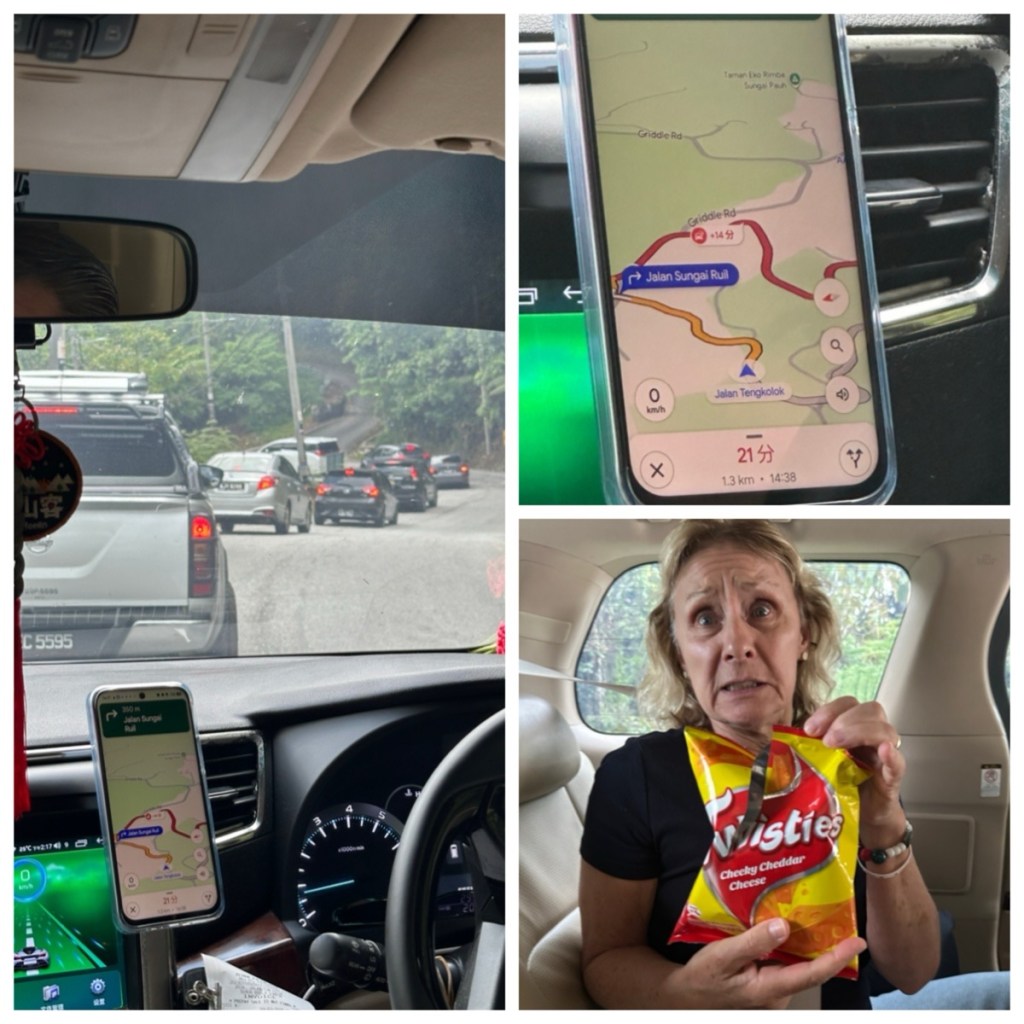
Our driver, Lai, was excellent and manoeuvred us along well – until we got near to the actual Cameron Highlands area. It was a school holiday week and it appeared that half the population of Malaysia had chosen to visit the highlands. There was bumper to bumper traffic which of course was then hampered by the occasional rear end collision and broken down car. What should have been a quick 20 minute drive extended to 1.5 hours and our total trip took over five hours. Lai was extremely patient and actually injected some humour into the situation! And Debbie saved the day with yummy cheesies!
At long last, we arrived at the Hotel de’la Ferns. This hotel is a bit older than the others on our trip but the rooms were the very large, extremely clean and had everything we needed.
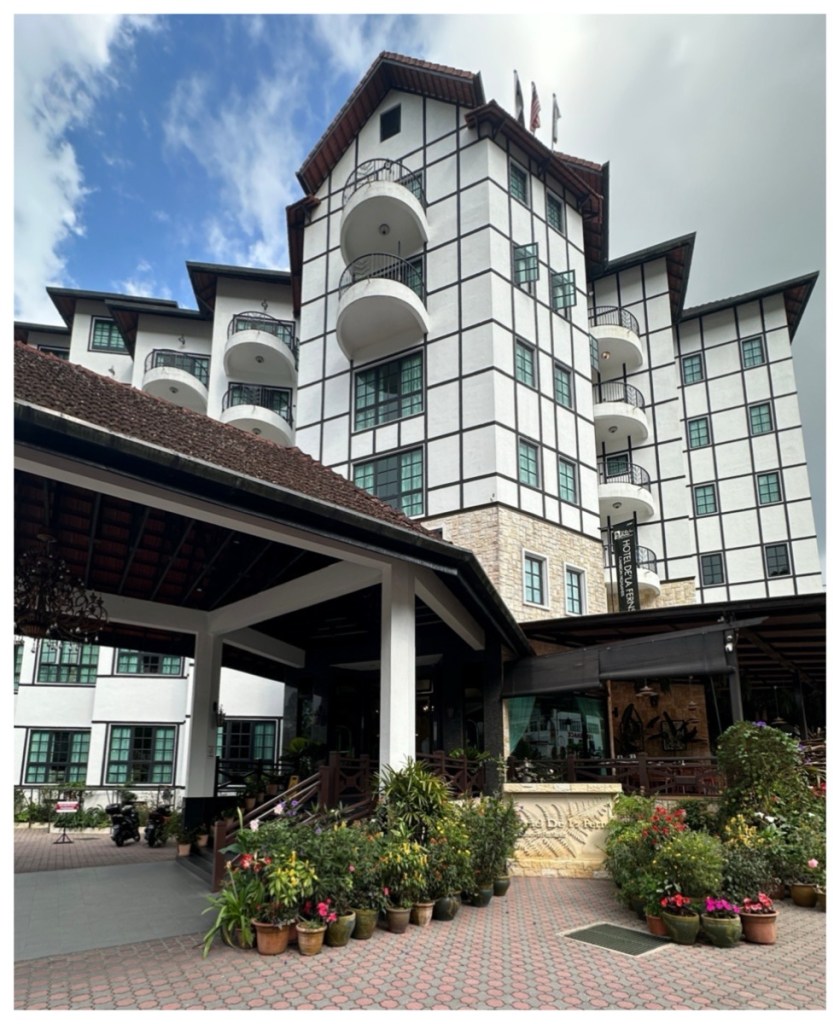
After settling in, we were thirsty but as the hotel was a Muslim establishment, no alcohol was served. We walked down the road a ways and found a lovely terrace on which to enjoy a refreshment.
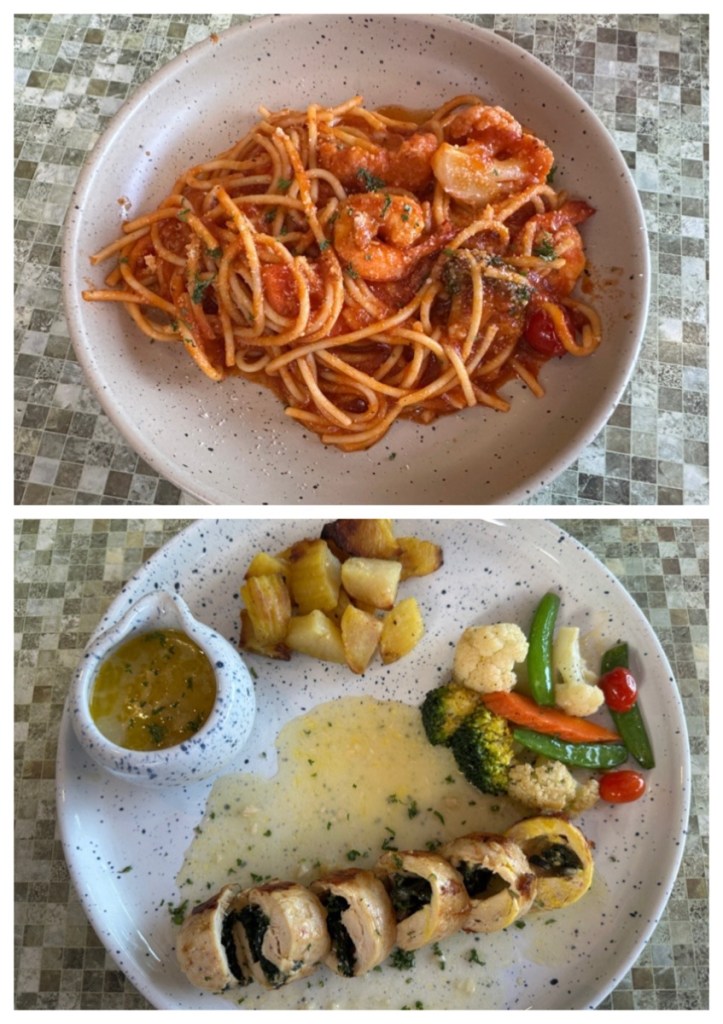
Dinner was at the Lemon Butter Restaurant in our hotel. The Spaghetti Prawn Marinara and Chicken Roulade were just what we needed after what had turned out to be a longer day than we expected.
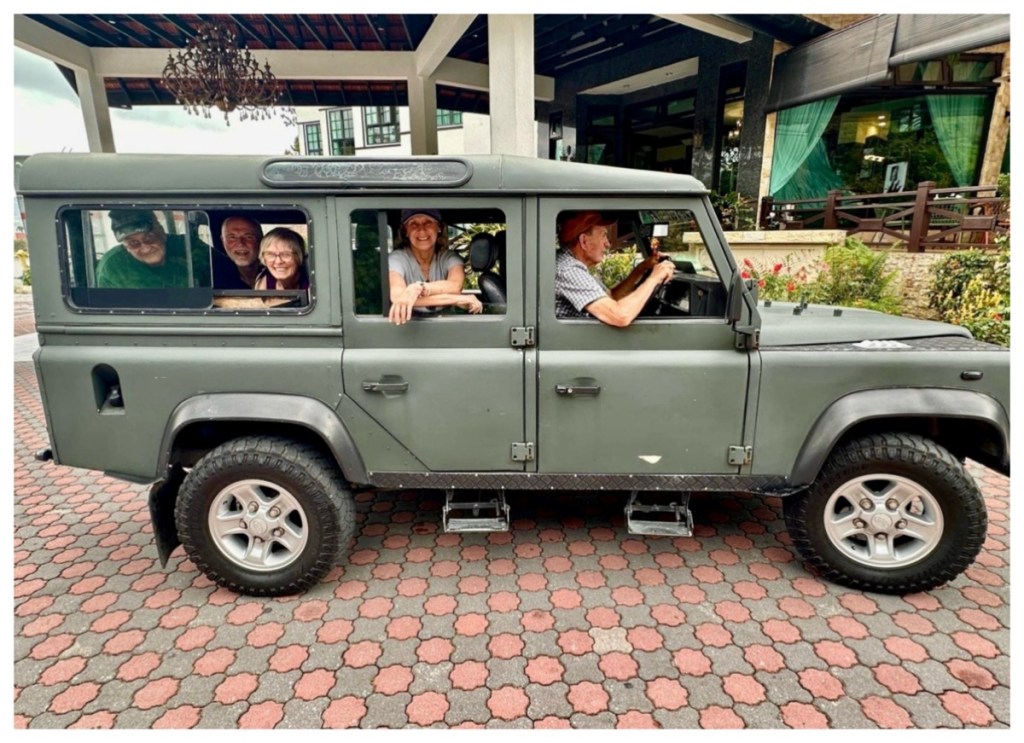
Day 4: We started the day with a half-day tour from Cameron Secrets. Our guide / driver Jasvin picked us up at 8 a.m. and off we went in the Land Rover.
Stop #1: Jasvin suggested the best way to beat the crowds would be to visit the tea plantation first.
The dominant crop in Cameron Highlands is tea. Vast plantations cover the hillsides for as far as the eye can see. The area is the largest tea-growing region in Malaysia. It was tea that spurred the development of the area as a hill station and is the major tourist attraction.
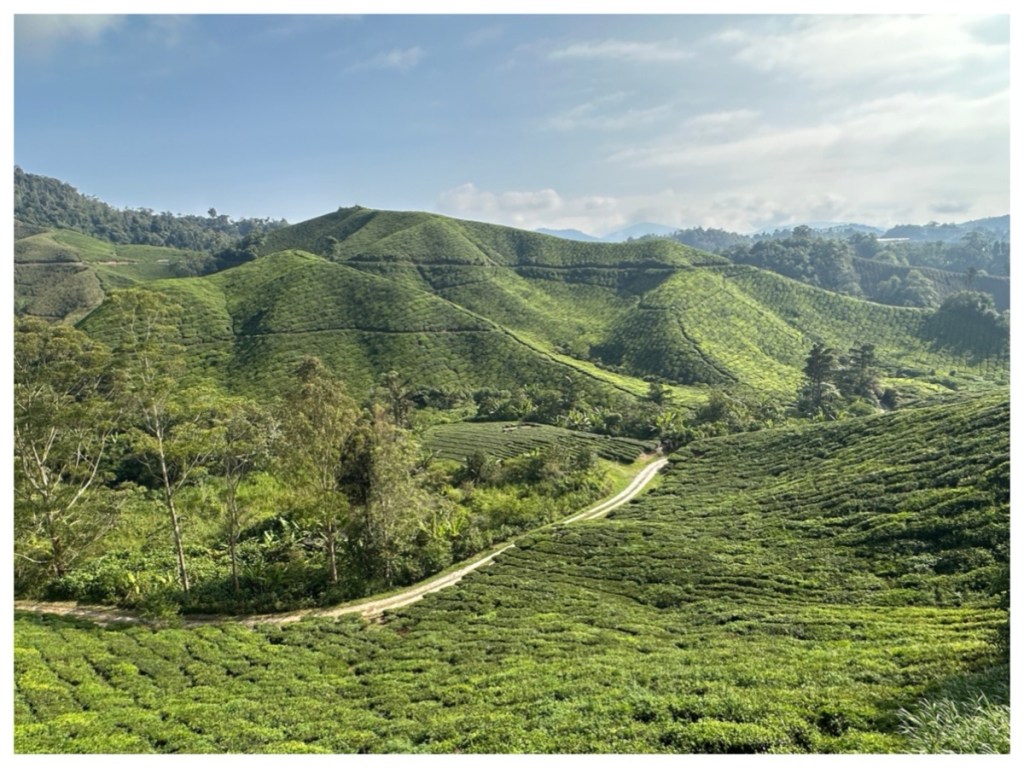
John Archibald ‘Archie’ Russell spent most of his childhood in Kuala Lumpur and after further education in England, he returned to Malaya where he built a railway station and started businesses in many areas including a rubber company and colliery. In 1929, he began planting tea at Cameron Highlands together with A.B. Milne, a veteran planter from Sri Lanka. They transformed jungle terrain into the first highlands tea garden in the country, now known as BOH Plantations. Despite turbulent times during World War II, the Malayan Emergency and the transformation to independence, BOH’s founding family remained committed to staying in Malaysia and the business grew and flourished.
Today, BOH is the predominant plantation owner in Cameron Highlands with estates covering a total 3238 hectares. It was their operation that we visited. The name BOH was derived from “Bohea”, the hills in Fujian Province also called Wuyi Hills, where tea was originally thought to have been discovered by the Emperor Shennong. Bohea was also the name of a premium tea grade in the early China tea trade. Boh means precious happiness in mandarin.
We stopped along the narrow two-way road to walk for a bit among the tea trees. Although the plants look like shrubs, Jasvin told us that they are actually trees and if allowed to grow, they become full- grown trees – he showed us an example of this. Jasvin was able to tell us interesting information about the plant growth, the harvesting techniques and the lifestyle of the workers.
I was surprised to learn that the same tree produces the different types of tea. It is during the processing of oxidation and blending that the unique flavours, aromas and colours are developed,
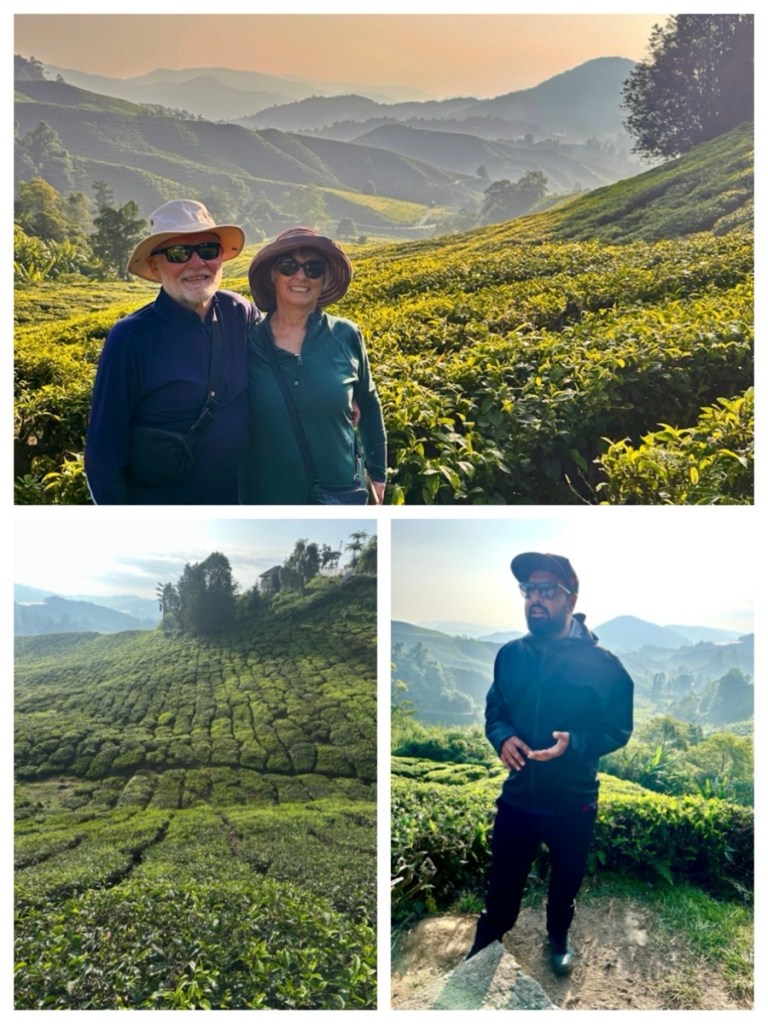
We passed through the area where the plantation workers live which includes dormitories, a small store, a basic health centre and a primary school.
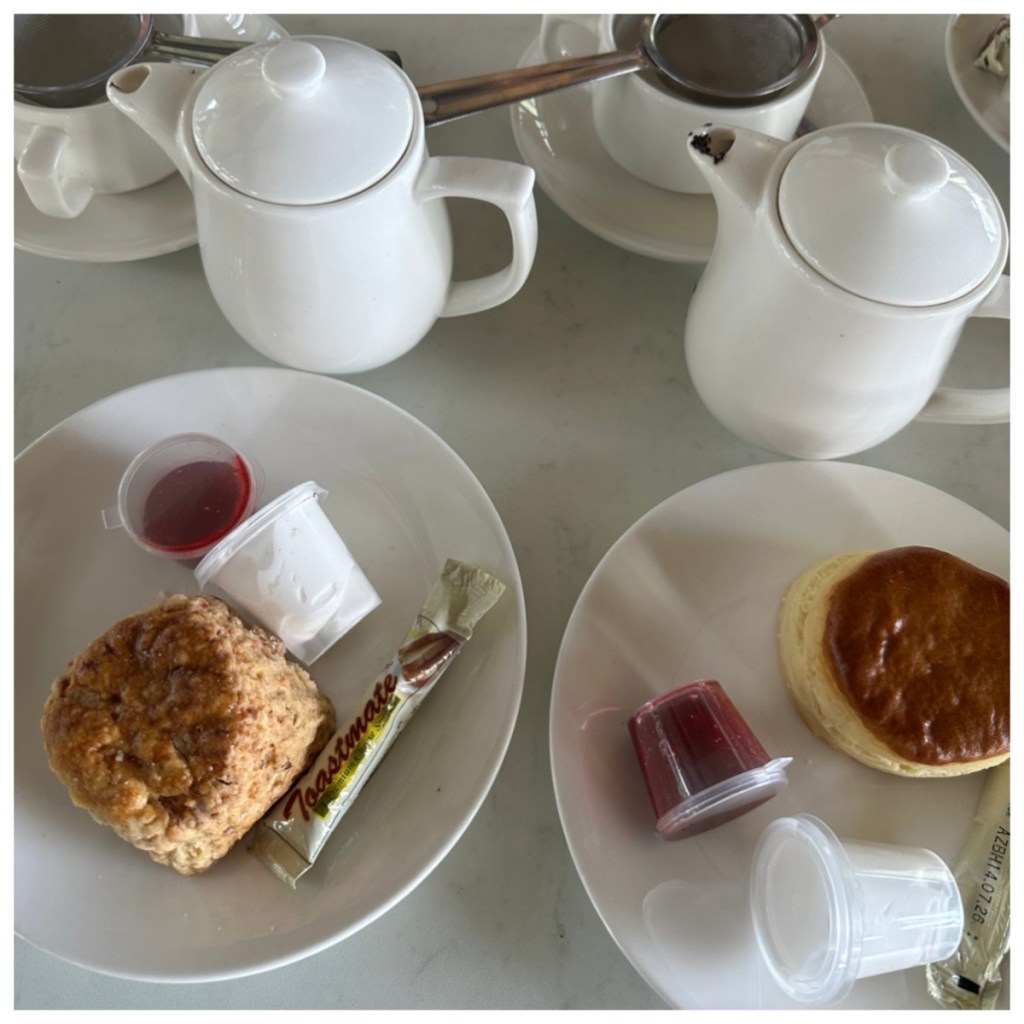
Arriving at the visitor centre, Jasvin advised that our first stop should be for tea and scones before all of the crowds arrived. This was good advice – the tea was excellent and the scones were delicious!
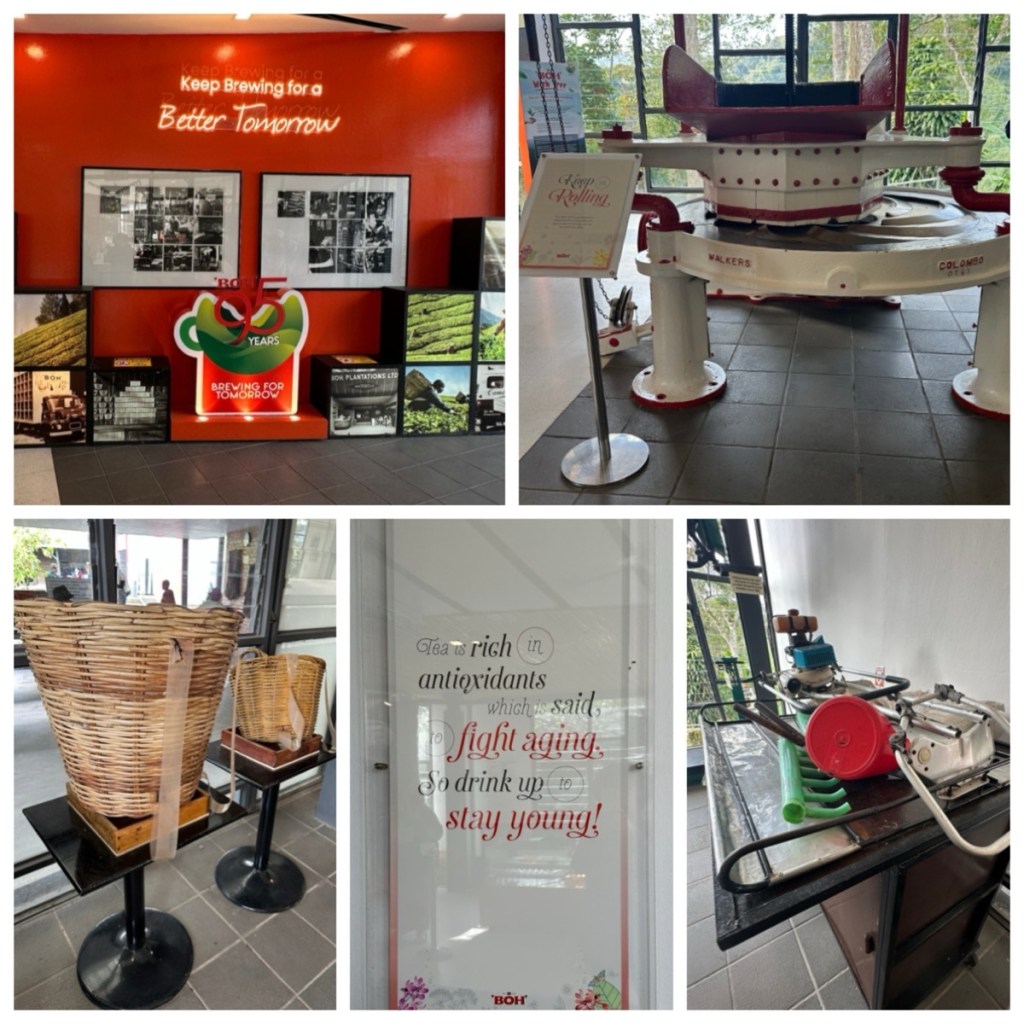
We spent some time in the visitor centre looking at the exhibits and of course, I had to purchase some tea! Unfortunately by this time, the masses of tourists had arrived and the line-up and wait for the factory tour was prohibitive for the time we had on our tour. I was quite disappointed to miss this but have since spent some time researching the production process. If you are interested, a good resource is the BOH website.
Stop #2: Jasvin then motored to our second stop, the The Coral Hill or Coral Mossy Forest. The Mossy Forest in Cameron Highlands is one of the few cloud forests in the world. In a cloud forest, a layer of mist can often be present leading to the feeling of being in a cloud and the high moisture level contributes to the growth of moss.
We first passed an area where various vegetables are being grown on the hillside.
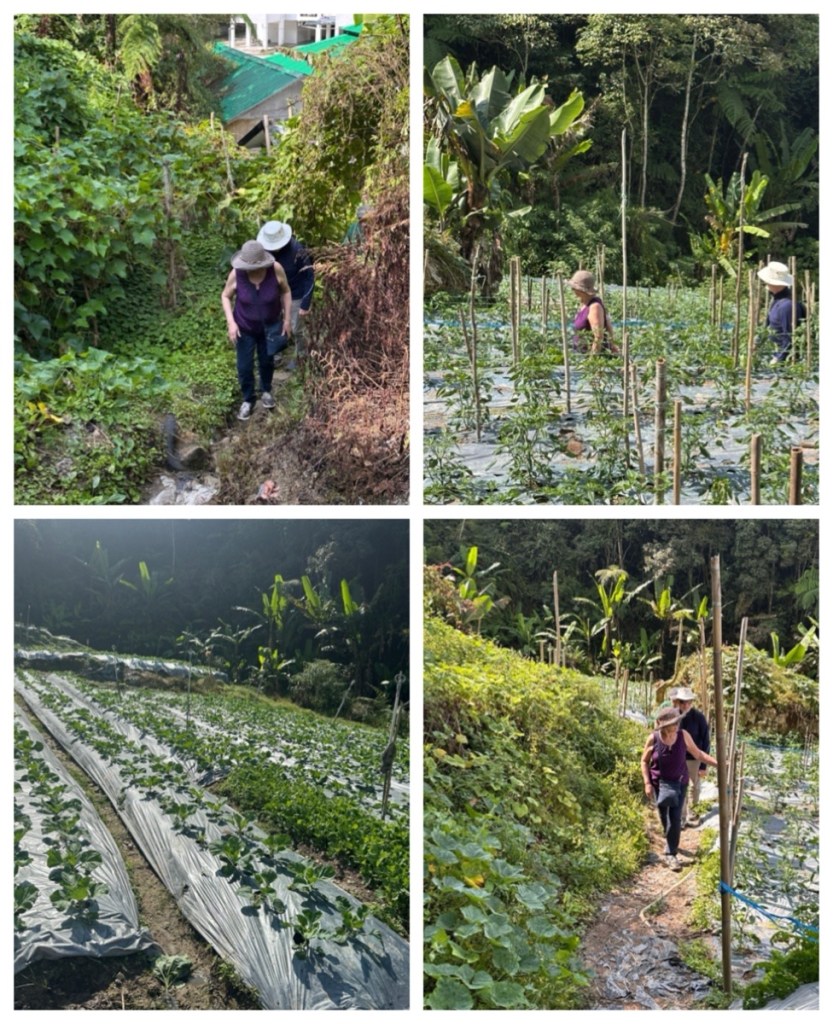
We then headed up on quite a rugged trail, especially for this non-hiker, that leads you through the jungle-like forest to a quartzite summit.
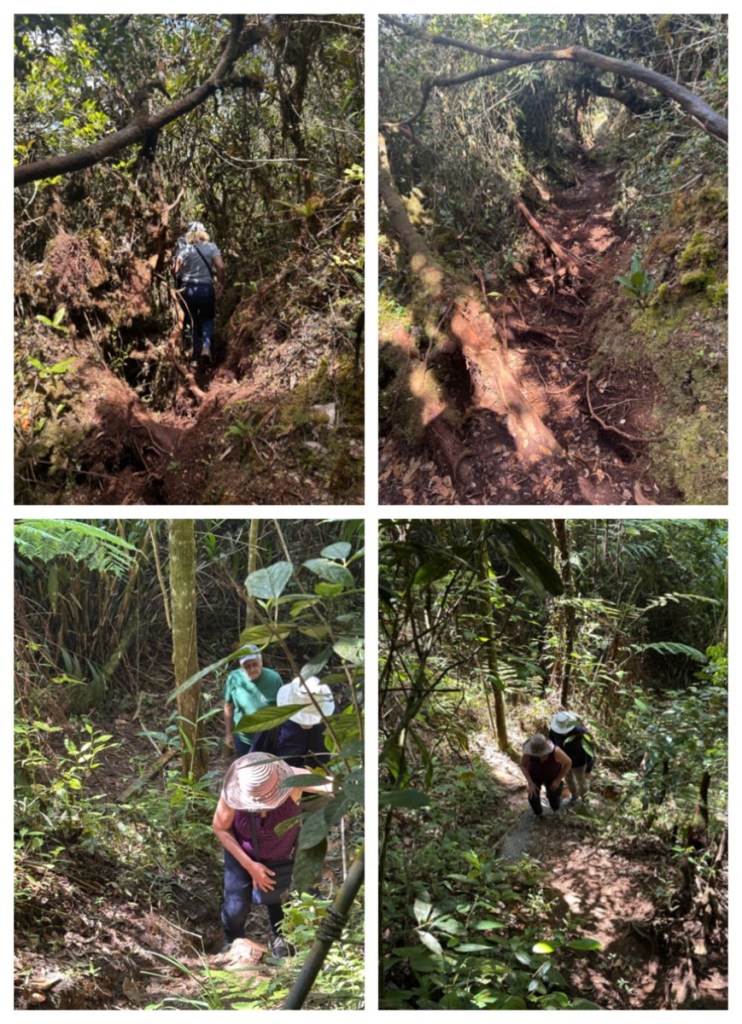
I was quite proud of us when we reached the summit.
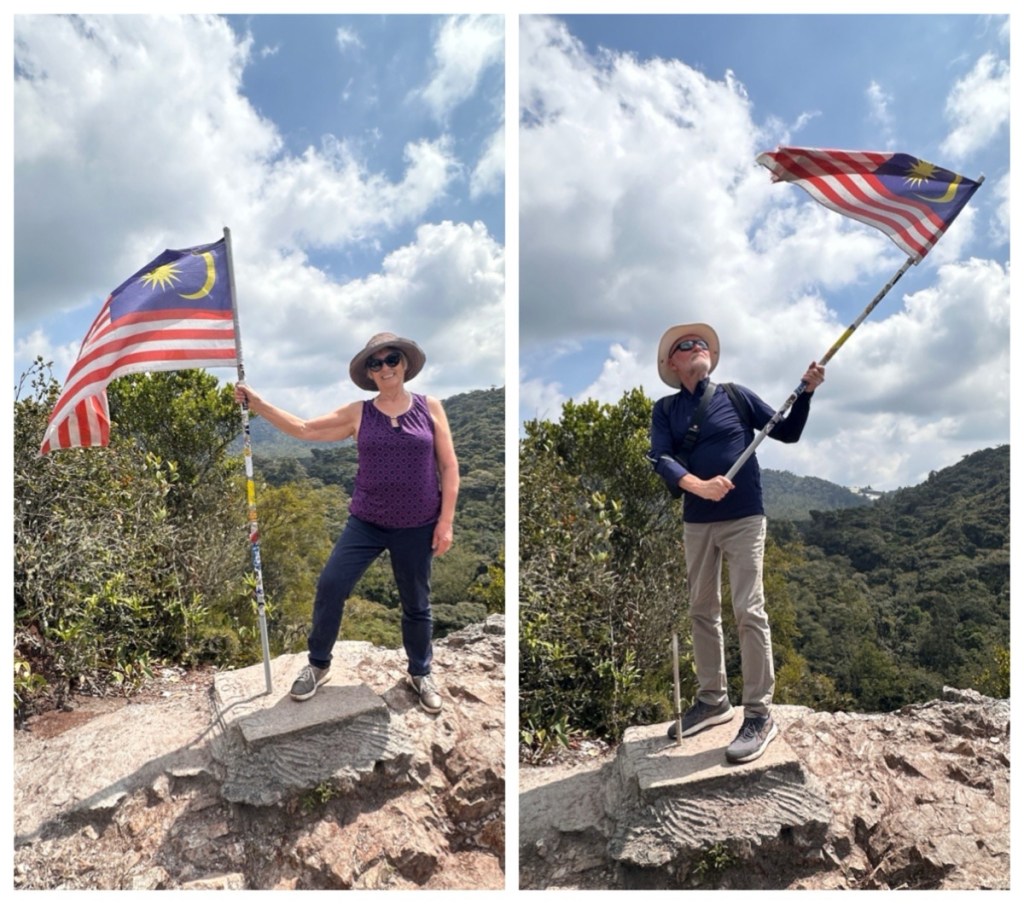
We took some time to enjoy the great views.
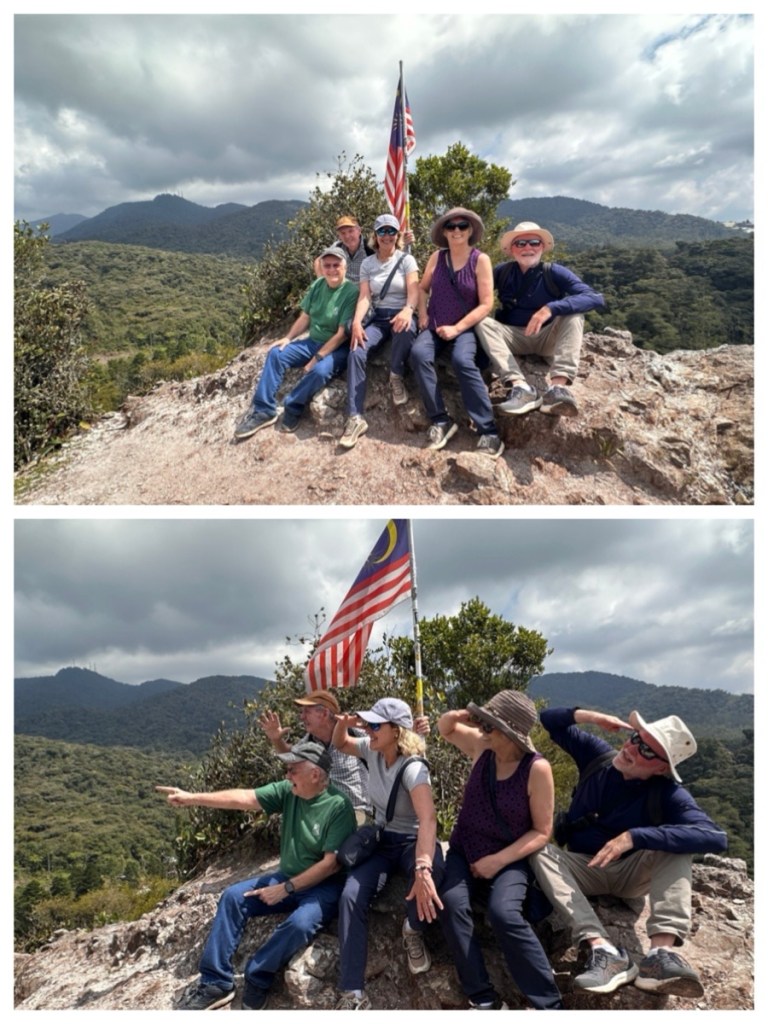
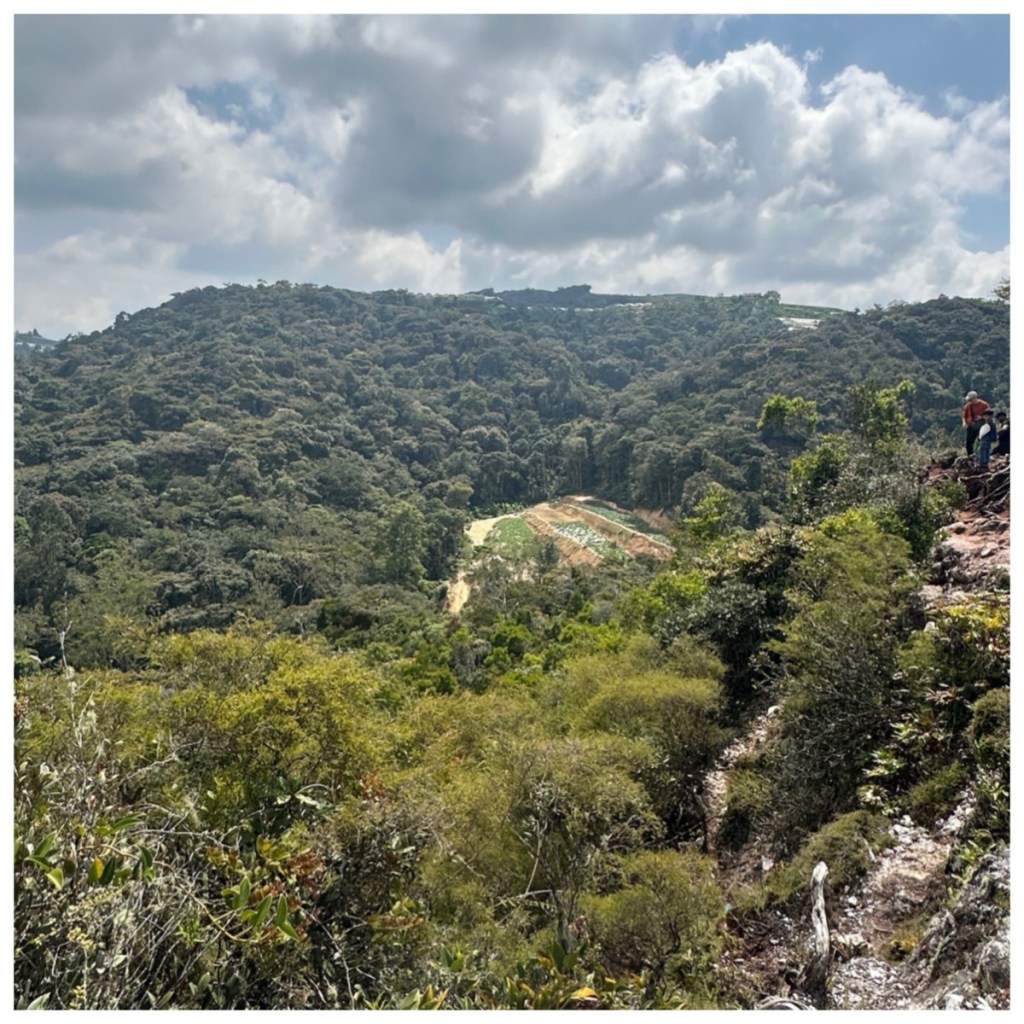
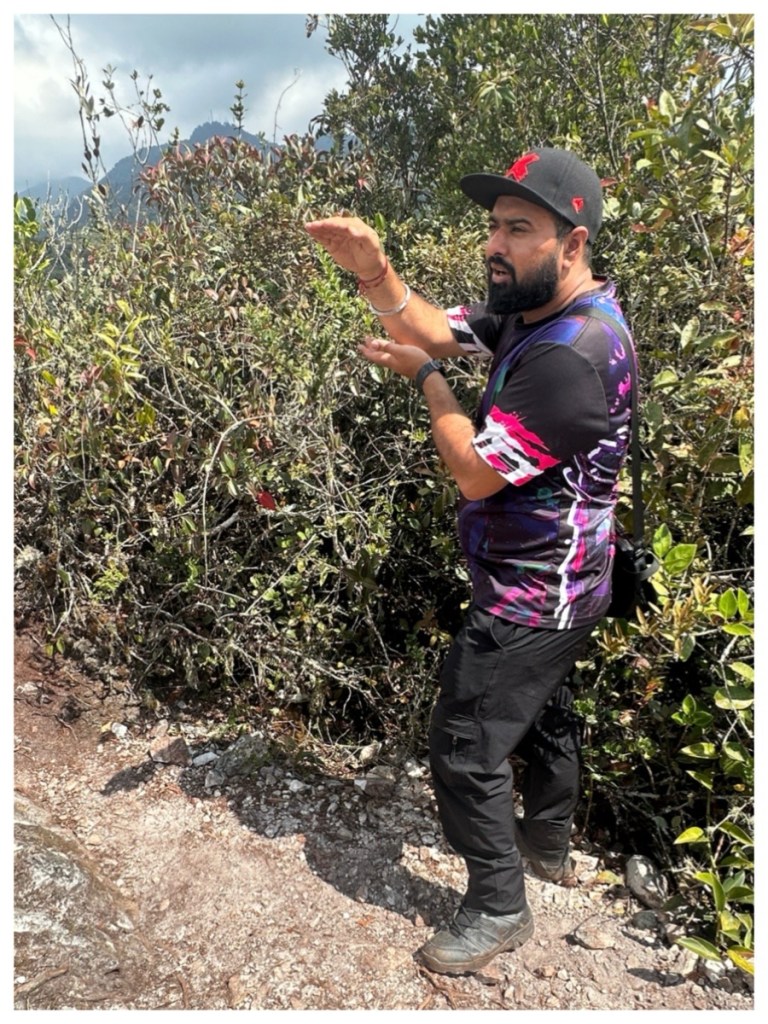
Along the way, Jasvin pointed out different types of vegetation. He also told us about the indigenous people who live deep in the hills. At one time, they allowed tours to visit their village but after the younger people were attracted by the things they learned from the tourists, the elder people disallowed the tours.
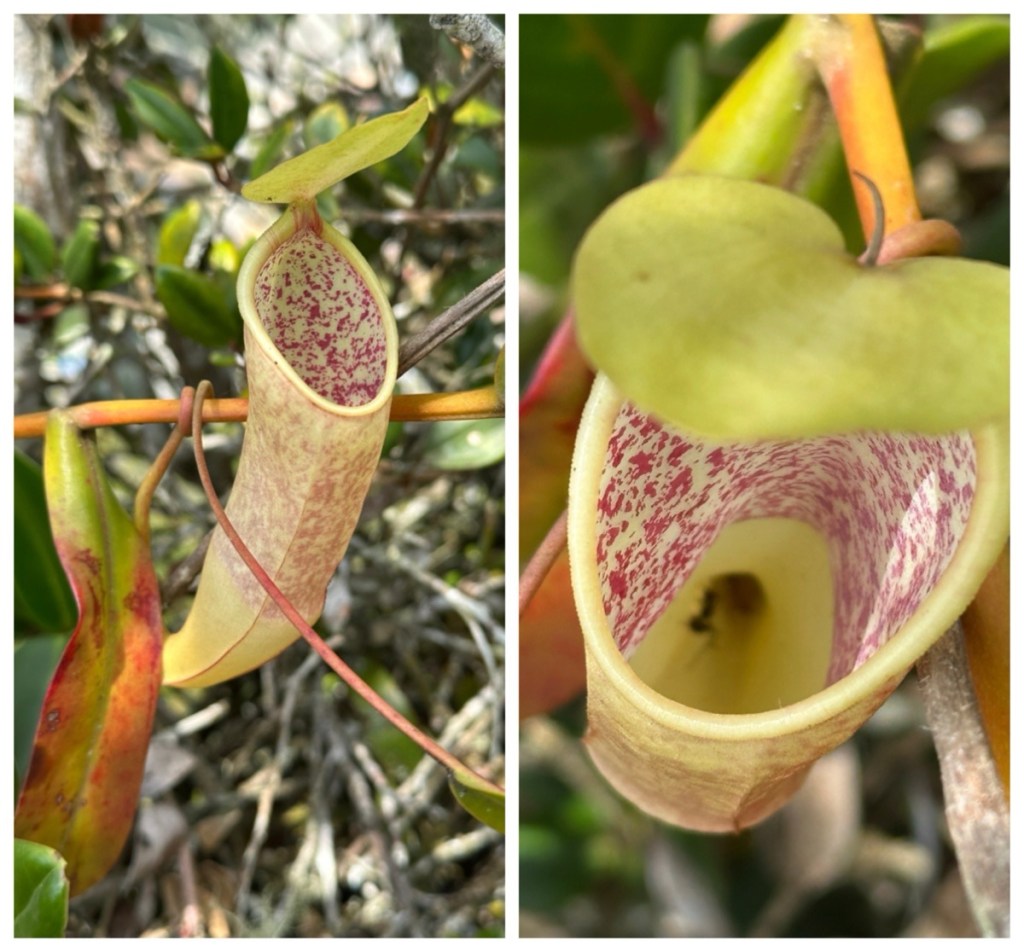
Jasvin pointed out a carnivorous plant, the Tropical Pitcher Plant. This plant belongs to the genus Nepenthes, of which 70% are tropical highland or mountain plants. They are generally beautiful plants that trap their prey in their pitcher-like blooms.
I think coming down was even more difficult so I was happy to arrive back at the bottom unscathed.
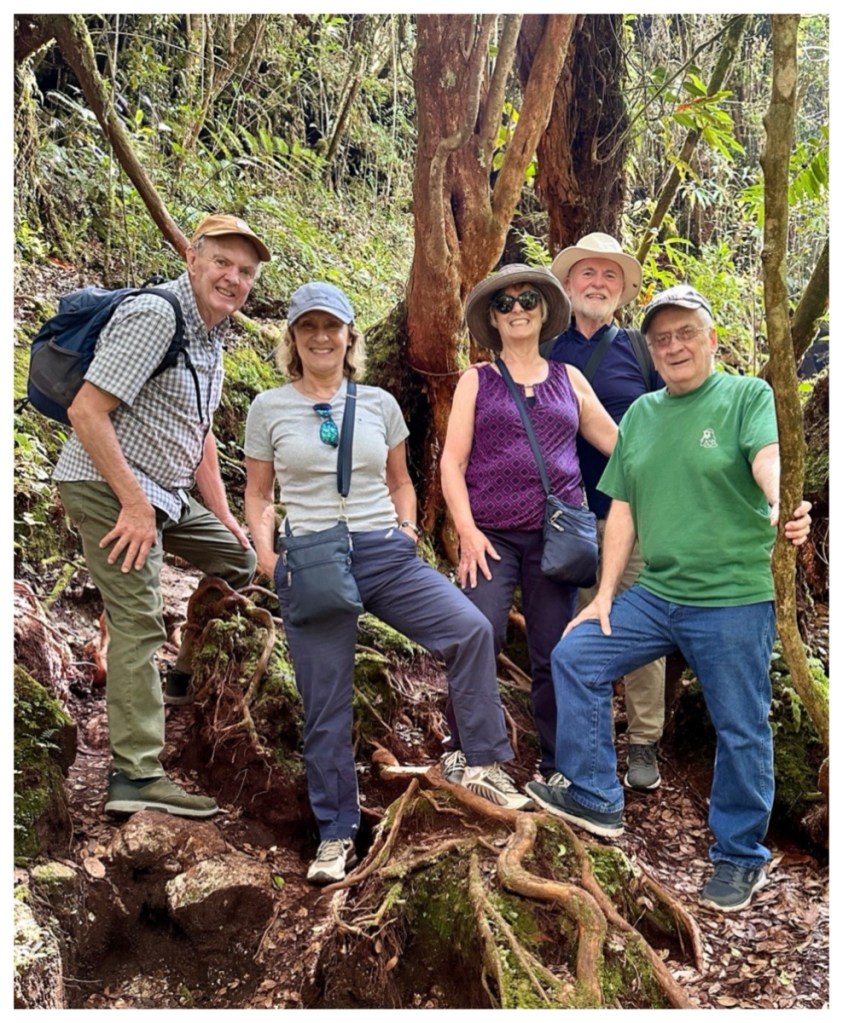

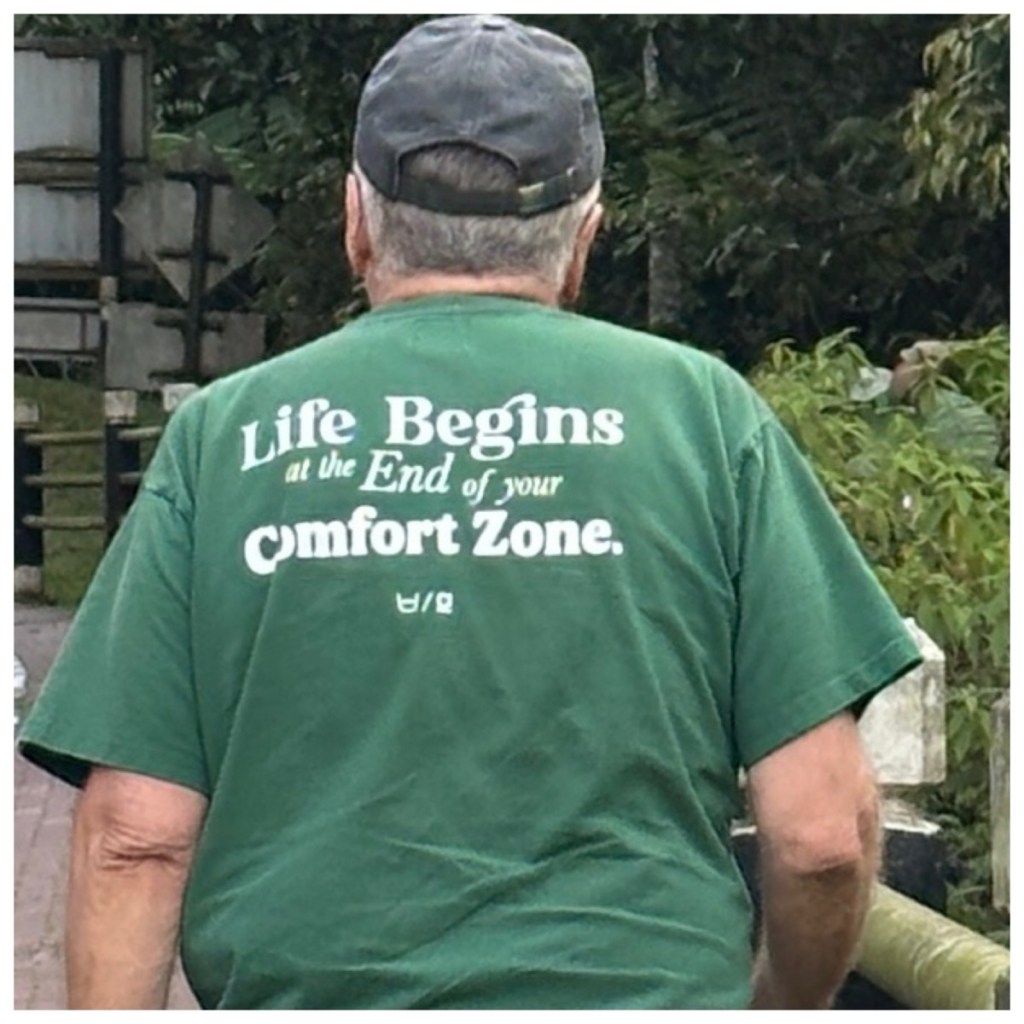
During this adventure, I kept my thoughts on the saying on the back of Ron’s T-shirt.
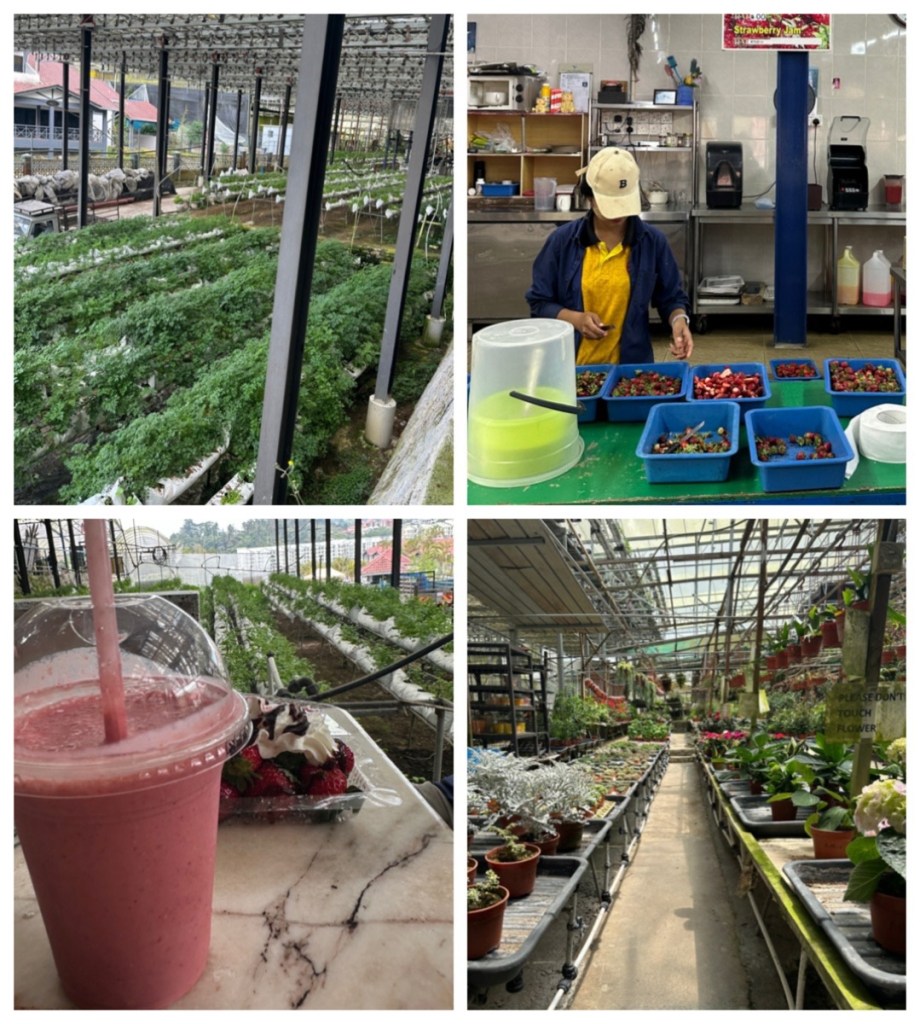
Stop #3: We had one final stop on our tour. In addition to tea plantations, Cameron Highlands is known for its strawberry farms. British colonialists in the early 20th century found that the climate and soil conditions were perfect for growing strawberries and the area has become Malaysia’s prime strawberry-growing hub.
We visited The Healthy Strawberry Farm. This farm has grown from a small family-run operation to a model of sustainable farming. As with most of the area’s strawberry production, the farm uses hydroponic methods in greenhouses to maintain the temperature at 20°C and the humidity at 70%.
We viewed the strawberries growing in the greenhouse, as well as several other plants. And then we sampled the product – first just the strawberries (absolutely delicious) followed by strawberries with whipped cream and chocolate and an amazing strawberry milkshake (think strawberry purée with a bit of cream).
We returned to the hotel after an excellent time with Jasvin and the Land Rover.
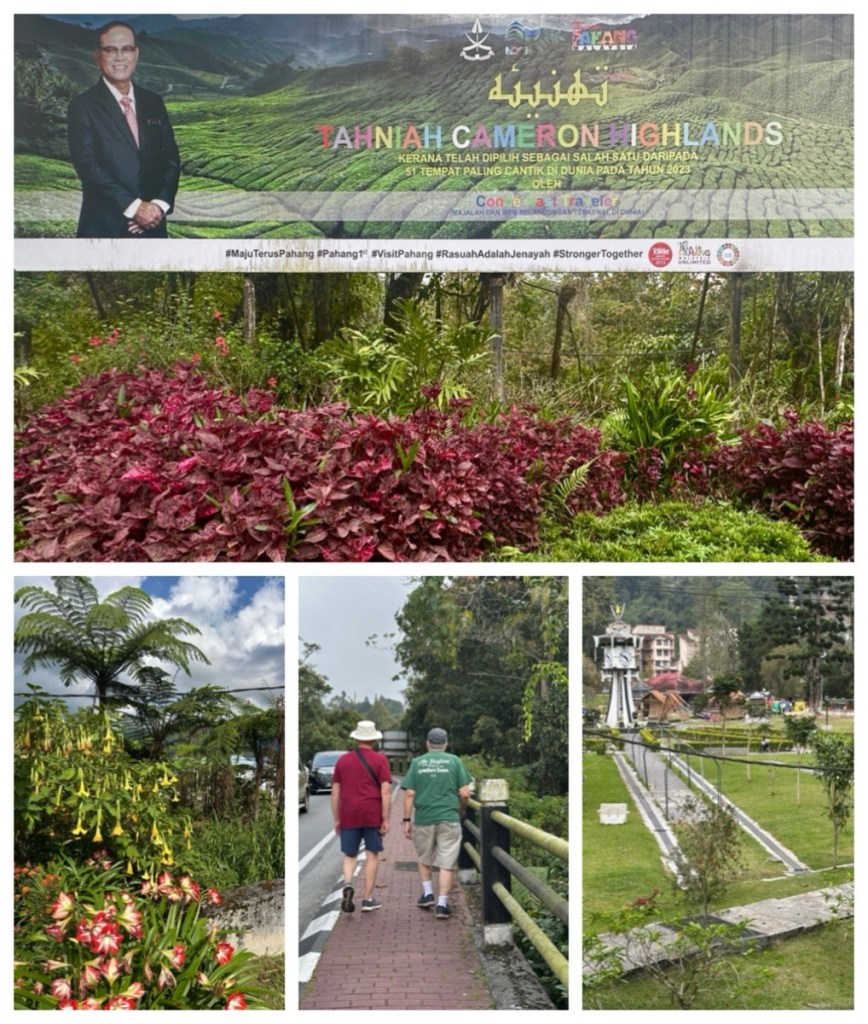
We had a relaxing afternoon with a walk into the town of Tanah Rata for a refreshment.
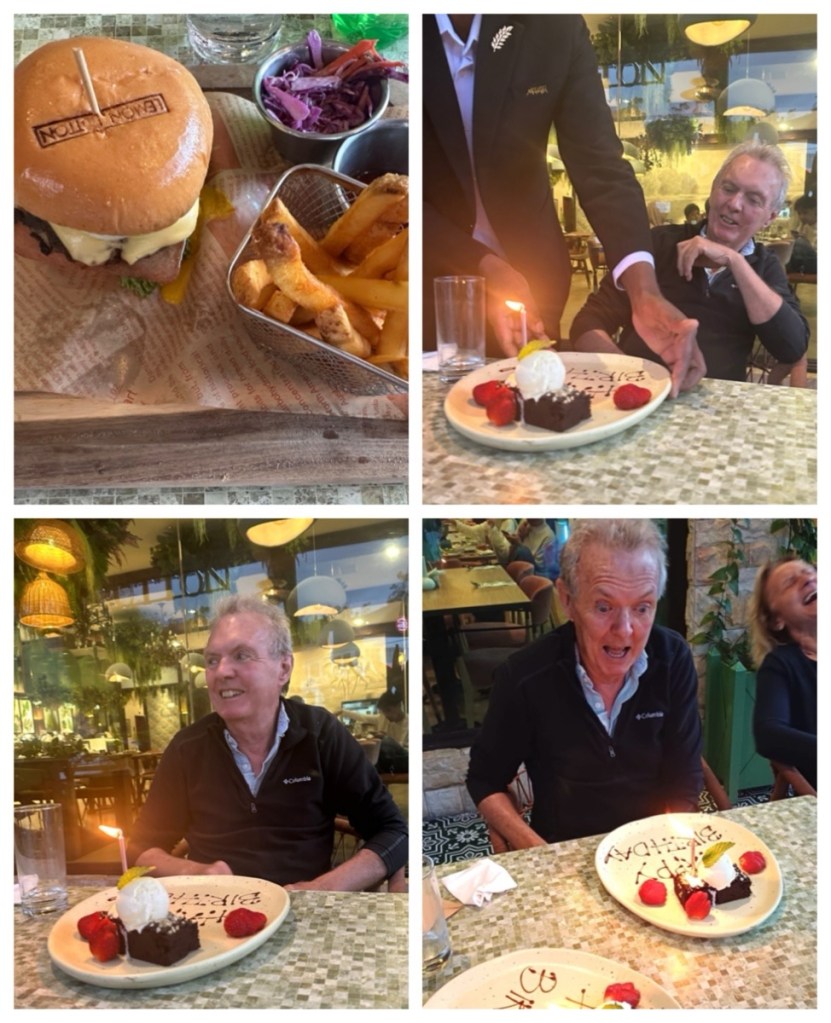
We once again had dinner at the Lemon Butter Restaurant in the hotel. It was Larry’s birthday which resulted in quite the hilarious production. We thought the Happy Birthday music played over the loud speaker would never end! If you know Larry, you know it was a bit much for him. 🤣🤣
A couple of interesting stories about Cameron Highlands:
- One of the biggest mysterious of Cameron Highlands is the disappearance of Jim Thompson. Jim Thompson was an American millionaire and was known as the ‘Thai Silk King’ for reviving interest in Thai Silk. The story goes that on Easter Sunday, 1967, Thompson, who was on holiday in Cameron Highlands, took a walk from his cottage in Tanah Rata and never came back. An extensive 11-day search operation involving nearly 500 people yielded no results of his whereabouts. It is still one of South East Asia’s oldest unsolved mysteries. There is a Jim Thompson museum in Bangkok.
- It is believed that Sir Ian Fleming based the character of James Bond off his close friend, Denis Emerson-Elliot, who was a MI6 spy. Elliot and his family lived in Cameron Highlands during the Malayan Emergency in 1948. Both Fleming and Elliot were recruited by MI6 and Elliott’s ID number was 007.
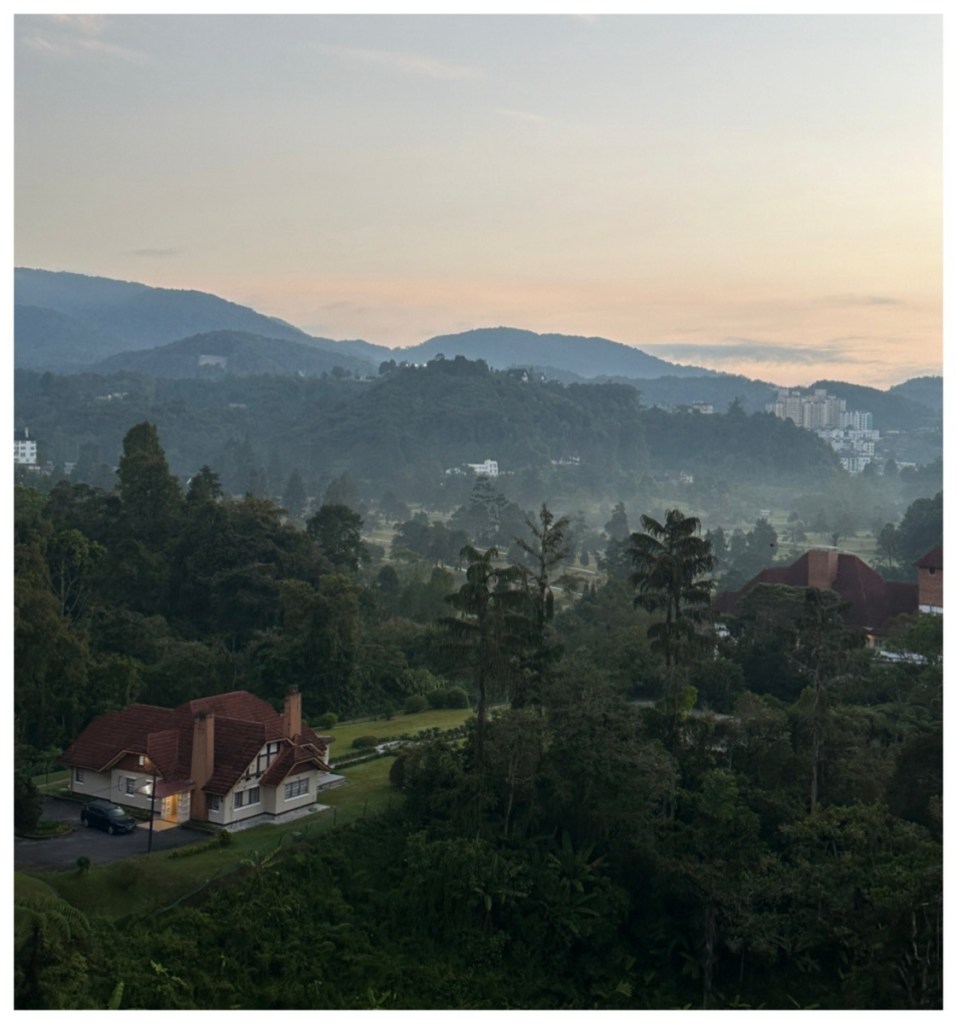
Day 5: We enjoyed our short visit to Cameron Highlands and I love this picture taken from our hotel room.
Our driver picked us up at 9 a.m. to beat the traffic for our return journey to Kuala Lumpur. Once again on the very curvy road, this driver drove quite speedily (luckily, he seemed very skilled) and by the time we reached the main highway, those of us in the back of the van were feeling a bit like we had been on Mr. Toad’s Wild Ride!
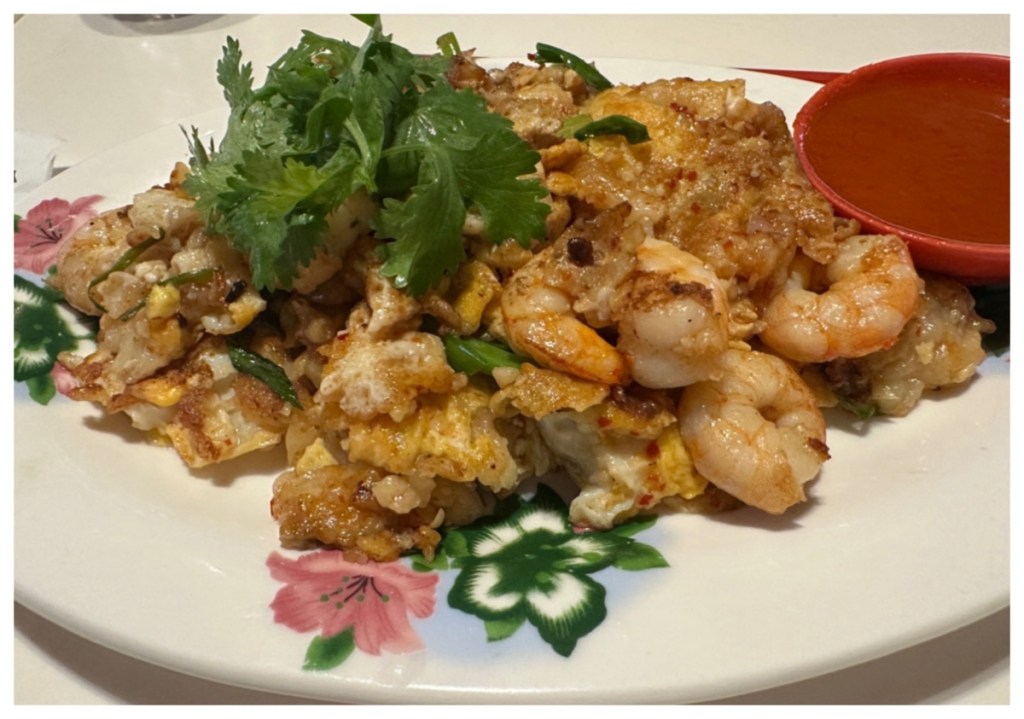
We returned to the Intercontinental Hotel (it’s starting to feel like coming home) for another three nights. Dinner was a prawn omelette once again at the Malaysia Food Village.
Day 6: We started our day fairly early to beat the heat and to be ready for a planned lunch date.
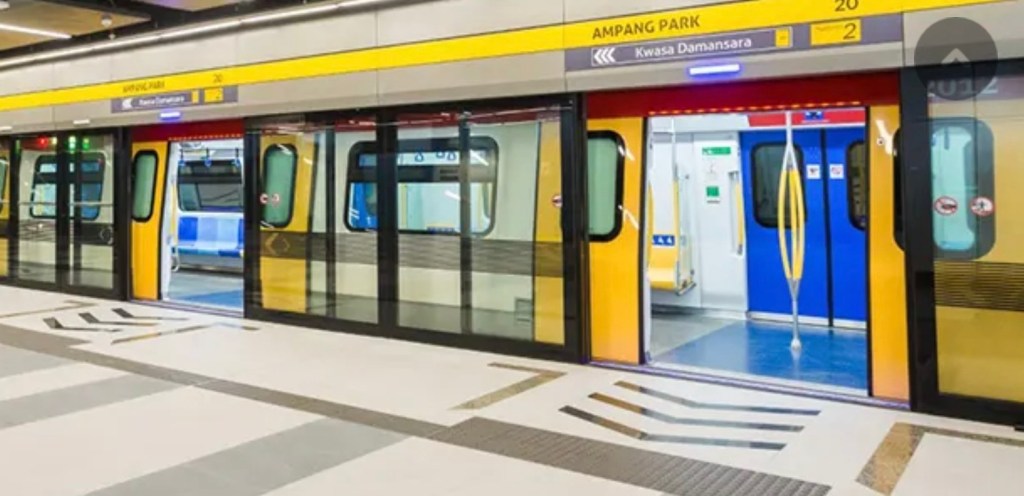
Stop #1: We took a ride on the MRT metro line from the Ampang Park station. This is KL’s deepest underground station. It is 39 metres deep and stretches 300 metres in length. The MRT Putrajaya Line is shiny and new, opening in 2023. The stations and trains that we encountered were fastidiously clean and service was fast and reliable – not to mention, very low cost.
Stop #2: The National Art Gallery of Malaysia originated in 1958 and moved to its current location in 1998 with an official opening in September 2000. The multiple galleries surround a circular ramp resulting in a light and airy space. The galleries host both permanent and temporary exhibitions.
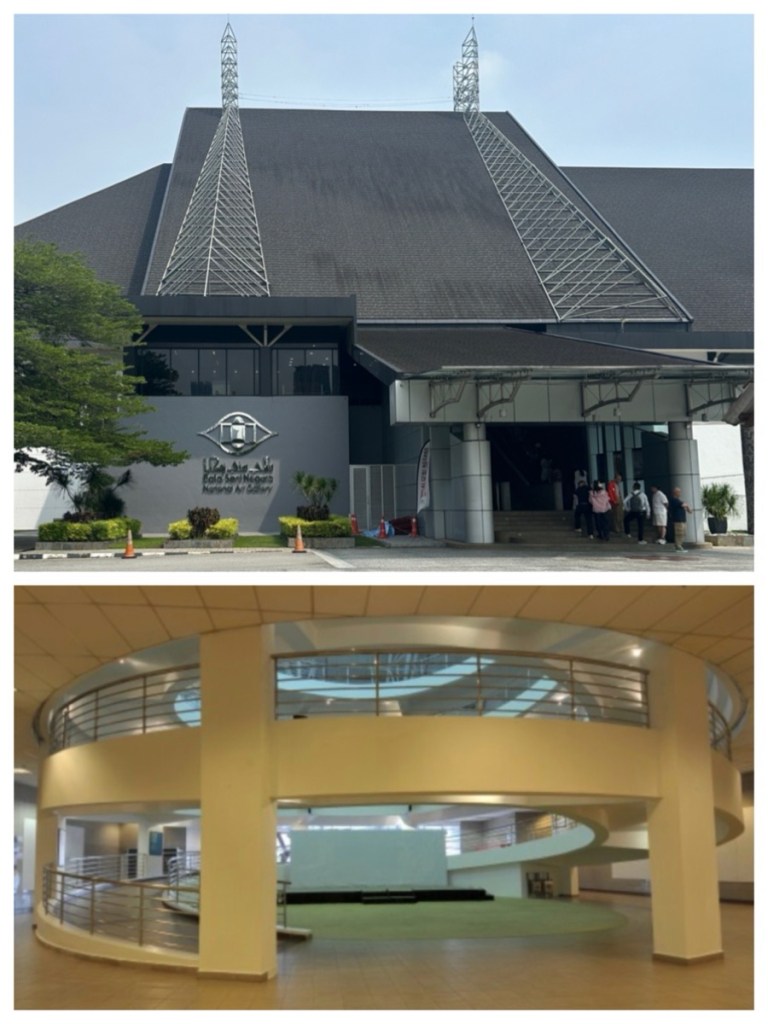
The gallery is modern with multiple digital and interactive displays. We thoroughly enjoyed our visit to what, in our limited experience, is a world-class gallery.
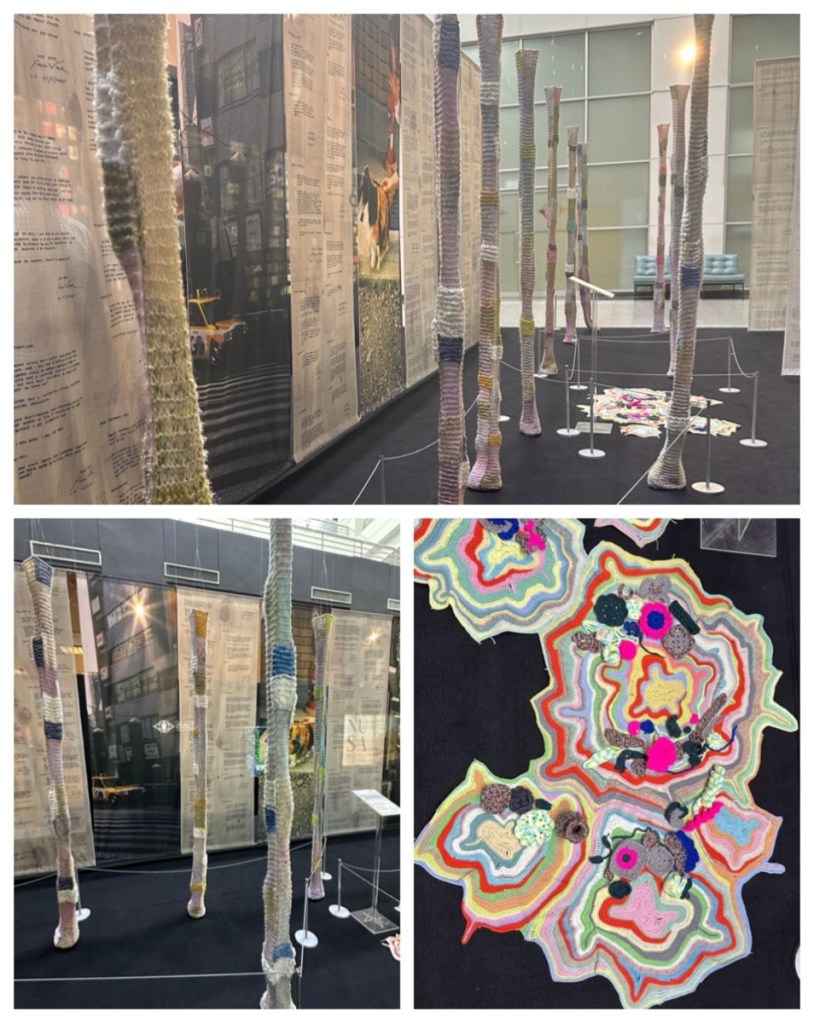
At the entrance to the gallery is a temporary installation titled Balai Di Balai by textile artist Xeem Noor. The installation depicts an apartment lived in by the artist. It is built using knitted pillars, printed fabric walls and a free-form crochet rug. As I knit and crochet, I found this display to be most interesting!
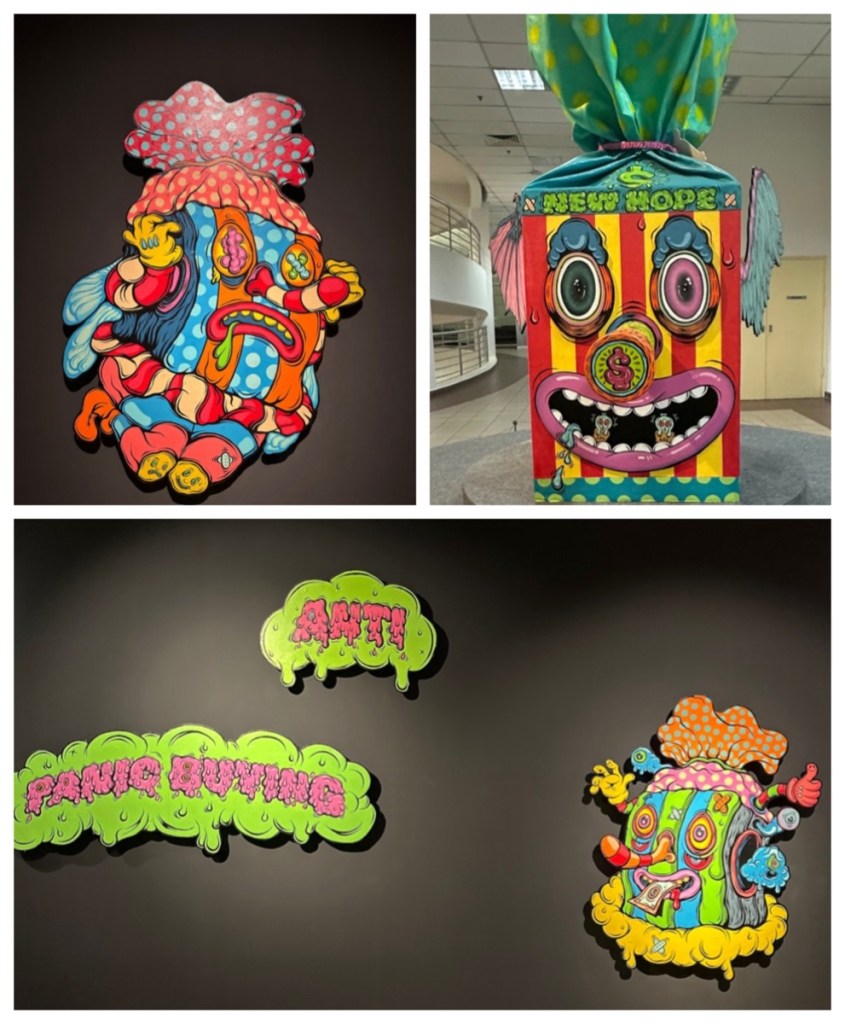
A fun exhibit addressed panic and anti-panic buying in a bright, cartoon manner.
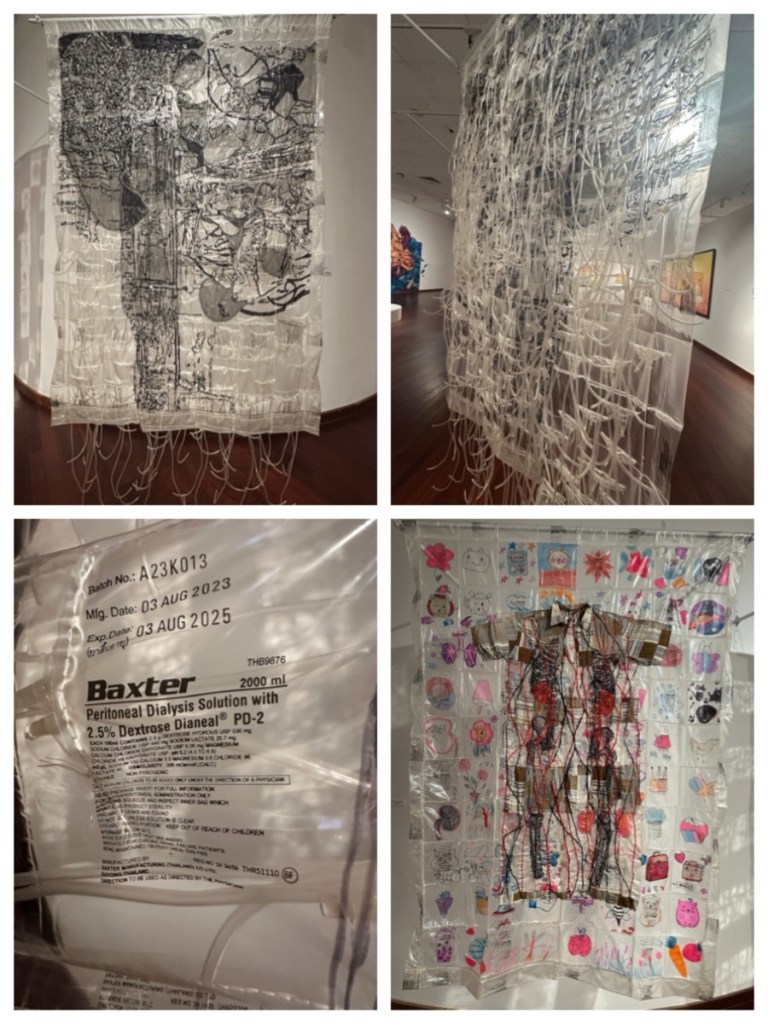
One installation caught my eye as my first thought was that it was made of empty blood bags. On closer inspection, the bags were Baxter peritoneal dialysis solution bags with infusion sets attached to some. I’m not sure of the point of the exhibit but it was interesting.
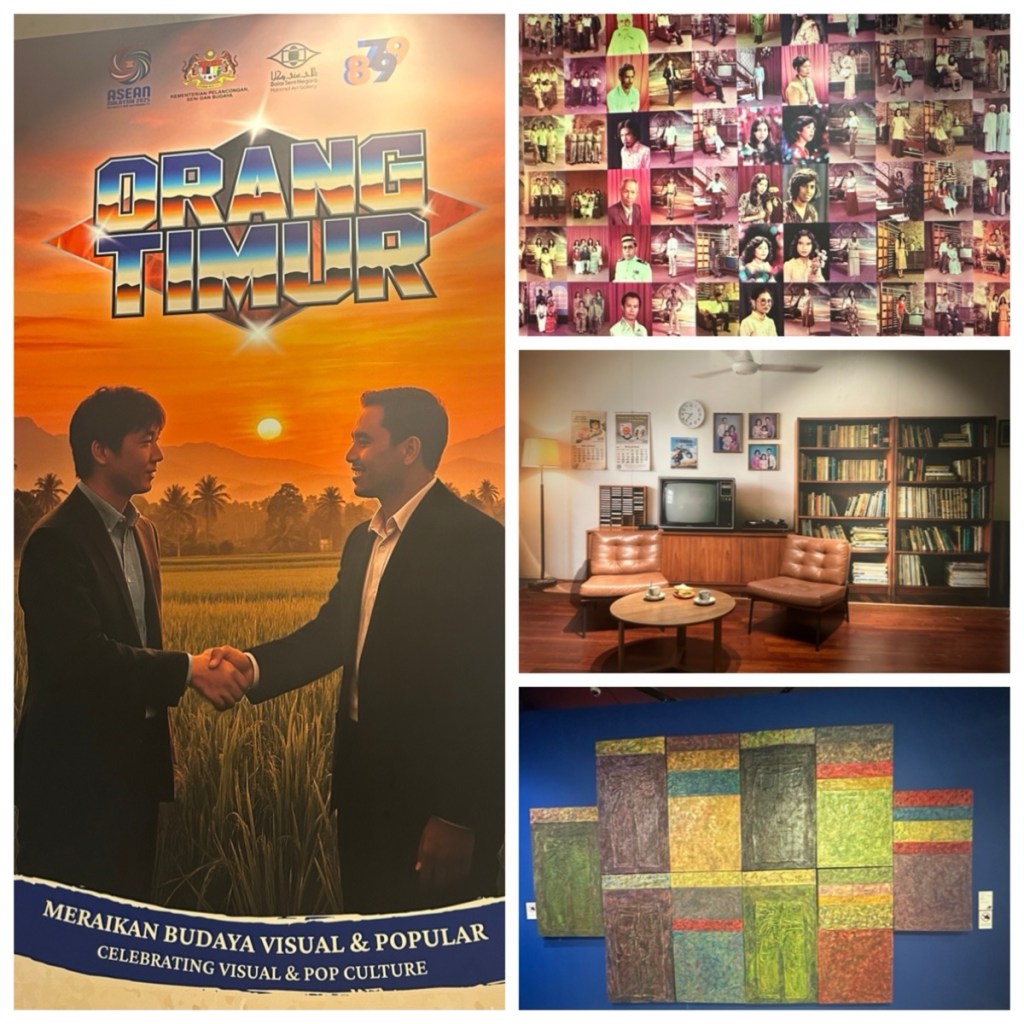
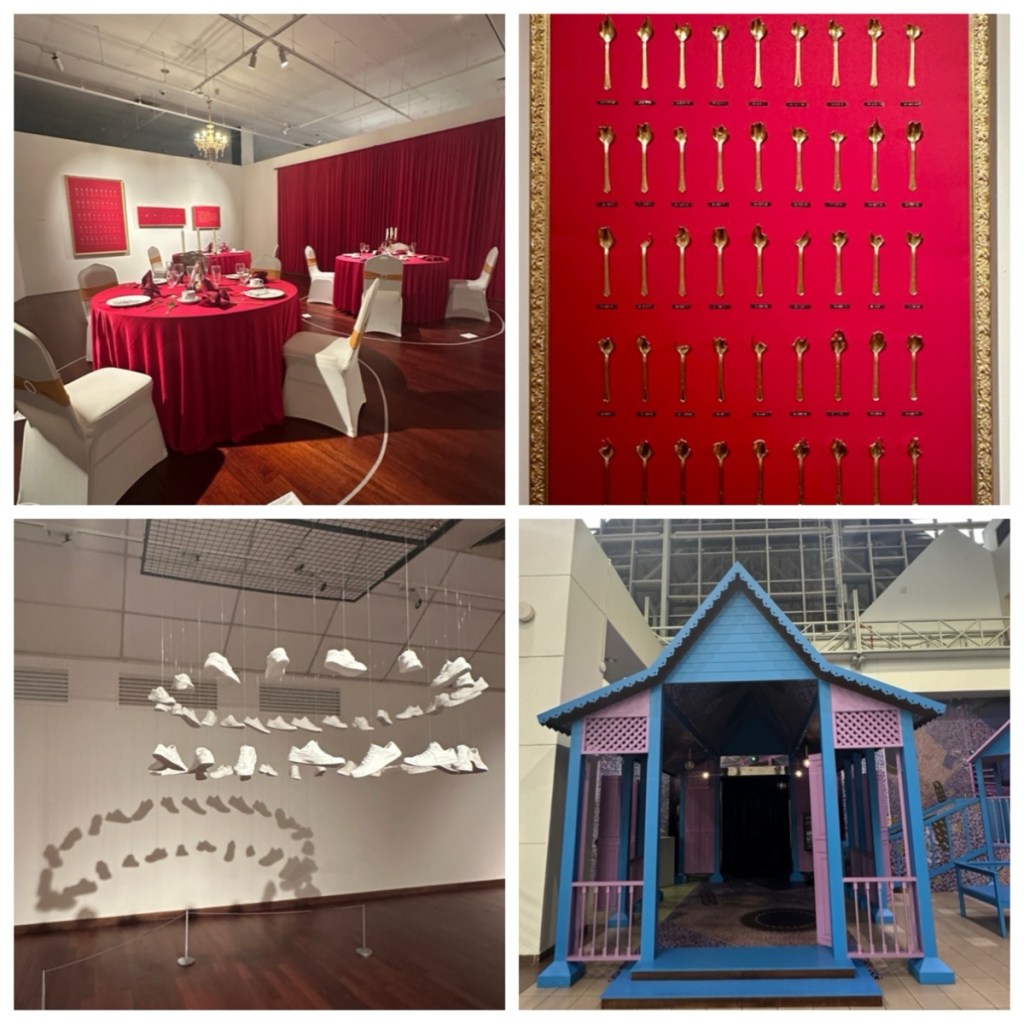
We spent time perusing a number of other galleries that all had interesting themes.
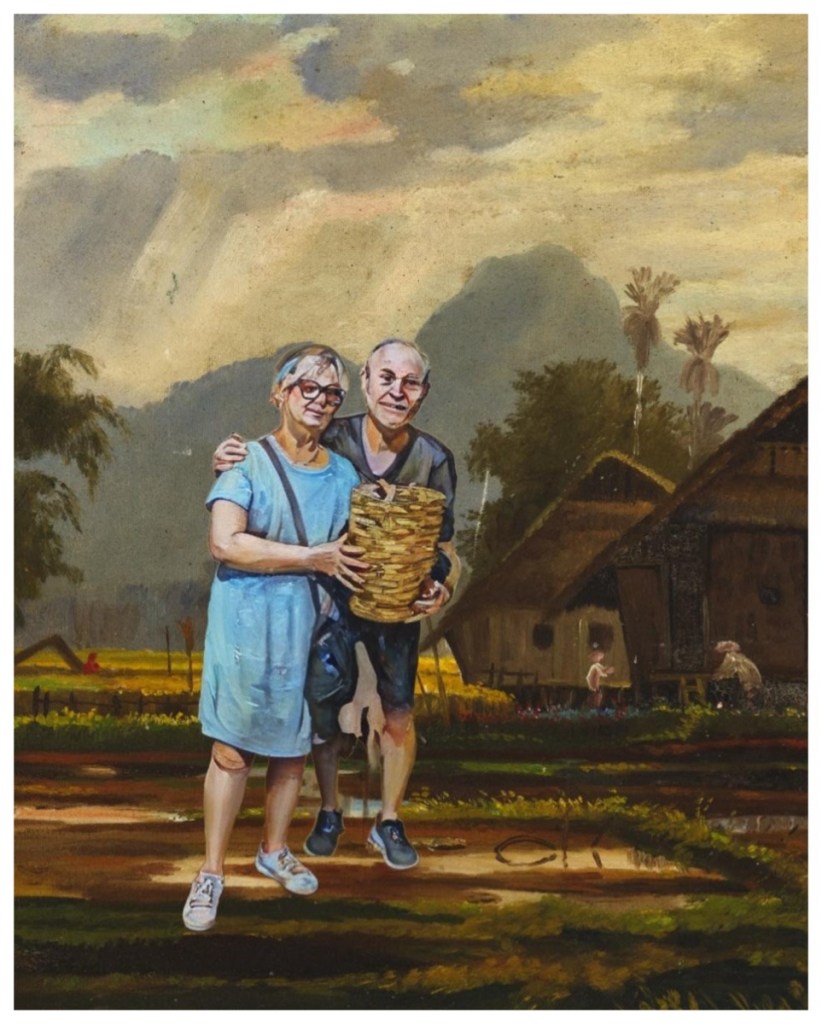
And then there was the multi-media room that produced this very strange photo.
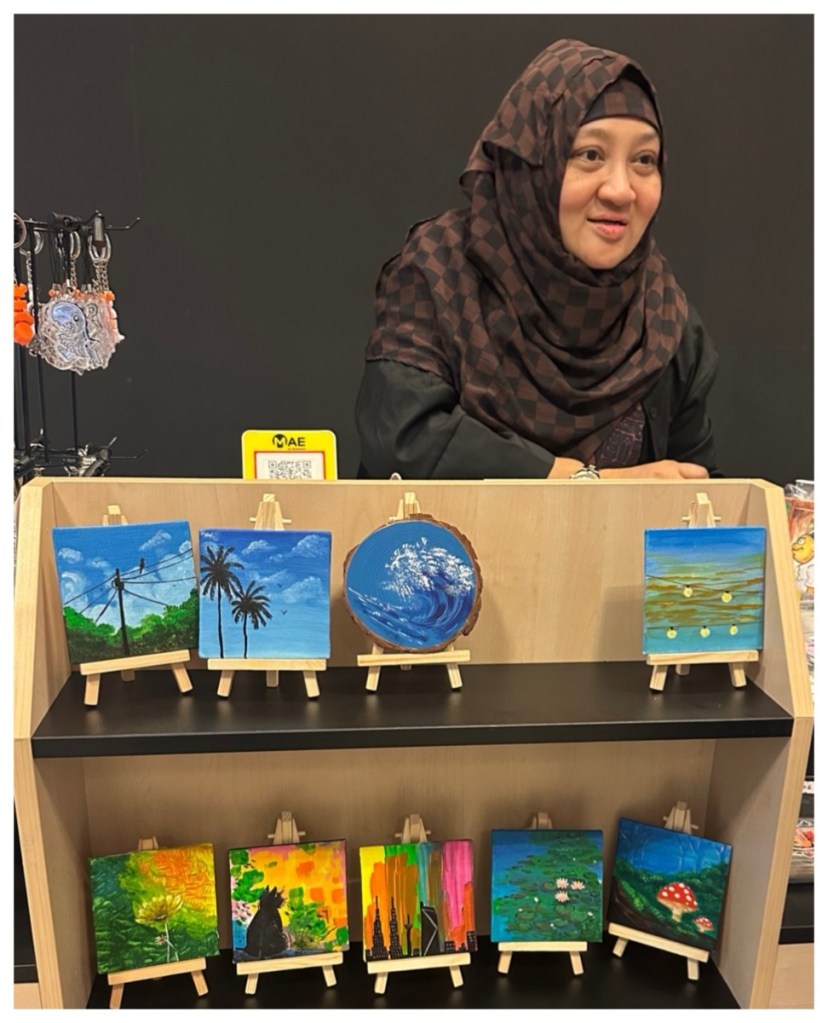
On the way out of the gallery, we purchased a small canvas. The seller told us that her husband, Tam Maba, is a Kuala Lumpur-based Malaysian artist and illustrator known for his work in painting, caricature, and character design, and he had painted the piece.
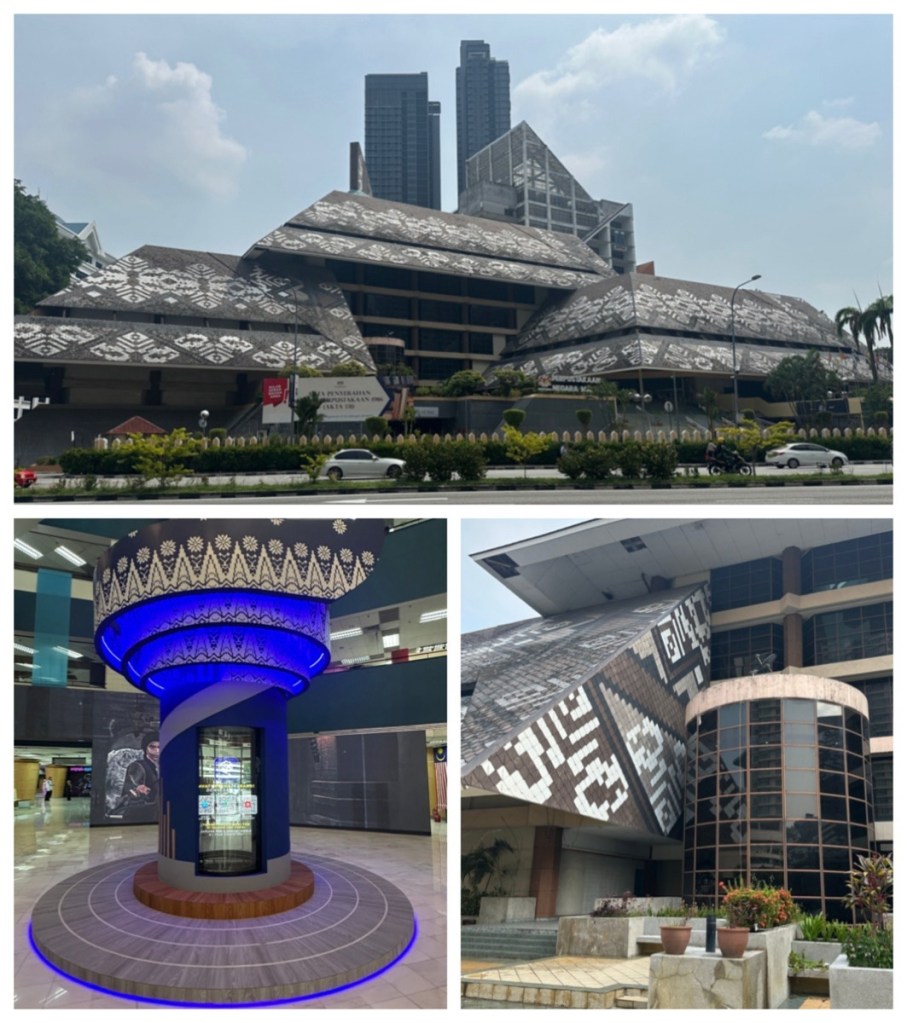
Stop #3: We stopped in at the National Library of Malaysia with its unique architecture.
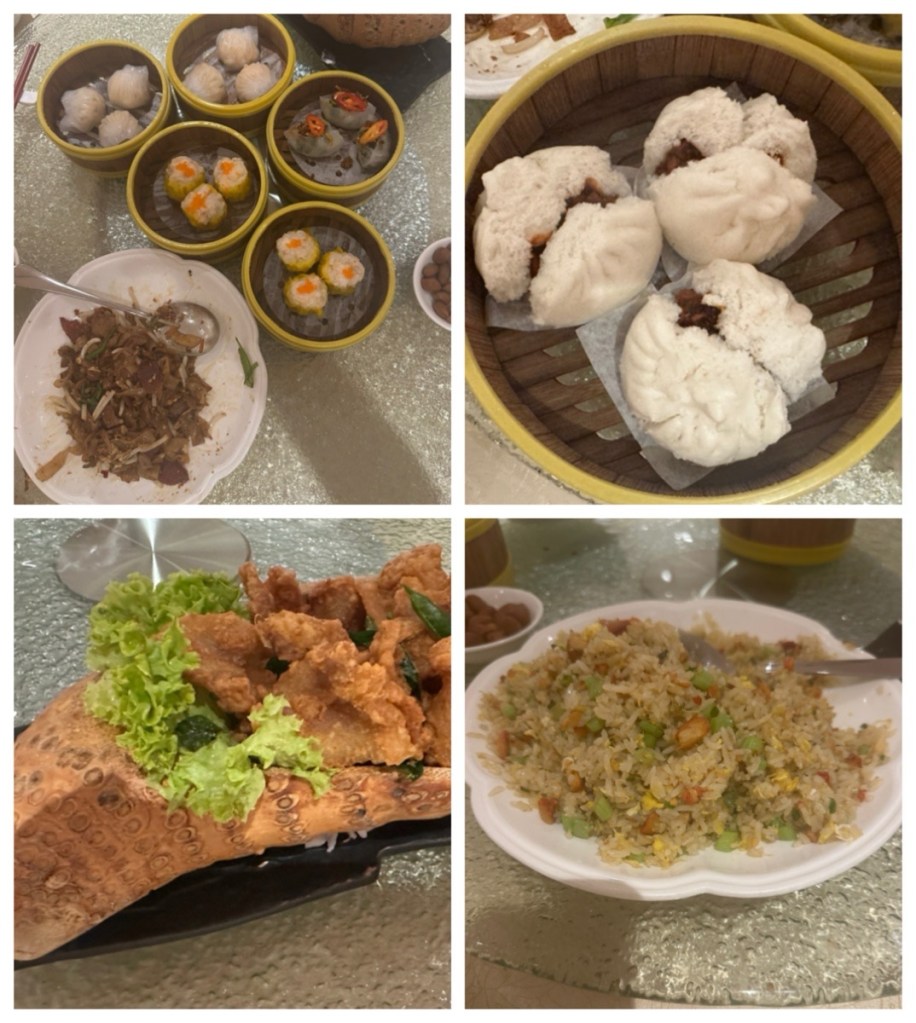
Stop #4: After a MRT ride back to our hotel area, we met our friends Carol, Elaine and Jonathon for lunch at the Oriental Landmark Restaurant. Carol treated us to an amazing dim sum! It was so delicious and we had a great visit with these lovely people that we met with Ron on our trip. We hope to see them again somewhere, sometime, being that we all live in different parts of the globe – Canada, the U.K. and Malaysia. As an aside, Jonathon was one of the civil engineers responsible for the KL MRT project so having now travelled on the system, we were able to congratulate him.
Another walk around the KLCC area in the late afternoon, ice cream for dinner after that wonderful lunch and our great day was complete.
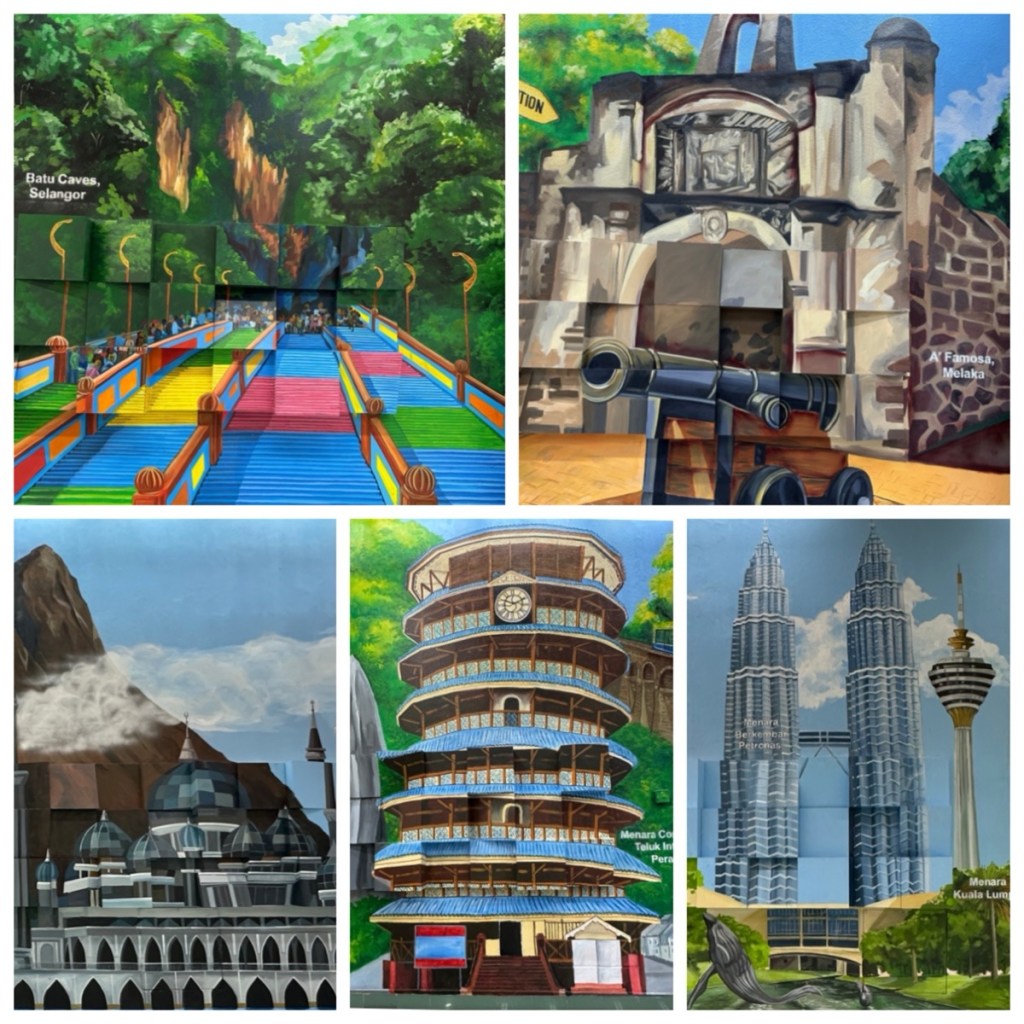
Day 7: We headed out early on the KL LRT which is older than the MRT but seems equally excellent. The wall murals in the Ampang Park station are vibrant depictions of some of KL’s great sights.
Stop #1: We hopped off the train at the Pasar Seni station and wandered into the Chinatown area. This area is filled with small, historic lanes that are home to local merchants and decorated with street murals.
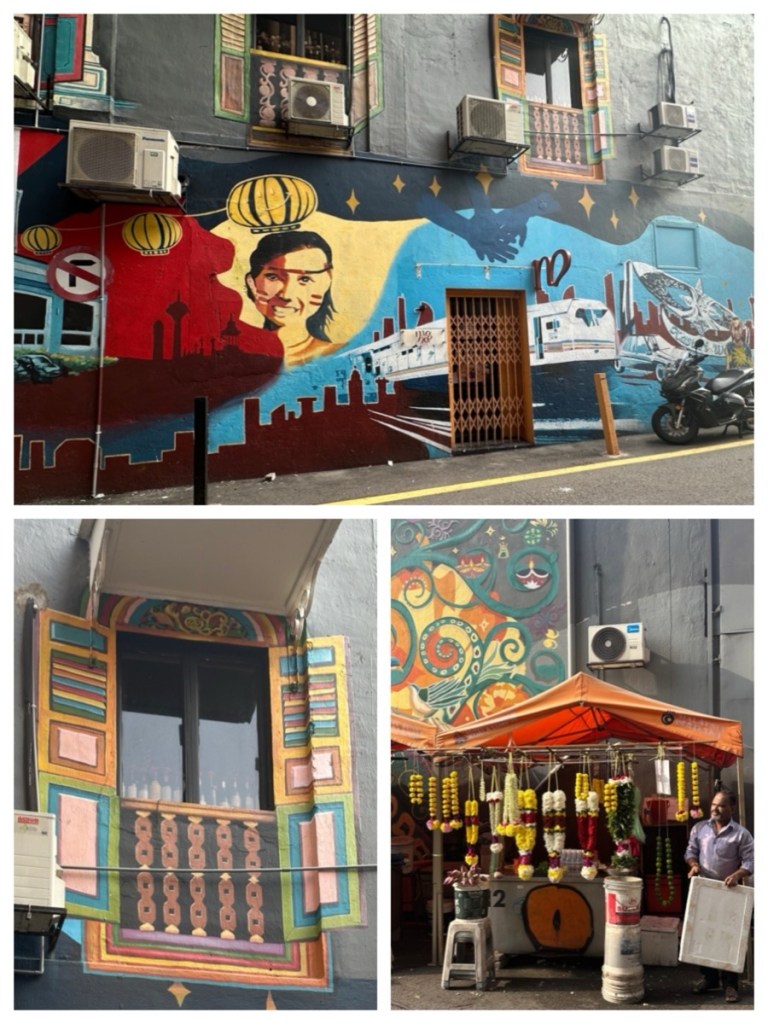
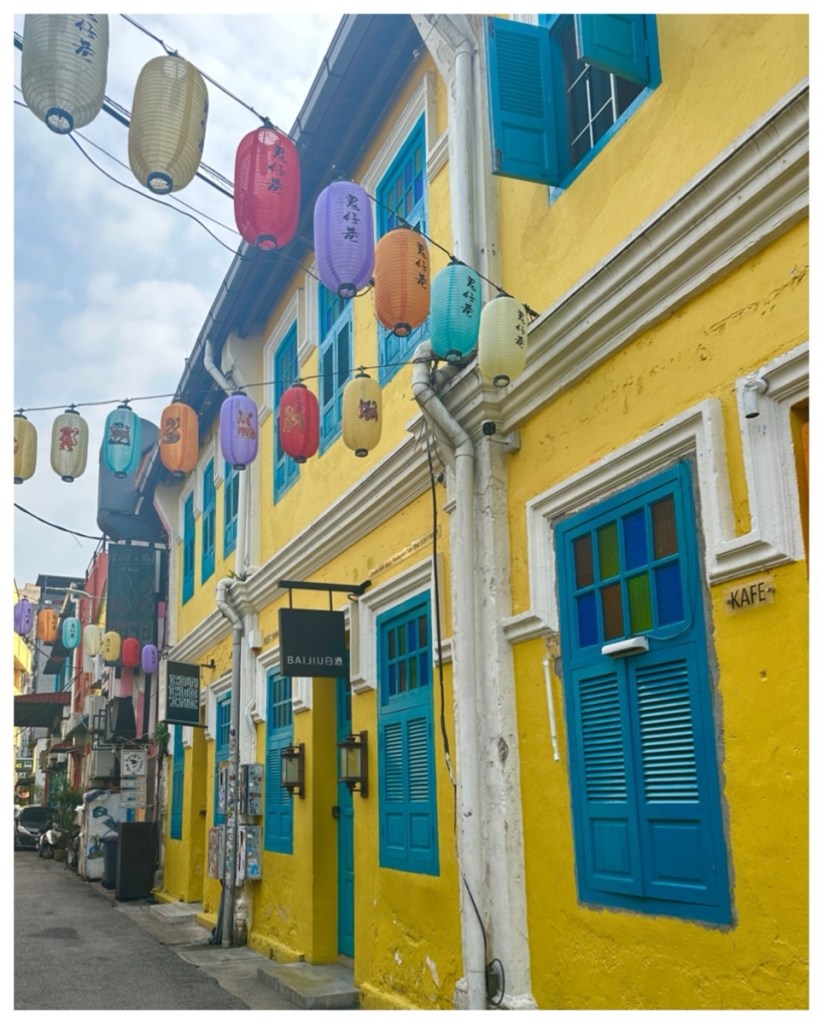
Stop #2: One of the best hidden finds in Chinatown is Kwai Chai Hong. Easy to miss off a street with a row of bright yellow shophouses and lanterns, the entrance to this charming alley is guarded by a statue of a graceful lady made from thousands of porcelain pieces. You pass over a red bridge made from wood that was salvaged during the restoration of this once forgotten alley.
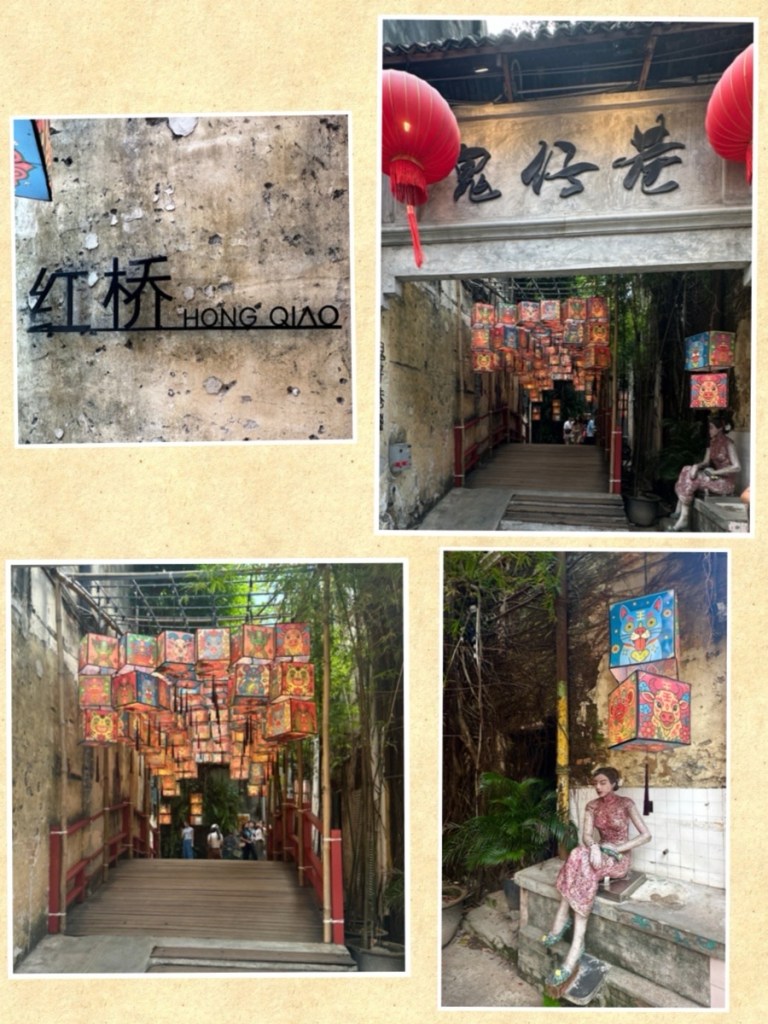
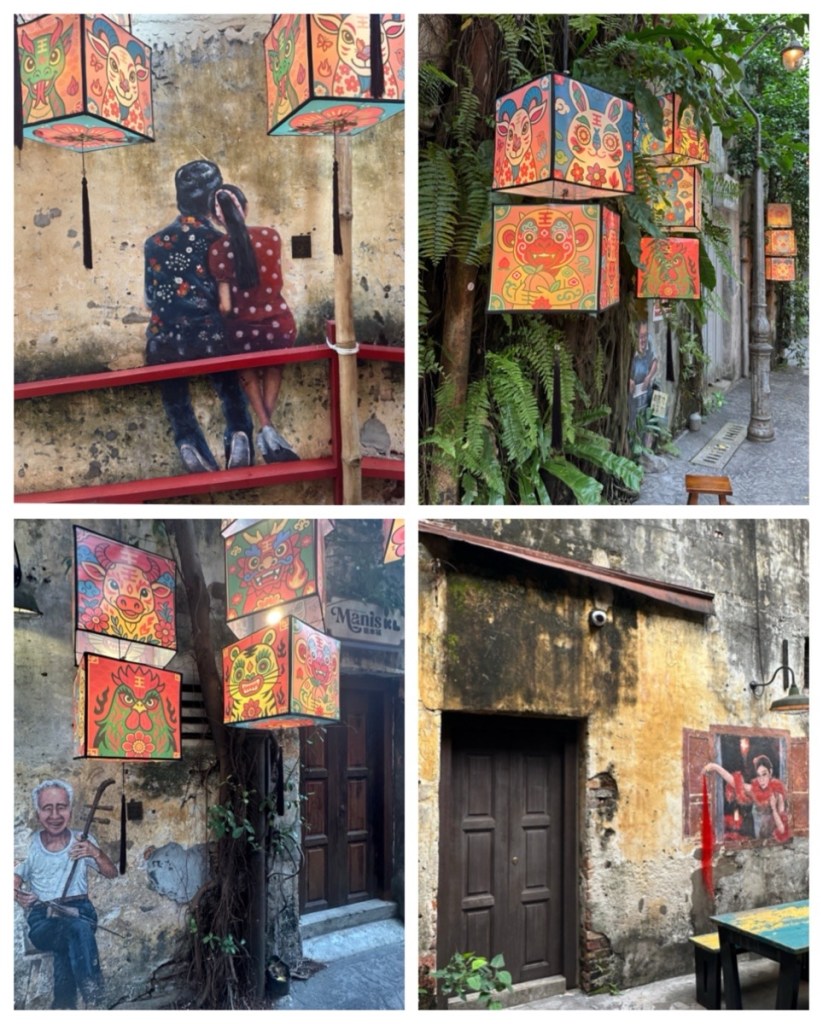
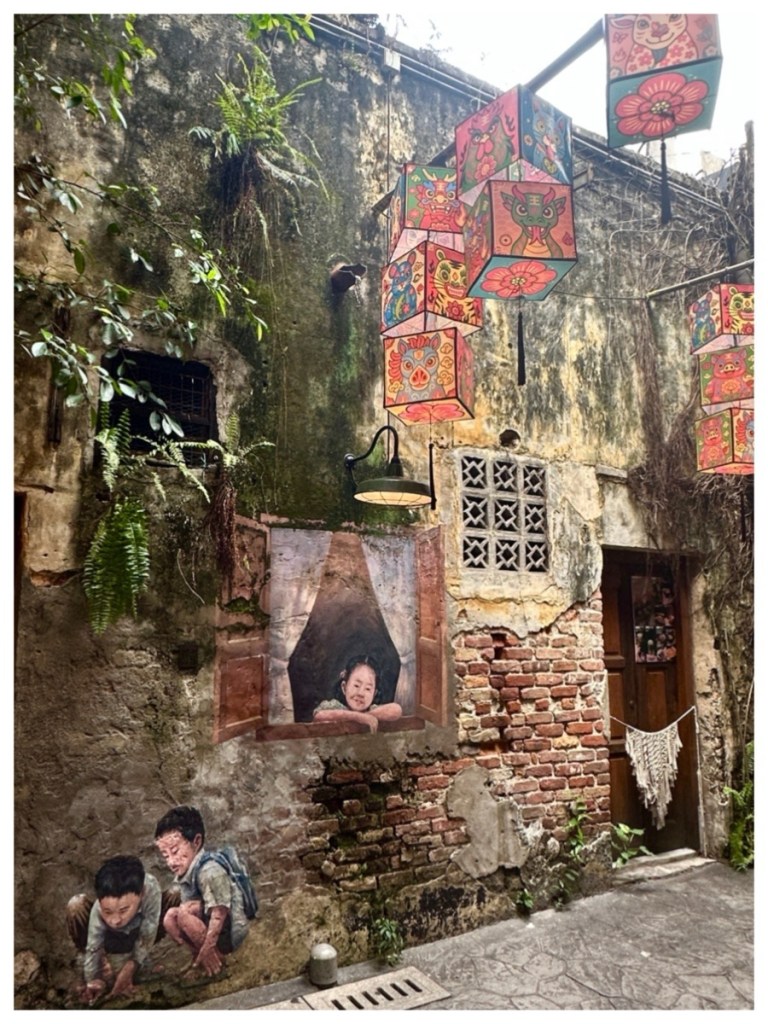
The murals and art installations in this alley were unveiled in 2019 and represent life in the area in the 1960s. Some things you see are kids playing, a cabaret girl, shopkeepers at work and young and old folks visiting.
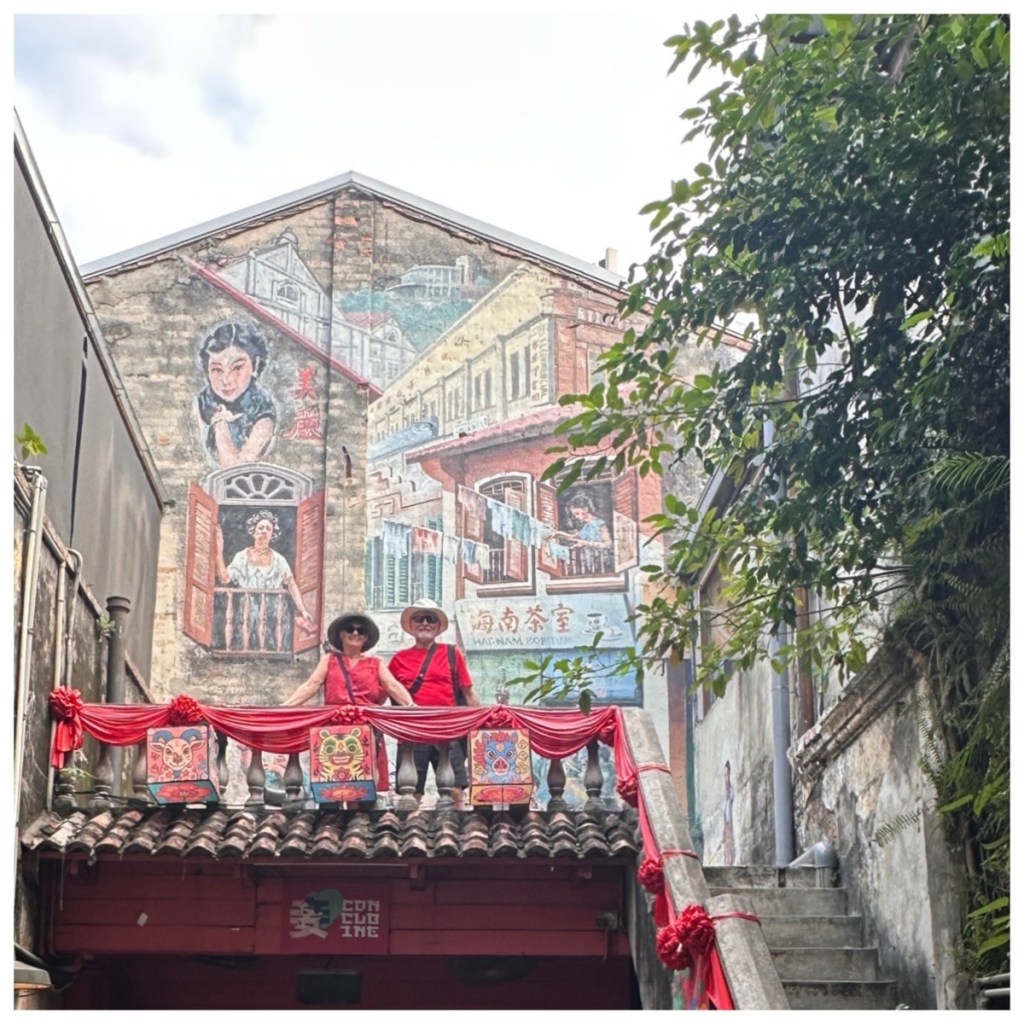
At the end of the alley is a huge mural of a busy street scene with a hard working barber and children jumping rope.
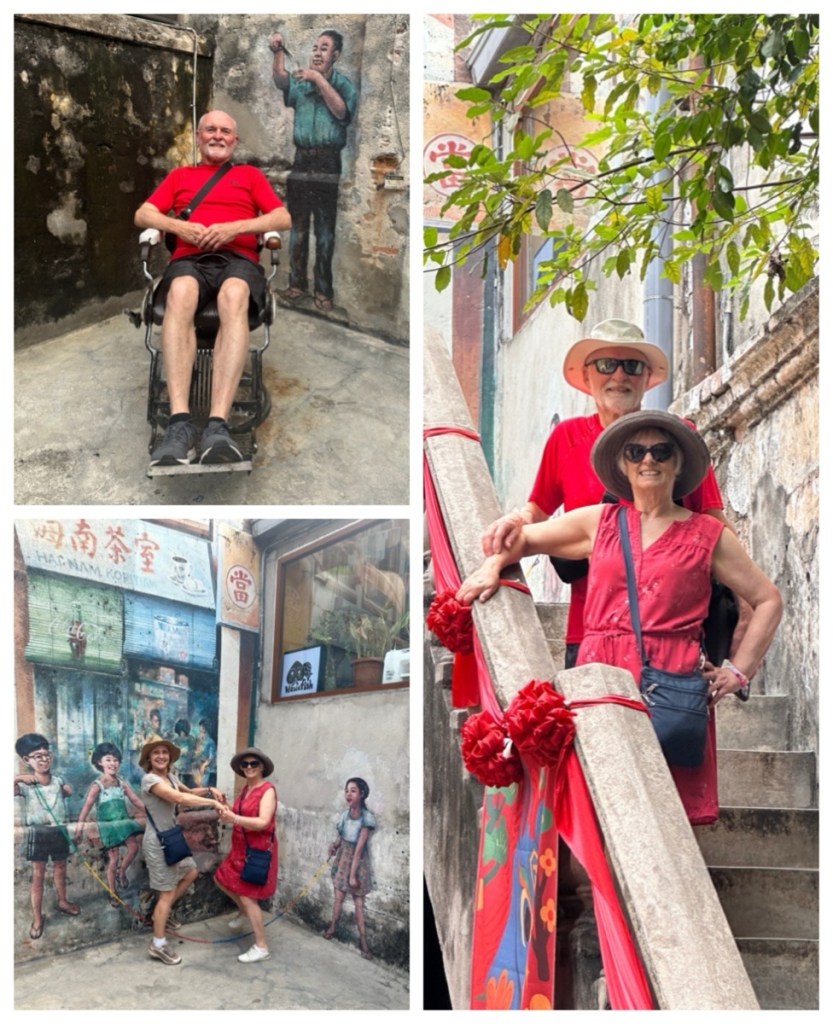
This alleyway is a must-see in the area as it is absolutely adorable!
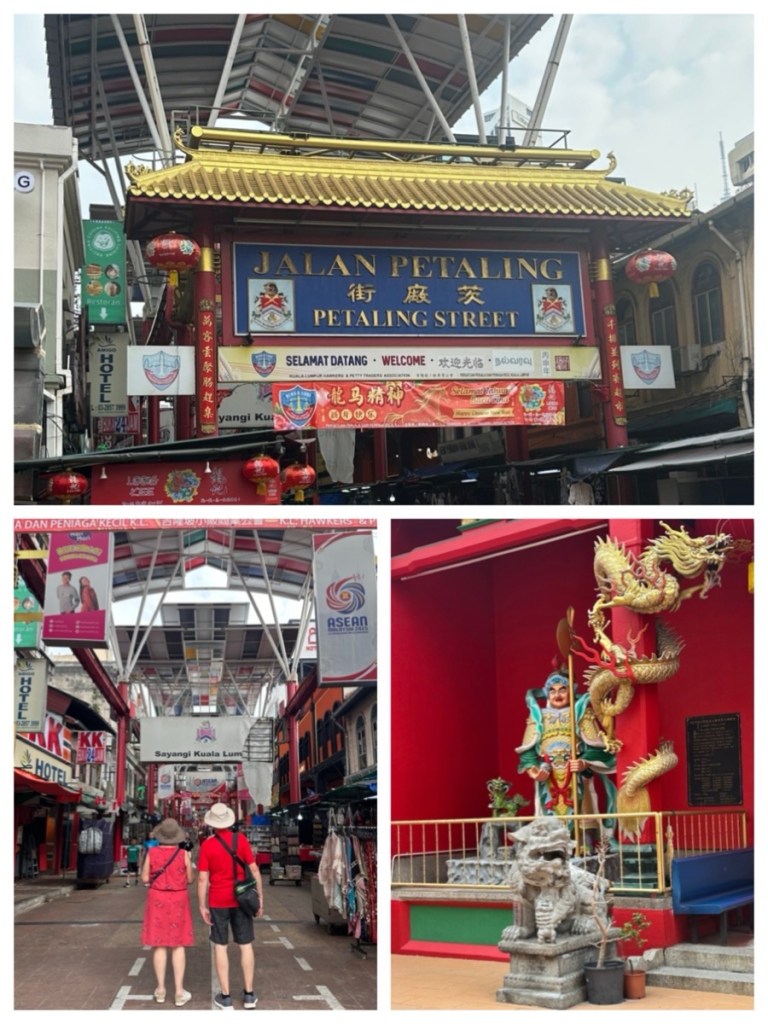
Stop #3: Jalan Petaling Market is the heart of Chinatown. This lively covered street is lined with shops selling most anything you may – or may not – be looking for. We were there fairly early in the morning so did not experience the full onslaught of these sellers that has been described to us by some of the locals.
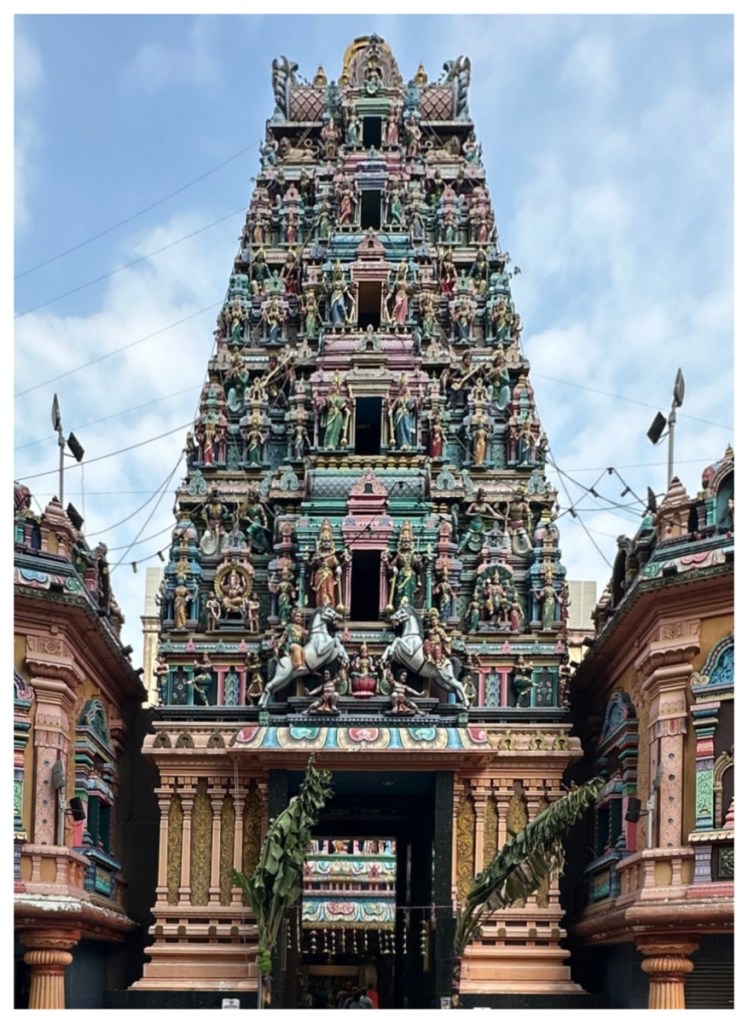
Stop #4: Sitting at the edge of Chinatown is Sri Maha Mariamman Temple, Kuala Lumpur’s main Hindu temple. Built on its current site in 1885, it is said to be in the form of a reclining human body, with the temple’s 5-tiered, 22.9 meter high gopuram (gate tower) representing the feet. The pyramid-shaped gate tower is decorated with carved statues of Hindu deities. The temple is dedicated to Mariamman who is popularly worshipped by overseas Indians as she is recognized as their protector during trips to foreign lands. We admired the temple exterior but were not suitably dressed for entry,
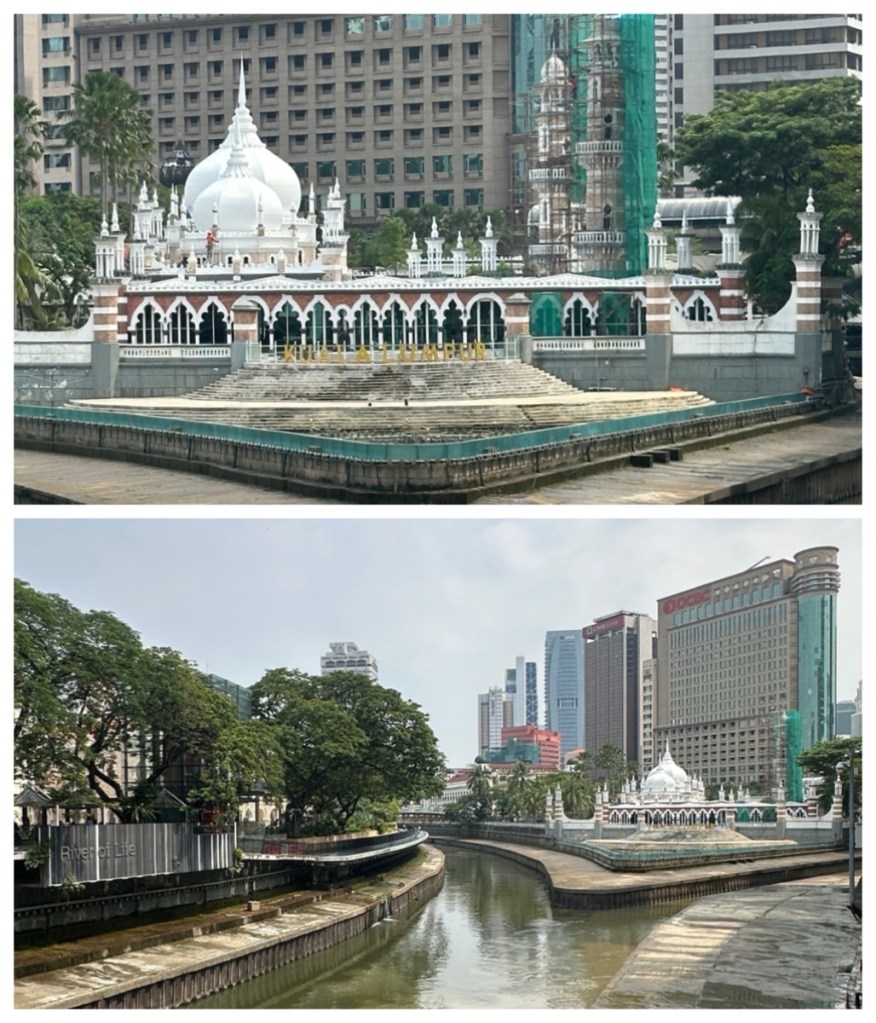
Stop #5: Masjid Jamek sits at the confluence of the Klang and Gomback rivers in an area known as the River of LIfe at the northern border of the Chinatown area. The city’s oldest mosque, it was built in 1909 by by Sultan Abdul Samad and was the city’s main centre for worship for the Muslim community until the opening of the National Mosque in 1965. We didn’t visit the mosque but admired its grandeur in a majestic setting from afar.
Stop #6: The Central Market is housed in an art deco building from the 1930s. Formerly the city’s primary produce market, it was in a state of dereliction until it was restored and reopened in the 1980s as a modern shopping complex for arts and handicrafts. The stalls in the market are grouped in three separate zones that represent the various races in Malaysia: Malay Street, Straits Chinese and Little India.


Stop #7: Kasturi Walk is an exterior annex of the Central Market lined with sellers of souvenirs and imitation designer goods as well as cute kiosks for street food and coffee. The entrance sign to the walk resembles the Wau Bulan giant kite. This kite, traditionally flown by men from the Kelatan State in northern Malaysia, is one of Malaysia’s national symbols and is featured on the fifty-cent coin as well as the logo of Malaysia Airlines.
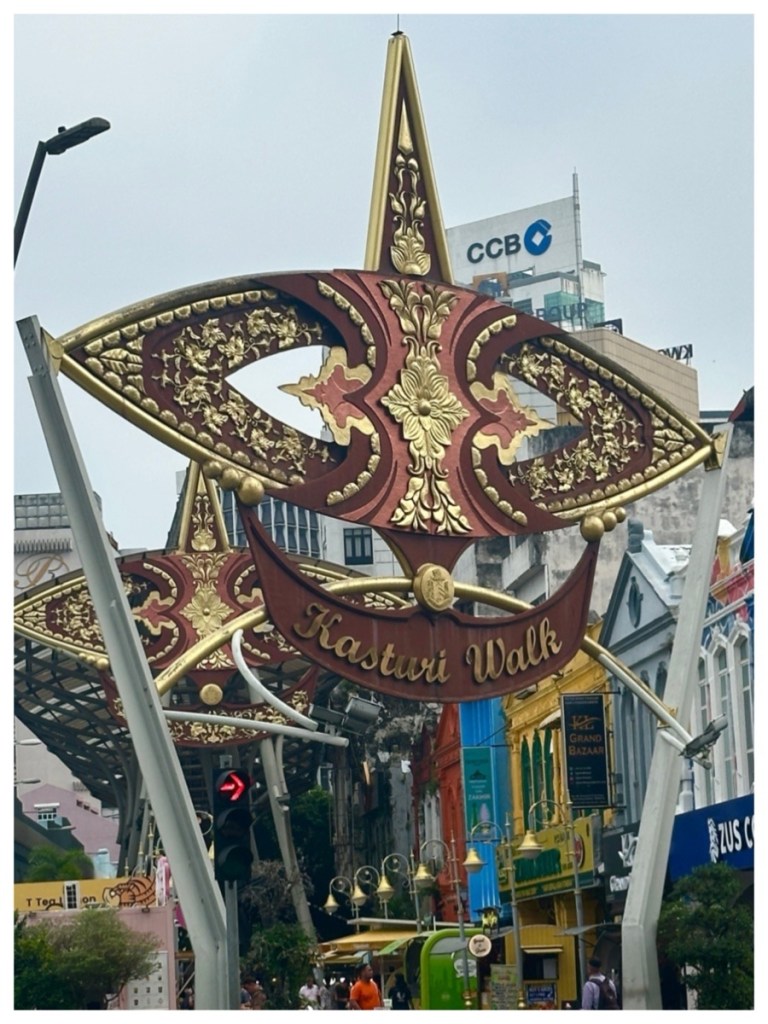
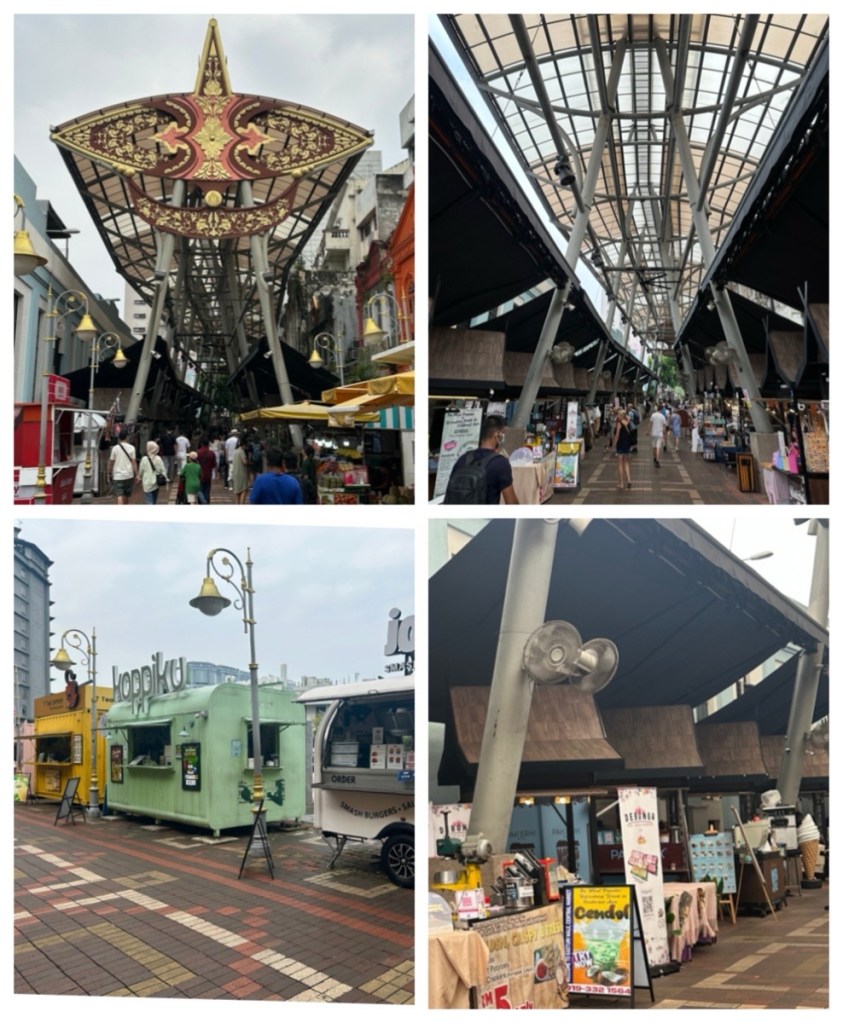
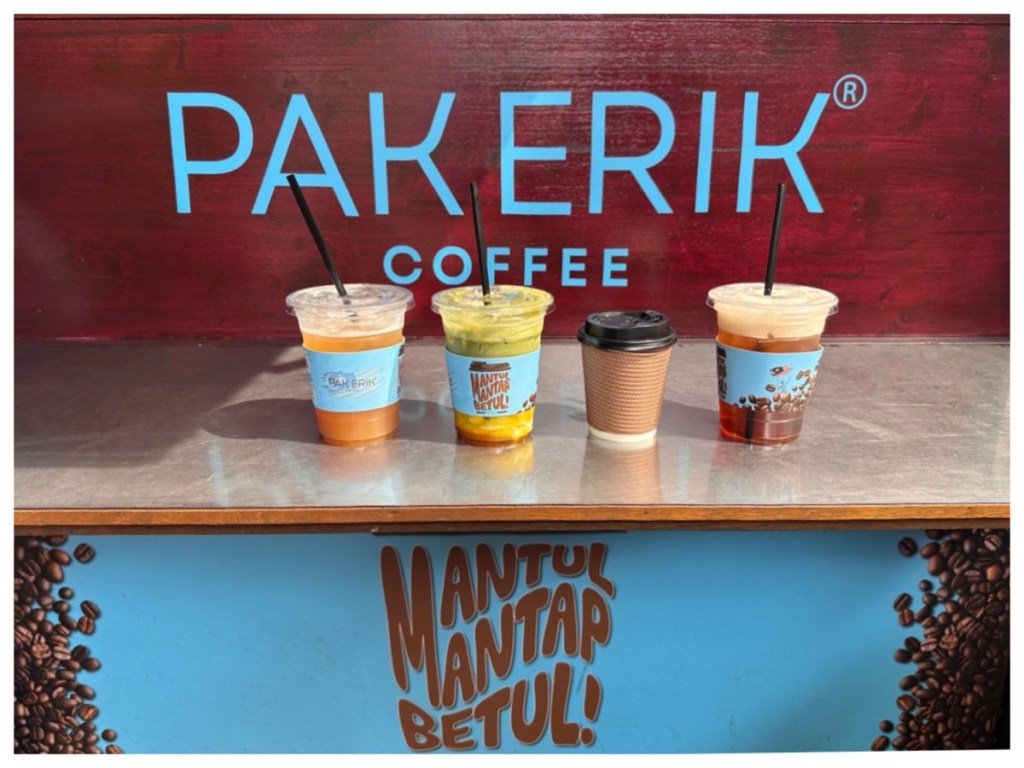
We stopped for a delightfully refreshing drink at Kopi Pak Erik.
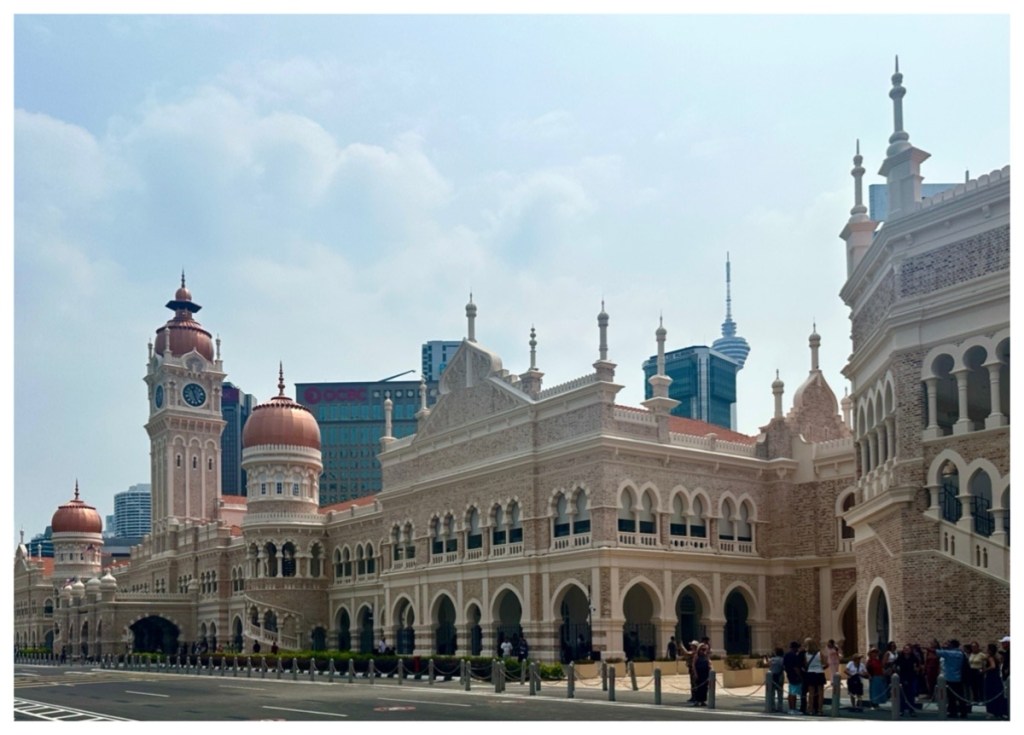
Stop #8: Merdeka Square is a large grassy square where the Malayan flag was raised for the first time at the stroke of midnight of 31st August 1957. The flagpole which holds the flag of Malaysia is one of the highest in the world, towering at a height of 100 meters. The square is lined with historic buildings including the Sultan Abdul Samad Building and the Royal Selangor Club.
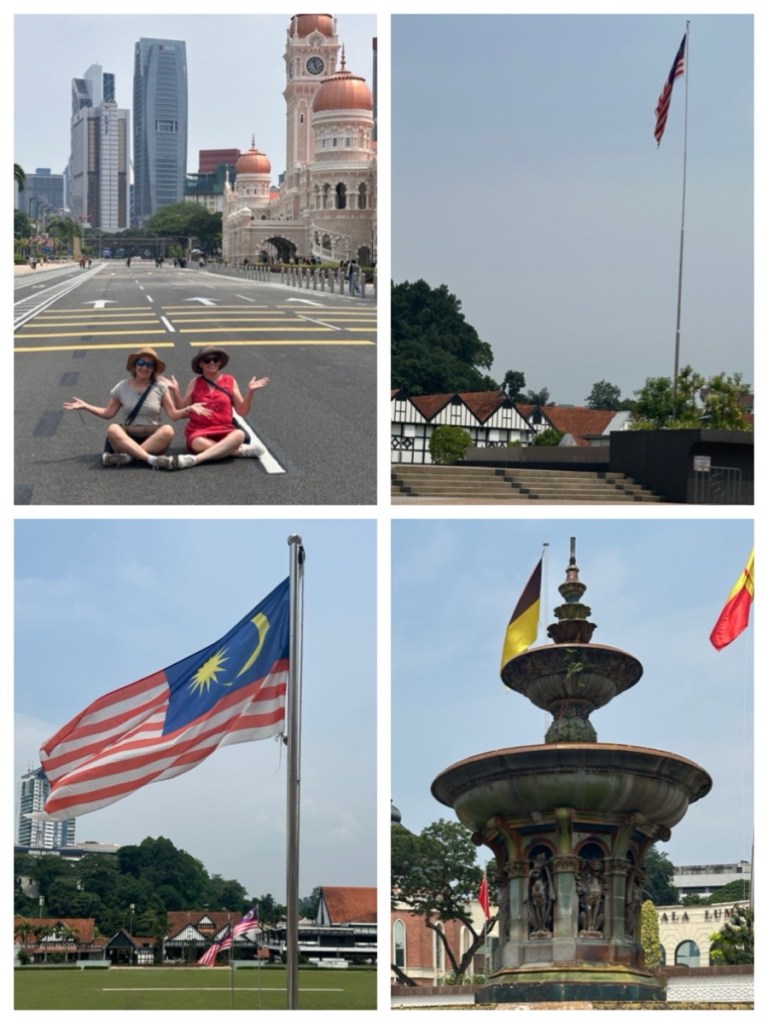
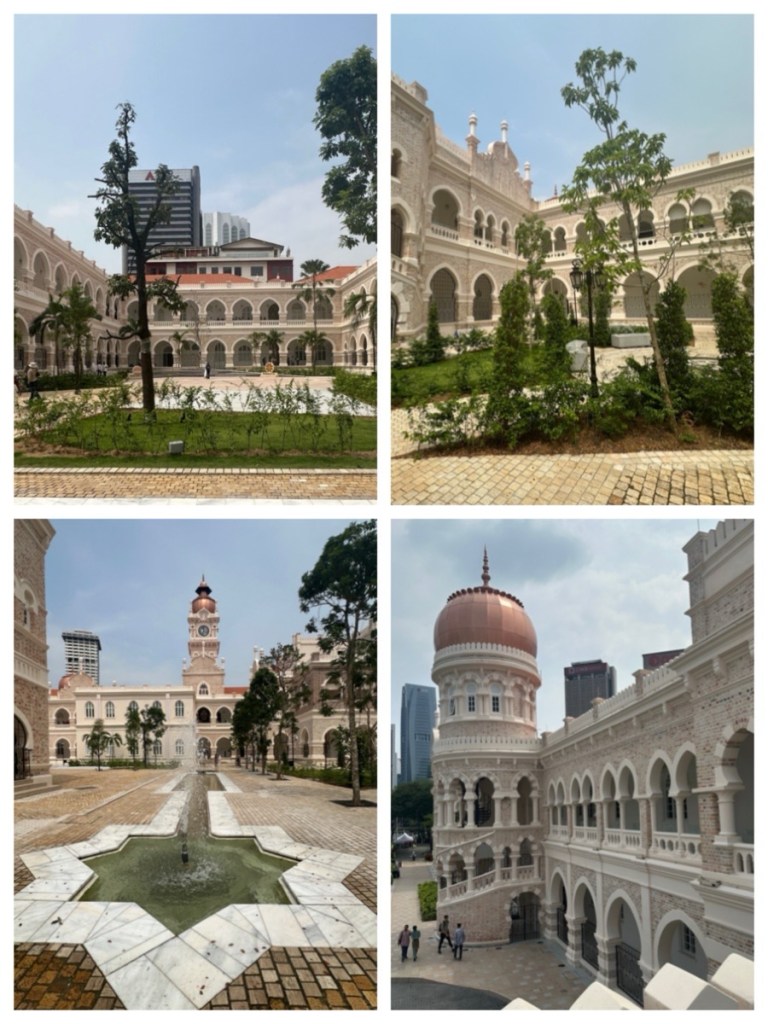
Stop #9: The Sultan Abdul Samad Building presides over the eastern side of Merdeka Square. It was built in 1897 following the formation of the Federated Malay States to serve as the headquarters of the colonial administration. It was designed by a British architect and melds Mughal, Egyptian, Gothic and traditional Islamic styles made of red brick and white stone.
Following the the formation of the independent Federation of Malaya in 1957, the building was a centre of governance, housing the Selangor State Secretariat, State Council and Treasury. From 1978 to 2007, the building housed the nation’s superior courts. Various other government ministries have occupied the structure and when we passed by last year, it was under restoration. It is now open to the public to showcase the history and heritage of Kuala Lumpur.
Stop #10: We walked through a portion of Little India and stopped for lunch at a traditional eatery. The waiter helped us order and we were very pleased with his recommendations!
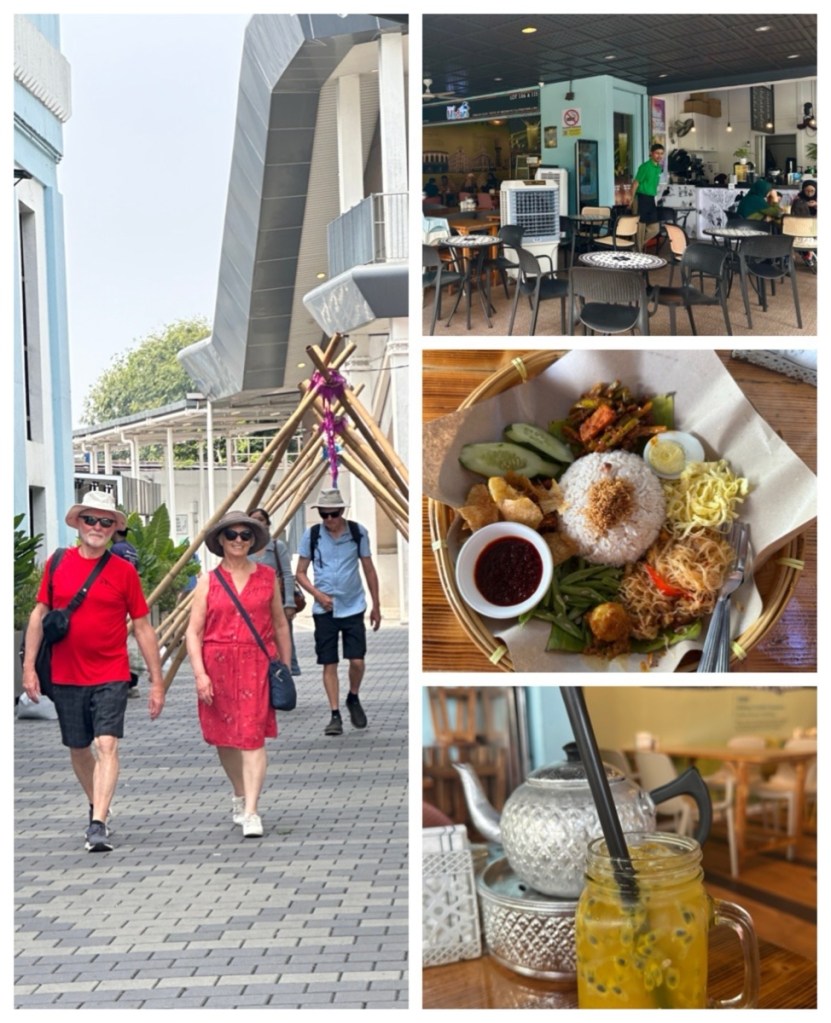
Stop #11: This was a busy and fun morning and early afternoon so it was back on the LRT to relax at the hotel. In the late afternoon, we met cousin Ron in Bentley’s Pub at the Intercontinental for one last visit over pizza and beer. It won’t be long until we see him again – possibly at the Calgary airport as he will arrive back in Canada shortly before we do.
Day 9: An early morning, a packed breakfast from our favourite hotel and we were off to Kuala Lumpur International Airport for a Malaysia Airlines flight to Narita, Japan. This was one of the best flights we have had in a long time – the seating seemed roomy, the flight attendants were friendly and happy, and the food was excellent. The 7.5 hour flight went by quite quickly.
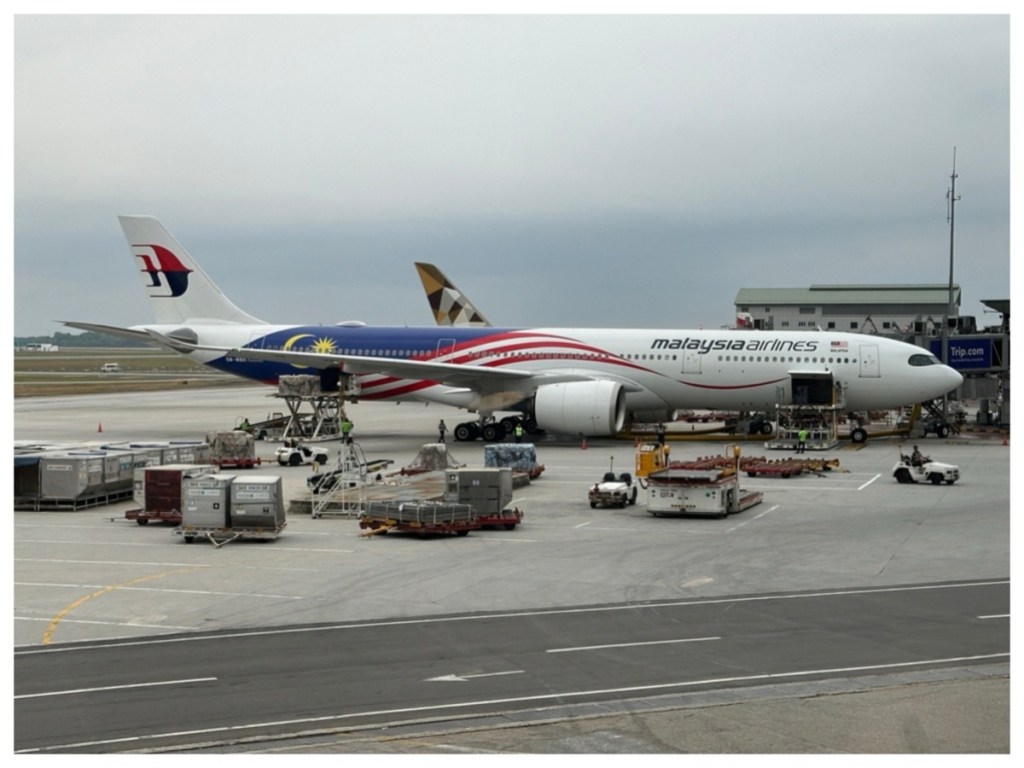
We returned to our Tokyo home away from home – the Tobu Narita Airport Hotel for two nights. We enjoyed a day wandering around Narita town a bit – with a break at a lovely Japanese Tea House.
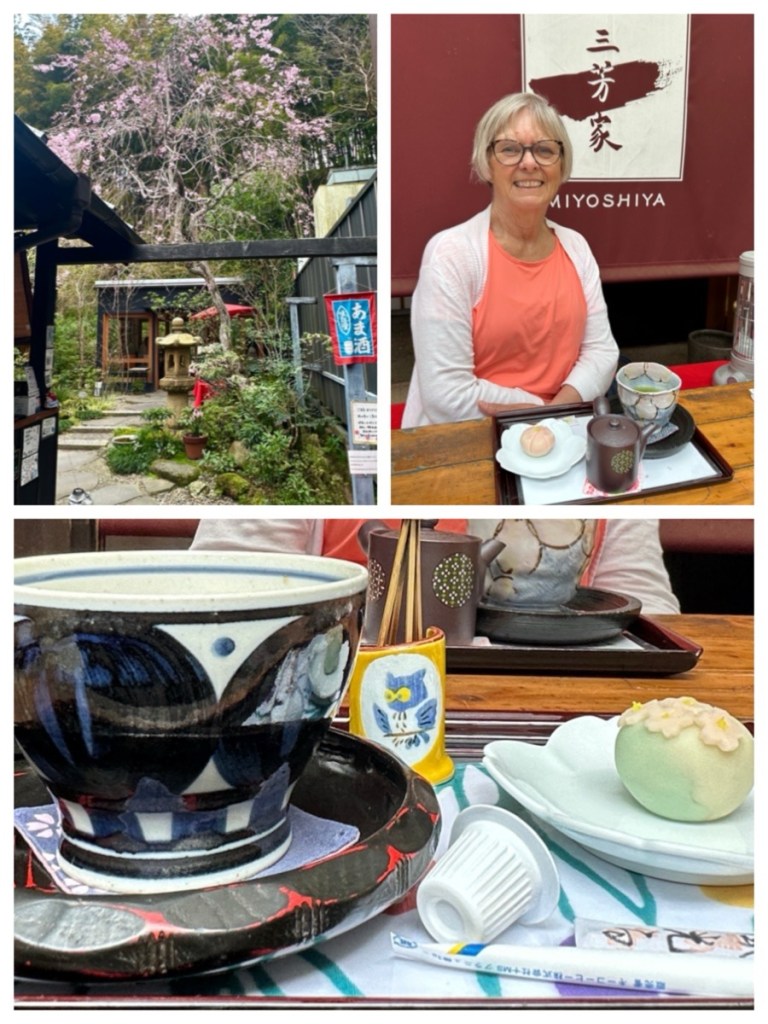
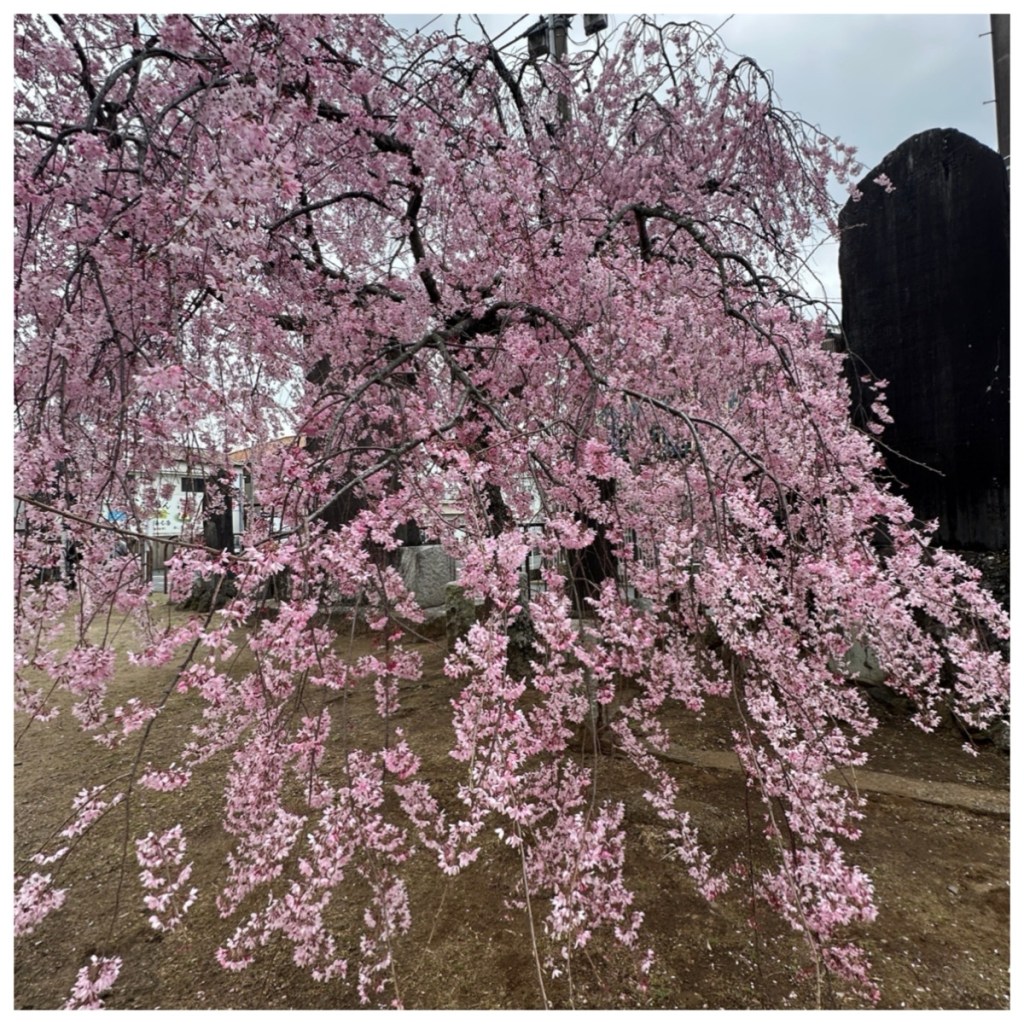
As I write this, we prepare to fly home tomorrow. This was an amazing trip – so many new experiences, such wonderful people and an abundance of new information about countries that we had never imagined that we would have the privilege of visiting.
We hope you enjoyed reading our blogs – or at least looking at the pictures. If you are considering travelling to any of these places and have questions, feel free to ask. Maybe we can help a bit.
Until next time…..
Cheers,
Bev & Harvey
 A Long and Winding Journey