Travelling west from County Cork, you come to County Kerry. This county combines rolling hills and farmland with the bountiful forests and the beauty of the Wild Atlantic Way. There is much to see in the county – we chose to visit the city of Killarney with a day trip to the Dingle Peninsula.
Travel from Cork to Killarney was a 1.5 hour Irish Rail train ride, with a few stops along the way. At one of the stops, a large group boarded. We visited with a few of the ladies in the group – they were unionized retail workers heading to a union conference in Killarney. Their stories were interesting and entertaining, including advice on when and where to drink Guinness.
In Killarney, we stayed at The Fairview Hotel. This boutique style hotel is a 3 minute walk from the train station and close to the express bus stop and multiple restaurants. The rooms are spacious, with a blend of antique and modern decor, and hardwood floors which are always a plus in my opinion. Breakfast was very good – the buffet items were somewhat limited, but the made-to-order items that we tried were excellent.
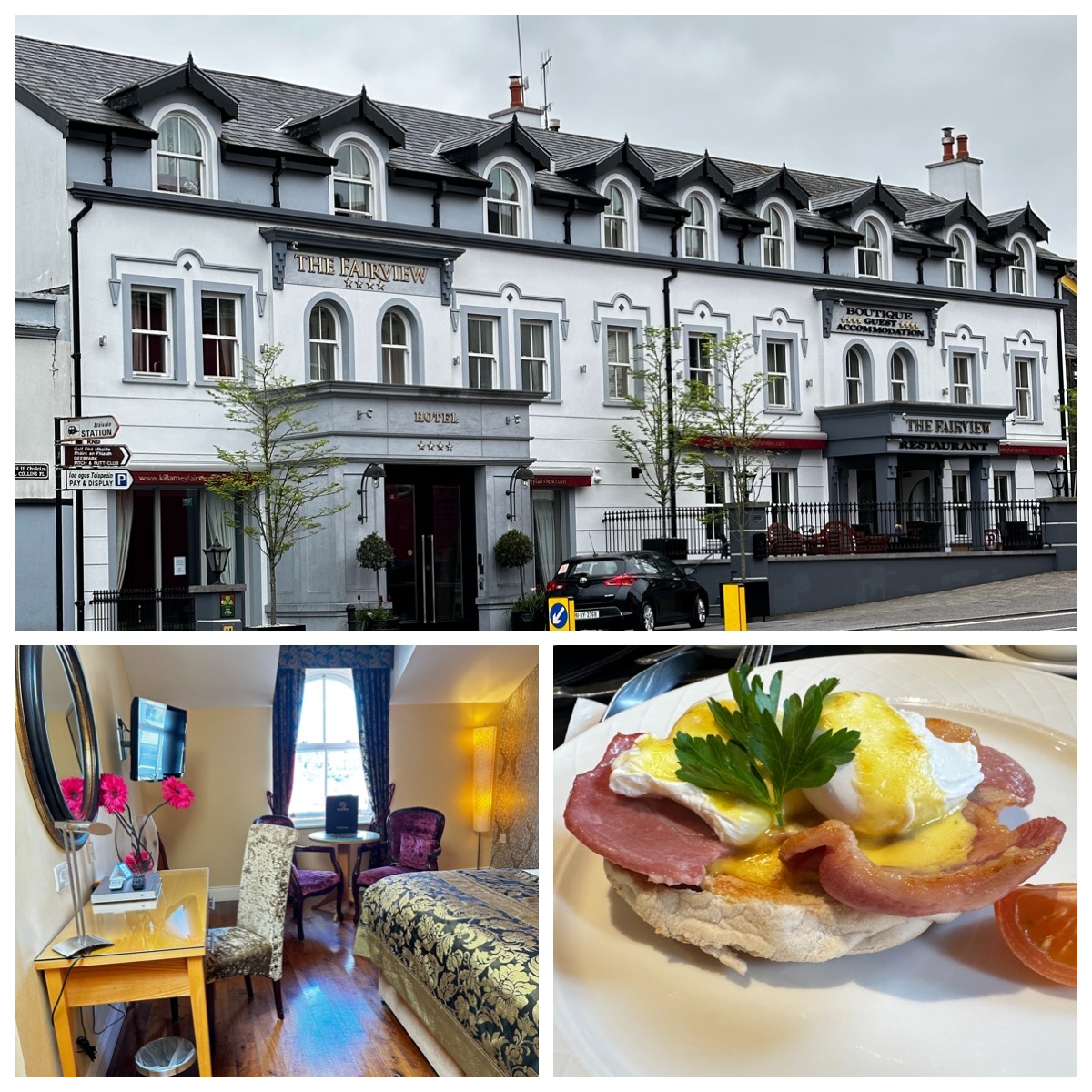
Some tour books (not to mention any by name, but the one I use most often) describe Killarney as a tourist town, not worth a stay. We disagree – we found it to be quite charming. Yes, the central couple of streets are lined with hotels, restaurants, pubs and tourist shops but if you step away from these streets, there are interesting buildings, statues and green spaces.
The Killarney tourist office has a walking map – it only takes an hour or two to cover the entire map and it provides you with an enjoyable way to explore the city.


The Cathedral of Our Lady of the Assumption, better known as St Mary’s, serves at the cathedral of the Catholic Diocese of Kerry. The architect Agustus Welby Pugin who worked on the iconic Palace of Westminster, designed a church with a rugged exterior, smooth light-filled interior and three slender lancets inspired by the ancient Ardfert Cathedral. Despite only having £800 in funding, the foundation was laid in 1842. However, the great famine and a lack of available funds delayed construction several times. In 1855 the building was ready for regular worship. The spire and nave were added in 1907 and a controversial renovation was performed in 1973.
We felt that St Mary’s was truly spectacular – the spaciousness and stained glass were magnificent.


The Bishop’s House is a 19th century building that sits in the grounds behind St Mary’s and is home to the Bishop of Kerry.
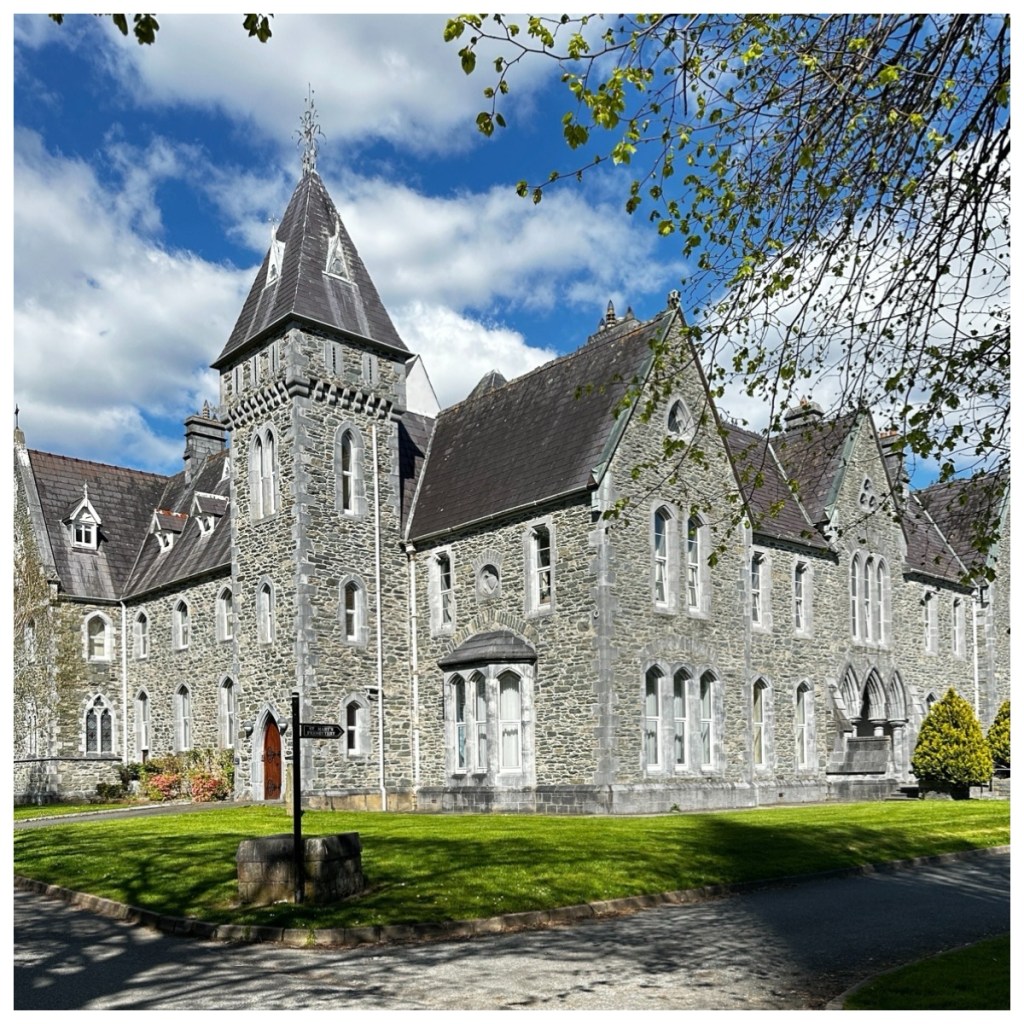
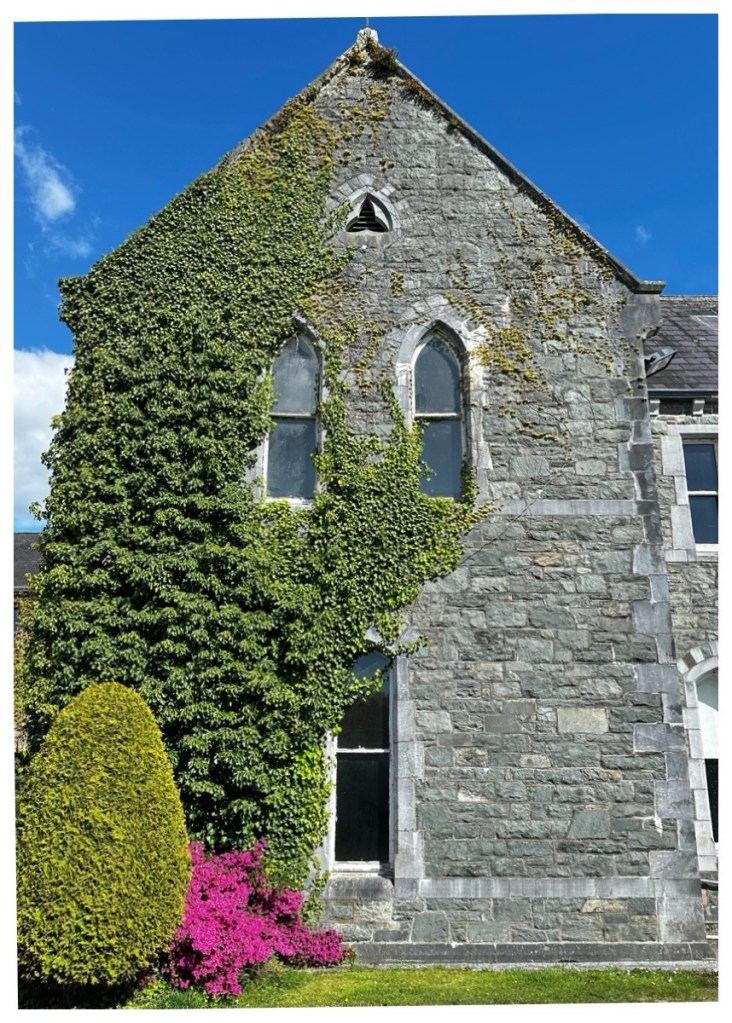
St Brendan’s College is a secondary school for boys established in 1860. It has some lovely historic buildings – loved the ivy crawling up the walls!
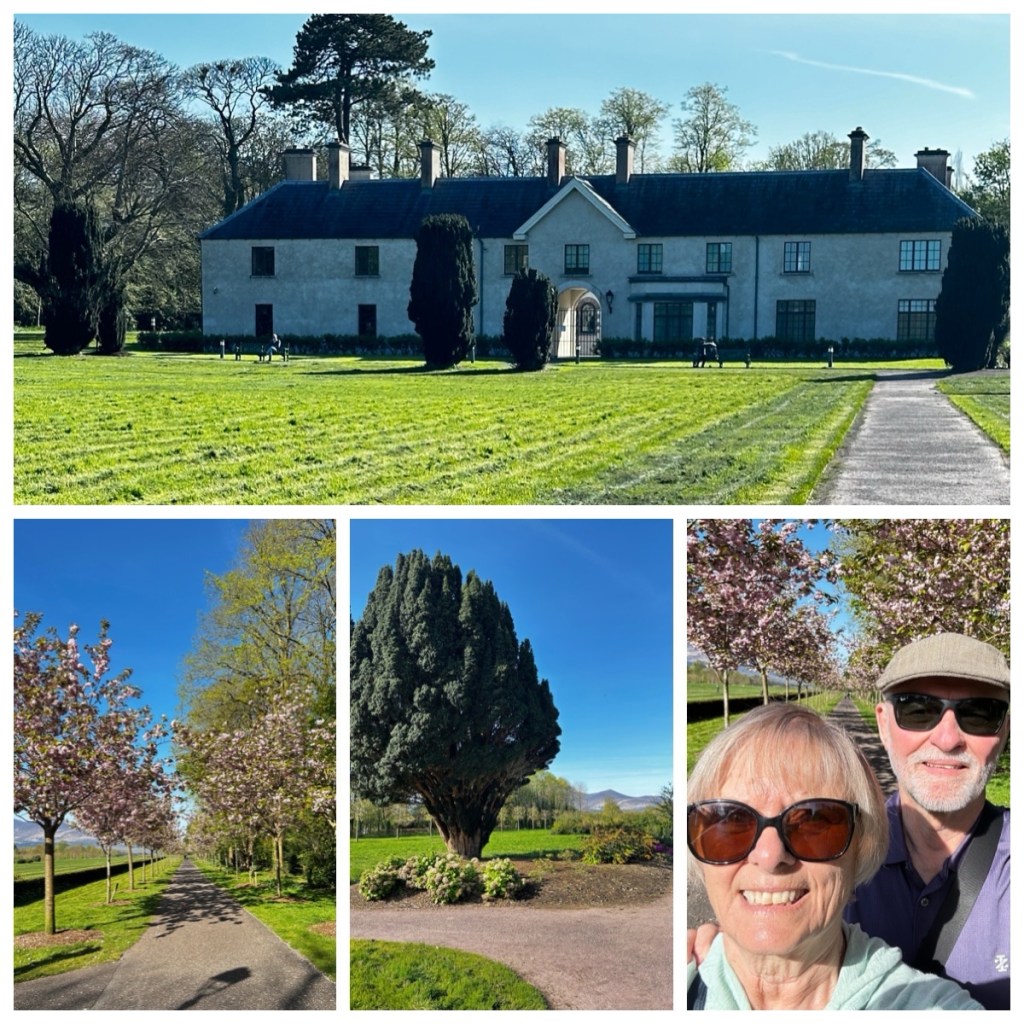
Killarney House was originally the stable block of a much larger mansion that was built in the 1720s. The mansion succumbed to fire in 1913 and the stables were remodelled as a family residence. Abandoned in the 1950s, the house was restored in 2016 and now is home to the Killarney National Park visitor centre. The gardens behind the house are lovely, with the Cherry Lane in full bloom on our April visit and wonderful views of the Kerry mountains.
Ireland’s oldest national park, Killarney National Park, was established in 1932 when Muckross Estate was donated to the nation. The 10,000 hectare park contains three large lakes and McGillycuddy’s Reeks, the highest mountain range in Ireland. The park has been designated as a Biosphere Reserve by UNESCO for their work in conservation and research.
The park contains multiple walking trails and hikes. We chose to walk the lakeside trail, a 5.1 km loop with both a paved path and a number of paths along the lake. This walk offered wonderful views of the forested area and Lough Leane (Lower Lake), without being a strenuous walk. It was a lovely day which added to the magic of the surroundings.

Alongside the Lakeside Walk is Muckross Abbey. The Abbey was built in the 1440s as a Franciscan Friary for the Observantine Franciscans, who were called as such because of their rigid observance of the order’s rule on matters such as diet, clothing and possession of private property. The friary was dedicated to the Holy Trinity and is known to have had in its possession a miraculous statue of the Virgin. The friary was suppressed by Henry VIII in 1541 but was formally re-established in 1612. The friary fell to the forces of Oliver Cromwell in 1652. It was subsequently burned down and today the ruins remain largely roofless but otherwise, quite well preserved. A burial ground surrounding the Abbey was established in the 17th century and continues in use to this day.
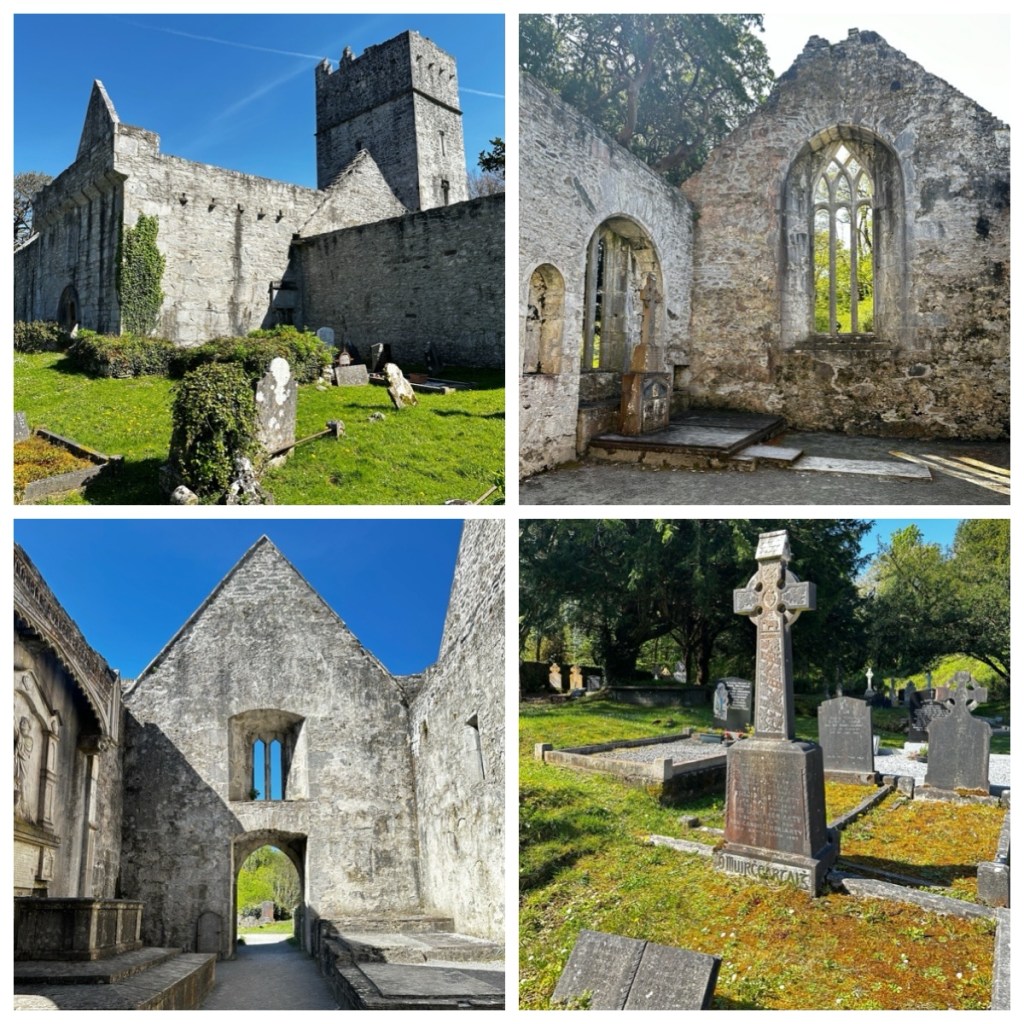
The enclosed cloister walkways of the Abbey are typical of Franciscan architecture in Ireland and are almost fully intact with a dramatic old yew tree in the centre. Yew trees are found in most old cemeteries and monastic sites in Ireland.

The cornerstone of Killarney National Park is Muckross House, an elegant 19th-century estate. Built in 1839, the resident Herbert family conducted extensive renovations before Queen Victoria’s visit in 1861, leading to financial strain. The Muckross Estate was eventually sold to Arthur Guinness in 1899 for preservation and in 1911, resold to William Bourn who gifted it to his daughter Maud and her husband Arthur Rose Vincent. The estate was donated to the Irish State in 1932. The house can be toured but as we still had a long walk to return to Killarney, we chose not to visit the interior.
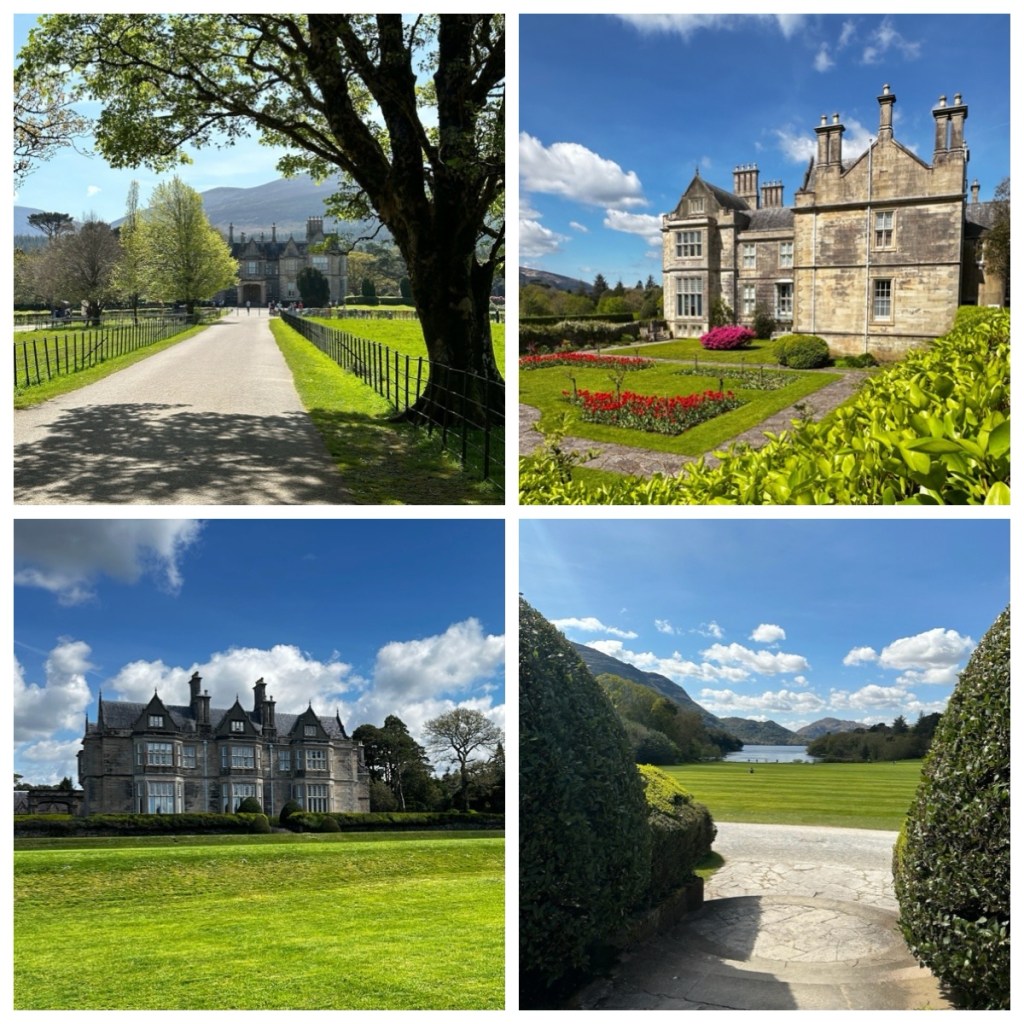
The beautiful gardens surrounding Muckross House were developed for Queen Victoria’s visit and expanded by subsequent owners. Highlights of the gardens are the Rock Garden, which is made from natural limestone, the extensive Water Garden and the ornate Sunken Garden. On our April visit, the tulips, cherry blossoms and rhododendrons were stunning!

We had an excellent lunch at the Garden Restaurant at Muckross House. Also, adjacent to the house and gardens is the Muckross Farm, an open-air farm museum. It wasn’t open during the week in April so we were unable to check it out.
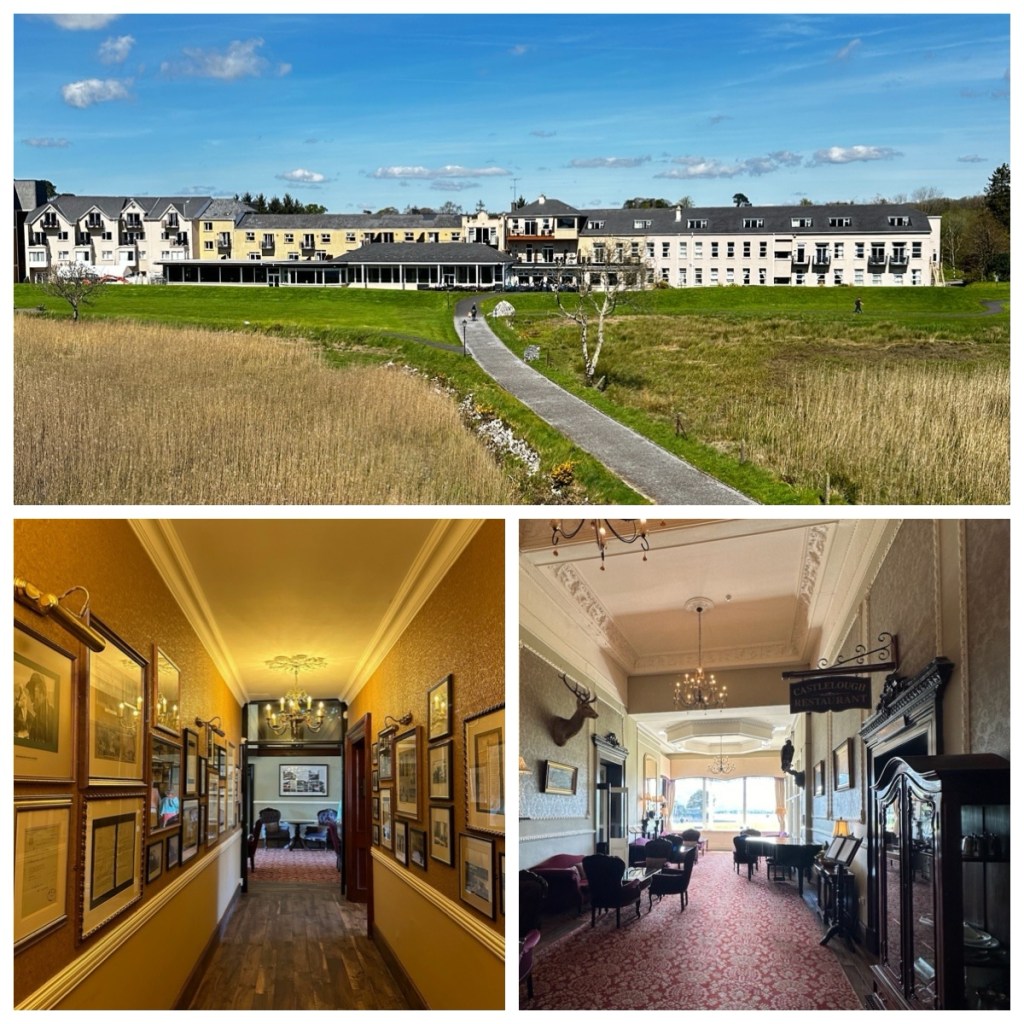
On our return walk to the town of Killarney, we stopped at the Lake Hotel for a refreshing break. This lovely property, located on the shore of the Lough Leane, has been welcoming guests since 1820. We enjoyed a delicious Dingle Gin & Tonic on the terrace of the Devil’s Punch Bowl Bar.
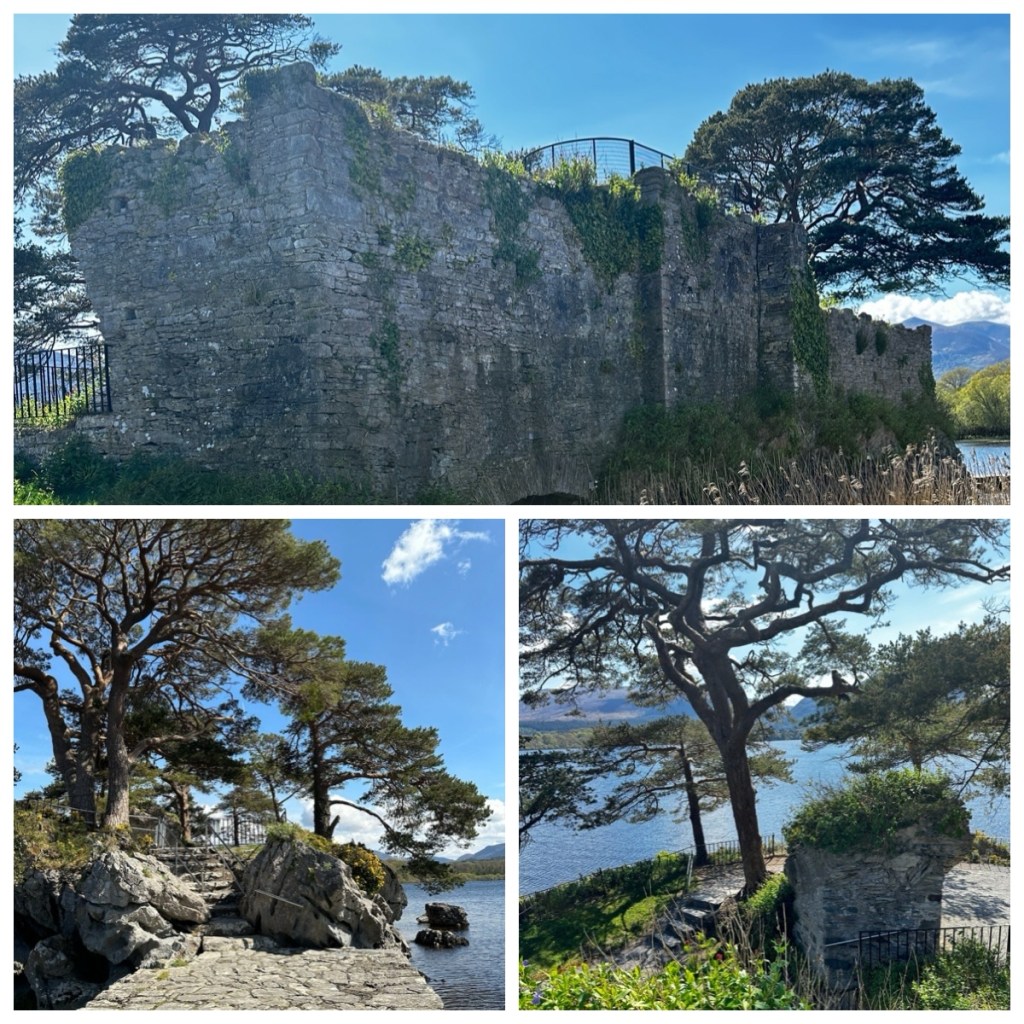
On the grounds of the Lake Hotel are the ruins of the McCarthy Mór Castle. There is little left of this medieval castle but one can imagine it standing guard on the shores of the lake.
The Wild Atlantic Way stretches 2500 km along Ireland’s west coast from Kinsale in the south to Derry in the north. In County Kerry, the coastline in highlighted by a number of loop drives – the Ring of Kerry, the Ring of Beara, the Dingle Peninsula Loop and the Skellig Ring loop. The Ring of Kerry is the most popular tour route, but our research told us that the smaller Dingle Peninsula provides a more enjoyable day trip. To paraphrase one tour guide – after touring the Dingle Peninsula, you walk away with a wow factor; after the much longer Ring of Kerry, you walk away exhausted, thinking I need a pint of Guinness.
Thus we chose a day trip from Killarney to the Dingle Peninsula with Rabbie’s Small Group Tours. This company offers tours in Ireland and other parts of Europe. We were on the first ever Rabbie’s one day “The Wild Coast of Dingle Peninsula & Slea Head” tour from Killarney. It was excellent! The Mercedes coach was very comfortable – the tour accomodates up to 14 people, but there were only 6 of us on our tour. Our driver / guide, Marcus, was exceptional! He was knowledgeable, humorous and took such good care of us. The history and anecdotes he provided made the tour so interesting and enjoyable. We loved the drive, the scenery and all of the stops (even some extra ones that Marcus threw in as it was a beautiful day for scenery). There was plenty of time at each of the stops. We would highly recommend this tour, the company and Marcus.

On our way to the peninsula, we passed through the town of Castlemaine. Marcus told us that Australians become very animated when they see this town. Apparently, they have a legend about a bushranger – the Wild Colonial Boy Jack Duggan. It appears that Jack Duggan is a fictional character from a song – perhaps a composite of a number of wild colonial boys. But Castlemaine boasts a statue so who knows for sure?? I know I have at least two Australian readers, so I’ll ask if they can sing along to these lyrics and weigh in on Jack’s actual existence. Hugh? Tom?
“There was a Wild Colonial Boy, Jack Duggan was his name
He was born and raised in Ireland, in a place called Castlemaine
He was his father’s only son, his mother’s pride and joy
And dearly did his parents love, the Wild Colonial Boy“

The Dingle Peninsula (Corca Dhuibhne) stretches 48 km into the Atlantic Ocean and is the westernmost point of Ireland. Some also say the westernmost point of Europe although apparently, Portugal disputes this claim. Head west and the next stop is Newfoundland – having been at the easternmost point in Newfoundland, we have seen that part of the Atlantic from both sides! The peninsula is 24 km wide at its widest.
The peninsula has a long history, with the first known evidence of human habitation dating from around 4000 BC. It was one of the most isolated and poor districts in Ireland in the 19th century with a population of 35,815 in 1841. The Great Irish Famine (commonly known as the Great Hunger) of 1845 – 1849 devastated Ireland with millions of lives lost and millions of people emigrating to escape starvation. The Dingle area population fell significantly and today has approximately 12,000 permanent residents.
Much of the Dingle Peninsula is a Gaeltacht or an area where the Irish language (Gaeilge, Gaelainn or Gaelic) is widely spoken in the home, workplace and school. In the other areas of the Republic of Ireland that we visited, we noted that road signs are in English and Irish (Gaelic) but in the Dingle area, many are in Gaelic only. Our guide noted that with the influx of tourists, English is starting to be added to many.
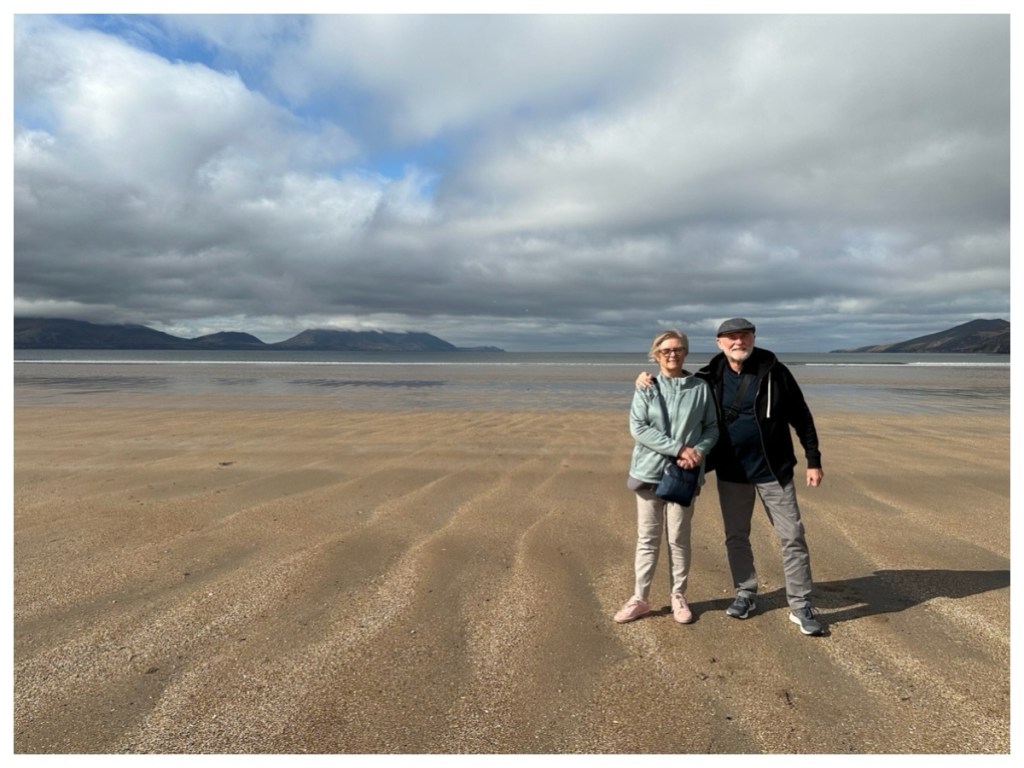
The first stop of our tour was at Inch Beach, a 5 km long stretch of sand and dunes alongside Dingle Bay. It is the largest and one of the best remaining ‘intact’ dune systems in the country and is very popular for surfing, swimming and fishing. We had it almost to ourselves on a Tuesday in April. The beach has Blue Flag status which means that it is compliant with European standards for bathing water and it also has lifeguards in the summer months. It’s cinematic claim to fame is that scenes for ‘Ryan’s Daughter’ and ‘The Playboy of the Western World’ were filmed on the beach.
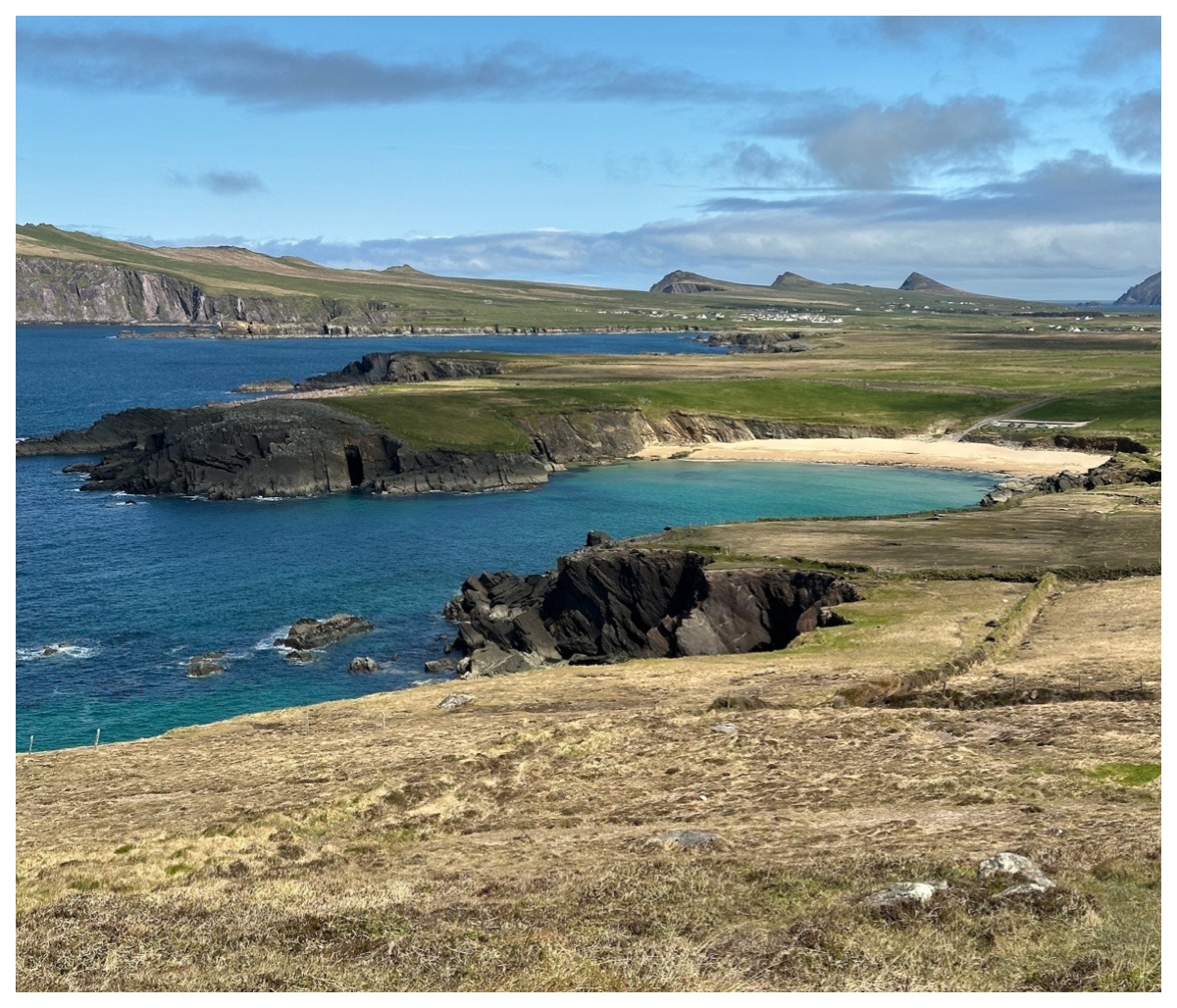
The Slea Head Loop drive is about 45 km long and must be driven in a clockwise direction on the narrow roads. There are signs indicating this, but we did meet one car heading the wrong way – the unfortunate driver had to backup quite a ways!! The scenery is spectacular – from rolling green hills and stone walls to gorgeous coastlines that are rough and craggy with brilliant blue waters.
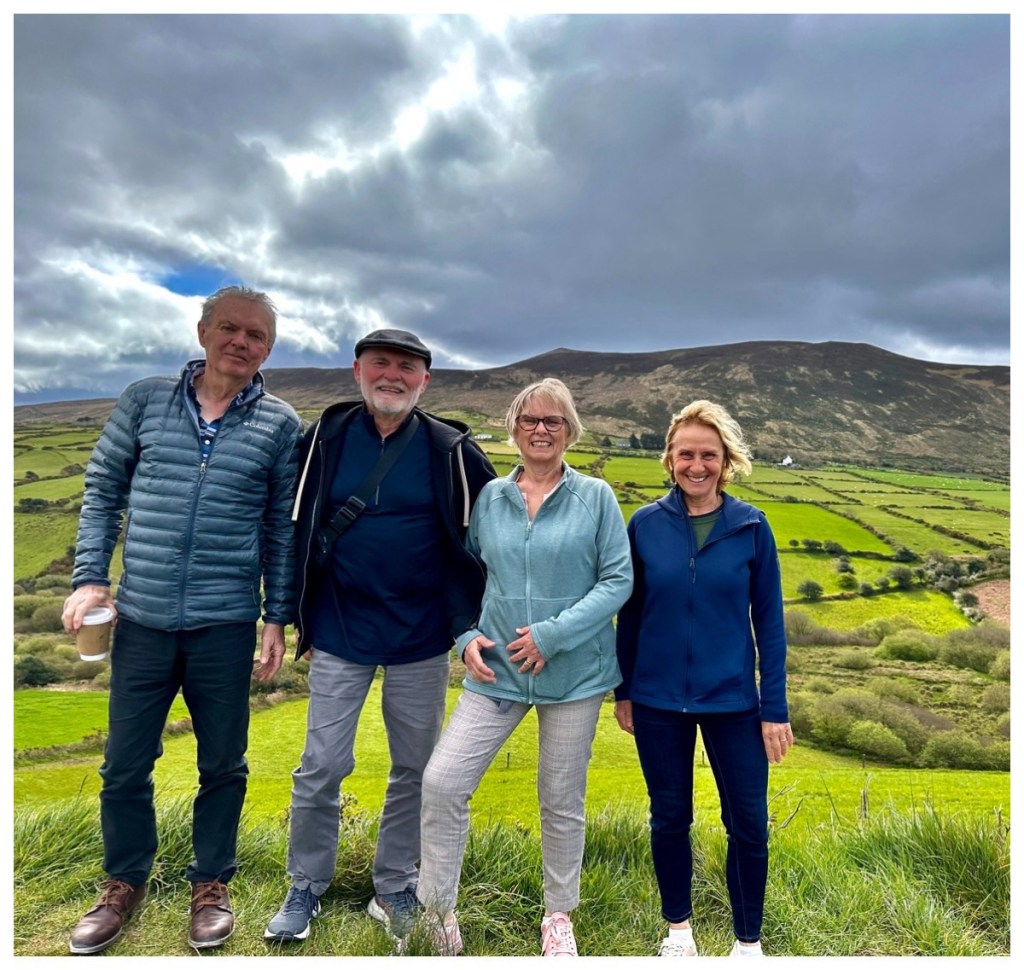
As you follow the loop, you pass through Dingle town (we returned later for a stop), tiny villages, and the ruins of a Stone Age ring fort. There was a very busy attraction featuring beehive huts but our Marcus knows the ropes. Just another couple of kilometres and we stopped at place with very few tourists. For 3 euro, we visited Beehive Huts at the Fahan Group and were also able to see newborn lambs and border collie puppies.
The provided information describes how the site is named after a structure called a cathair, which is a Gaelic word to describe a ring fort. The buildings at the Fahan Group stand within a thick stone enclosure. There are five beehive huts and the ruins of a structure that may have been used as a church. The exact age of the houses is uncertain, and different theories date them anywhere from the eighth to 12th centuries AD. The builders didn’t use any mortar. Rather, rings of stone were stacked, each layer a bit further inward until a pointed roof was formed . It is also unknown if these were permanent residences or used as stopover sights for pilgrims.

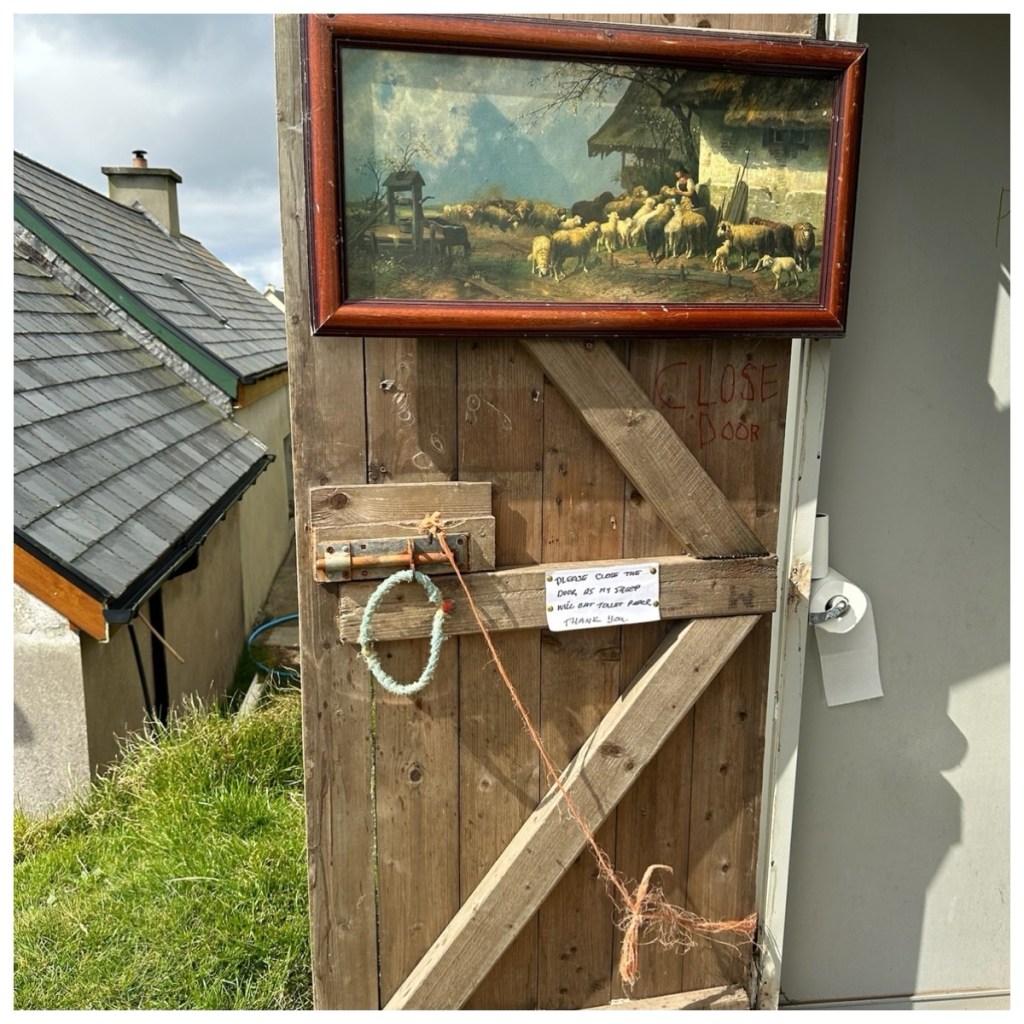
The outhouse at this stop was unique. The sign on the door reads “Please close the door, as my sheep will eat toilet paper”.
In the distance as you drive, you can see Skellig Michael, a UNESCO World Heritage Site. This pyramid-shaped island holds the ruins of St Fionan’s monastery, as well as the beehive huts where the monks slept. The monks left the island in the thirteenth century. It became a place of pilgrimage and, during the time of the Penal Laws, a haven for Catholics. More recently, the island is well-known for its starring role as Luke Skywalker’s Island Sanctuary on the planet Ahch-To in both Star Wars Episode VII: The Force Awakens and Star Wars Episode VIII: The Last Jedi.
You also view the Blaskett Islands, an archipelego of uninhabited islands. The last island to hold a significant population, Great Blasket Island, was abandoned in 1954 due to population decline, although you can apply to spend the summer as a caretaker to manage the coffee shop and 4 holiday cottages.
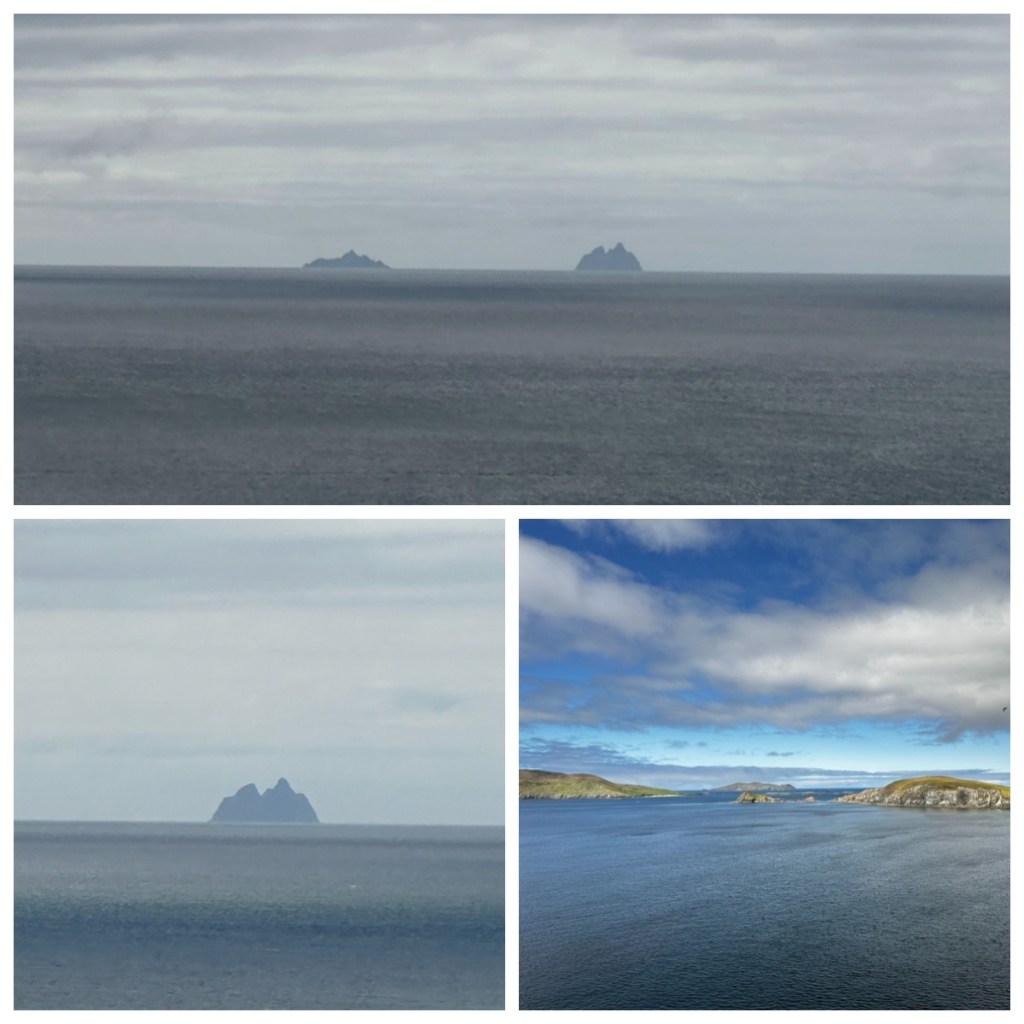
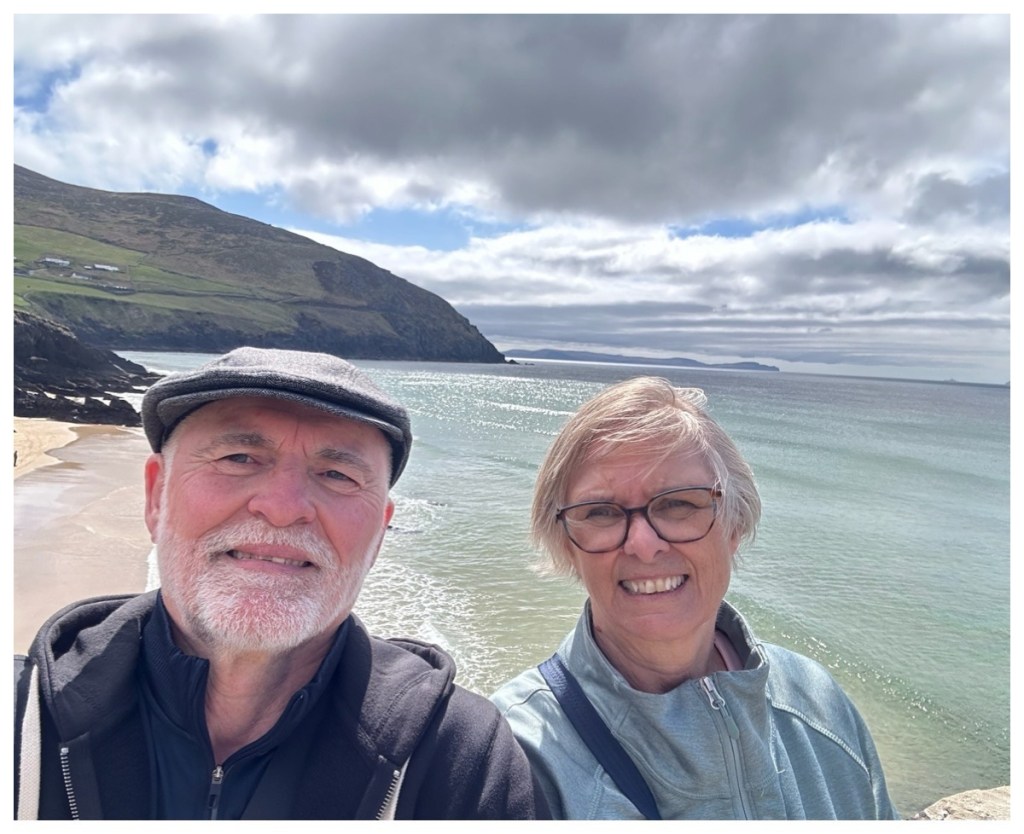
Dunmore Head (An Dún Mór) is the westernmost point on the mainland of Ireland. The scenery is amazing and the roar of the waves crashing on the rocks is mesmerizing. A 2 km loop takes you to the top of the promontory; we didn’t do the climb although one of travelling partners did and said the views were wonderful! Coumeenoole Beach is adjacent to Dunmore Head and is considered by many, including our tour guide, to be the most beautiful beach in Ireland.
Although most of the filming for Luke Skywalker’s Jedi retreat of Ahch-To in Star Wars, The Last Jedi was done on Skellig Michael, scenes were filed on Dunmore Head as well other spots on the peninsula.

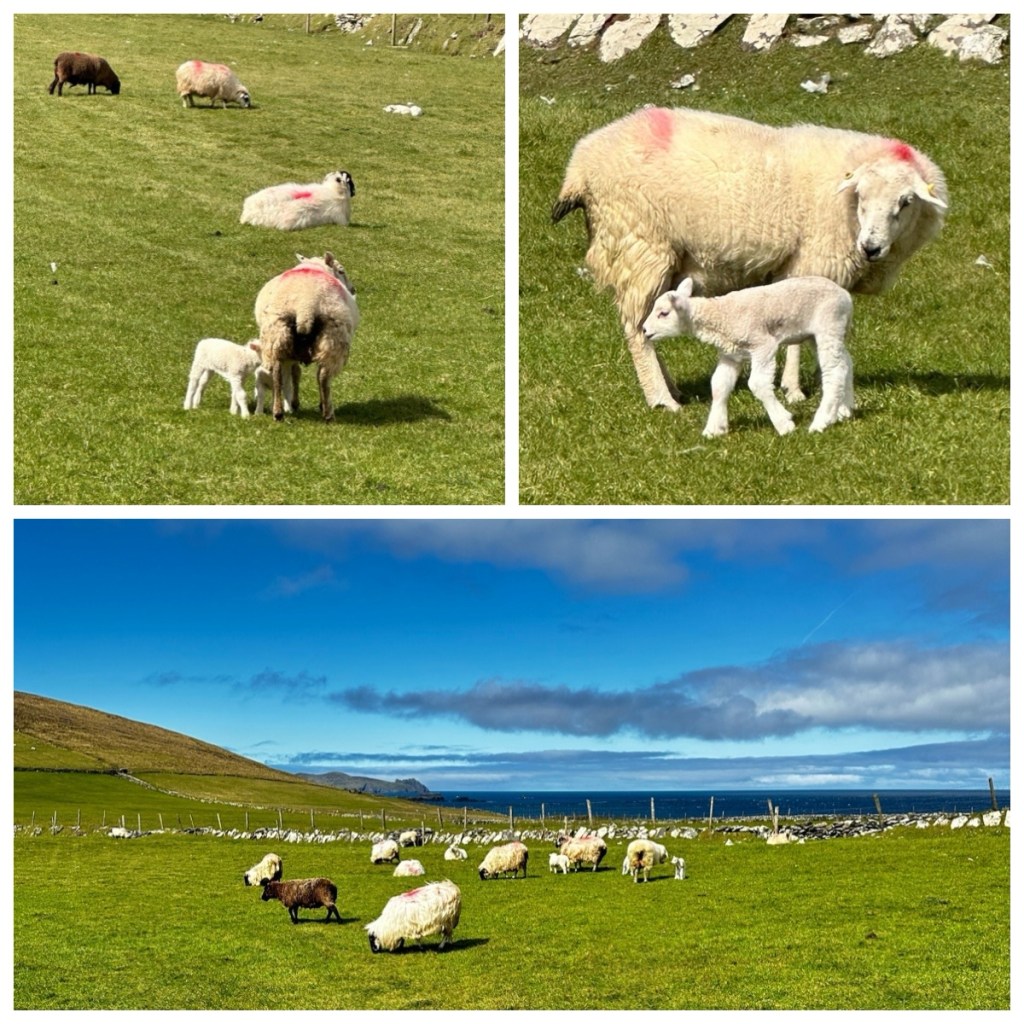
The Dingle Peninsula is home to 50,000 sheep and they are everywhere. The little lambs were so fun to watch!
The Gallarus Oratory is located just off the Slea Head Drive. The site, a National Monument, can be accessed either for free down a short path off a side road (to reach this, go past the first sign directing you to the oratory), or by going to the Gallarus visitor centre where there is a café and toilet facilities, and a video show for a small charge.
It is impossible to accurately date this building, but modern scholars tend towards a 10th or even 11th century date, although others prefer to place it somewhat earlier. It is the best preserved ancient church in Ireland and one of the few remaining churches of this type to survive intact today. The oratory is built of large stones, cut on every side and end and fitted together perfectly to follow the curve of the wall. It is situated within a monastic enclosure and overlooks Smerwich Harbour and the Atlantic Ocean to the west and Mount Brandon to the east.

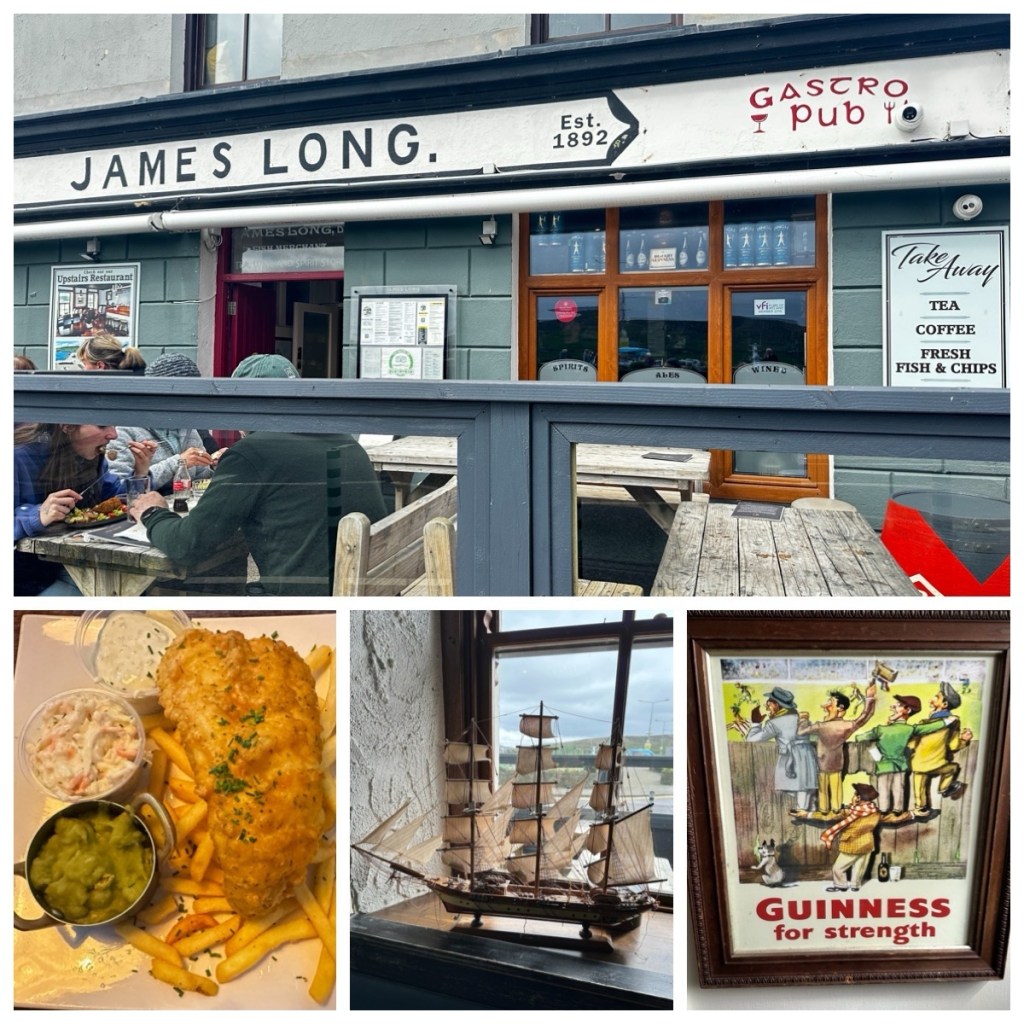
The final stop on our tour was the town of Dingle. Here we had adequate time to have lunch and explore the town. The fish & chips at the James Pond Gastropub were excellent.
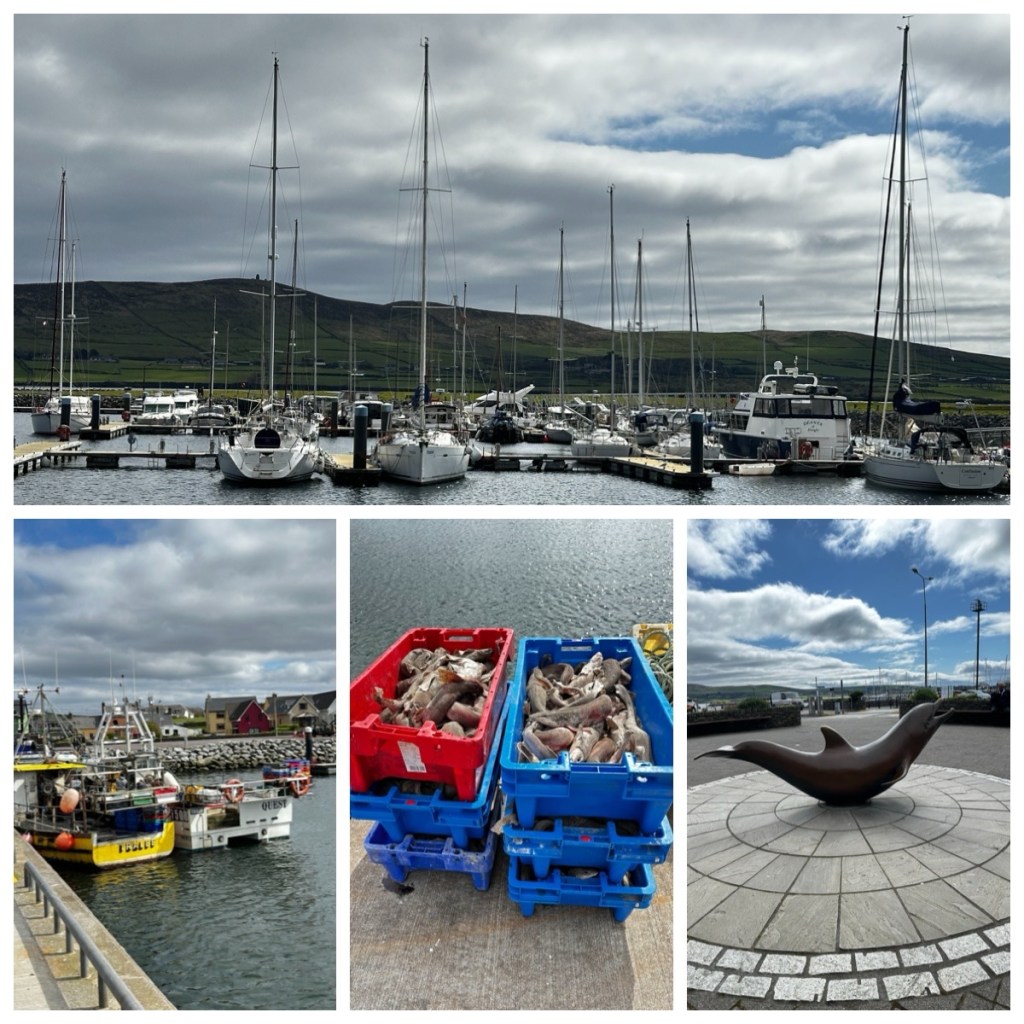
We were assured that the fish we enjoyed came fresh from Dingle Bay and the fishing boats sheltered in the fishing harbour. Adjacent to that area is a pleasure boat harbour, home to numerous sailing vessels. Fungi, a male bottlenose dolphin, lived in the Dingle Harbour area from 1983 – 2020. While entertaining locals and tourists alike, he became the town mascot. It is believed he most likely died of old age in 2020, but he is immortalized with a bronze statue.
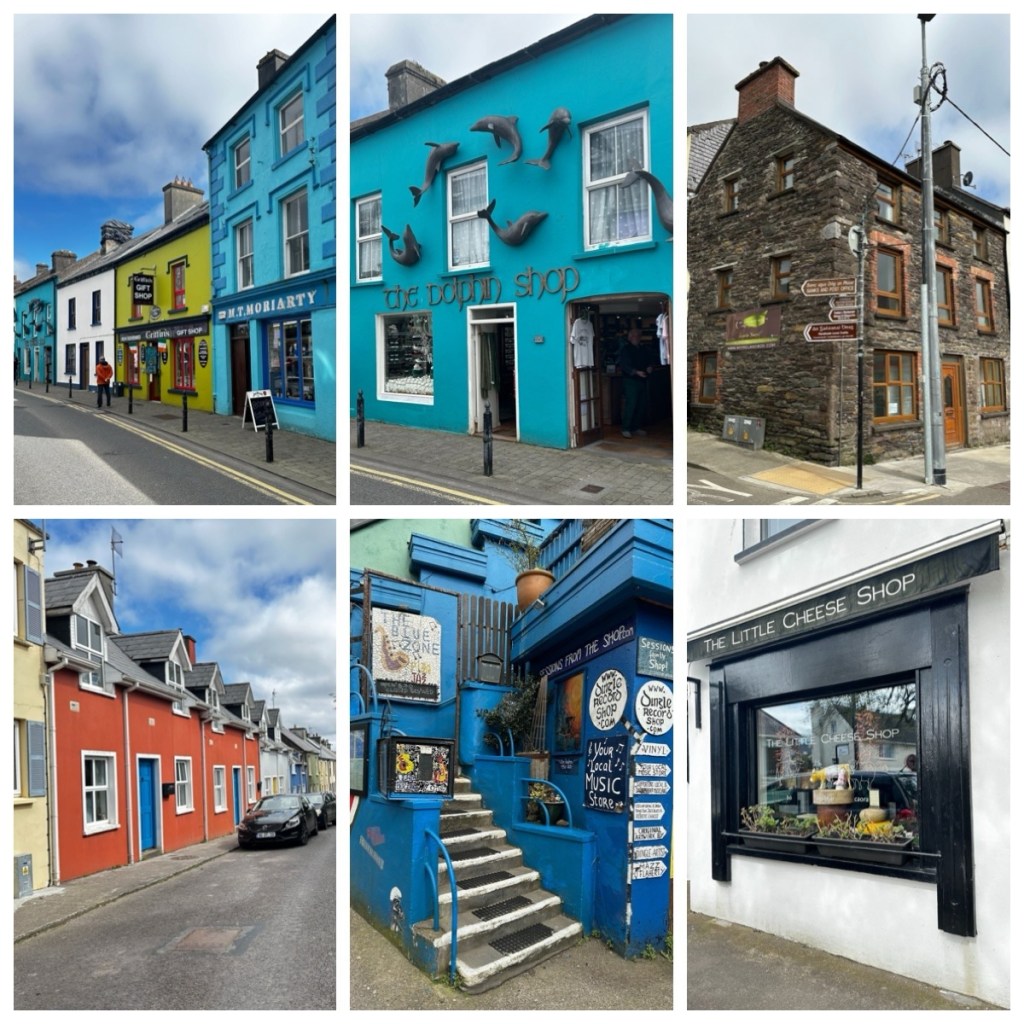
About 2000 people live in Dingle, but the summer season (May – September) is very busy. The central area has a few streets, with brightly coloured buildings and quaint shops.
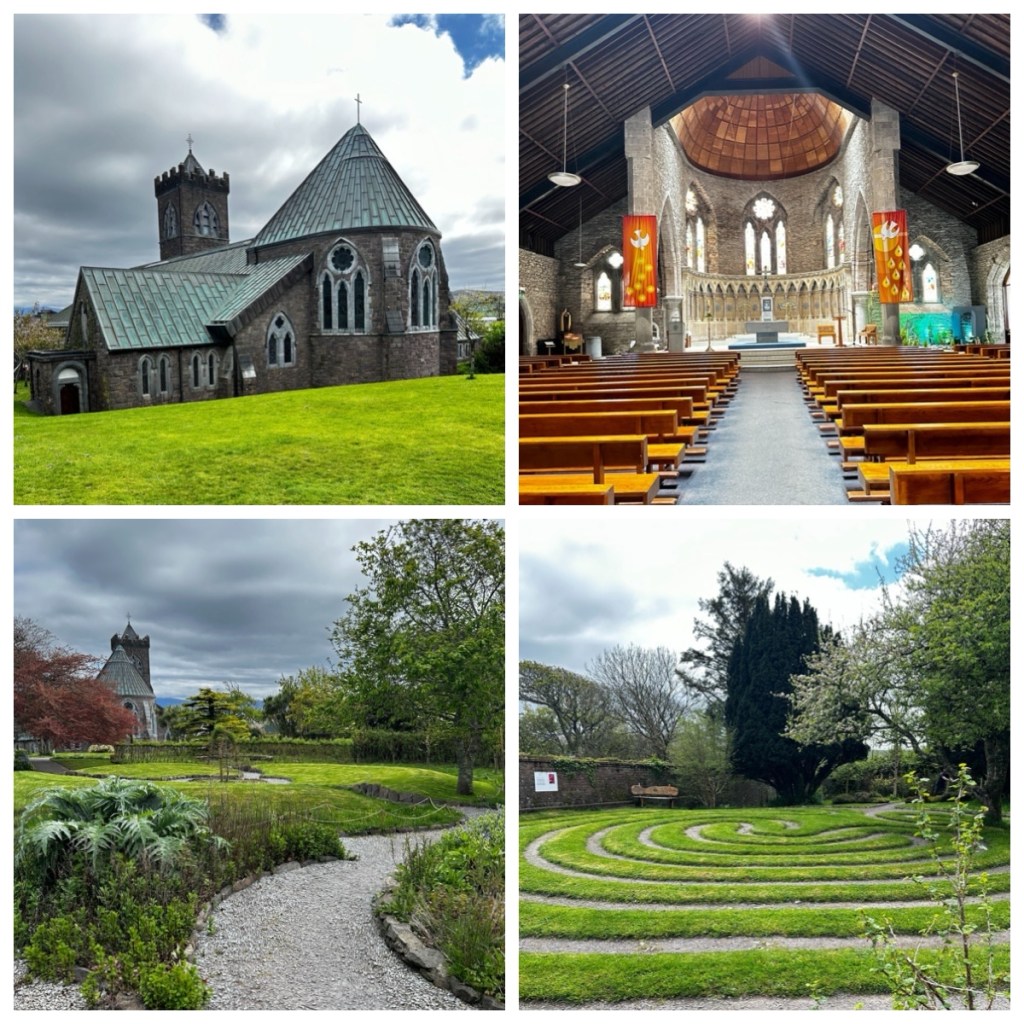
Saint Mary’s Church is a neo-Gothic Catholic Church built in 1862. It sits at the heart of Dingle and shares the grounds with the former Presentation Convent and lovely gardens including a labyrinth. The convent contains the Chapel of the Sacred Heart which is home to 12 stained glass windows by Harry Clarke, Ireland’s top stained-glass designer. Unfortunately, our short visit didn’t allow time to view these.
Our day trip to Dingle was a highlight of our vacation and a great way to end the trip!!
We enjoyed our dining experiences in Killarney. As it had been in Cork, Quinlan’s Seafood Bar was exceptional! Bob’s Ranch was recommended to us by a local – while the food was good, the American western saloon decor wasn’t really what we were looking for in Ireland.
Murphy’s ice cream originated in Dingle. Having had a great lunch while we were there, we weren’t quite ready for ice cream. Luckily, there is a Murphy’s outlet in Killarney where we thoroughly enjoyed our choices of Dingle Gin / Raspberry Sorbet and Chocolate Whiskey / Honeycomb Caramel.

We so enjoyed our trip to Ireland, the land of Céad míle fáilte (a hundred thousand welcomes). From friendly energetic Belfast to cosmopolitan Dublin and on to the rolling green hills and craggy seasides of Counties Cork & Kerry, we loved it all. The people were amazingly friendly, proud of their island whether in the North or the Republic and definitely have the ‘gift of the gab’. The Irish isles have lived through many troubled times and have emerged stronger, optimistic and progressive, while maintaining their history and culture. We definitely hope that we can visit more of the island in the future!
Until next time…….
Slainté,
Bev & Harvey

 A Long and Winding Journey
Bev
Wild Colonial Boy?
In an unofficial history comment it said: In the official notices which fruitlessly offered £20 for his apprehension, Donohoe was described as ’22 years of age, 5 feet 4 inches (163 cm) in height, brown freckled complexion, flaxen hair, blue eyes, and has a scar under the left nostril’. In the late afternoon of 1 September 1830 a detachment of soldiers and police came up with the gang in the Bringelly scrub near Campbelltown. During the ensuing fight Donohoe urged the police to ‘come on, using the most insulting and indecent epithets’. He was killed by a ball fired by Trooper Muggleston.
Hugh
LikeLike