While staying in Brindisi, we took a day trip to the city of Lecce. An easy Trenitalia 30 minute train ride took us south to the Lecce central train station.
Lecce is often nicknamed “the Florence of the South” due to its predominance of Baroque architecture. The origins of the city date back to the 5th century BC. The Roman conquest started the city on its path to importance. With the Norman invasion and later under the rule of the Kingdom of Naples, Lecce grew to become a lively cultural centre that developed trade with merchants from all over the world.
Today, Lecce is one of the main tourist centres in Puglia.
As we were only spending a day, we chose to book a tour from Velo Service. This company specializes in bicycle tours but offers a number of other options. We chose the walking Street Food Tour. We happened to be the only ones booking that tour and so were very pleased to have our own private guide. Francesca is an independent guide who contracts to Velo. The comprehensive information and history that she provided during our 2.5 hours together was excellent. We also had some great tastings – olive oil, wine, traditional Puglian taralli (a ring-shaped cracker), other Apulian snacks and gelato – but apparently, I was enjoying them too much to take pictures….

There are three main gates that offer access to the ancient nucleus of Lecce. We visited two of them.
On the eastern walls of the city, Porta Rudiae is the most interesting and oldest of the gates of Lecce, the one that turned towards the ancient destroyed city of Rudiae. Built on the ruins of an older gate that collapsed towards the end of the 17th century, Porta Rudiae was rebuilt in 1703. This gate, also called Sant’Oronzo , is surmounted by the statue of the saint, protector of Lecce, and by those of the other protectors of the holy city, Irene and San Domenico.

The southern gate, Porta San Biagio is dedicated to San Biagiom, born in Lecce and bishop of the city of Sebaste in Armenia in the 4th century. Legend says that he left for Armenia due to the persecutions from the road on where this door stands. Built in place of an older gate commissioned by Charles V, Porta San Biagio was rebuilt in 1774. The door is surmounted by the coat of arms of King Ferdinand IV of Naples and that of the city of Lecce. The sculpture of San Biagio in bishop’s clothes completes the artistic ornamentation of the door.

The Anfiteatro Romano di Lecce (Roman Amphitheater of Lecce) was once the scene of animal fights, gladiatorial contests, and other extravaganzas. The theatre was unearthed in 1906 while digging the foundations for a bank and remains difficult to date, but most likely it was built during the reign of Augustus, with restorations over the centuries. In the 15th century, the last remains above ground went into the foundations of the Isola del Goveratore complex of Lecce. The amphitheater takes the form of a circus ellipse, measuring 335 feet by 269 feet. It is built of square blocks of Lecce stone and cement. The basic ground plan divided the structure into four sections, providing four entrances. Twenty-four pillars out of the original 68 arches still stand. It could have seated as many as 15,000 people. It currently is often used for concerts and events.
The amphitheater sits at the edge of Piazza Sant’Oronzo (St. Orontius Square), the heart of the city. Atop the ancient column donated to Lecce from Brindisi is a statue of Sant’Oronzo, the patron saint of the city who is credited with saving Lecce during the dreadful epidemic of plague that devastated the Kingdom of Naples.

The Piazza di Duomo (Cathedral Square) is enclosed on three sides by some of the most ornate Baroque buildings in Lecce, the Cathedral, the Bishop’s Palace, the Seminary, and the lofty Lecce bell tower.
Dedicated to the Assumption of the Virgin Mary, the Lecce Cathedral (Duomo di Lecce) dominates the square. It was first built in 1144, renovated in 1230 and finally rebuilt by architect Giuseppe Zimbalo in 1659. The main entrance is flanked by two stout columns. On either side of the columns are niches holding images of Saints Giusto and Fortunato. Above the balustrade, within an ornately decorated arch, is the figure of Saint Orontius.
The Bishop’s Palace was designed as the background to the square. The clock and facade were added in 1758. The seminary was built in 1729 and covers the whole west side of the piazza. The 230-foot bell tower was built by Giuseppe Zimbalo in 1682.

The exact number of churches in Lecce is hard to pin down – I have seen reports of 48 but we were told it’s actually closer to 100. Suffice to say, there are many! We viewed a few exteriors, only entering a couple in our short visit.
The Basilica di San Giovanni Battista al Rosario (Church of St. John Battista of Rosario) was built between 1691 and 1728, replacing a previous structure from 1388. It has been serving as the parish headquarters since 1914. The basilica’s façade is elaborate with two levels. The lower-level features two large fluted columns framing a grand entrance. Above the entrance, the Dominican symbol and the San Domenico di Guzman statue can be seen. Adjacent to the entrance are niches containing stone statues of Saint John the Baptist and Blessed Francis of the Order of Preachers. Internally, the basilica takes the shape of a Greek cross, with a spacious octagonal chamber covered by wooden trusses. Along the internal perimeter are twelve small chapels with intricate Baroque altars.

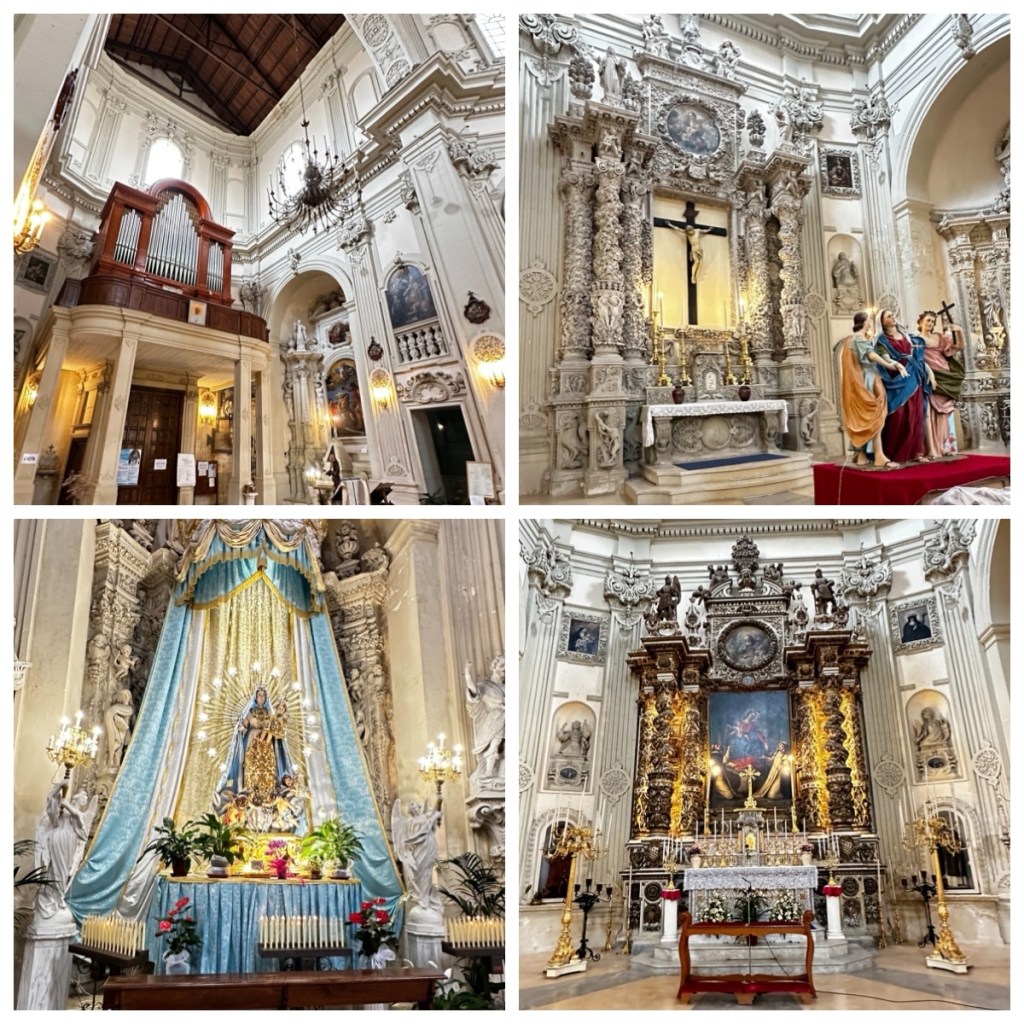
The Chiesa di Sant’Anna was built in 1680. The simple, linear architectural structure is similar to the classical design of the main facade of the Duomo, suggesting the same architect.

A few of the other churches we viewed on our walk around the city include (clockwise from top left):
- Chiesa di Santa Chiara (St. Chiara Church) was constructed in 1429 with extensive renovations between 1687 and 1691.
- Chiesa di San Matteo (Church of St. Mathew) was built in the latter half of the 17th century, replacing a 15th-century chapel also dedicated to Saint Mathew.
- Basilica di Santa Croce (Basilica of the Holy Cross) was under construction for more than 100 years (1549 – 1699).
- Chiesa del Gesu (Church of Jesus) has served as the headquarters for the Society of Jesus since it opened for worship in 1577.

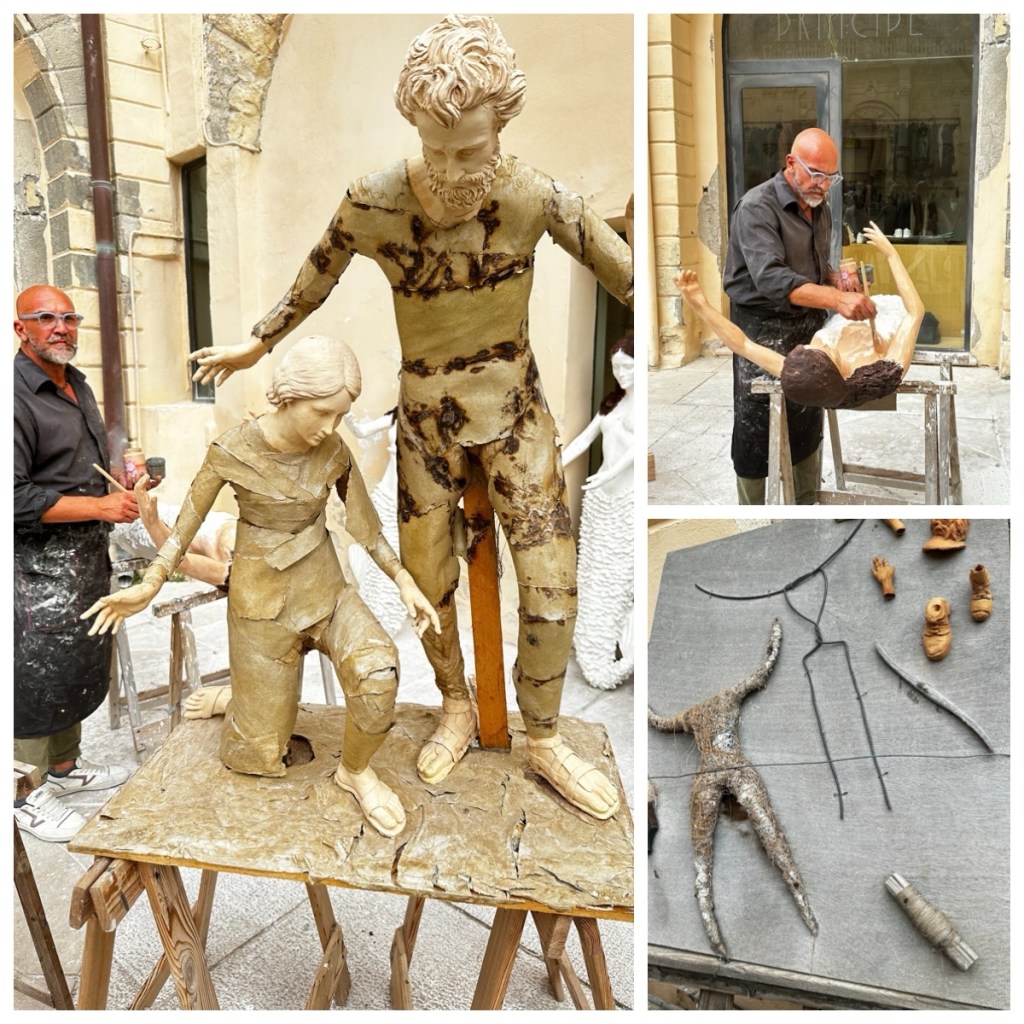
Papier-mâché is a traditional Lecce craft. Marco Epicochi is a master of the art and it was interesting to watch him work in his workshop in the center of Lecce.
The architecture of Lecce encourages a photo around every corner. Here are just a few of the highlights.
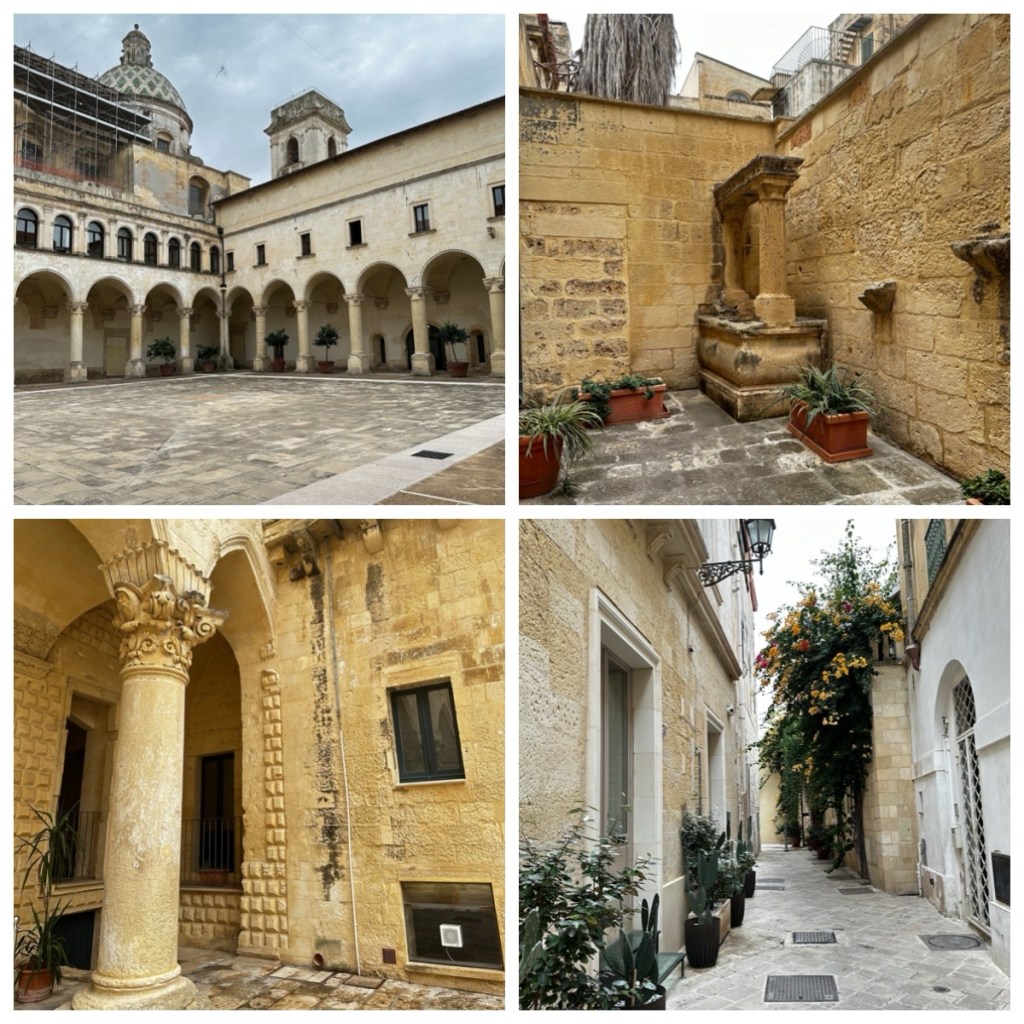
We enjoyed our day in Lecce and appreciate why many would choose to spend more time in this Baroque city.
Cheers,
Bev & Harvey

 A Long and Winding Journey
wonderful architecture.
LikeLiked by 1 person
Very well done again !!
LikeLike