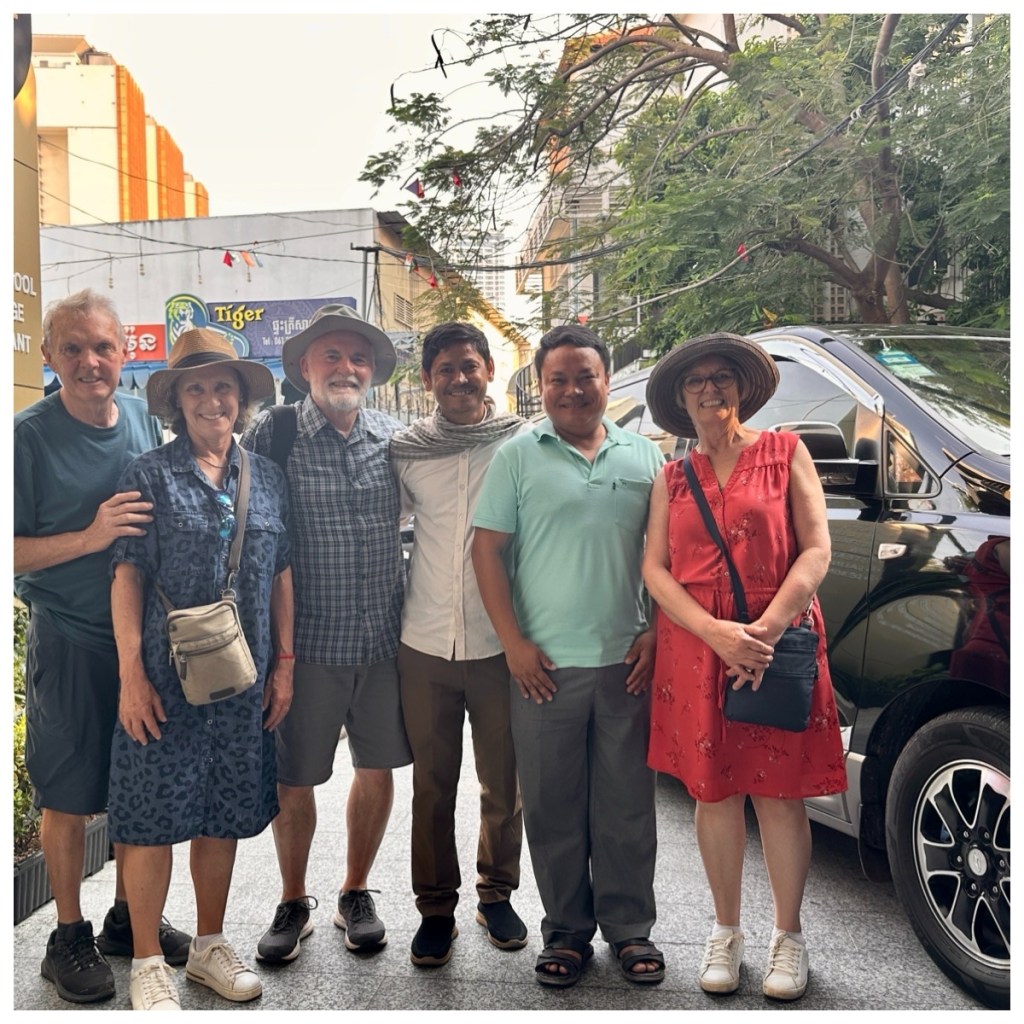
On our second day in Phnom Penh, we booked a full day private tour with Viator tours. We were greeted at 8 am by Tokk, our guide, and the driver (I’m sorry, his name escapes me). Off we went in a great van!
We headed directly to the Royal Palace and were basically the first visitors. This was excellent as not too long later the bus tours arrived.
The original palace was built by King Ponhea Yat in 1434 but nothing remains of this structure. Likewise, very little remains of the wooden palace of King Norodom who moved the capital to PP in 1866. The current Royal Palace was built in the last hundred years. It is the official residence of King Norodom Sihamoni.
Born in 1953, the king was elected by the Throne Council in October 2004 after his father’s surprise abdication. He had an interesting education, studying dance, music, theatre and cinematography in Prague and Korea.
The King of Cambodia is a figure-head in Cambodia’s constitution, which in 1993 stipulated the king’s role as a mainly ceremonial one. It declared that the king “shall reign, but not govern” as well as being the “symbol of national unity and continuity.” The king performs important functions of state as required by the constitution.
There is no designated heir to the throne, and the Royal Council of the Throne elect the next king based on the constitutional guidelines. Candidates must be a male member of the royal family descended from King Ang Duong and must be over 30 years old. King Norodom Sihamoni is a bachelor with no children but his siblings have plentiful progeny; moreover, one of his older brothers, Prince Norodom Chakrapong, is still alive although an unlikely candidate.
The Palace Victory Gate opens from Sothearos Boulevard and faces the Throne Hall. It traditionally symbolizes victory and happiness and serves as the entrance for royal family members and visiting dignitaries only.
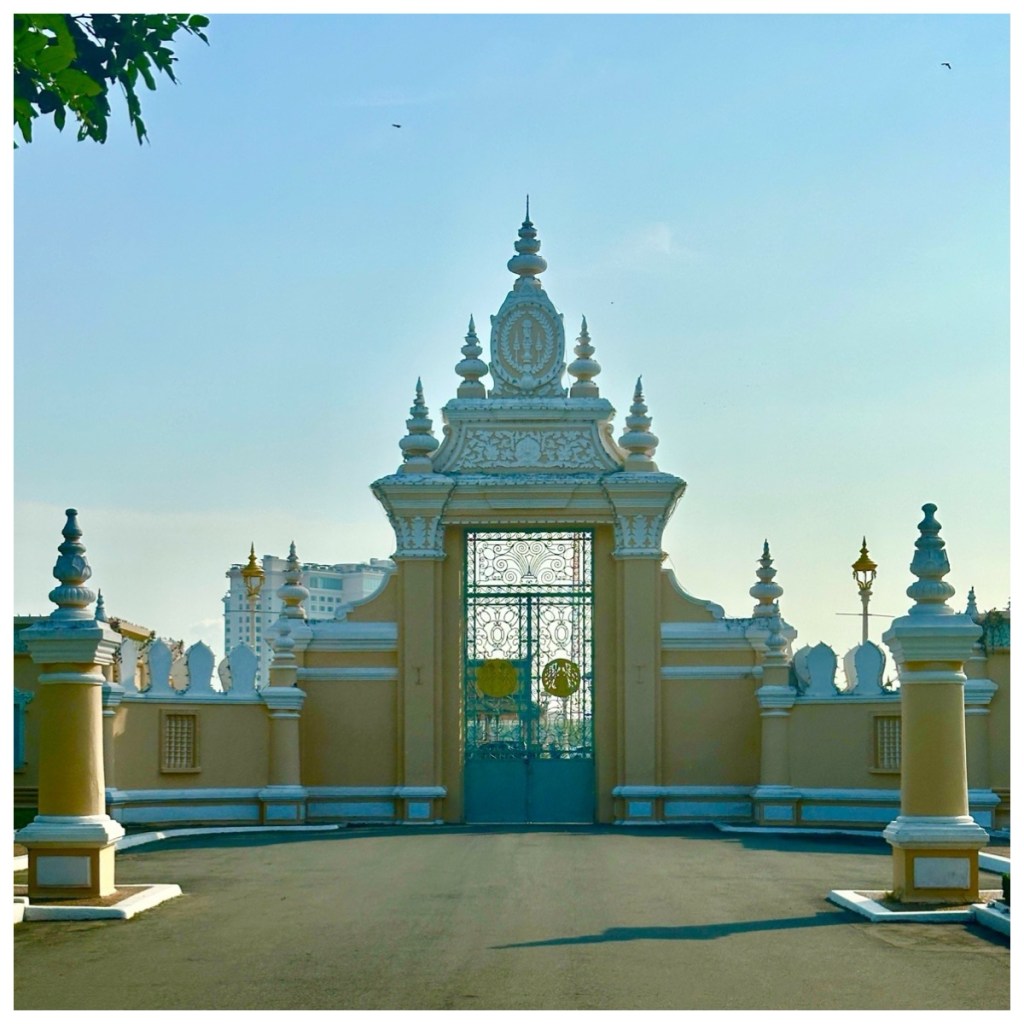
We commoners enter the palace grounds through a gate further along the wall to the south of the Victory Gate.
Built in the traditional Khmer style, many of the complex of royal buildings and the wall surrounding them are painted pale yellow and white, the two colours representing the Buddhist and Hindu faiths.
The gardens of the palace grounds are pristine and lovely to walk through.

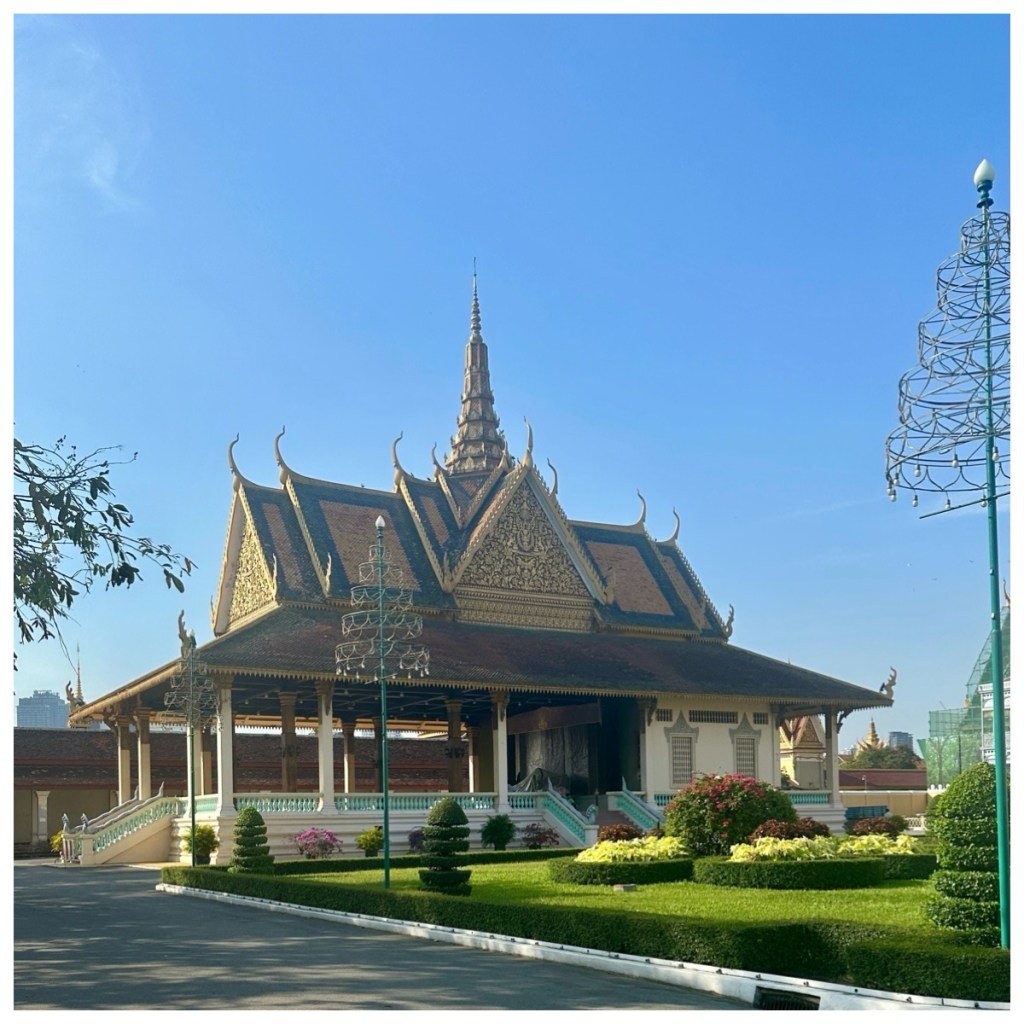
The first major building you pass is the open-sided banqueting hall formally known as Preah Tineang Phochani. The pavilion was built in 1912 as a replacement for an older banquet and dance complex. This pavilion is used for formal banquets, as well as royal dance performances for distinguished guests.
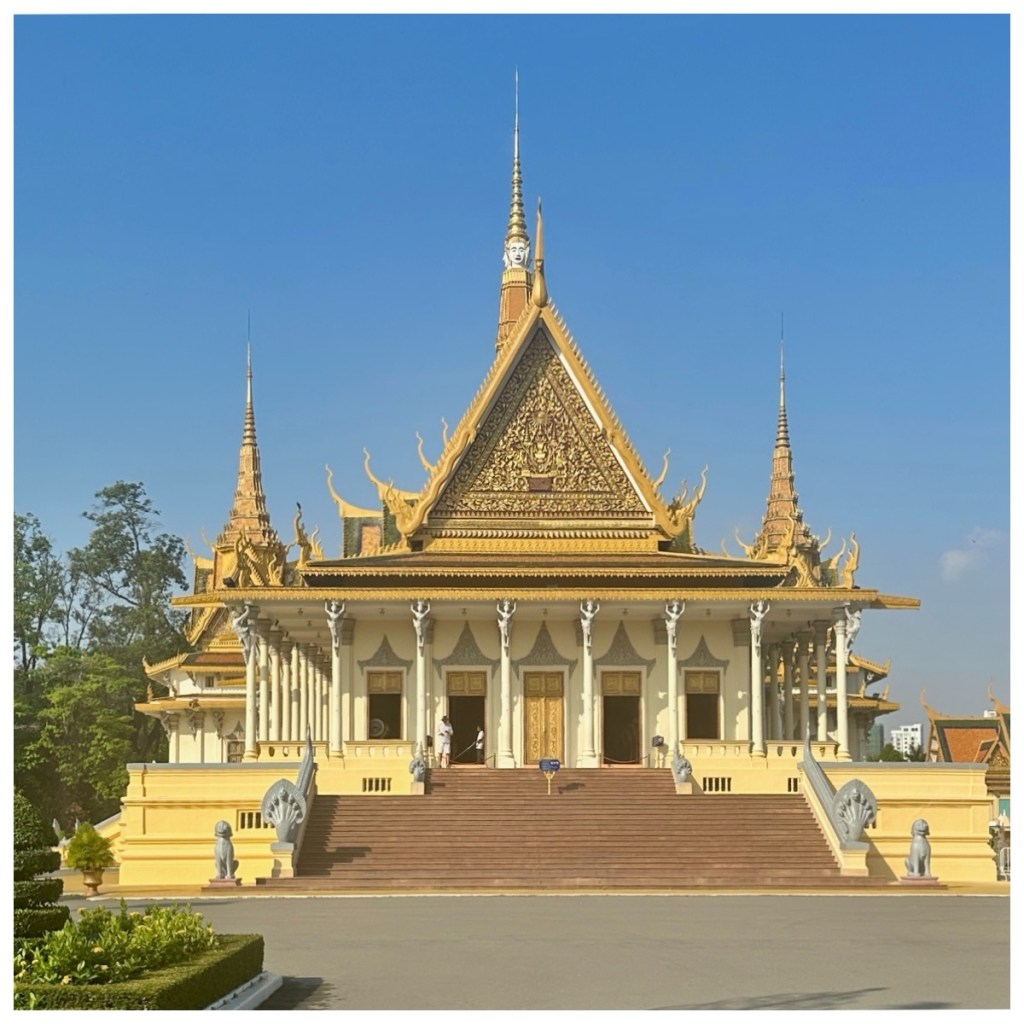
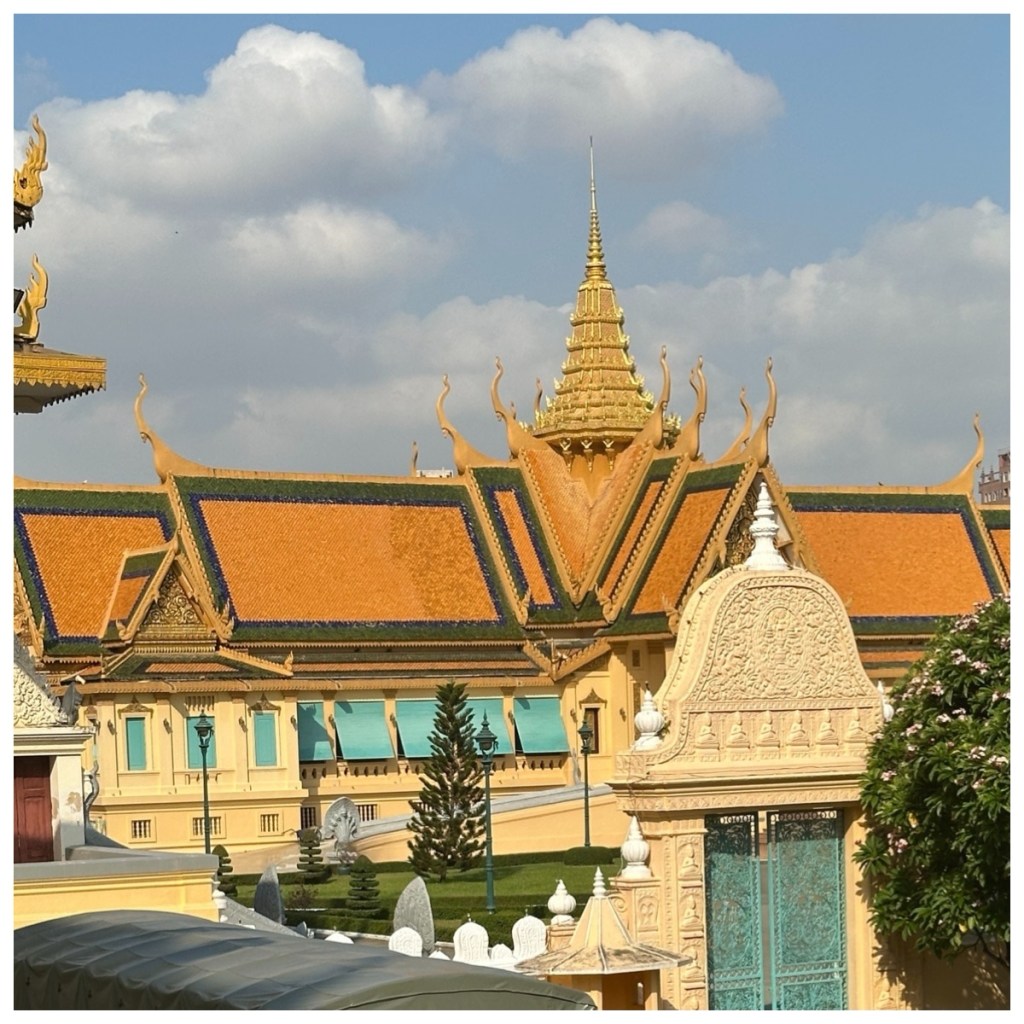
The first wooden Throne Hall built by King Norodom was destroyed in 1915. The current Throne Hall ( (Preah Tineang Tevea Vinichhay) opened in 1917 and is used for meetings and formal receptions, as well as coronations, royal weddings and ceremonies. It is the most impressive building in the complex with its seven tiered roof tiled in orange, sapphire and green representing prosperity, nature and freedom and a 59 meter four-faced golden tower. Golden nagas at the corners of each level protect against evil spirits. We were able to look into the main hall with a 35 meter long runway flanked by rows of gilt standard lamps. Photos were not allowed.
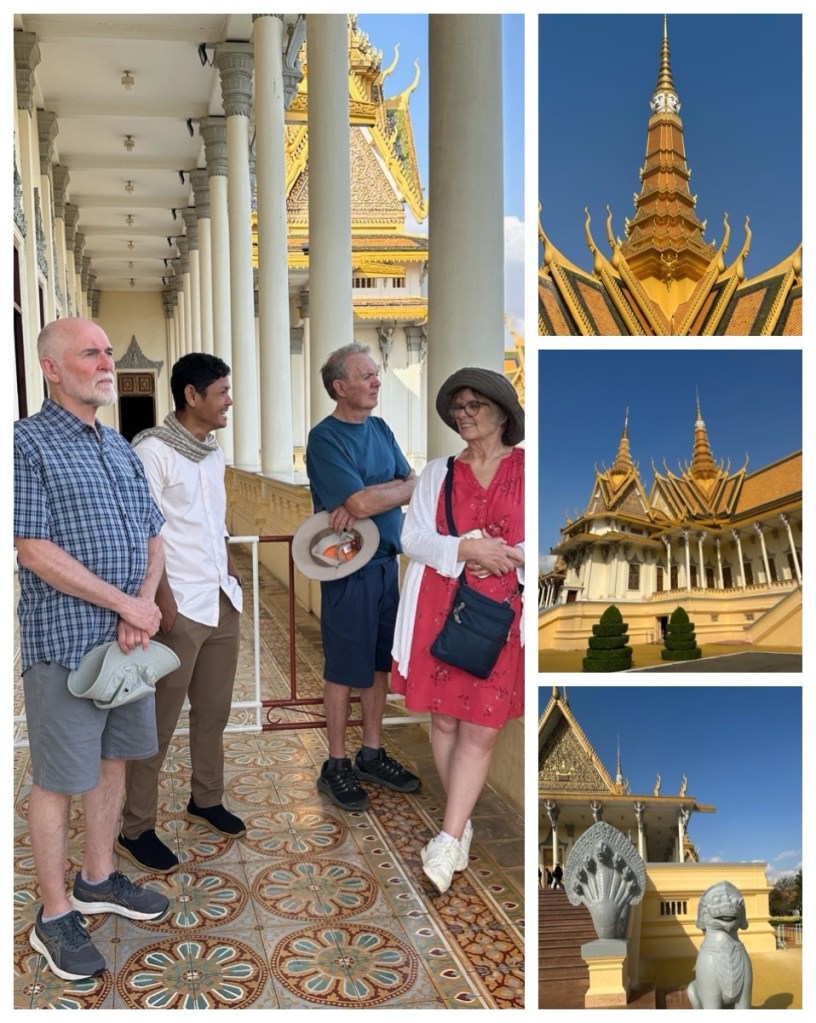
The Royal Waiting Room (Hor Samranphirum) sits next to the Throne Hall and is used on coronation days. Until 1962, the King and Queen would wait for their elephants to be bought around for the coronation processional. It also houses various royal paraphernalia and gifted artifacts. Posts on one side of the building were used to harness the elephants while the royals boarded.
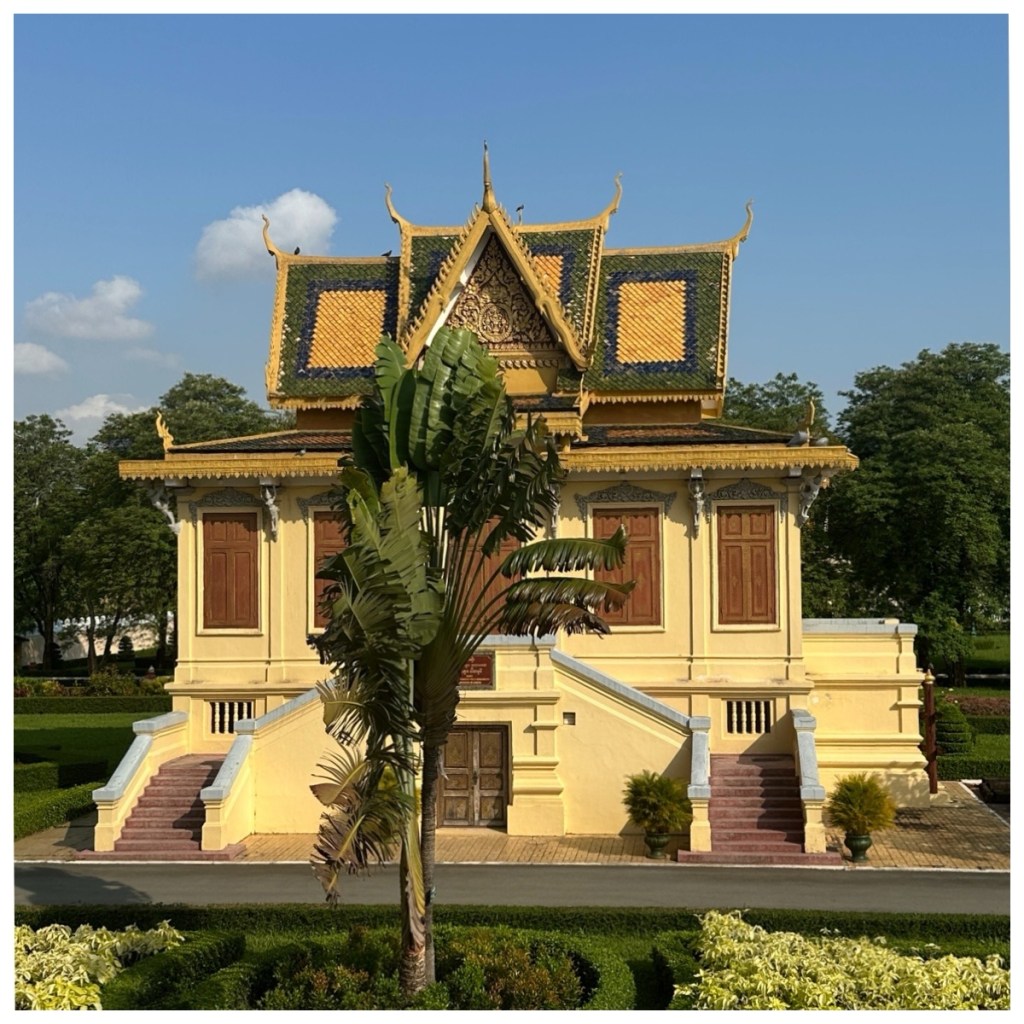
Like Throne Hall, Chanchhaya Pavillion is a reproduction of the wooden one built by King Norodom. It is crowned by a stunning roof with orange tiles, beautiful patterns and a high tower. It is also known as the Moonlight Pavillion and serves as venue for Royal dancers.
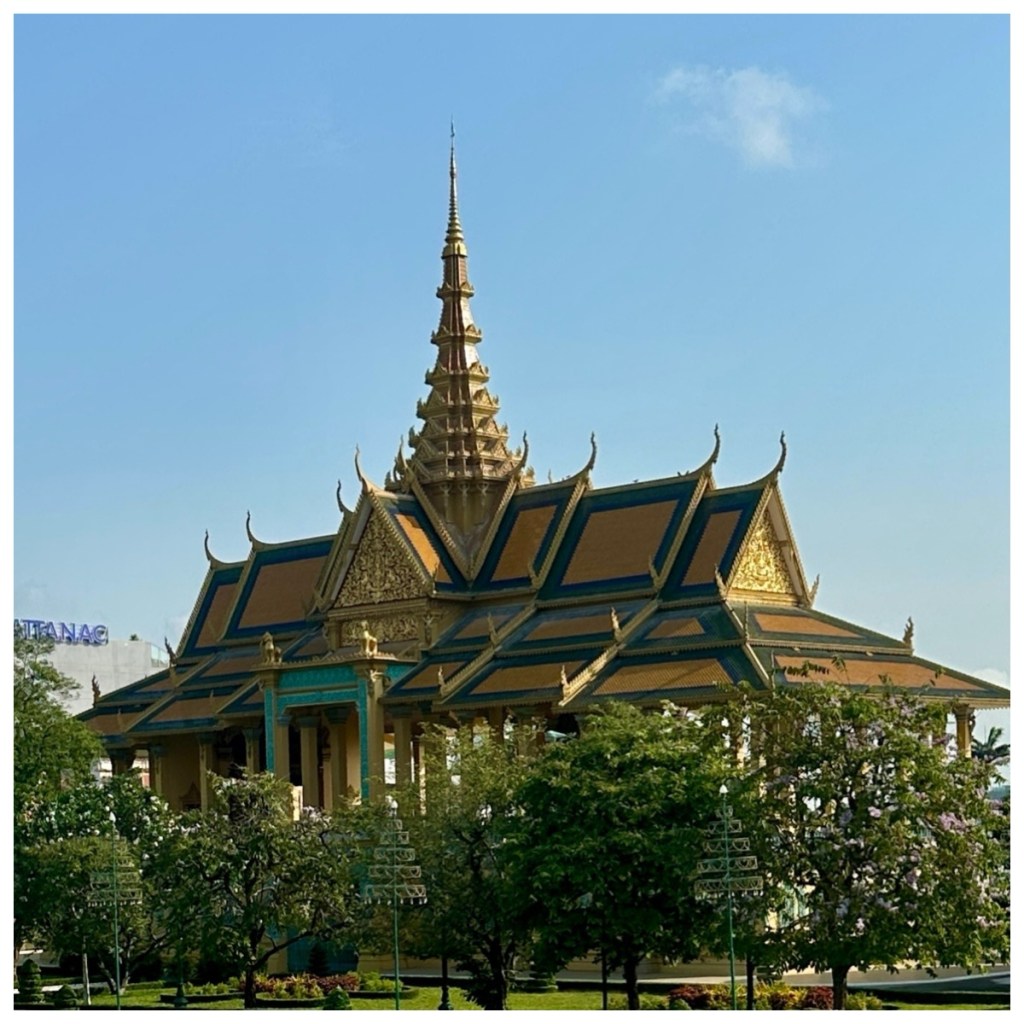
Khmarin Palace includes the Royal residence, the guest house and Damnak Chan – the Royal administrative offices. This compound is separated from other buildings by a small wall and is located to the right of the Throne Hall. The main building is topped with a single spired prang. This area is closed to the public.
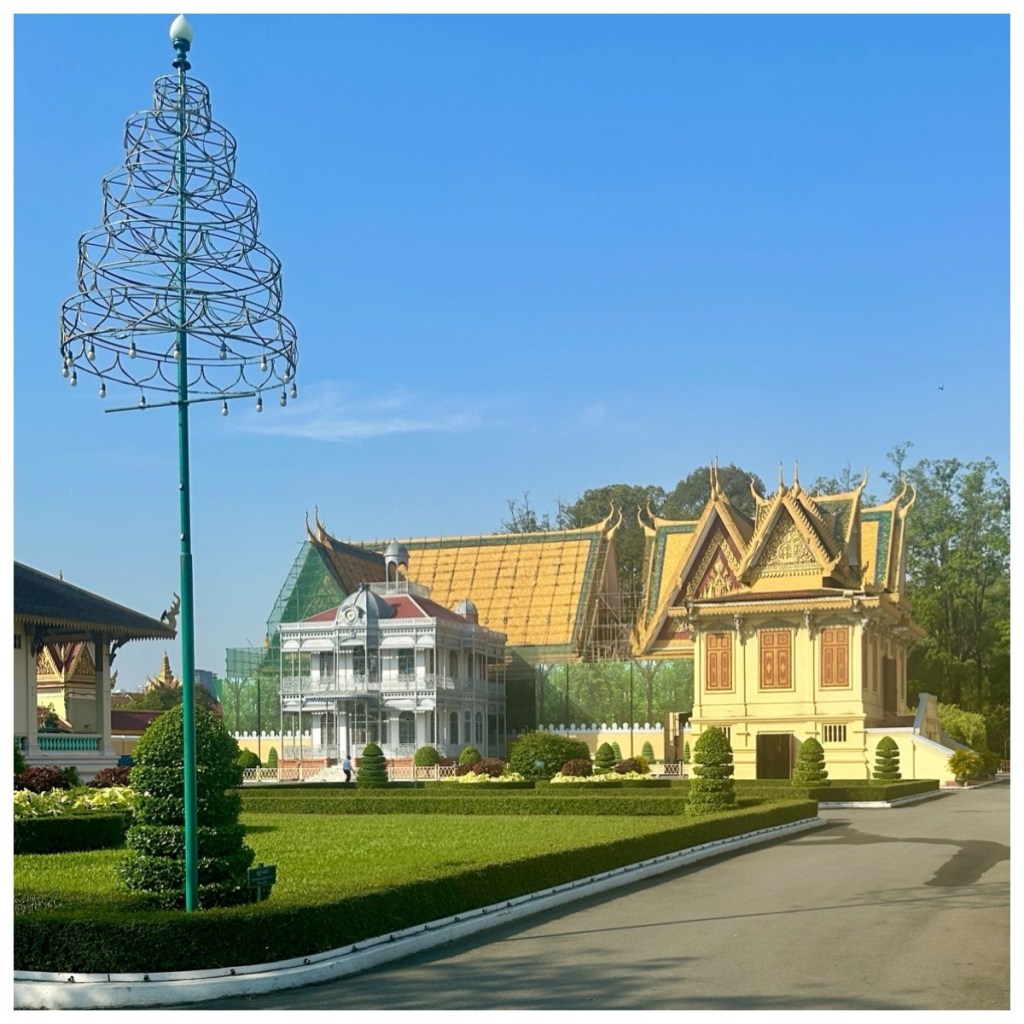
The Napoleon Pavilion, to the left in the photograph, is a prefabricated cast iron villa gifted to King Norodom by Napoleon III in 1876. It is now a museum of royal memorabilia.
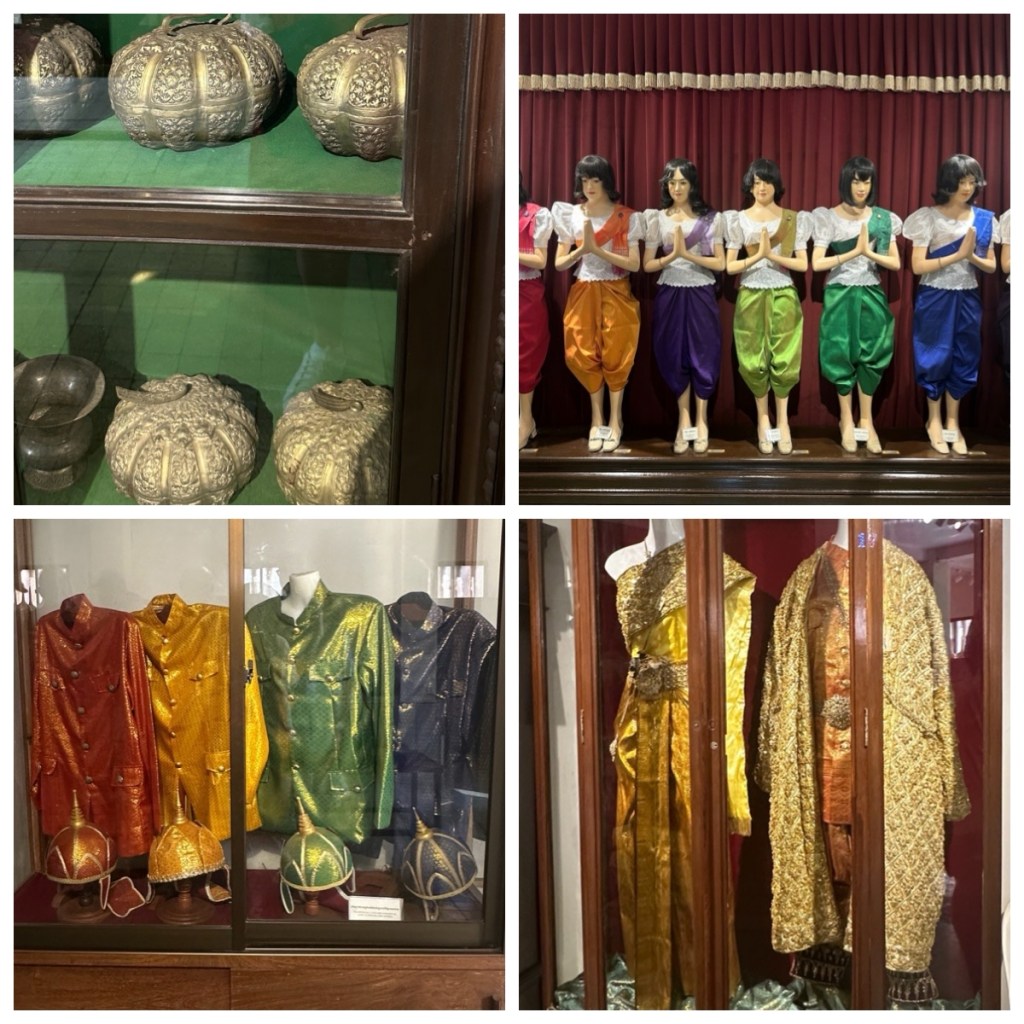
Hor Samrith Phimean, also known at the Bronze Palace, sits to the right of the Napoleon Pavilion. Constructed in 1917, it currently houses a display of royal regalia and costumes.
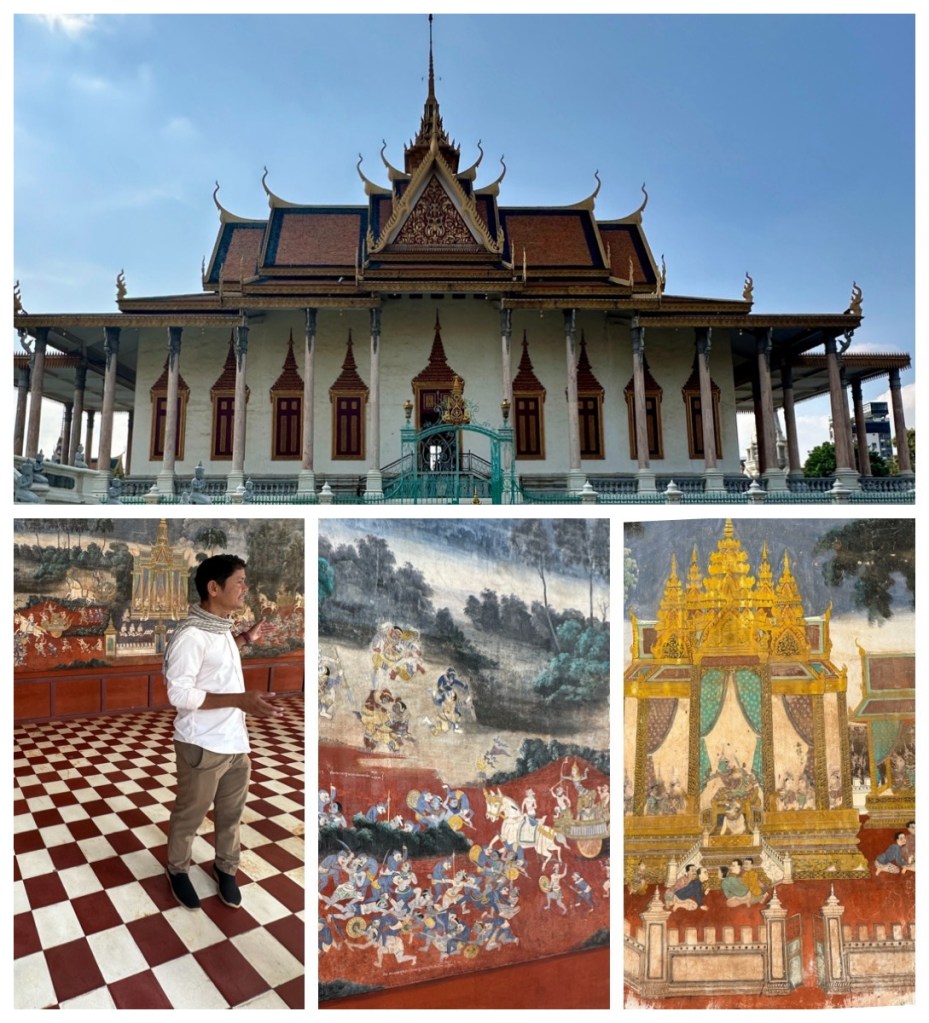
The Silver Pagoda is a compound located on the south side of the palace complex. It features a royal temple officially called Preah Vihear Preah Keo Maorakot (commonly referred to as Wat Preah Keo). Once a simple wooden structure, the current temple dates from 1962. Its name comes from its floor which is covered with over 5,000 silver tiles (now mostly hidden by protective rugs and carpets). The pagoda houses an extensive collection of Buddhist artifacts, including a life-sized gold Buddha adorned with 9584 diamonds, the revered emerald Buddha statue and various gifts from international heads of states. Photography is not permitted in the Silver Pagoda.

The chapel sits in the center of a large paved courtyard. The courtyard is enclosed by a gallery completely covered with murals depicting the Hindu tale of the Ramayana, the national epic of Cambodia. These murals were painted in 1903-1904 by 40 classically-trained Cambodian artists.
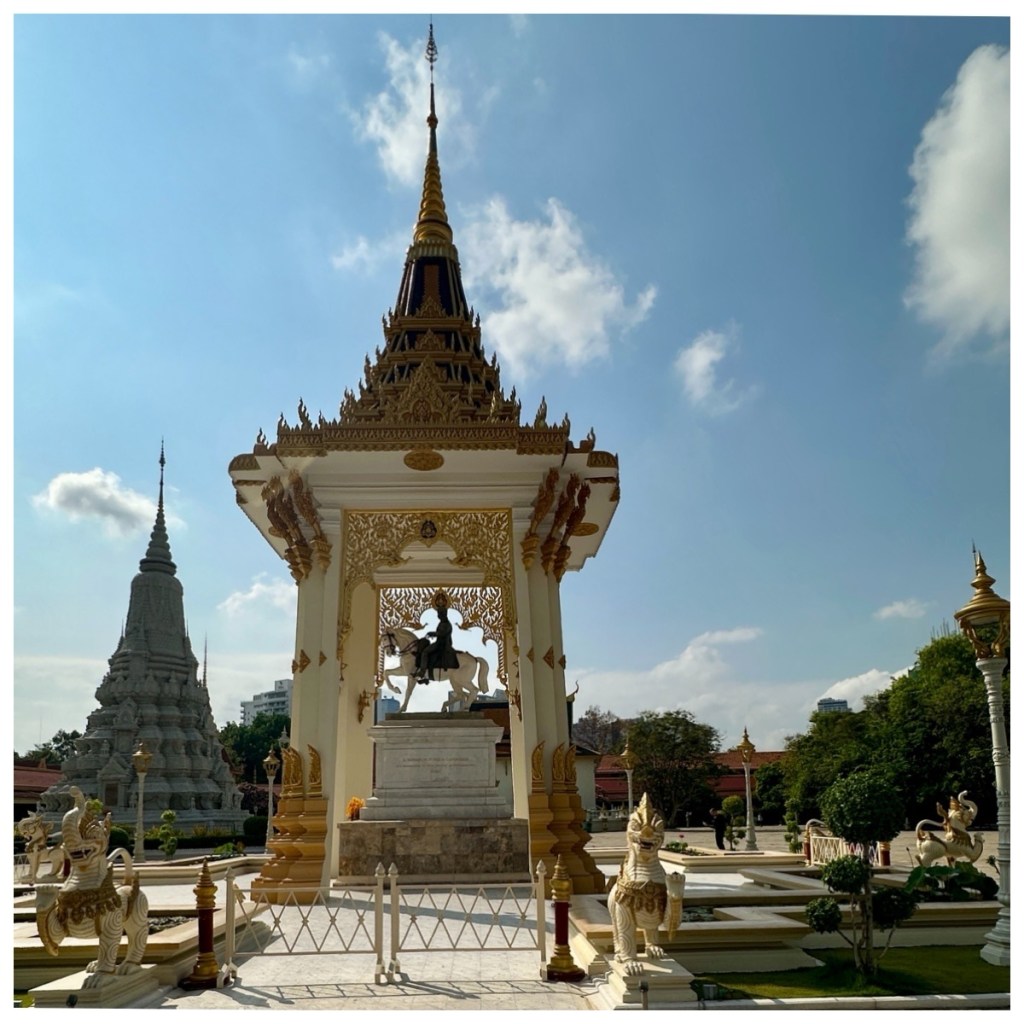
There are also other structures surrounding the main pagoda. To the east is a covered equestrian statue. It was a gift to King Norodom from Napoleon, and originally depicted the emperor himself, but the head was later changed to a likeness of King Norodom. Also dotted around the courtyard are several gray chedi holding the ashes of former kings and queens. Although painted a uniform gray color, the chedi are intricately carved.
A touching stupa is the memorial sanctuary of Princess Kantha Bopha. The beloved daughter of the former King Sihanouk, the Princess passed in 1952 at the age of four, succumbing to leukemia. The stupa was built in 1960. King Sihanouk died in 2012 and his ashes were interred with the Princess in 2014.

Following our time at the Royal Palace, we travelled to Choeung Elk and the Genocide Museum. As the details of these two sites are very sensitive, I’ll post them in a separate blog to follow.
Our first afternoon stop was at Wat Phnom. The only hill in Phnom Penh, this is believed to be the site where Lady Penh discovered five statues: four Buddha statues and one Vishnu statue. The imposing white stupa sits atop the 27 meter high hill the gave the city its name. The staircase up the hill is flanked by nagas (mythical serpents), bronze friezes and dancing apsaras.

The stupa contains the ashes of King Ponhea Yat (1405-1467) who founded five monasteries including Wat Phnom.
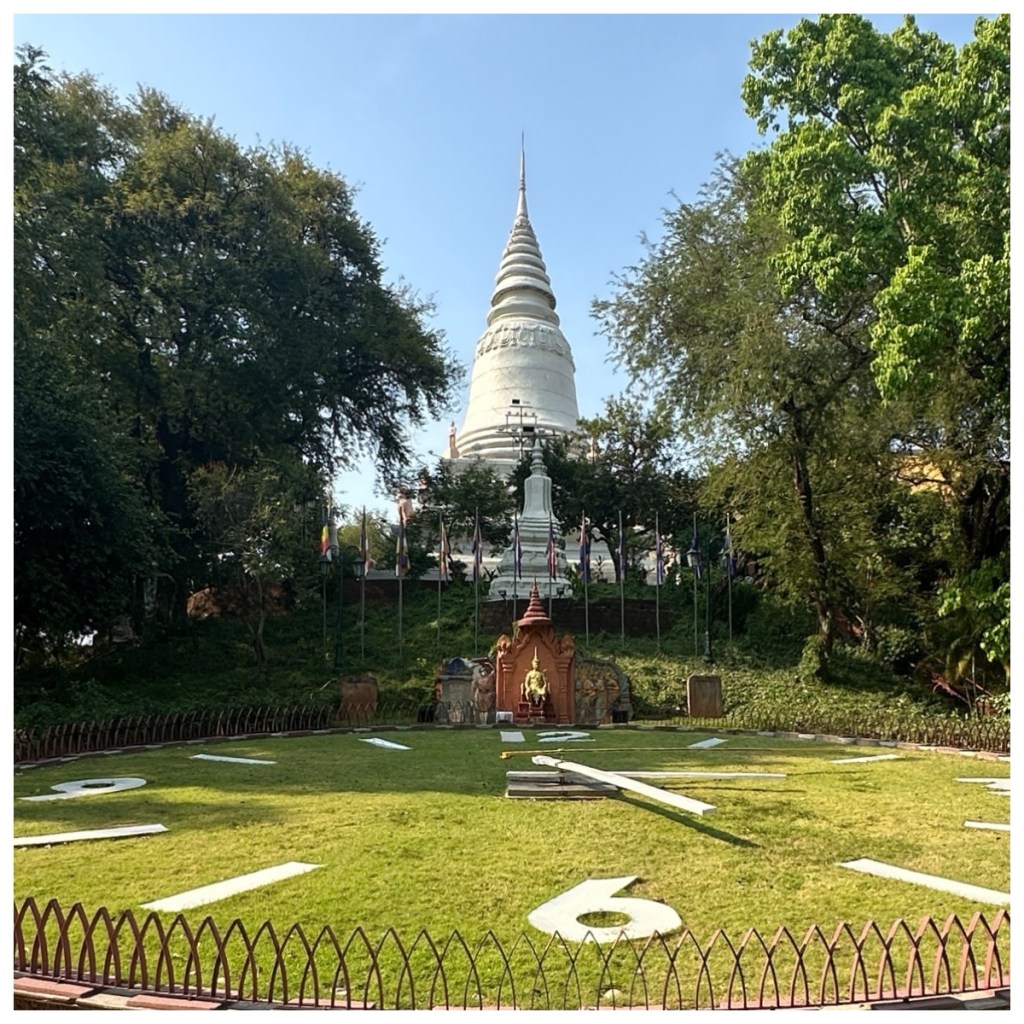
The vihara (temple sanctuary) was rebuilt in 1434, 1806, 1894 and 1926. The temple’s interior has a central altar complex surrounded by sculptures, flowers, candles, and objects of devotion and worship, including a large bronze image of a sitting Buddha. This Buddha is surrounded by a haze of burning incense and encircled by wall paintings telling stories that describe previous incarnations of the Buddha. There is also a somewhat garish statue of Lady Penh.


Khmer people are seen paying their respects and also looking for a hint at their future by holding a palm-leaf book above their head and blindly inserting a small pointer between the pages – which reveals the prediction.
The Preah Chao shrine is dedicated to a Tao goddess whom people come to ask for good luck, health or success. Judging by the elaborate offerings, it may be that these wishes are granted.

At the bottom of the Wat Phnom hill, we watched toucans in the trees and large fruit bats flying above.

Our next stop was to be near the river at Wat Ounalom, where ashes of many prominent Khmers are held in an austere grey stupa. This is one of Phnom Penh’s oldest pagodas, also dating back to the reign of King Ponhea Yat. In the early 1970s, over five hundred monks lived here. Unfortunately, when we entered, it appeared that a set-up for some major event was occurring and we were unable to visit.
We then travelled to the Central Market (Psar Thmei). This market was designed by the French in 1937 and renowned at that time as Asia’s largest. It has an Art Deco design with an enormous central dome and spider-like shape. The central hall is filled with stalls selling jewelry and watches (we have no idea how authentic they are) while the wings offer low-grade electronics, household items, clothing, souvenirs, etc. It was definitely not the type of market we enjoy and after taking some quick pictures and appreciating the lovely flowers at the entrance, we were on our way. Watch for my next blog to see a market that met our expectations!


Our day with Tokk and our driver was most enjoyable and informative. It was very interesting to see these aspects of the capital city.
More to come on Phnom Penh in my next blogs. Thanks for checking this one out!
Cheers,
Bev & Harvey
 A Long and Winding Journey
You guys are going to need a holiday at home to recoup and relax. What a pace of travel! Very interesting. Ralph
LikeLiked by 1 person
Lots of history! And lots of ceremonial buildings.
LikeLiked by 1 person