We flew away from Phnom Penh on Singapore Air. Another good airline where we were given a nice meal on a two hour flight. Our destination was Changi Airport in Singapore. Changi is a main hub through which more than 100 airlines operate in and out of Singapore. As with the other countries on the trip, we had completed a pre-arrival on-line form and immigration was just a scanning of our passports.

Singapore is an island, a country and a city – all wrapped up in one great package! The main island is about 49 km from east to west and 28 km from north to south with a coastline of 223 km and a total land area of approximately 735.7 km². The population of just under six million is composed of a majority of citizens of Chinese descent, followed by Malays and Indians. Added to the mix are a large number of working Western expatriates, and an even bigger number of foreign immigrant workers. It is therefore a very multicultural society.
Singapore is often referred to as “Asia light”. Most everyone speaks English although you will hear many dialects spoken. The city is very clean and very safe. This is due to strict enforcement of many laws against littering, smoking and public disorder. Chewing gum, famously, is completely banned. Fines are hefty. For instance, jaywalking could result in a fine of S$50 the first time, and up to S$1,000 and a jail term of three months for repeat offenders. You can be fined up to S$1,000 for smoking in prohibited areas (outdoor smoking areas are very well defined) and S$1,000 for littering. Other criminal offences include vandalism, not flushing the toilet, and carrying or consuming drugs.
On the drive from the airport into the city, we noticed immediately that it was a very green city! In the 1960s, Lee Kuan Yew, who is known as the founding father of modern Singapore, outlined his vision for Singapore to become a “Garden City,” and its tree-lined avenues and beautiful green open spaces are testament to his success. The goal now is to become known as the “City in a Garden,” planning to become the greenest city in the world, by adapting its streets, parks, and even skyscrapers. “Green building” – that is, constructing energy-efficient sites in an eco-friendly manner – has been mandatory in Singapore since 2008. Lush tropical plants are everywhere which provide much needed shade from the tropical sweltering weather.
Our hotel of choice was the Royal Plaza on Scotts. Conveniently located just off Orchard Road, this independent hotel with a 50-year legacy has a lobby with Italian marble floors, two grand staircases, Burmese teak paneling, stained-glass skylights, and tapestries. The 32 m2 room was excellent.

The breakfast buffet in the Carousel Restaurant was wonderful with a plethora of Western and Asian dishes and very attentive and helpful staff.

We purchased a two day pass on the Big Bus Singapore Hop-On Hop-Off bus. The two lines cover the most iconic Singapore landmarks and attractions, giving you the chance to see the city and travel from site to site easily.
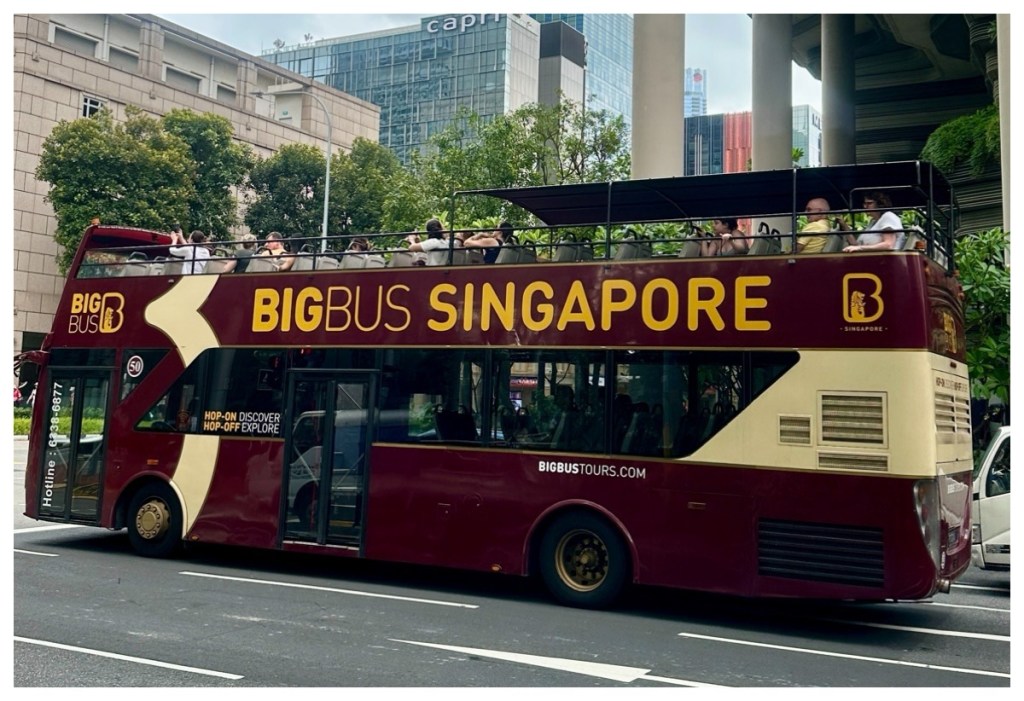
Singapore’s neighbourhoods range from traditional and multicultural to glitzy and modern. In this blog, I’ll look at the newer areas. Keep an eye out for a second part to see the colorful traditional areas!
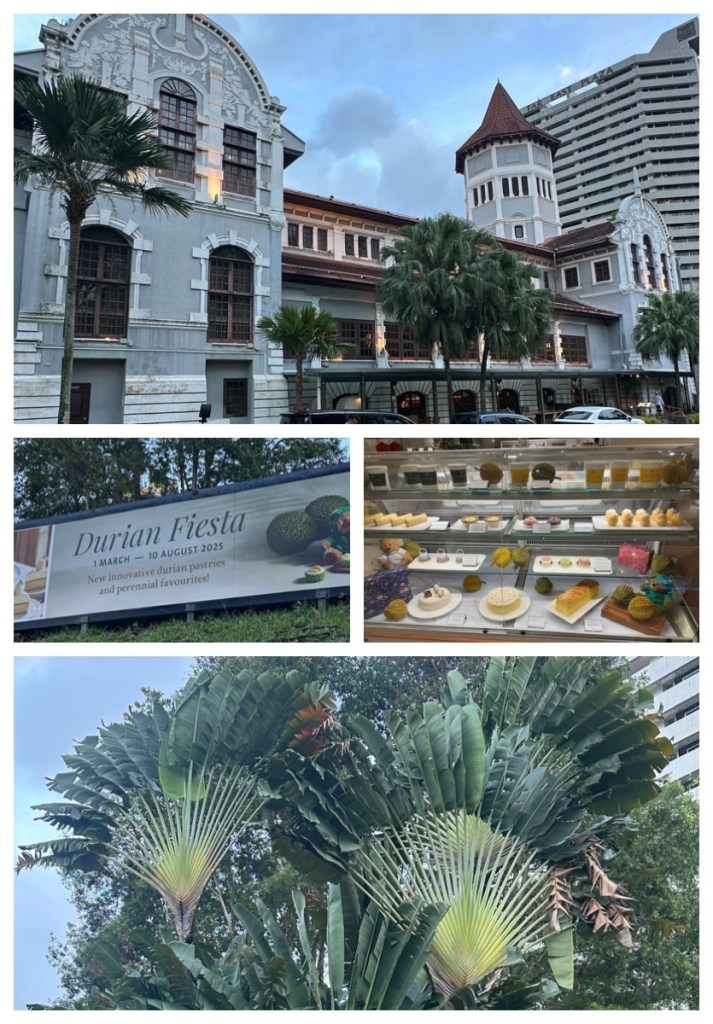
The Goodwood Park Hotel is located just down the street from the Royal Plaza and has a great history. Built in 1900, the hotel has served as Teutonia Club for German expatriates in the early 1900s and then during World War I, the hotel was declared enemy property and seized by the government. In 1929, the club was converted into a hotel but when World War II broke out, Goodwood was again seized, this time by the occupying Japanese forces. After the war, it was chosen to be the venue of a court dealing with war crimes. Today, parts of the exterior are under renovation. The interior is modelled on European design and was lovely to wander through.
We noted that the Goodwood was holding a Durian festival. For those not acquainted with Durian, this fruit smells dreadful – so badly that our hotel had a sign prohibiting it in the rooms! It is apparently an acquired taste – we tried some Durian chocolate and were not impressed, feeling that it tasted like petrol (not that we have tasted that). However, the Durian desserts in the display case looked great – we really should have tried one.
Orchard Road is Singapore’s bustling three-lane-wide, one-way, shopping street flanked by tree-lined walkways. The road was named for the fruit plantations found here in the 19th century. The first malls lining the broad avenue were built in the 1970s, and continuous development has occurred ever since. Large, glitzy buildings are interspersed with smaller designer boutiques, antique stores, cafes and food courts. You can pass along Orchard Road via air-conditioned underground tunnels if you need an escape from the sweat-inducing outside world.
Our hotel was just up the street from Orchard Road’s ION mall and the Shaw Centre. The ION is packed with more than 300 stores, including top fashion labels, across multiple floors. The Shaw Centre houses more designer stores, as well as IMAX theatres.
Popularly known as “Taka,” Ngee Ann City has marble twin towers, cooling fountains and a columned entrance guarded by two hand-carved foo dogs imported from China to bring good fortune.
As we cooled down by passing through one shopping mall, we were surprised to see a Tim Hortons. Further research tells us there are actually 13 locations of this Canadian icon in Singapore.

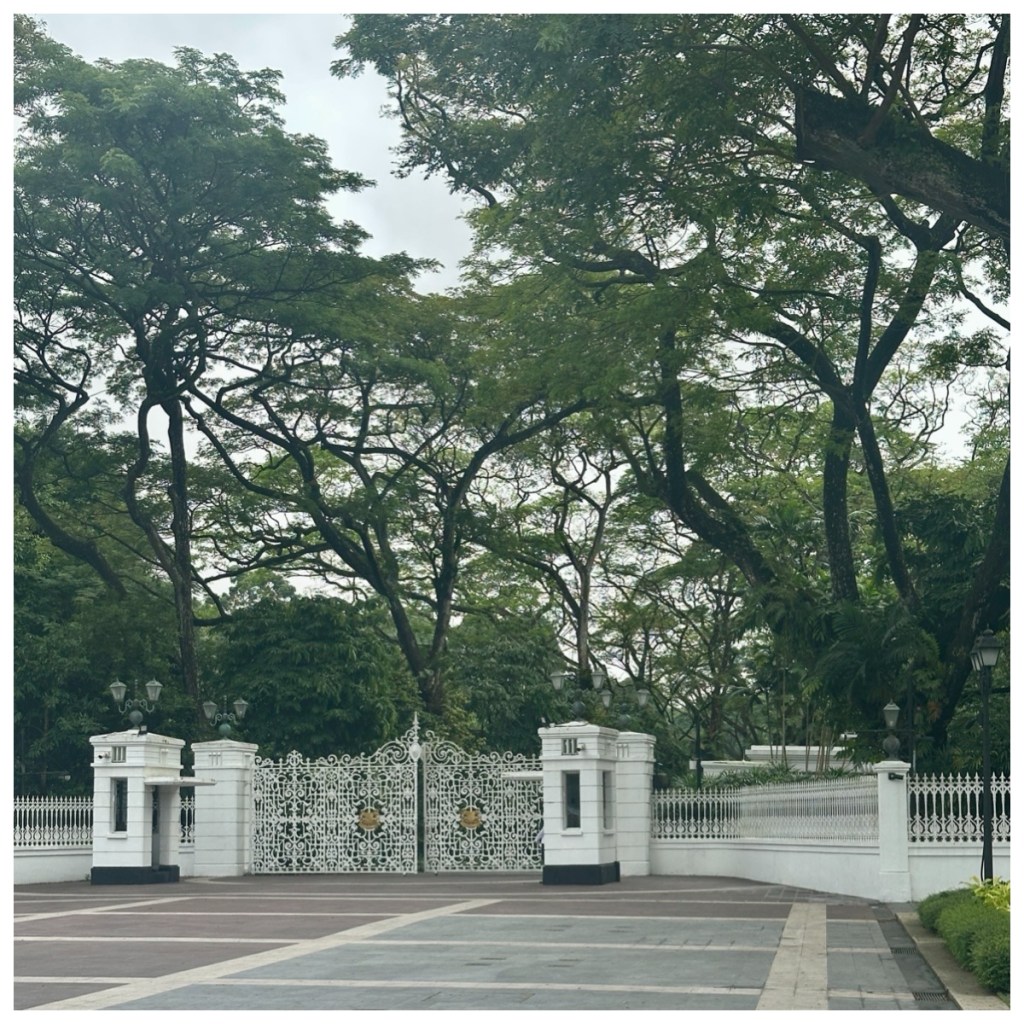
The Istana is the official residence of the President of the Republic of Singapore. It occupies over 40 hectares on Orchard Road. Built in 1869, this elegant neo-Palladian style building is set in extensive tropical gardens. The building and grounds are only open to the public on special holidays; therefore, we offer only a picture of the gates.
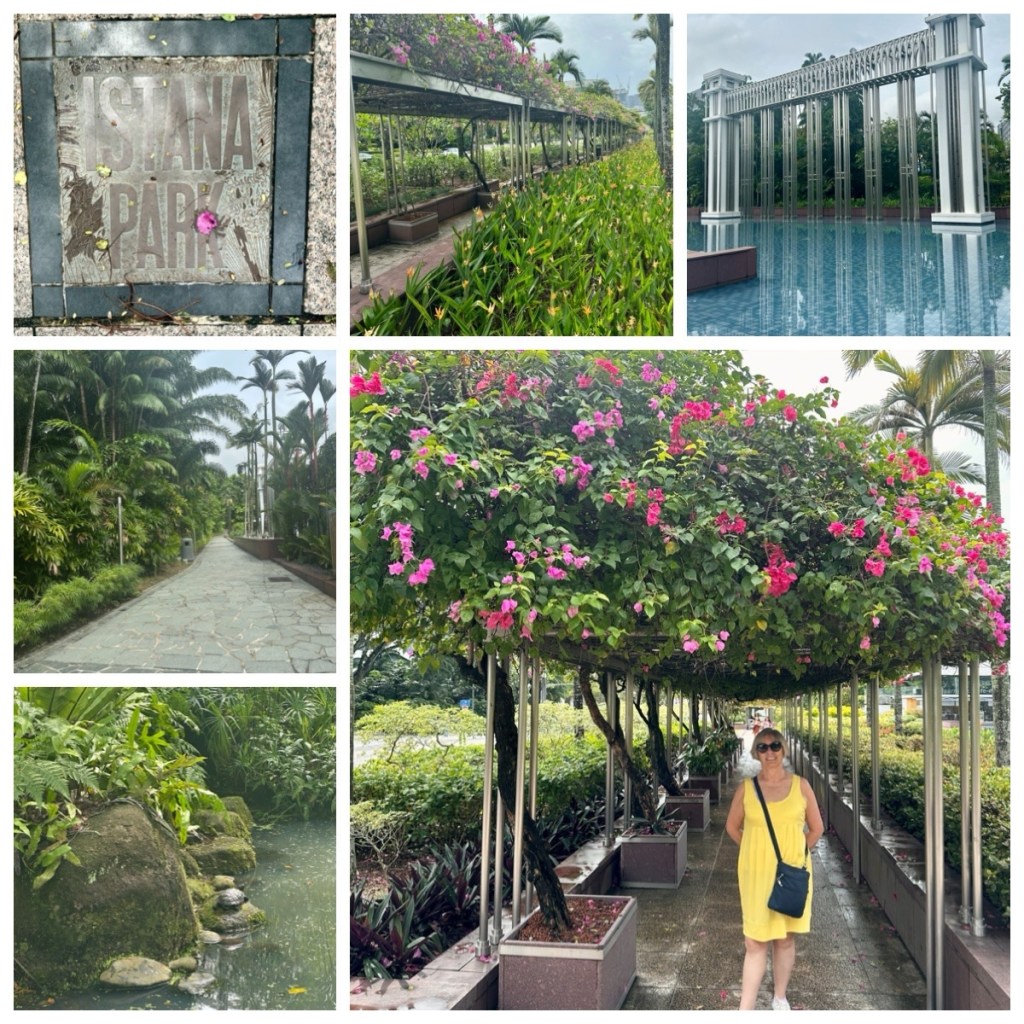
Located across Orchard Road from the Istana Palace is the small Istana Park. It was quite lovely to wander through.
Singapore’s street food was inscribed in UNESCO’s Intangible Cultural Heritage of Humanity in December 2020. It is characterized by its rich fusion of Malay, Chinese, and Indian influences. Uniquely Singaporean is the way in which food is eaten, in food court complexes, or “hawker centers.” The traditional hawker centres are outdoor complexes, but newer, similar food courts have moved to indoor venues. Prices are low, the quality of food is high and it’s a great way for visitors to sample a range of traditional dishes, all under one roof.
Close to our hotel were two extensive food halls offering a myriad of choices, from the best hawker fare to international flavours. The 27 different vendors at the Food Opera @ ION Orchard sell everything from crispy fried carrot cake to spicy prawn noodles and rich chicken satay. The food court takes its design inspiration from the British colonial decor of the early 1890s, with a light blue, ivory, and copper-gold palette, and lush green plants. The Food Republic @ Shaw houses more than 20 colourful stalls selling everything from Thai curries to duck wonton. We enjoyed the proximity of these areas to our hotel and visited on a number of occasions.


Singapore’s earliest example of urban planning is the Civic District, which runs along the north side the Singapore River. The birthplace of the country’s modern historical, architectural, and cultural heritage, it’s dotted with imposing reminders of British rule. This is also the museum district.
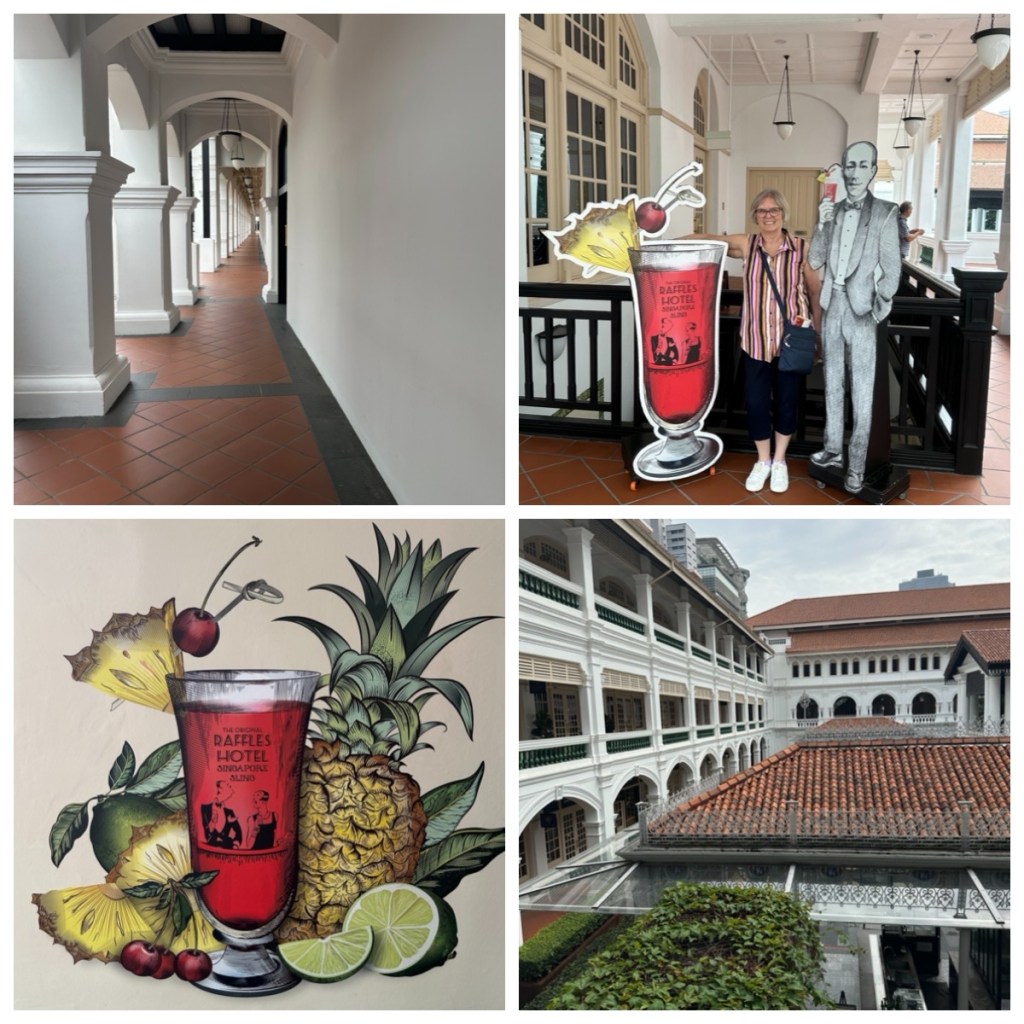
Singapore’s most famous hotel is a remnant of the British colonial era and an emblem of the modern nation founded by Stamford Raffles. A national monument, the Raffles Hotel, which opened in 1887, is a complex of white, veranda-enclosed, colonial-style buildings with terra-cotta-tiled pitched roofs. It was once the venue for grand balls and dances and its guest list features such names as Noel Coward, Somerset Maugham, Rudyard Kipling, Joseph Conrad, Charlie Chaplin, Elizabeth Taylor and Michael Jackson.
The signature drink of the Long Bar in the Raffles Hotel is the Singapore Sling. Invented by a Chinese bartender at the hotel’s iconic bar in the early 20th century, the concoction of gin, cherry brandy, lemon juice and soda, served in a highball glass, is legendary. We visited the hotel in the morning and the Long Bar was not open. A sling at the Long Bar will set you back S$41 and although it’s revered as a must while in Singapore, we didn’t return to try one.
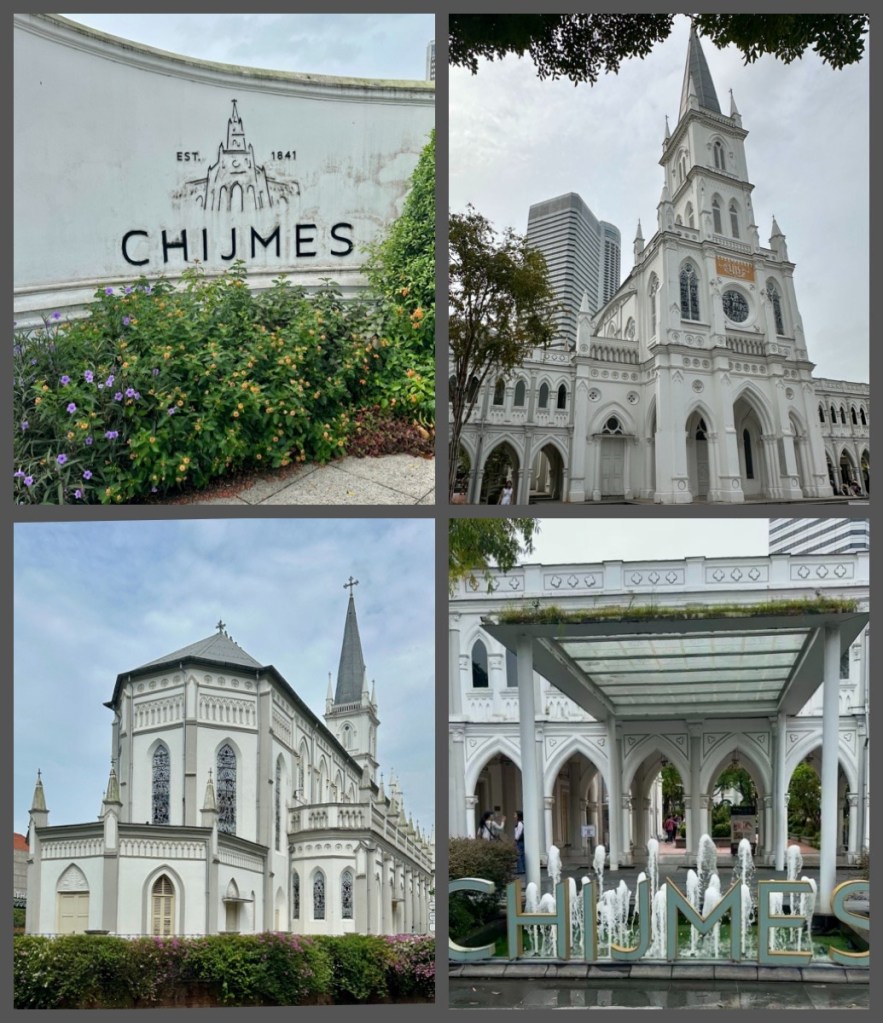
The Chijmes, pronounced chimes, is an elegant walled complex of quiet courtyards, cobbled paths, fountains and covered walkways that are interspersed with restaurants, bars and gallery spaces. The oldest building in the complex is Caldwell House, a private mansion built in 1840. In 1852, it became the Convent of the Holy Infant Jesus where nuns housed and schooled abandoned children. The most striking building is the former chapel, designed in Neo-Gothic style by the Jesuit priest Father Nain, and one of the locations featured prominently in the film Crazy Rich Asians. In 1983, the Chijmes complex was redeveloped into an entertainment and restaurant complex.
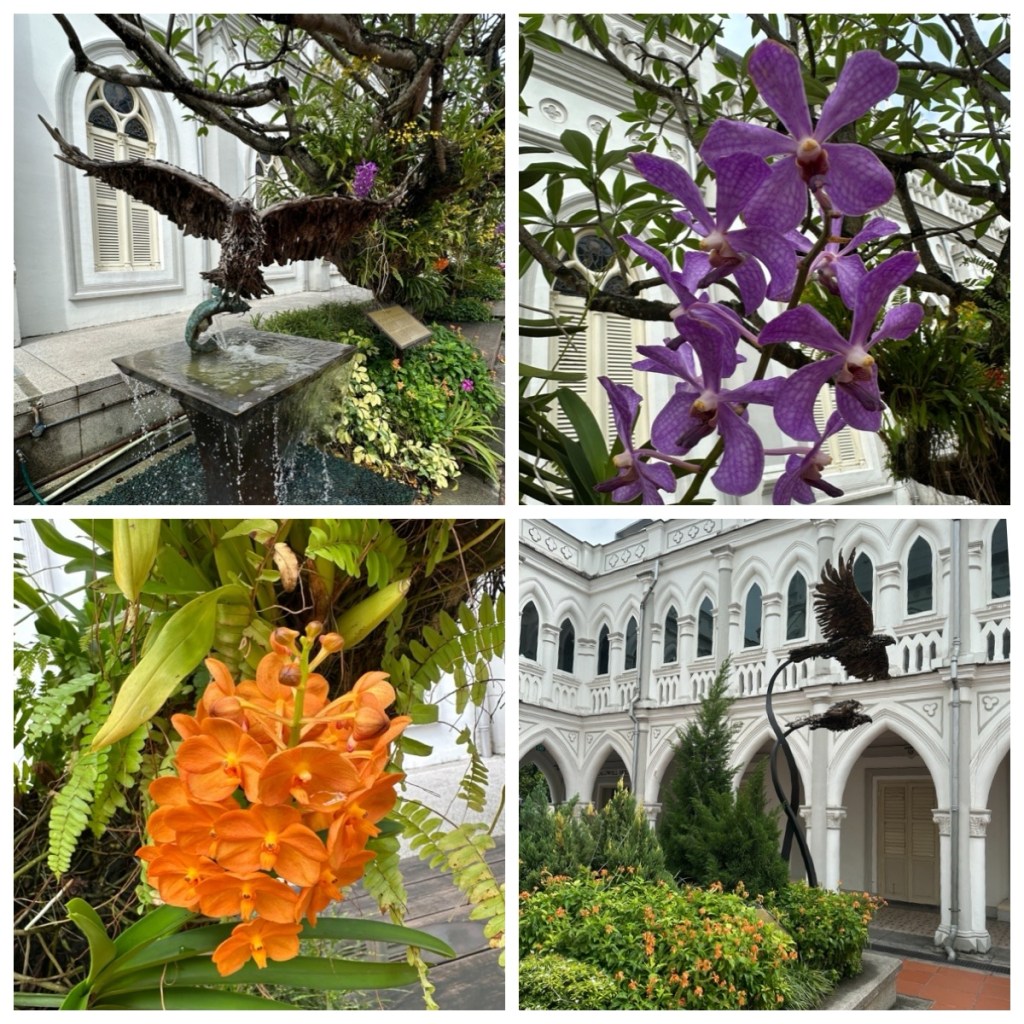
Two of the sculptures in the Chijmes courtyard are “Breakfast” which tells the story of an early morning catch as a White Bellied Sea Eagle swoops to pick up a Catfish and “Journeys” that features Crested Honey Buzzards.
St. Andrew’s Cathedral is an Anglican Church named for the patron saint of Scotland in recognition of the Scottish merchants who contributed funds to build it. In 1862, Indian convicts were brought in to construct the cathedral in the early Gothic style, reminiscent of England’s Salisbury Cathedral and Hampshire’s Netley Abbey. The bells were cast by the firm that made the bells for Big Ben. The church was expanded in 1952 and again in 1983.

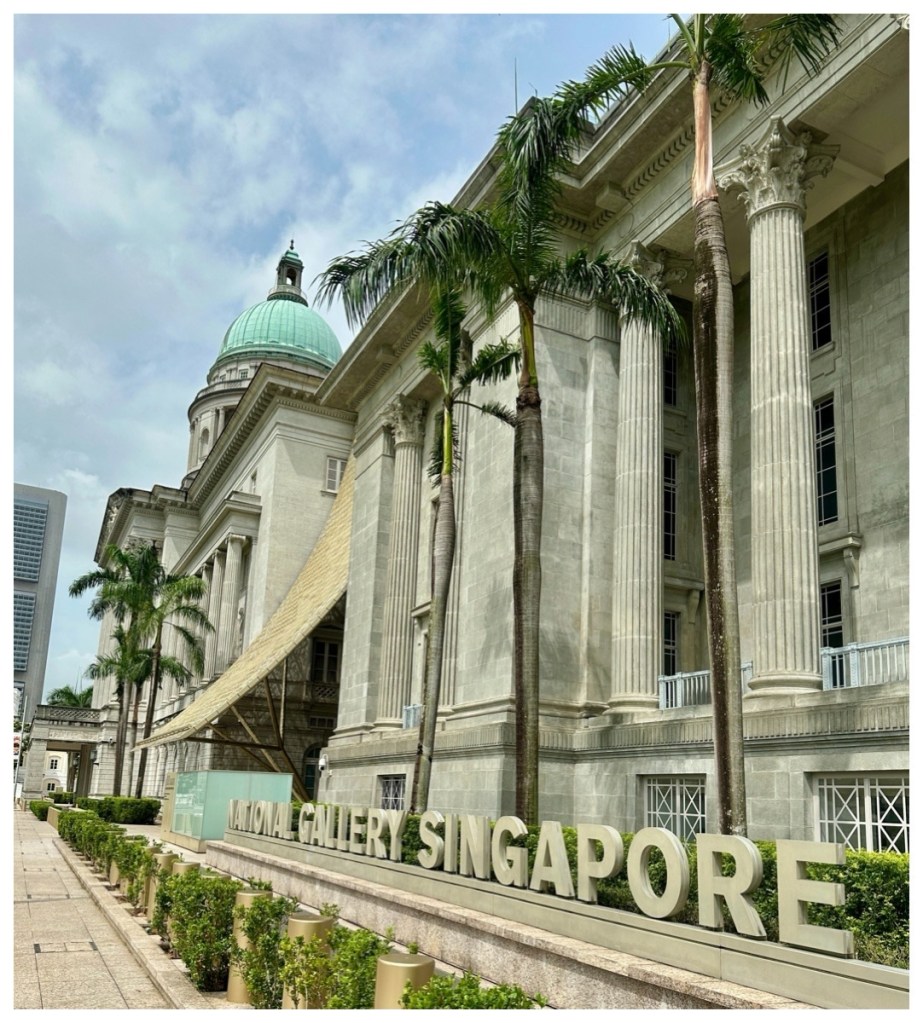
In the heart of the Civic District, the National Gallery Singapore is dedicated to the display, promotion, research and study of southeast Asian and Singapore art. The building was reborn from two striking buildings – the City Hall and the former Supreme Court. Unfortunately, we did not have time to visit the Gallery – maybe next time…..
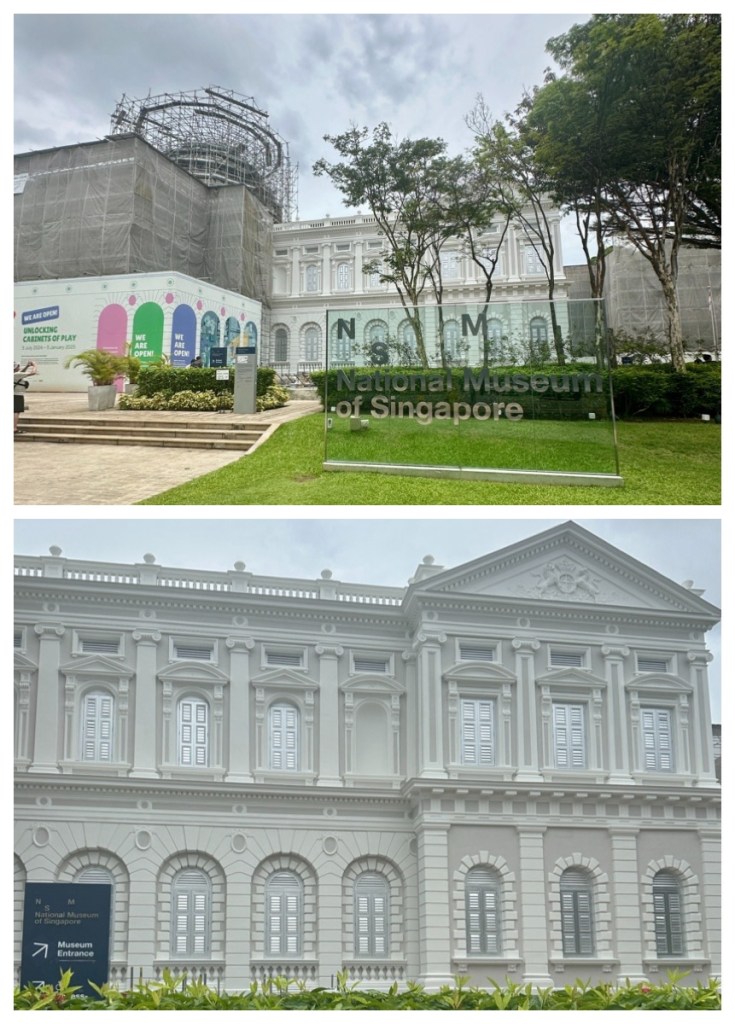
The National Museum is a Neo-Palladian structure, crowned with a stained-glass dome. Formerly known as the Raffles Museum and Library, it is the island’s oldest museum, opened in 1887. Following Singapore’s independence in 1965, the museum was renamed the National Museum to reflect its new role and altered its focus to exhibitions that concentrated on the history and peoples of Singapore. Currently, restoration of its facade and upgrading of the building’s facilities are taking place. Expected to be completed later this year, the museum remains open for visiting.
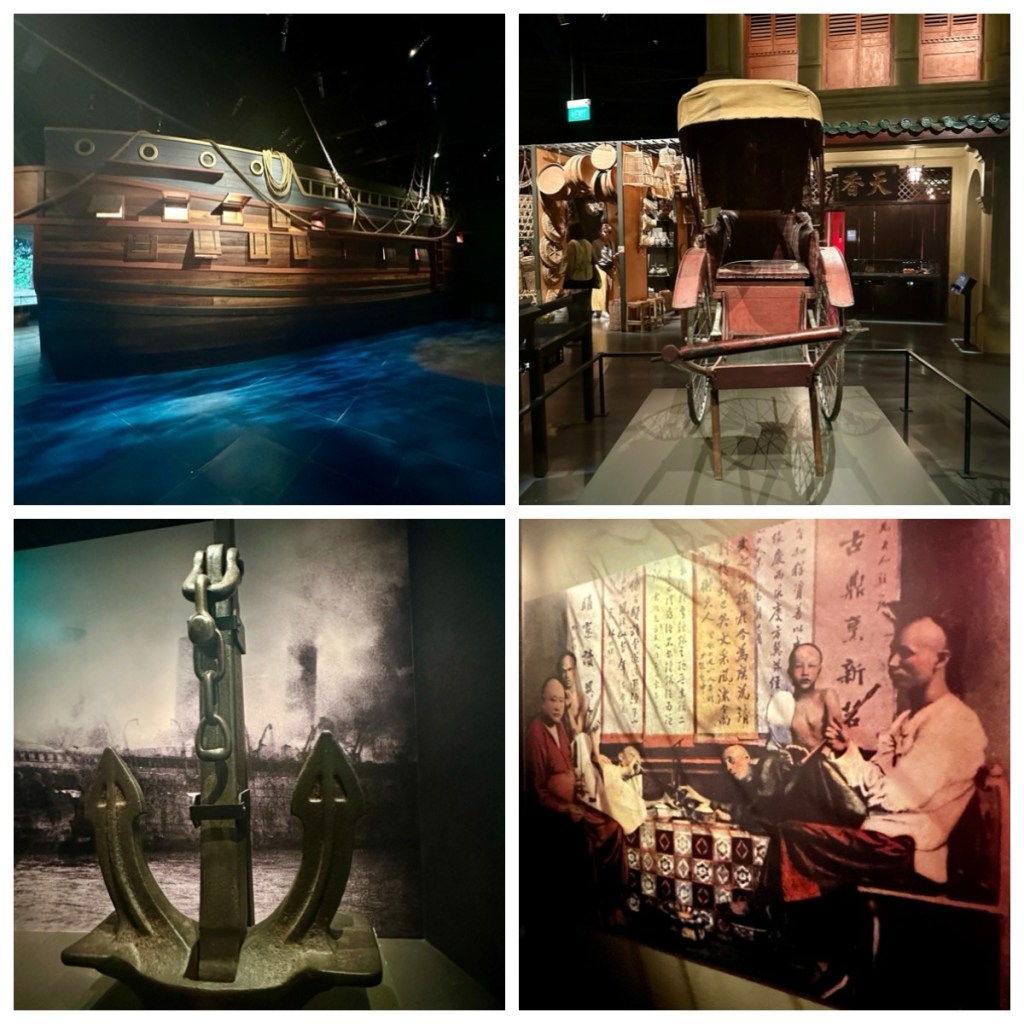
We spent almost three hours touring this building and learning about Singapore. I have included a few pictures below.
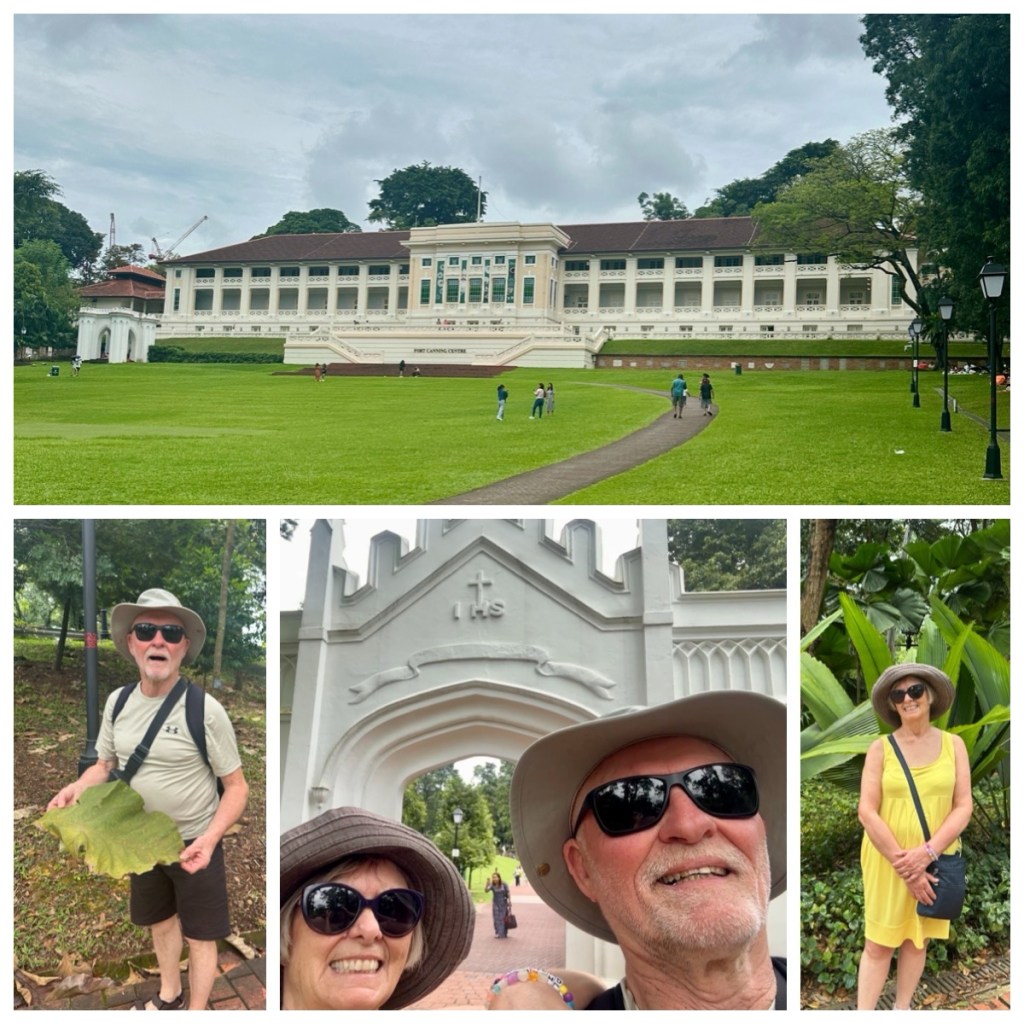
Fort Canning Park is a lush, tranquil sanctuary in the heart of the city. Because of the lovely view the site commands, Sir Stamford Raffles built his bungalow here and experimented with a botanical garden. Until the mid-19th century, it was home to Singapore’s governors. In 1860, Fort Canning was built here; only the fort gate still stands. The large building atop the hill was formerly a barracks and is now Fort Canning Center. Massive fig trees, luxuriant ferns and abundant birdlife—including piping black-naped orioles and chattering collared kingfishers—flourish here in the many gardens. A Spice Garden is home to a grand mix of herbs and spices. On the Sunday afternoon that we visited, the park was teeming with Singaporeans enjoying picnics, music and fellowship.

The Central Business District (CBD) is home to stunning modern architecture.

Esplanade Park contains the Queen Elizabeth Walk and several landmarks, including the Cenotaph, which commemorates those who lost their lives in the two world wars.

Located on the waterfront, the huge, spiked shells of the Esplanade – Theatres on the Bay sparked a debate over its radical architecture. The complex houses a plethora of performing arts venues, including a concert hall, a theatre, an outdoor theatre and a recital studio, as well as a gallery space, a performing arts library and a shopping mall. We had a nice lunch at Coffee Bean & Tea Leaf.

Along the water from the Civic District is Marina Bay, an extension of the business district that was created through land reclamation in the 1970s. It’s now one of the most architecturally significant parts of the city. A current major construction project will result in NS Square which will house a permanent stage and grandstand for large-scale annual events. The circular grandstand bowl with cantilevered structures spanning up to 25m will be a first in Southeast Asia and will accommodate about 30,000 people.
One of Singapore’s most eye-catching attractions is its towering observation wheel, set on the edge of Marina Bay. As the wheel slowly turns on the 30-minute trip, the pods climb to reach an impressive height of 165 meters above ground level.
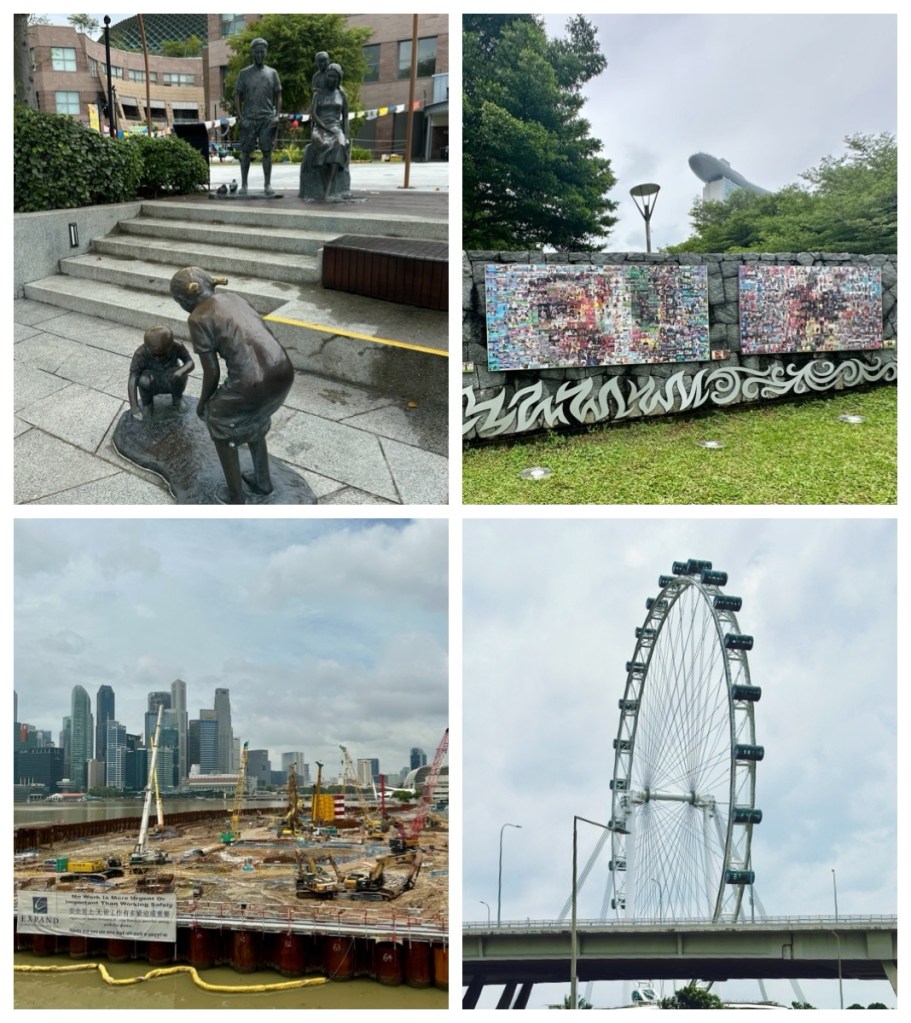
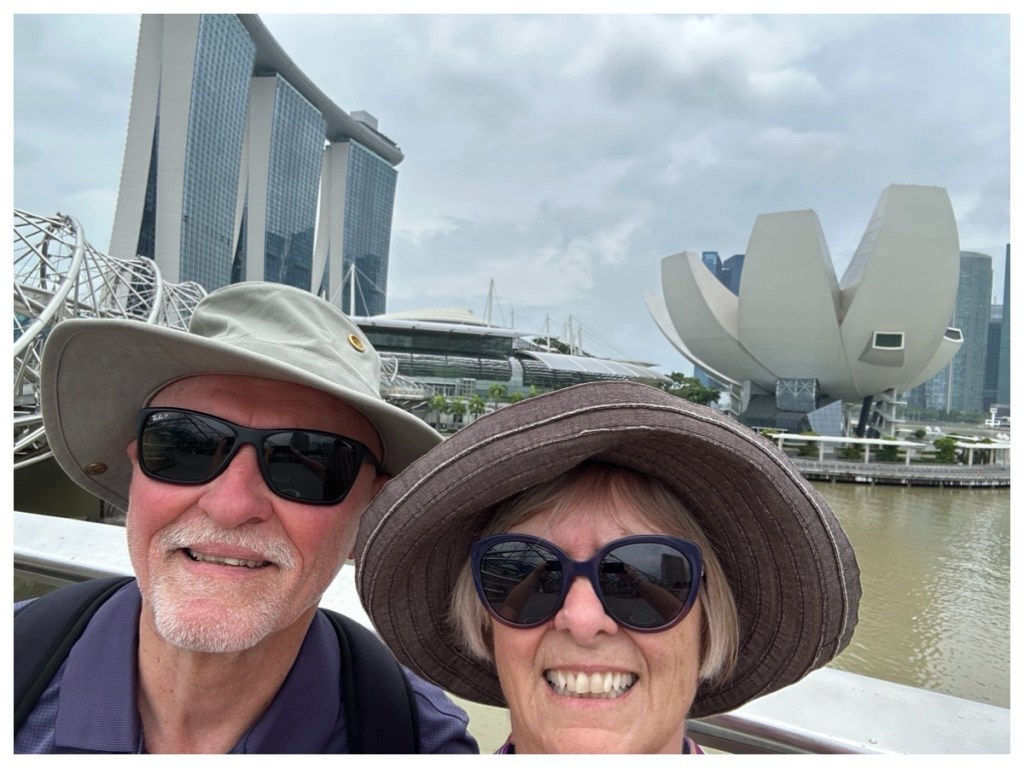
Spanning the Singapore River from the city’s central business district and bayfront area, the 280-metre-long Helix Bridge allows pedestrians to walk its curved deck from one side of the river to the other. The bridge was inspired by the geometric arrangement of a DNA strand, resulting in a walkway that is enclosed by opposing double-helix structures of stainless steel.
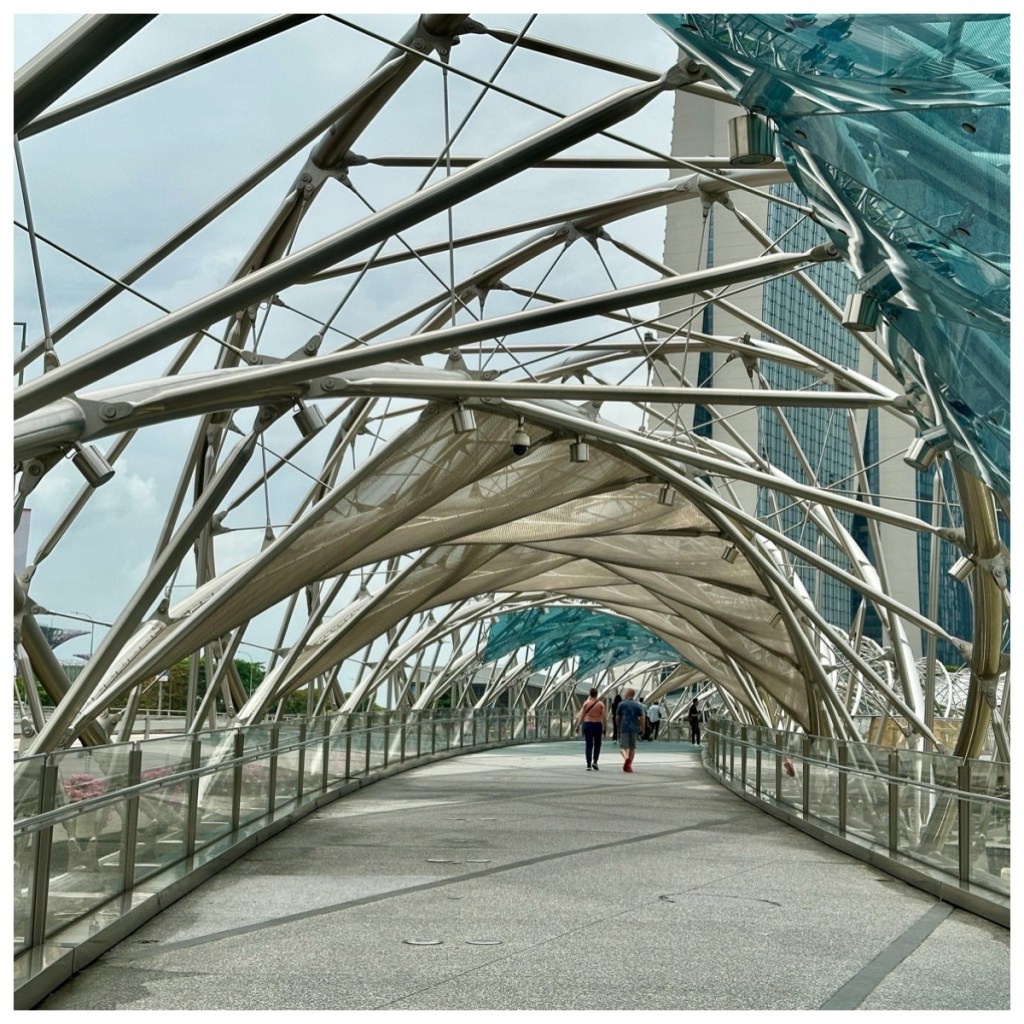
The views of the CBD from the Helix Bridge are quite stunning.

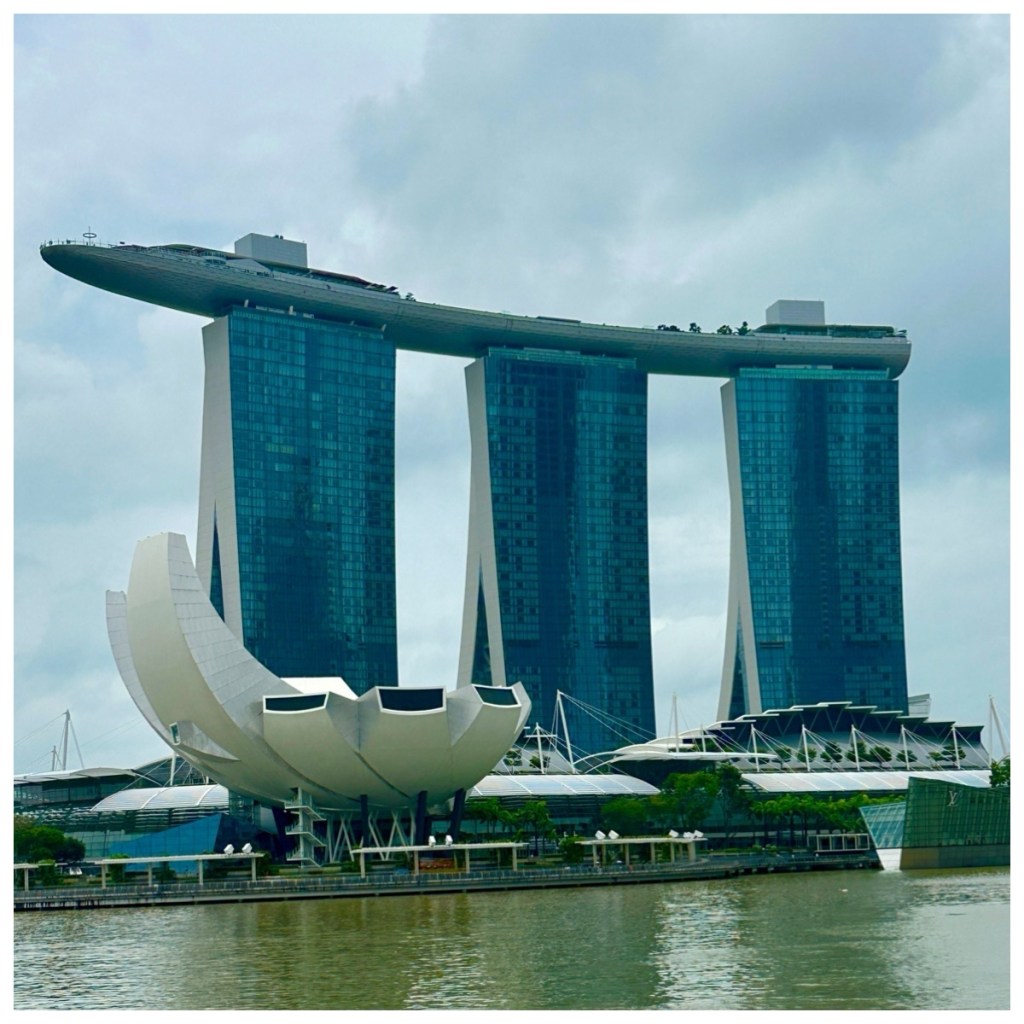
It is impossible to miss the Marina Bay Sands, which dominates Marina Bay, and can be seen from many parts of the city. The site includes a 2,561-room hotel, the Shoppes at Marina Bay Sands mall and several acclaimed celebrity-chef-run restaurants. There are also two large theatres, an ice skating rink (which we somehow missed) and a casino.
The Science Museum is an architectural highlight of the Marina Bay Area. This structure is often compared to an open hand or a lotus flower and has exhibits of everything from technology to design. We didn’t visit the interior – again, maybe next time….
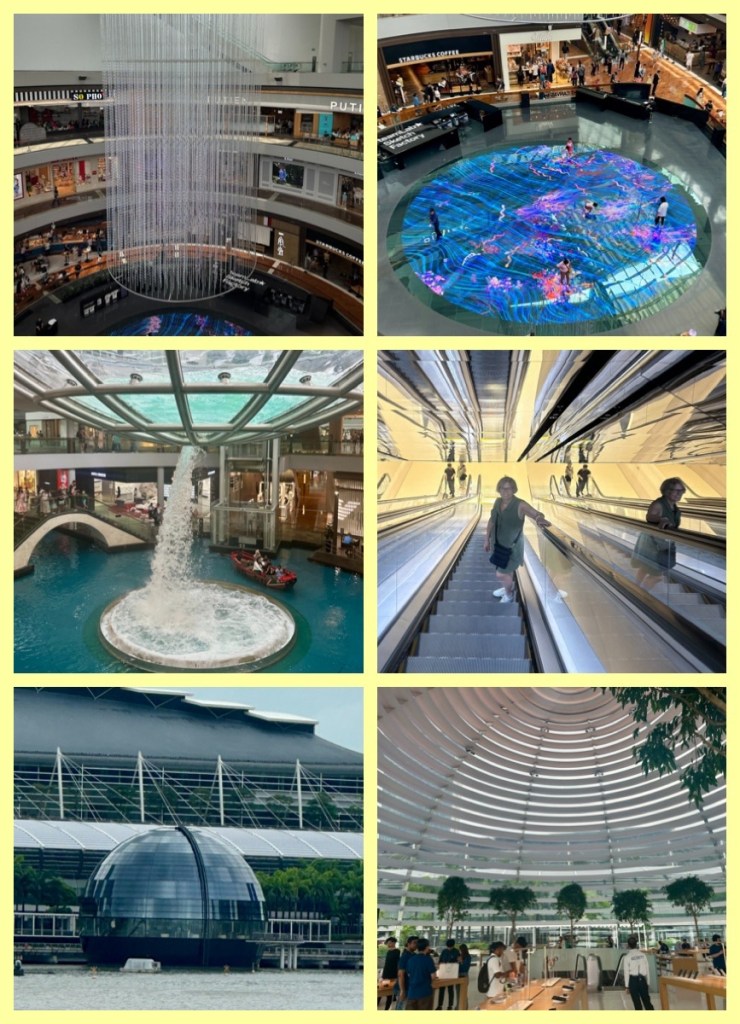
The Shoppes at Marina Bay Sands has over 300 stores featuring all the high-end designers. The state-of-the-art Apple Store Marina Bay Sands is in an all-glass dome sphere floating on water and offering 360-degree views of the city’s skyline.
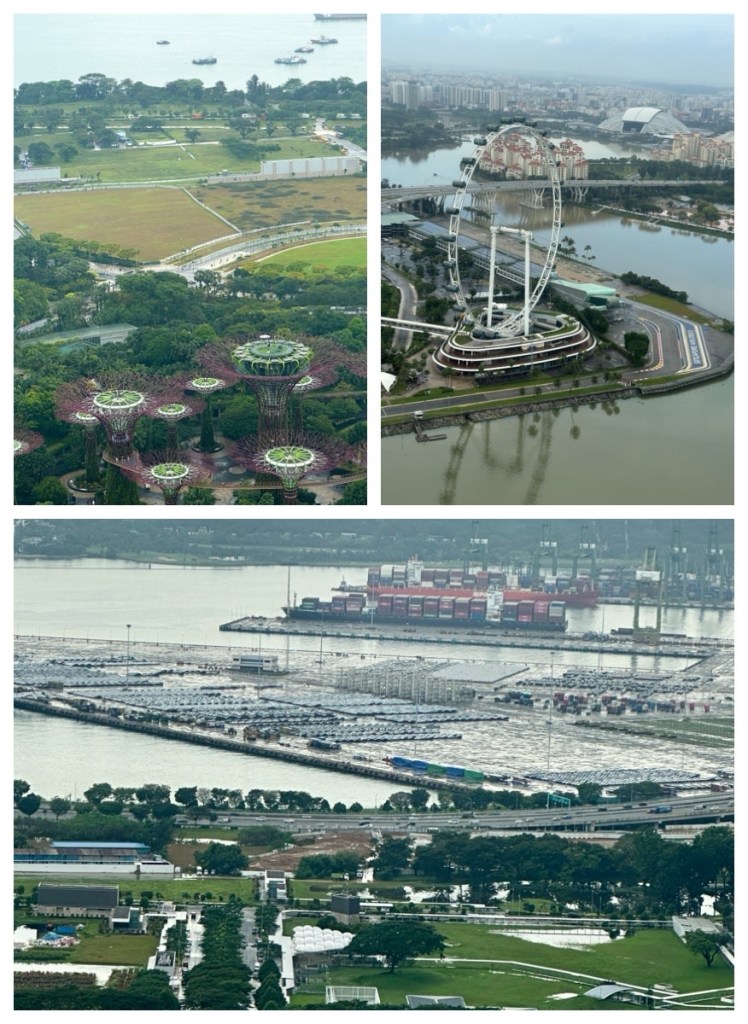
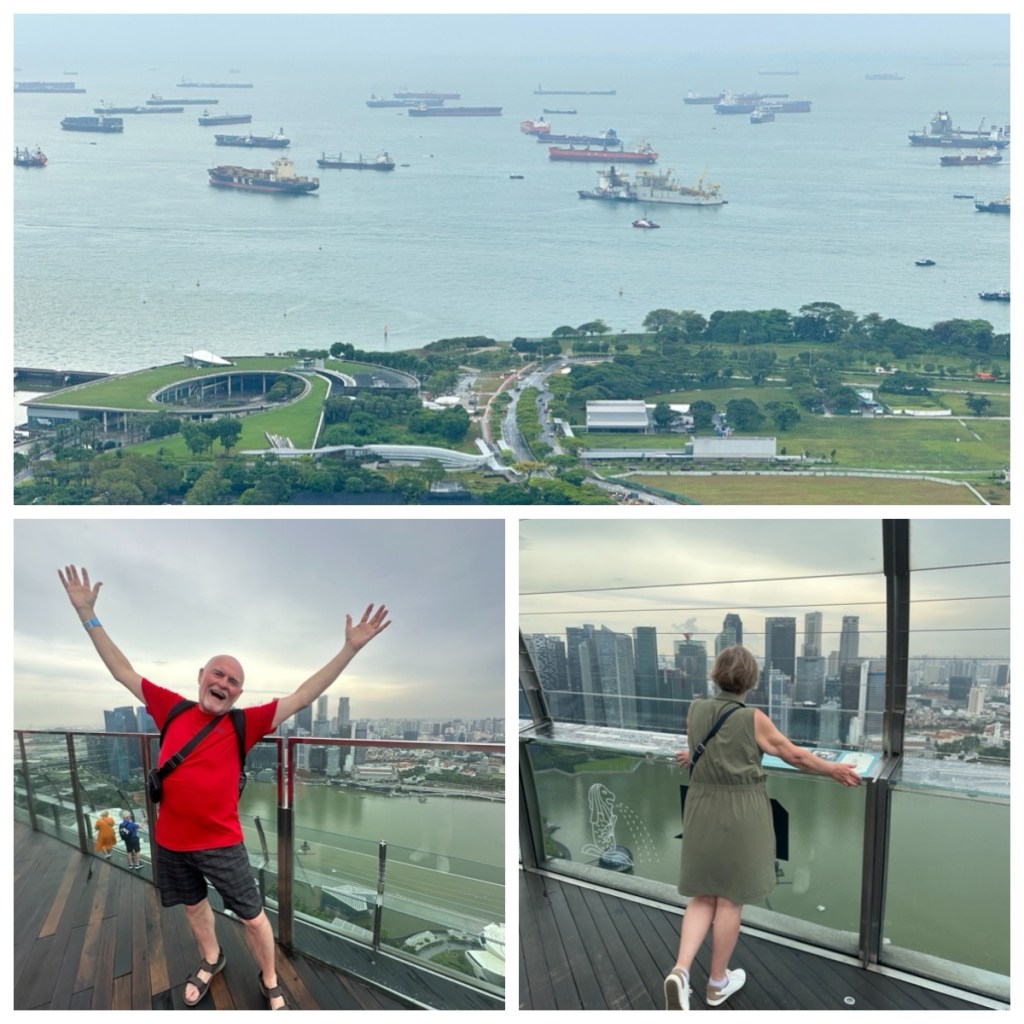
Atop the Marina Bay Sands Hotel is the SkyPark, an observation deck that’s 200 meters high. This is the world’s largest public cantilevered platform and offers panoramic city views. We purchased tickets, had to wait out some inclement weather and then were lucky to be the first people in the elevator up. The views of Singapore were truly spectacular. The platform is also home to an 150 meter-long infinity pool—the world’s largest outdoor elevated body of water. Only hotel guests are permitted to visit the pool.
Here are just some of the many photos we took from the SkyPark.

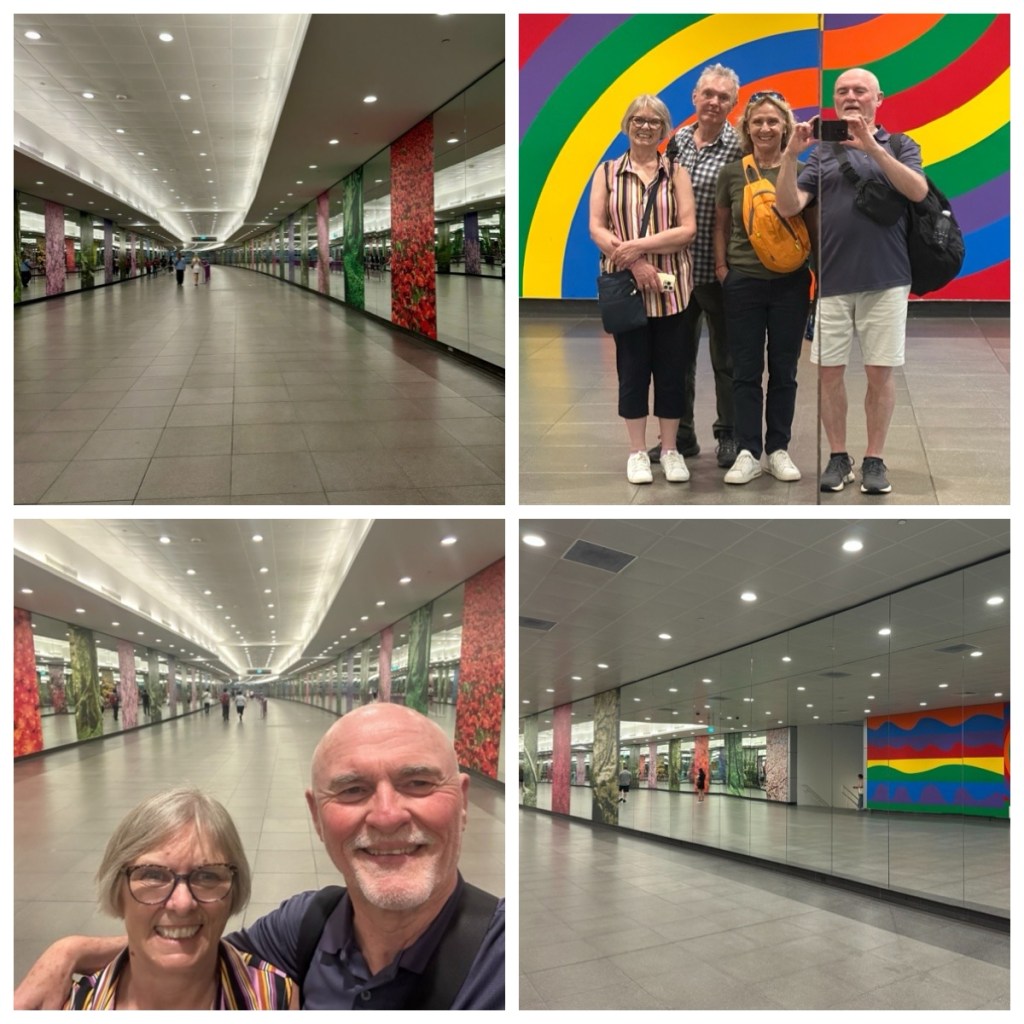
A tunnel with infinity mirrors links the Bayfront metro station to the Gardens by the Bay.
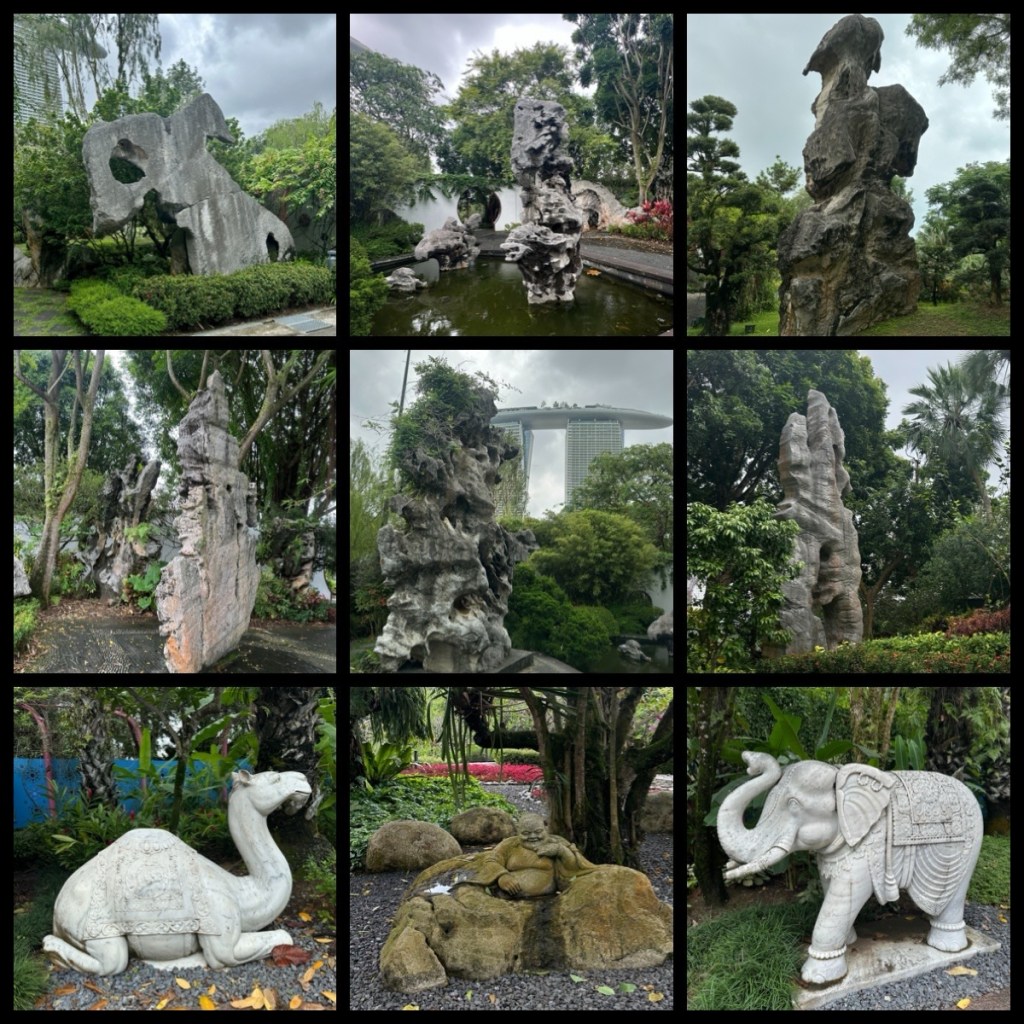
Built on reclaimed land in Marina Bay, the Gardens by the Bay sprawl over 250 acres of green space, with lakes, cascades, wetlands, aerial bridges and sculptures. These government-funded, large-scale gardens, opened in 2012, are home to more than 250,000 rare plants in landscaped gardens and conservatories. The government’s vision of creating a city in a garden has been realized: carbon-neutral electricity is generated on site; energy-efficient technologies, including the use of biowaste, cool the conservatories; rare and endangered plants are prioritized in the plant collections; and biodiverse ecosystems provide nursing environments for birds, fish, and insects.


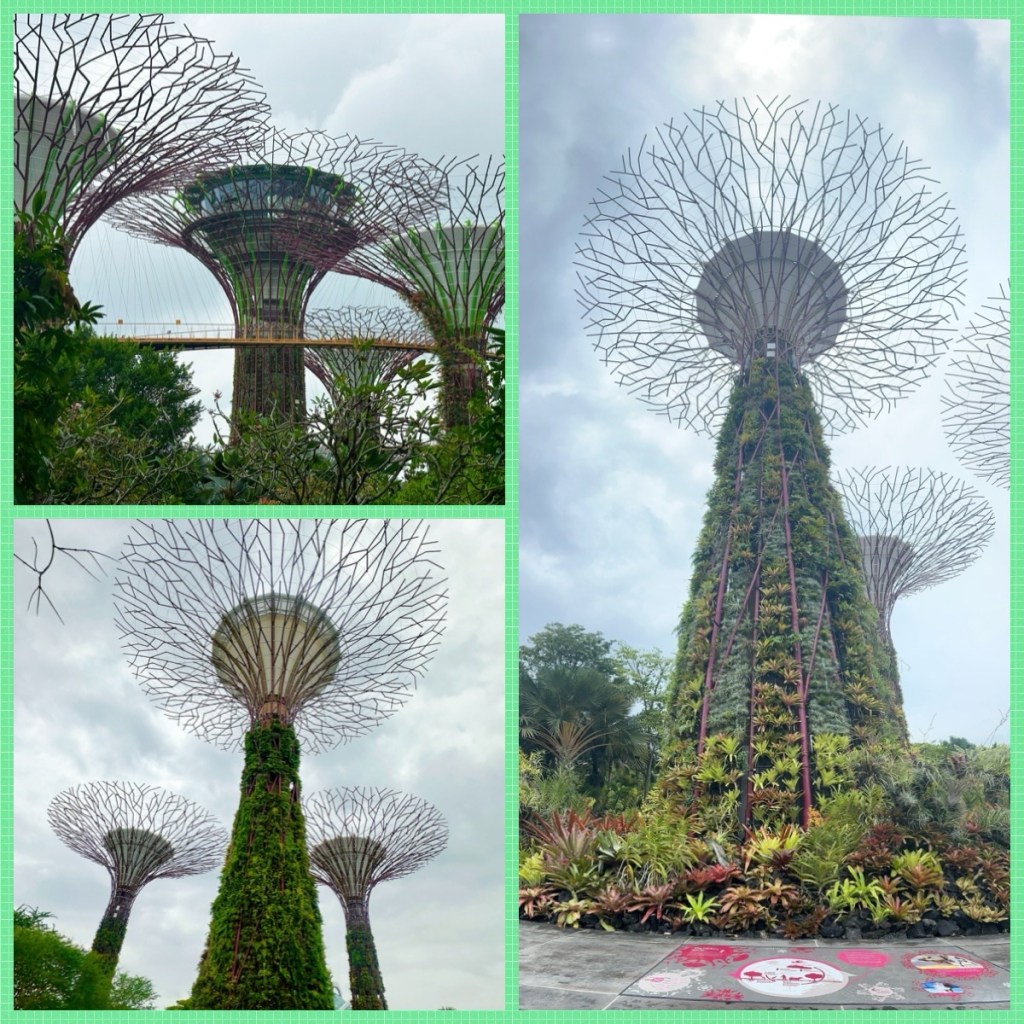
Possibly the most iconic symbols of modern Singapore are the eighteen Supertrees of the Gardens by the Bay. These colossal, futuristic structures are a fusion of nature, art and technology. They range in size from 25 to 50 metres (82 to 164 feet). The Supertrees are vertical gardens densely planted with more than 200 plant species such as bromeliads, orchids, ferns and flowering climbers which thrive in Singapore’s tropical climate. As well, they collect and store rainwater, harvest solar energy and act as air venting ducts for the nearby conservatories. Twelve of the Gardens’ eighteen Supertrees are gathered in the Supertree Grove while the remaining six are placed in clusters of threes near the Arrival Square and Dragonfly Lake. Entrance to the Gardens by the Bay including the Supertree Grove is free.
In a quiet and green corner of Gardens by the Bay is Satay by the Bay. This alfresco food court was a great place to enjoy Hawker Stall food before travelling back to the Supertree Grove for the evening.

Each evening, the towering Supertrees dance with light in time to musical accompaniment. The theme when we visited was Garden Waltz. This is a definite must-see in Singapore!


Modern Singapore is world-class! The amazing architecture is seamlessly blended with lush greenery and offers something to see wherever you look.
More to come soon on a more traditional side of this great city!
Cheers,
Bev & Harvey
 A Long and Winding Journey
Very impressive. Clean and modern with malls!
LikeLiked by 1 person