In my last blog, we looked at some of Singapore’s modern neighbourhoods. In this post, I would like to show you some of the colourful traditional areas.
The culturally rich and historically significant neighbourhoods of Little India and Kampong Glam are north and east of the Singapore River. They have a charming mix of old and new, with vibrant streets and small lanes, religious monuments next to trendy boutiques and smart cafes beside century-old coffee houses.
This northern part of the city came to life in the mid-19th century, when ranchers settled along the banks of the Rochor Canal and raised cattle in the area now known as Little India. As Indian labourers supported this growing trade, the government later set up brick kilns and lime pits. To this day, Little India remains the spiritual heart and commercial centre of the local Indian community.
Serangoon Road, one of the oldest roads in Singapore, is at the centre of Little India and offers a kaleidoscope of quintessential Indian life. On this and adjacent streets are shops selling saris, flower garlands and all the necessary ingredients for an Indian meal as well as hip restaurants and bars sharing space with traditional eateries. The colourful sights, the amazing smells and the sounds of locals and tourists mixing together delight your senses. It is an area to browse the shops, visit the temples and enjoy the food.
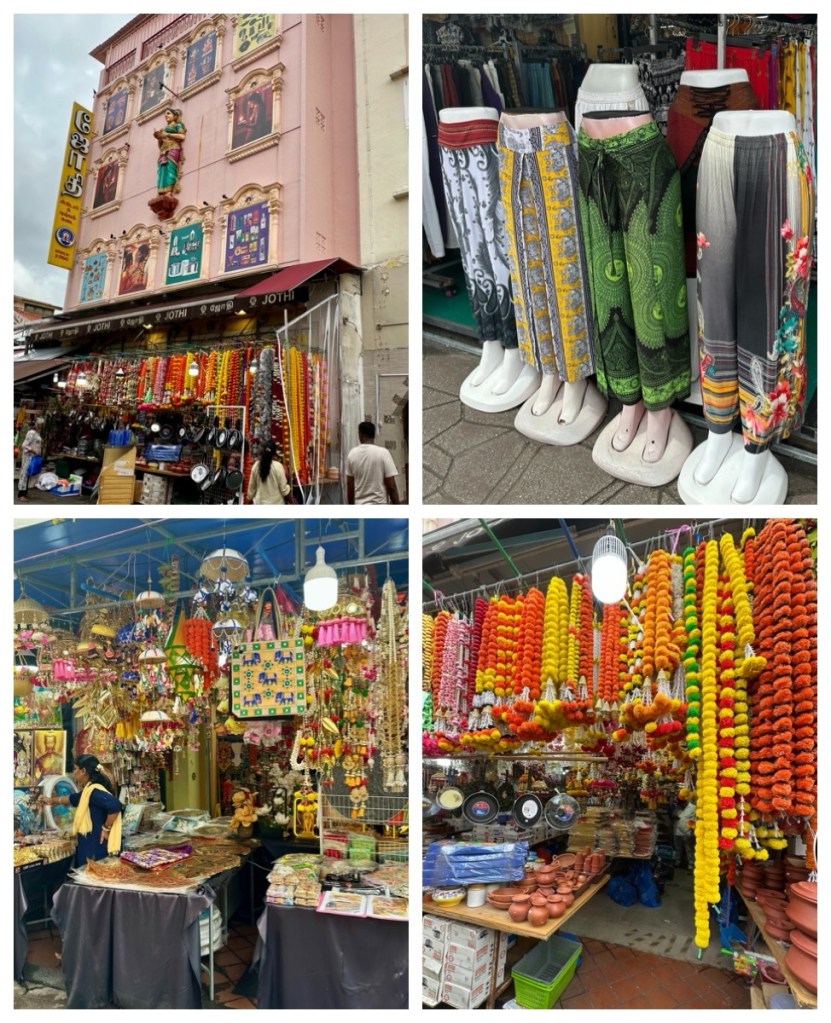
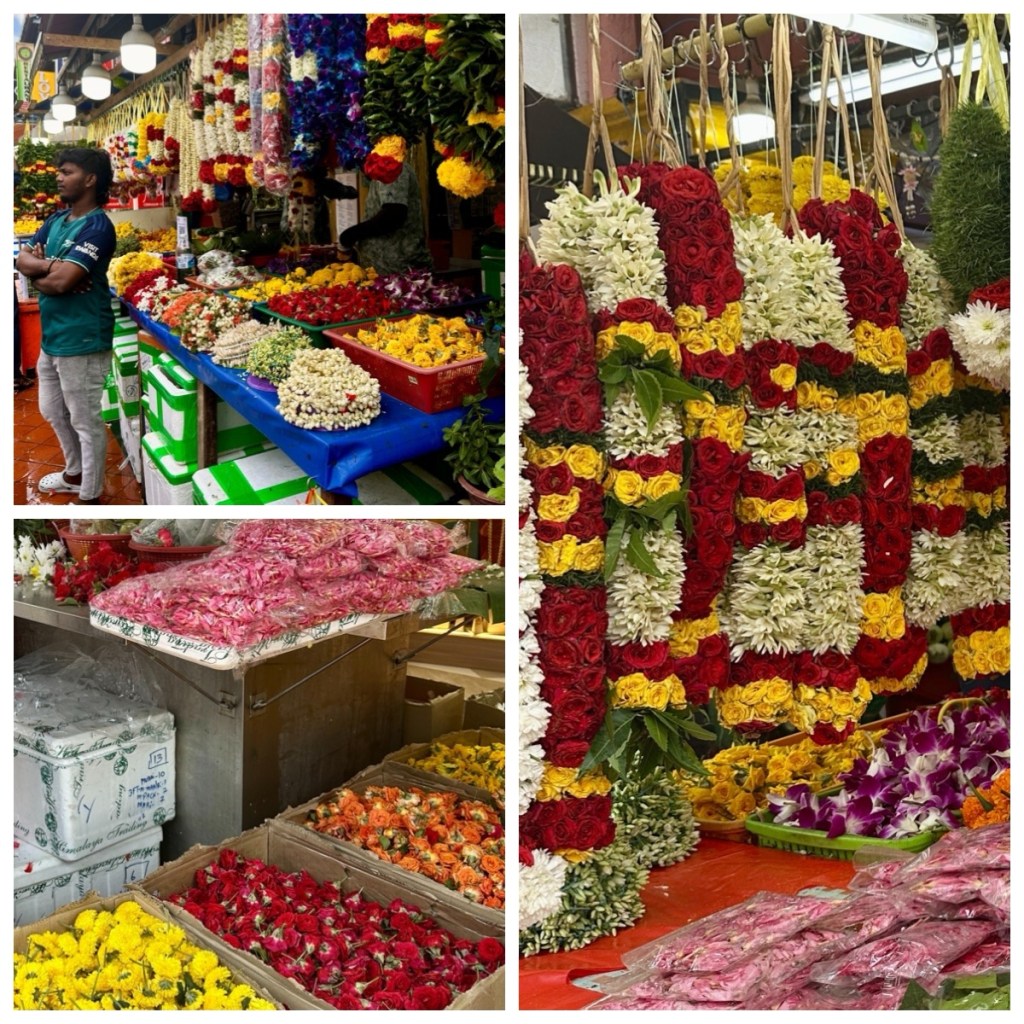
The Tekka Market is one of the city’s largest and busiest markets featuring a vast array of foods. Sungei Road next to the market has the Little India Arcade. Here you’ll find many stalls selling flower garlands, vibrant symbols of a tradition rooted in Indian culture. These garlands are made with care from different flowers. In religious practices, flower garlands are deeply respected and revered. They are frequently used in Hindu worship, called Puja, where they are presented to gods in temples and home shrines as a gesture of honor and devotion. Crafting and presenting these garlands is seen as a sacred duty, reflecting the devotees’ love and commitment to their gods. Each flower used in the garlands has its own special meaning, with lotus, marigold, and jasmine being especially favored for their divine connections and pleasant fragrance. The flower garland stores in Little India transcend their role as shops; they are guardians of tradition, showcasing the cultural heritage of the Indian community in Singapore.
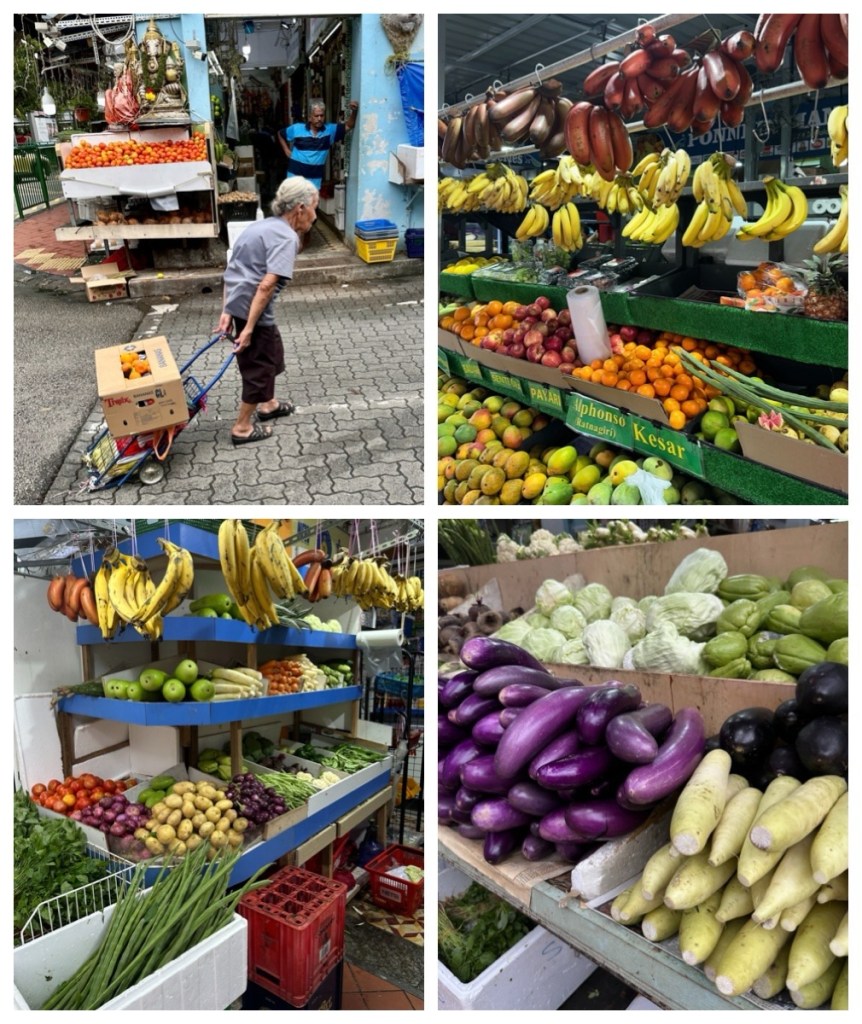
The produce stands in markets are always a joy to browse and those in Little India were no exception. These are the markets that locals visit daily and the sights and smells are wonderful.
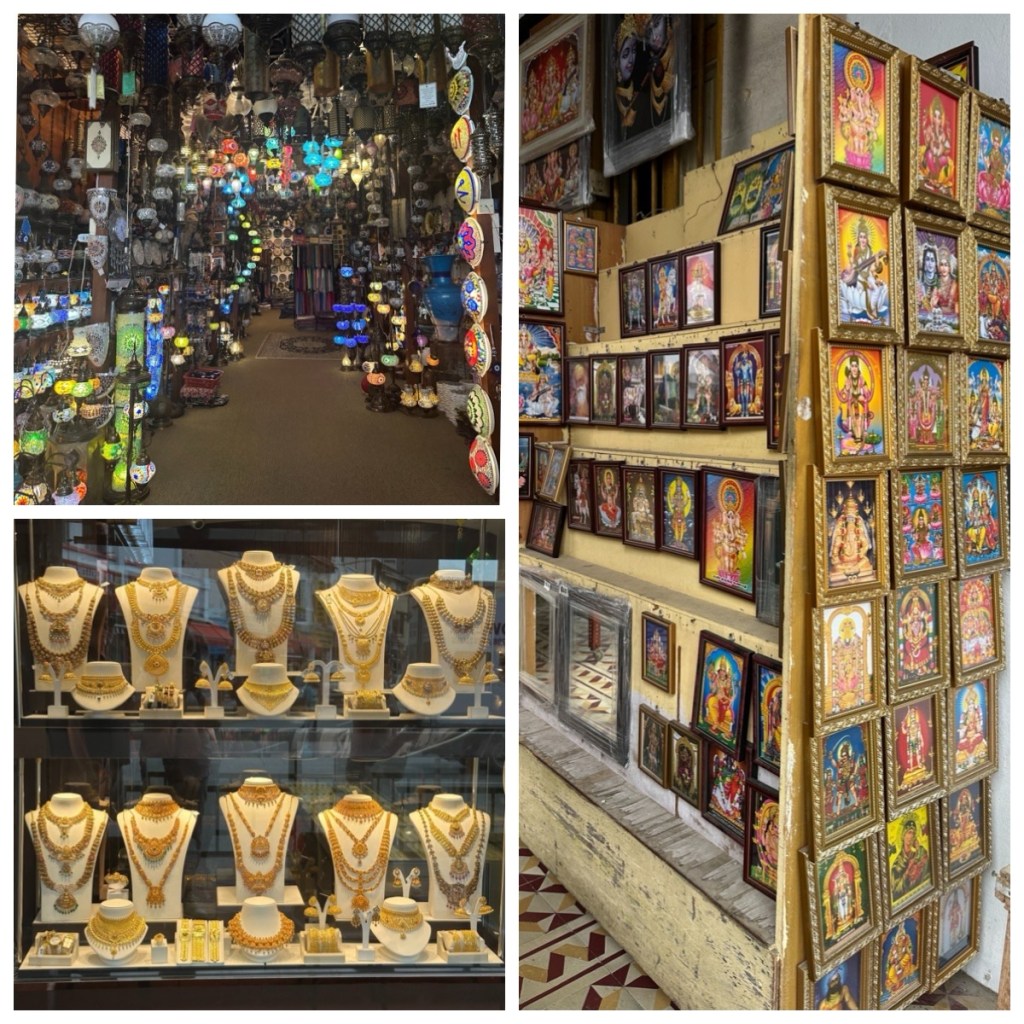
Art and jewelry fill many of the shops along Serangoon Road, as well as the smaller streets. We browsed, but didn’t buy. 🙂
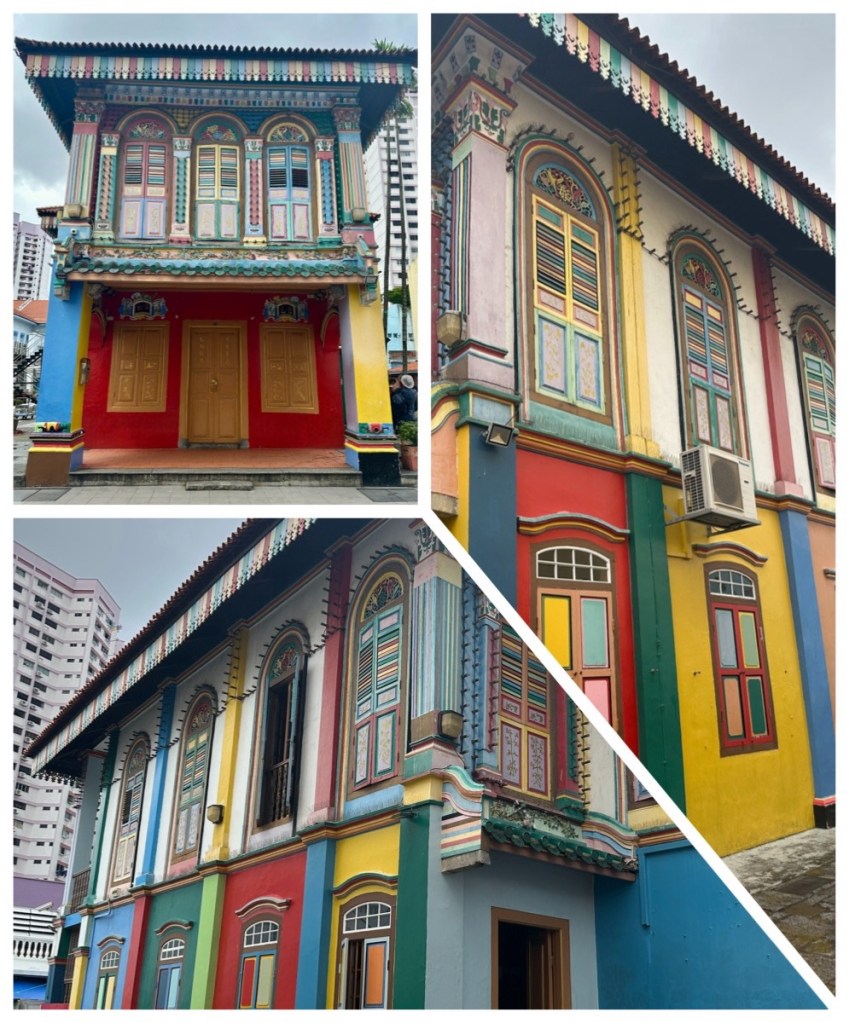
Tan Teng Niah was a Towkay (Chinese businessman of good standing) who used sugarcane to produce sweets in several factories that he owned along Serangoon Road. His house, built in 1900, is a two story, eight room villa with an exterior rainbow of colours. The house was restored in the 1980’s – this project was awarded the Singapore Institute of Architects Honourable Mention.
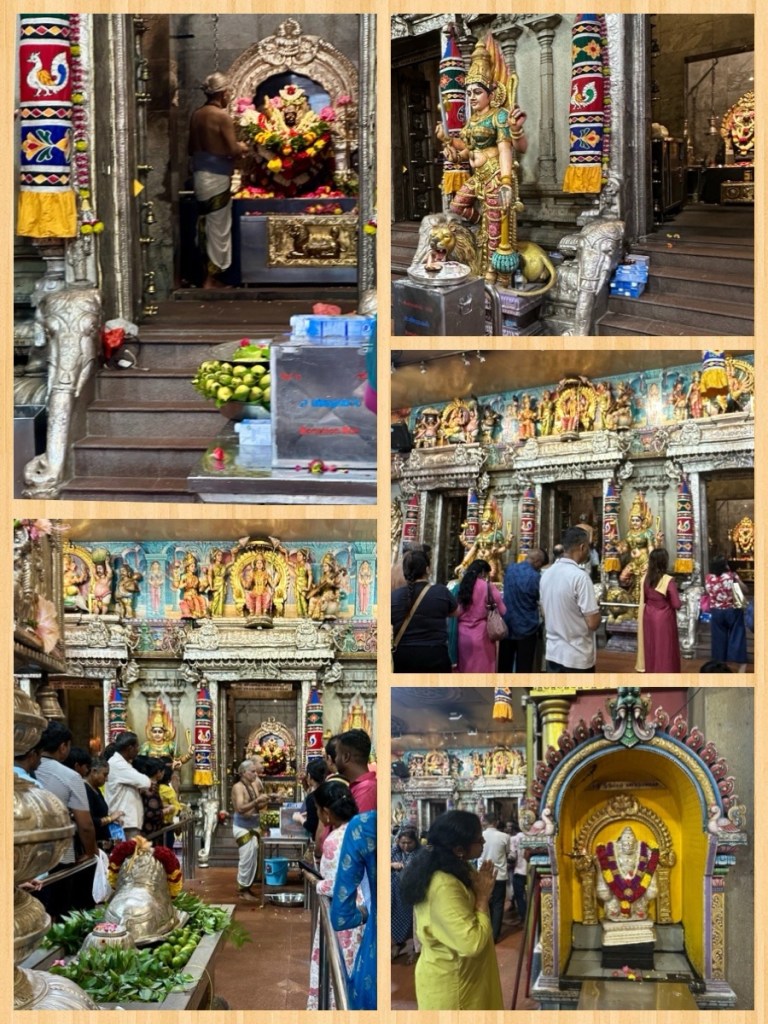
Sri Veeramakaliamman Temple is one of many temples in Little India. Built in 1881 by Bengali laborers, the temple’s name means Kali the Courageous. The temple is dedicated to the Hindu goddess Kali, who epitomizes the struggle of good over evil and is the consort of Shiva, the god of destruction. The main altar has a statue of the goddess, flanked by her two sons Ganesh, the elephant god, and Murugan, the child god. Hindu holy days are Tuesdays and Fridays and the temple is expected to be busy as devotees throng the temple to worship. We visited on a Saturday and still found there were many worshippers as well as tourists. The temple was originally known in Tamil as Soonambu Kambam Kovil or the “temple at the village of lime” because of lime kilns found in the area. In 1908, the dilapidated temple was restored after municipal labourers took over the management of the temple and the overseers of the labourers were made trustees.
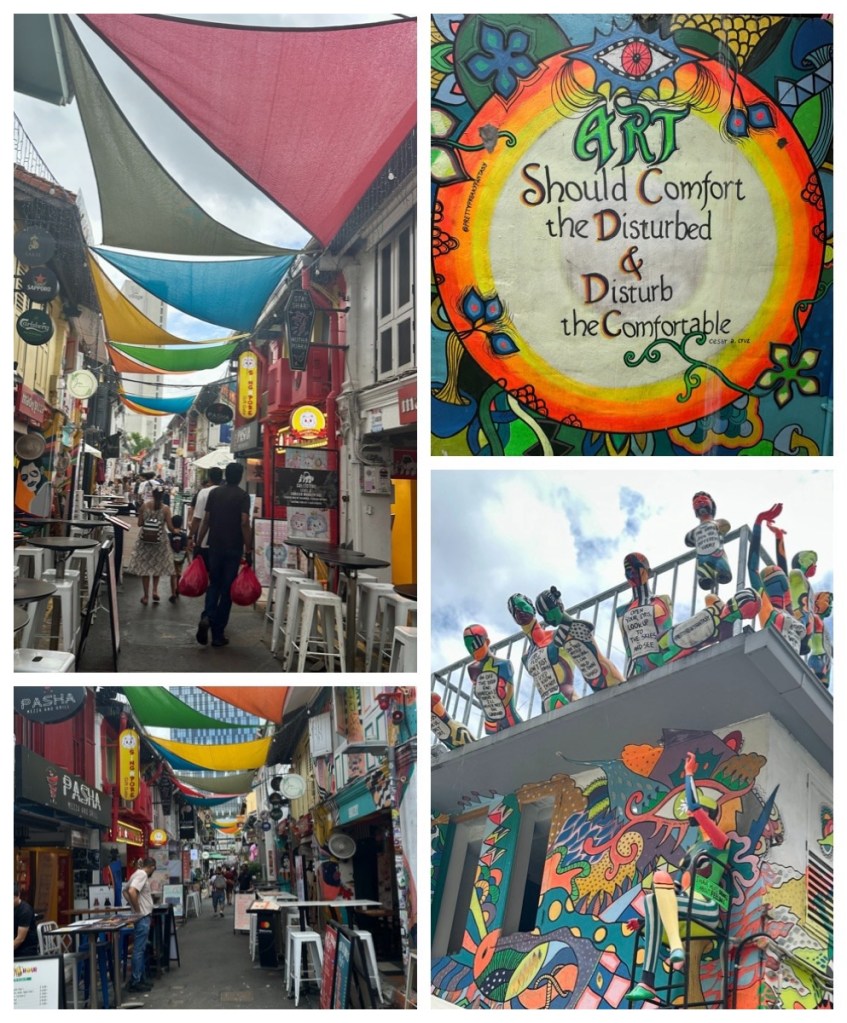
Little India and Kampong Glam are home to some of Singapore’s best mural art. The murals are located sporadically around the area, some sprawling across the sides of buildings and others in narrow alleyways. There are many maps to follow to spot all of this artwork and it would be a fun way to spend a day when you had lots of time – and perhaps, it was a slightly cooler day (not sure that really happens). These are a few of the murals that we spotted as we meandered through the neighbourhoods.
- Cattleland 2 (artist Eunice Lim) – inspired by the name of the nearby Kerbau (Malay word for Buffalo) Road and the reverence that Hindus place upon cattle. The cattle are adorned with traditional Indian patterns.
- Traditional Trades of Little India (artist Psyfool) – a look at the trades of the past, including a dhobi (washerman), a parrot astrologer, a milk seller and more
- Mayura (artist Muhammad Taufiq Rosle aka Boon) – a 70 meter long mural that features three elegant peacocks parading down an alley. Mayura means peacock in Sanskrit. In Hindu epics, peacocks often symbolize the cycle of time.
- In Kampong Glam’s Haji Lane (artist PrettyFreakyFantasy) – an eye-catching, building covering mural
- I could find no information on the whimsical colourful mural we spotted near Arab Street in Kampong Glam.

Kampong Glam (pronounced glum) adjoins Little India and is the focal point of Muslim life in Singapore. The name is derived from the Malay words kampung, or village, and gelam, a tree that once grew abundantly in the area. In 1819, the area was given to Sultan Hussein Shah as part of a treaty by which Singapore was ceded to the British. Muslims were attracted to the area by the palace and Masjid Sultan (mosque). The community was formed by local Muslims as well as Muslim immigrants from Malaysia, Indonesia and the Middle East. Some street names, such as Arab Street, Baghdad Street and Kandahar Street, reflect that history.
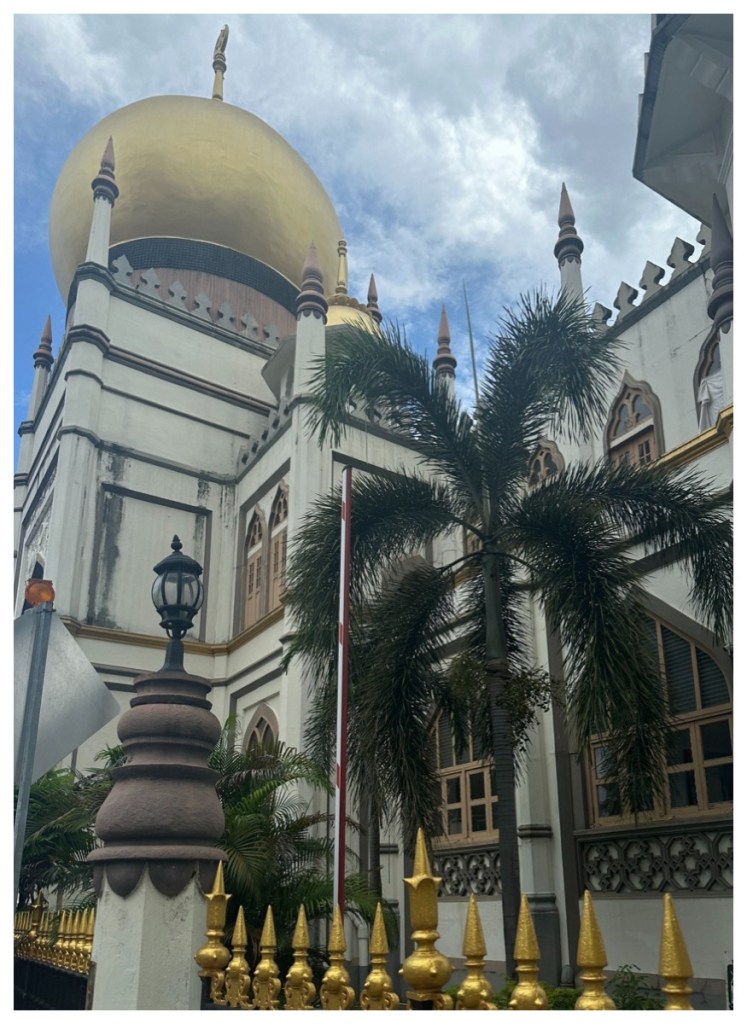
The Masjid Sultan was built on this site in 1824. It was replaced in 1928 by the present structure which is a dramatic building with golden domes and minarets. Interestingly, hundreds of bottle ends are jammed in between the dome and the base, a feature that originated as a way for lower-income Muslims to donate during the mosque’s construction. As Singapore’s largest mosque, it can accommodate 5,000 worshipers in its main hall. Visitors can only view the main hall from the entrance.
Overlooked by the majestic Masjid Sultan, Arab Street acquired its name from the Arab merchants who settled here when they came to trade in the 19th century. The street is famous for its textile stores as well as ready-made batik clothes and table linen. Other shops offer everything from Turkish and Iranian rugs to traditional Malay wedding outfits.
Haji Lane stretches across Kampong Glam and is home to numerous indie fashion and lifestyle shops. Many of the shops, restaurants and bars are adorned with brightly coloured art.
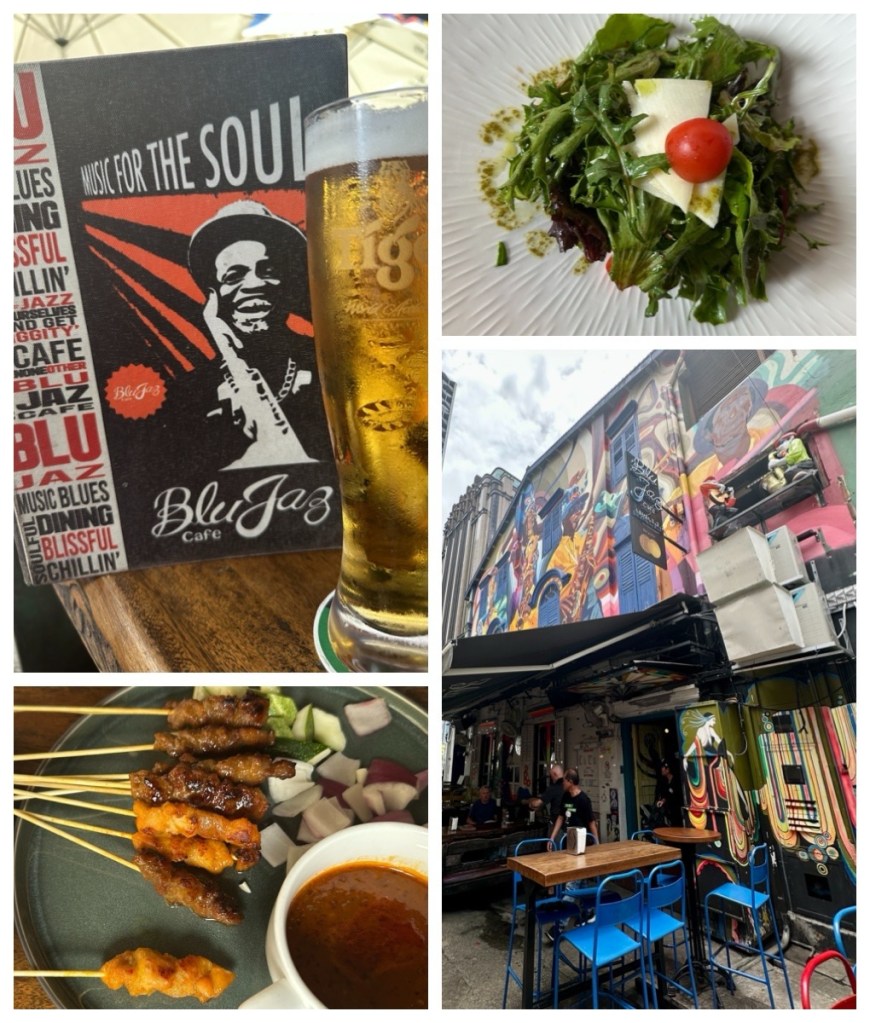
We had a great lunch at the BluJaz Cafe. This lounge-bar-cafe is an institution of the Kampong Glam area and Singapore’s live music scene. We enjoyed relaxing at the spacious outdoor seating area. The menu is a mix of Eastern and Western dishes.
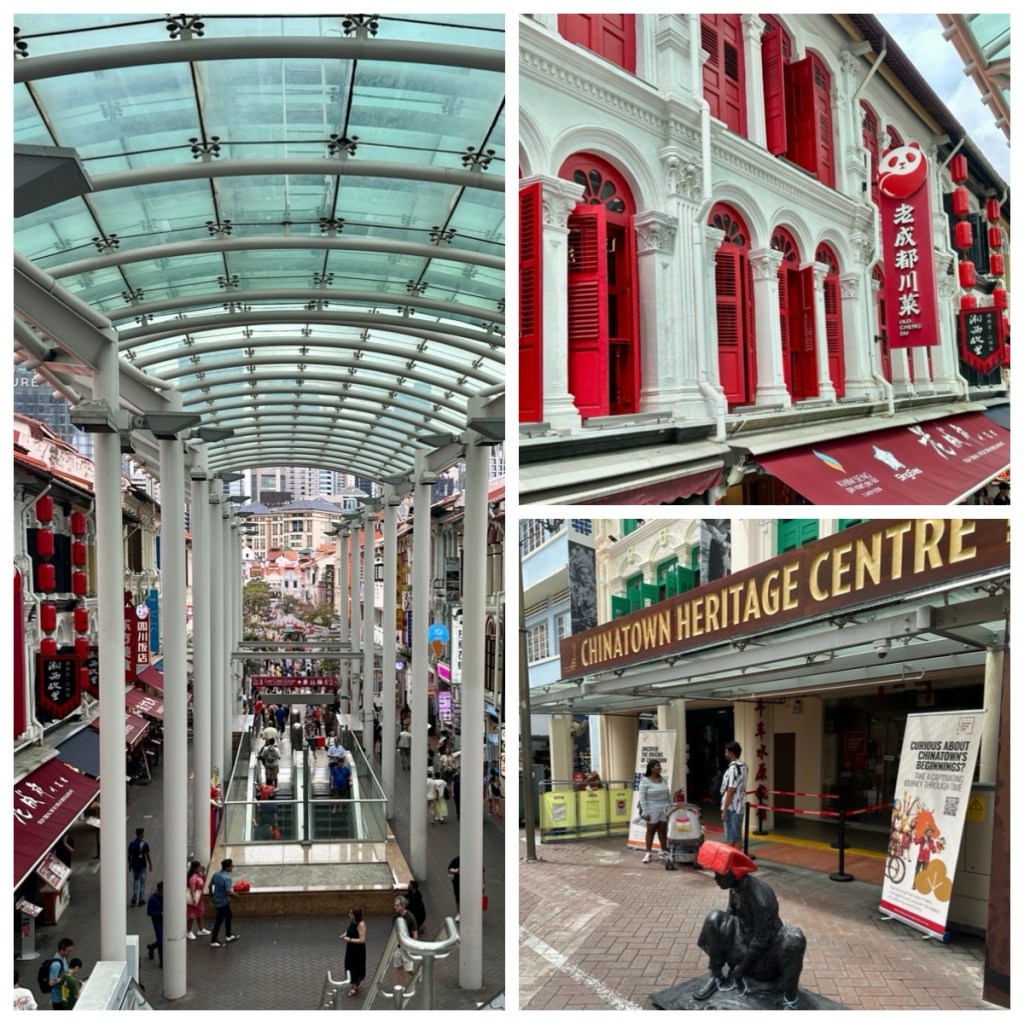
Adjoining the modern Civic District is Chinatown, which buzzes with its incense-infused temples, colourful shophouses and dynamic markets. Chinatowns are typically found in cities where the Chinese are a minority. However, in Singapore where ethnic Chinese substantially outnumber all other groups, a Chinatown may seem out of place. The defined area dates to 1882 when Sir Stamford Raffles was attempting to organize immigrants by their race. At that time, he officially allocated the area south of the Singapore River to the Chinese community as Chinese merchants and labourers were settling into the area and godowns (warehouses) and shipping offices were opening up. In following years, Indian workers also lived here and today, Taoist and Hindu temples, churches, and mosques stand side by side, typifying the multicultural spirit of the area.
Chinatown is a dynamic and colorful part of the city. While there are plenty of individual sights to see, just exploring the neighbourhood of red lanterns, street art and ornate architecture is a great experience.
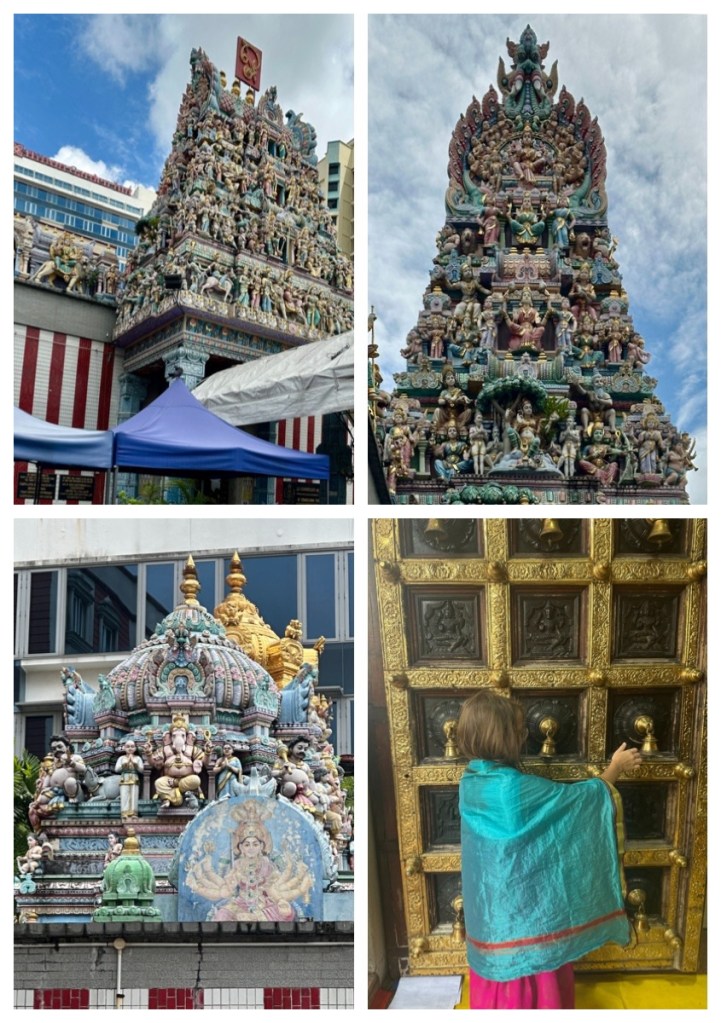
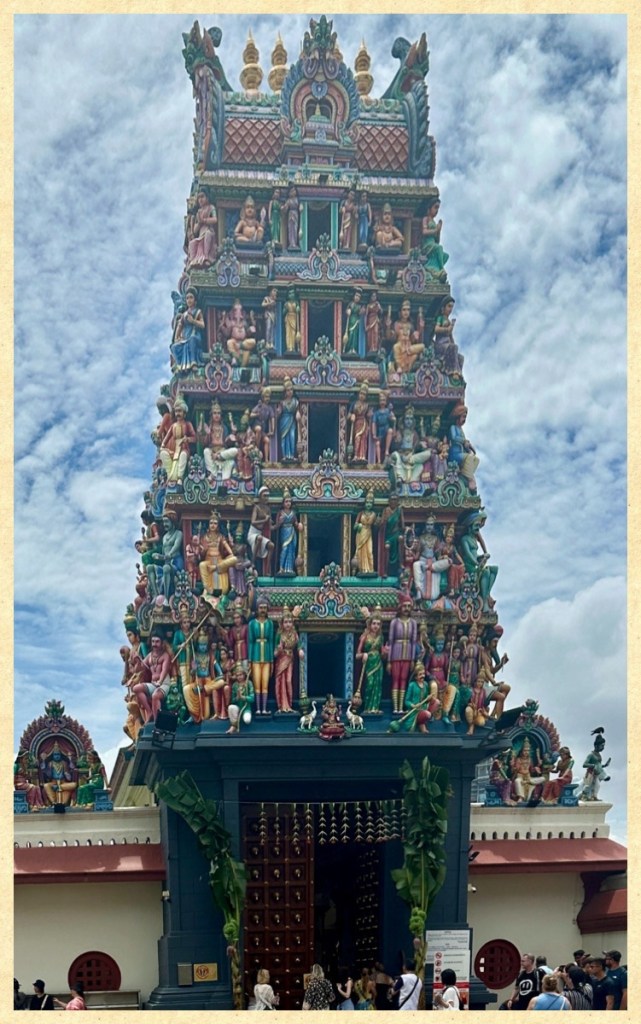
Sri Mariamman Temple, Singapore’s oldest Hindu temple, has a pagoda-like entrance topped by an ornate gopuram (pyramidal gateway tower). Hundreds of brightly colored statues of deities and mythical animals line the tiers of this towering gate. Atop the surrounding walls, contented glazed concrete cows are perched.
The first temple was built in 1827 of wood and flexible palm branches on land owned by an Indian merchant. This temple was replaced in 1843 by the current brick structure. The gopuram was added in 1936. All HIndu temples in Singapore are closed for refurbishment every 12 years.
Although many of the splendid friezes and statues depict the Hindu divine trinity of Brahma, Vishnu, and Shiva, as well as other Hindu deities, the temple is dedicated to the goddess Sri Mariamman (an incarnation of Shiva’s wife Parvati), known for her power to cure disease. The temple is where Hindu weddings take place and as the venue for the annual Thimithi festival in October or November, during which devotees walk on hot coals as a sign of faith.
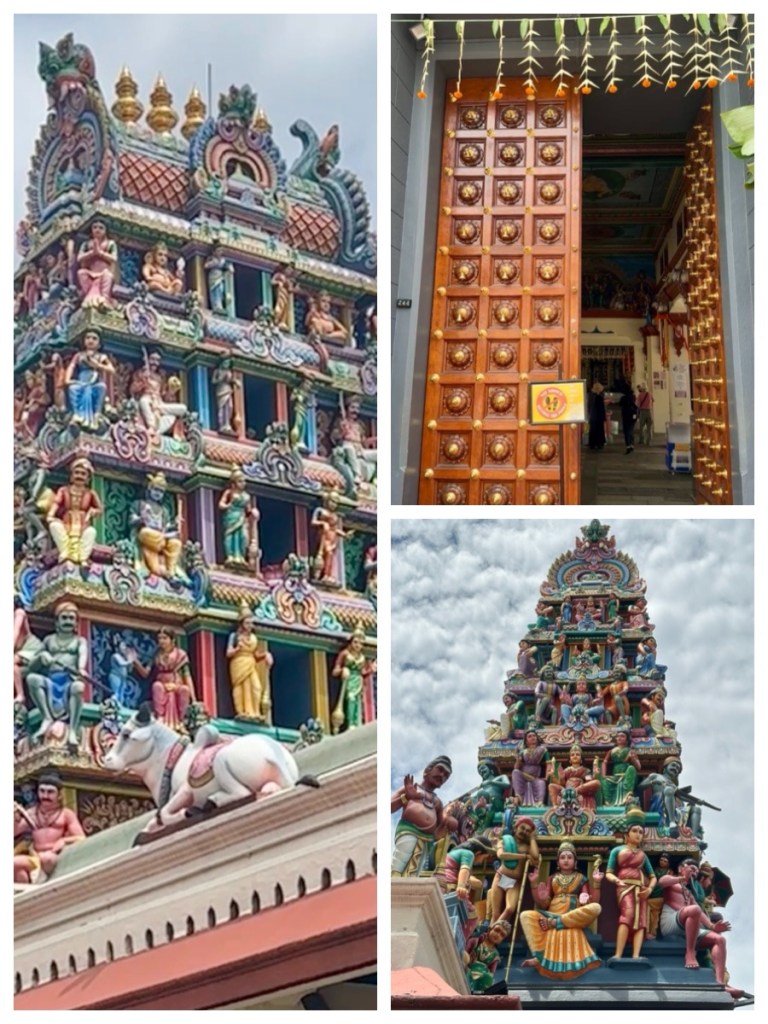
The interior of the temple is adorned with some intricate paintings that have been restored by Tamil craftsmen from South India.

Pagoda Street gets its name from the Sri Mariamman Temple’s gopuram that looks like a pagoda. The street is lined with shops and eating establishments. The Chinatown Heritage Centre is said to be a superb museum housed in three restored shophouses, providing one of the most vivid accounts of the history and culture of Chinese immigrants. We didn’t check it out on this visit, but as I’ve said before, maybe next time…….
It was hot and humid as we toured around Chinatown. I was reaching my limit when we happened upon Nanyang Old Coffee. On the corner of Smith Street and South Beach Road, the motto of this old-fashioned, bright red coffee shop is “bringing back the good old taste of Singapore traditional coffee”. Debbie, our resident coffee connoisseur, stated that it just might be the best coffee she has ever had! This Hainanese coffee is made from Robusta beans that are roasted with butter and sugar. The coffee is brewed in a pot and traditionally strained through a sock. The actual pour-over is from a very high height. Not being a real coffee drinker, my iced sweetened tea was just what I needed to be revived for the rest of the afternoon.
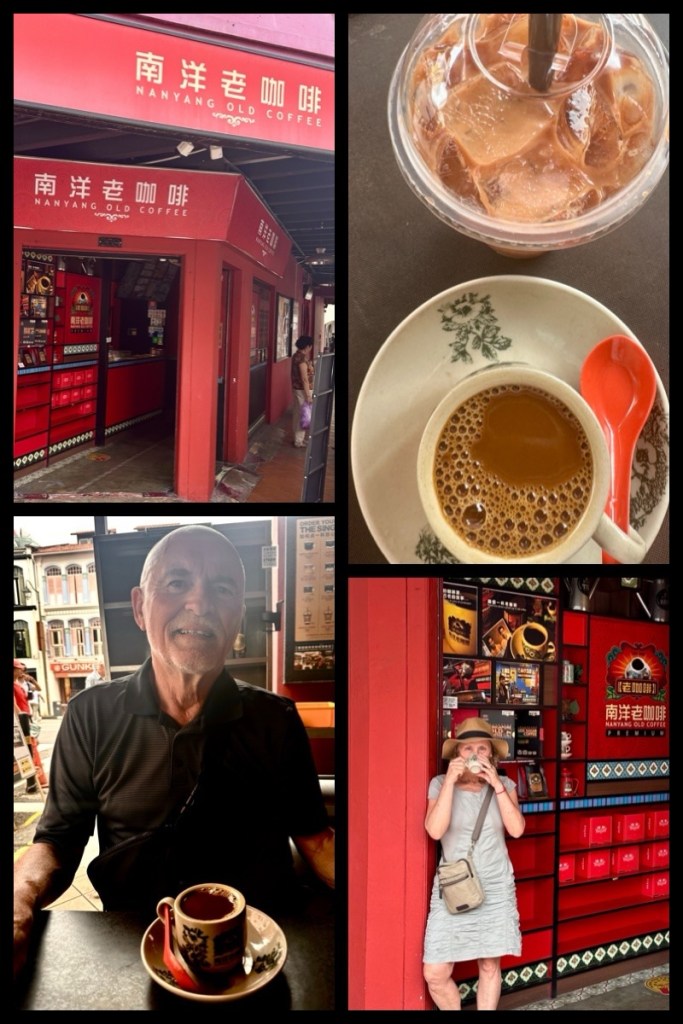
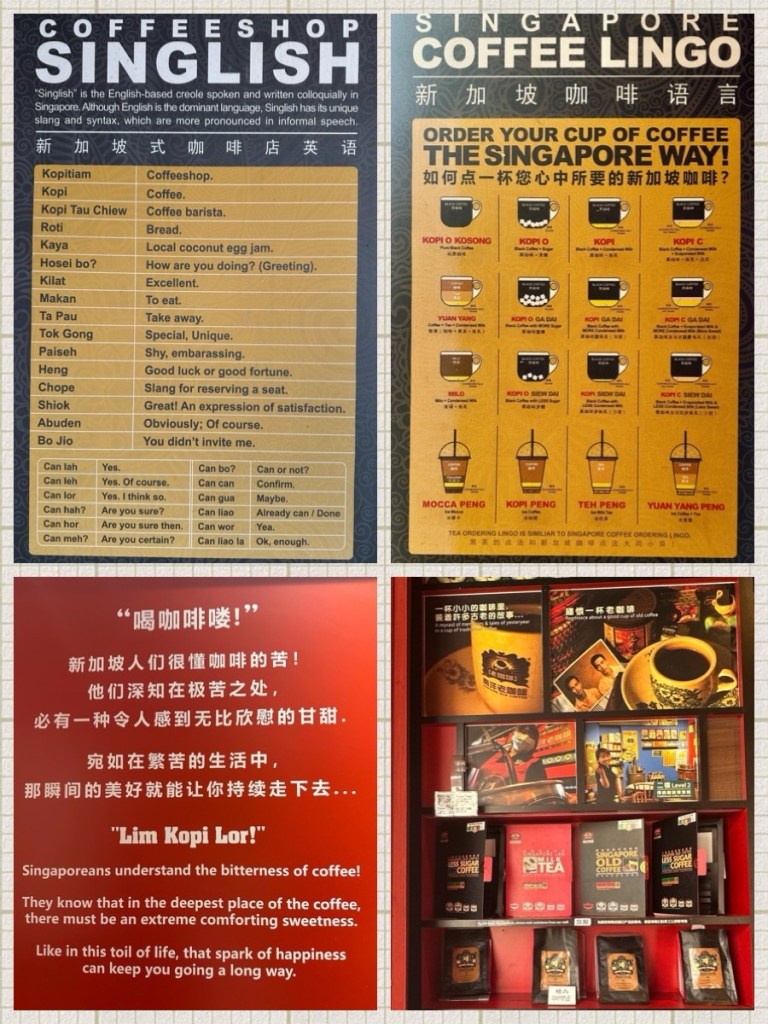
Great signs at Nanyang Old Coffee!
We continued on Smith Street and were treated to the Five Footway Festival. The festival is billed as an unique opportunity to explore the cultural stories of yesteryear with captivating performances, interactive workshops, exhibitions and traditional games. The term Five Footway refers to a continuous colonnaded covered walkway running the length of the front and sometimes the sides of a shophouse. The purpose was to provide a sheltered space for pedestrians and social activities in the hot and wet climate. The Five Footways Festival honours these iconic structures as a living testament to the rich heritage, resilience and spirit of the community that have shaped Singapore’s Chinatown.
We enjoyed watching the activities and even had some special lettering done for us!


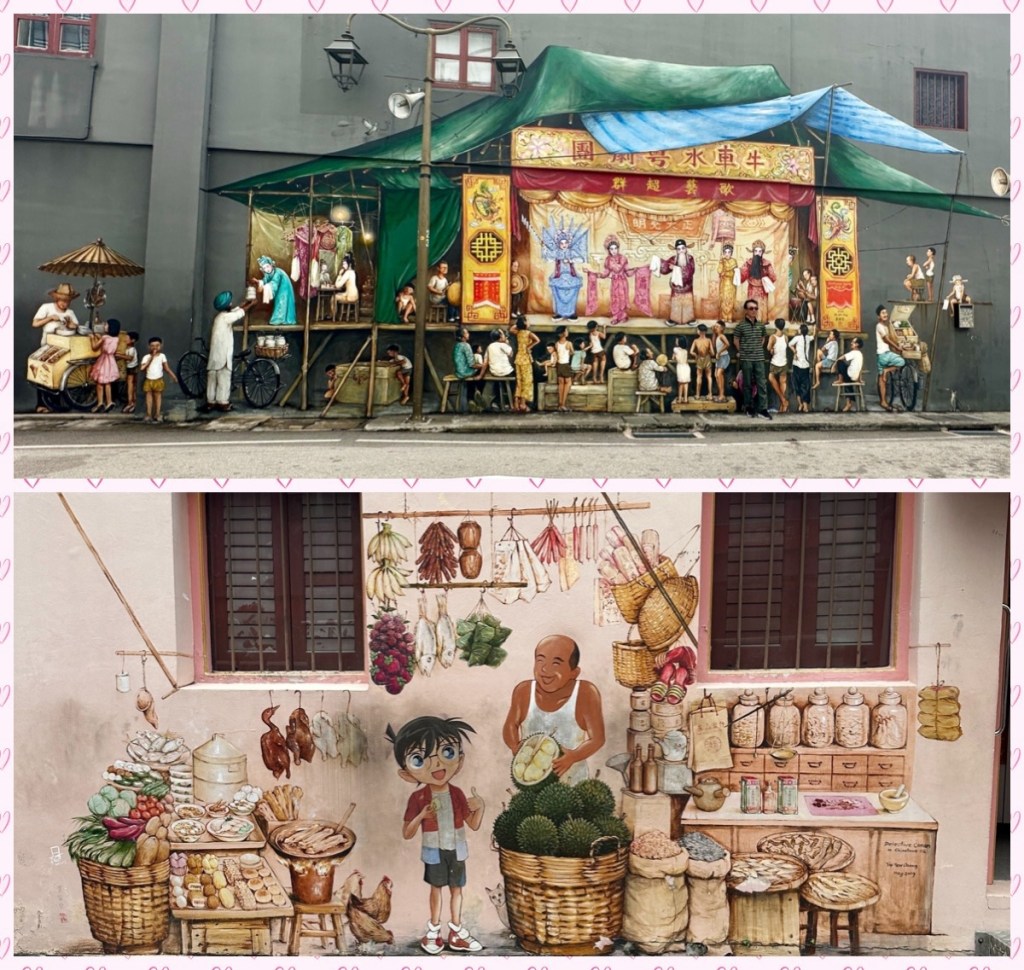
As with the other areas, Chinatown has great murals. Here are just a couple of examples.
- Cantonese Opera Mural (artist Yip Yew Chong) – an elaborate scene of a Chinese opera performance
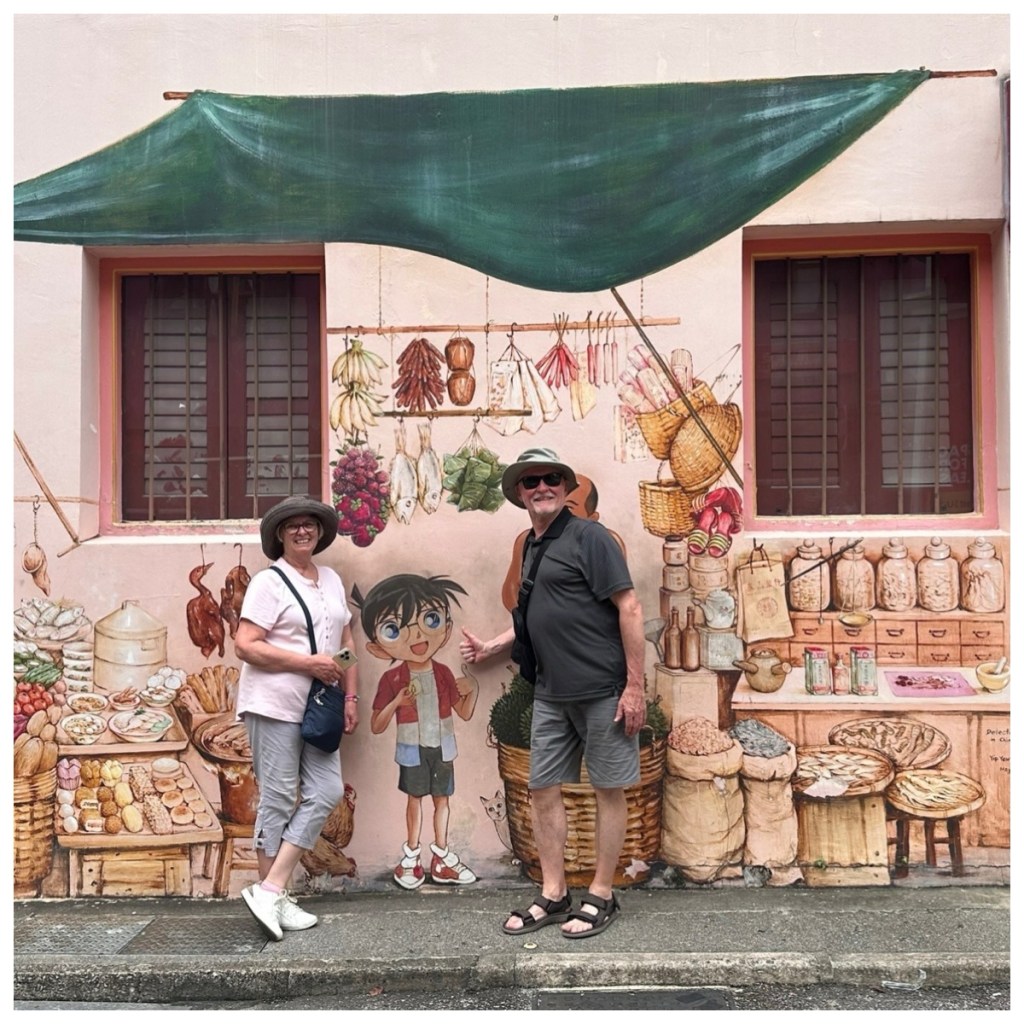
- Detective Conan Mural (artist Yip Yew Chong) – a Japanese manga character discovers durian in a market in Chinatown
We had an excellent day exploring Singapore’s charming multicultural neighbourhoods. The contrast to the modern areas was quite striking, but we found both experiences to be excellent! As I said before, Singapore is a world-class city with so much to offer a traveller. We would definitely love to return to see more!
After our four great days, we were once again off to Singapore Changi Airport. This facility has won multiple awards for World’s Best Airport and it has also been named one of the world’s most outstanding retail real-estate projects. The sprawling four-terminal complex houses hundreds of stores and restaurants, as well as an entertainment complex that features the Rain Vortex, the world’s highest indoor waterfall and indoor rainforest areas that perfectly embody Singapore’s “garden city” ethos. We were flying out of Terminal 2 so we didn’t get to see the waterfall. However, this terminal has its own highlights, with a heritage street, great decor and some interesting children’s play areas.

And next we are off to Tokyo!
Cheers,
Bev & Harvey
 A Long and Winding Journey
Wow, you have certainly seen a lot of interesting and colourful structures!
LikeLiked by 1 person
Another Great One, do you write while you are travelling or every evening of every day about what you saw during the day?
Lots of work, with all the wonderful pictures !!
Waiting for the next one !!
LikeLike
I should write every evening but am often too tired to do so. So I usually write on our resting or travelling days. It takes quite a bit of time to do further research on things we have seen and to put together the picture collages (by doing collages, it saves on the space used up on my blog site).
I primarily do the blogs as a diary for us to remember our trips but I am very happy that my dedicated readers enjoy them as well.
Thanks for always reading and commenting!
LikeLike